Tesla: Rare recovery in car manufacturing, AI master plan delayed again
Tesla (TSLA.O) released its Q1 2026 earnings report after the U.S. stock market closed at around 4 a.m. Beijing time on April 22. The automotive business still achieved a better - than - expected performance amid widespread pessimism. Specifically:
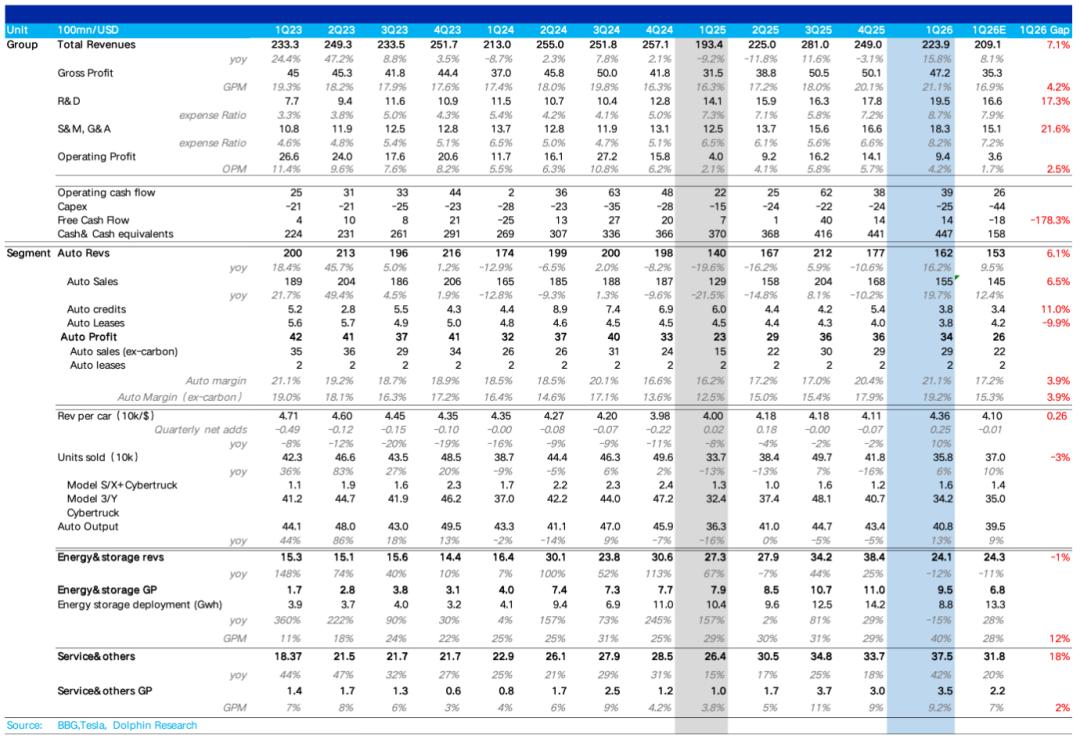
① Good performance in total revenue: The total revenue for this quarter was $22.4 billion, a year - on - year increase of 16%, significantly exceeding the market's general expectation of $20.7 - 20.9 billion.
Although it included a positive foreign exchange impact of approximately $900 million, even after excluding this factor, the adjusted revenue of $21.5 billion still exceeded expectations. This was mainly due to the sequential increase in the average selling price of vehicles, which effectively offset the short - term decline in shipments and revenue of the energy storage business this quarter (energy storage revenue was $2.41 billion, a year - on - year decrease of 12%) caused by the pre - emptive installation demand in the previous period.
② Automobile revenue also far exceeded expectations: The total revenue of the automotive business this quarter was $16.2 billion, exceeding the market expectation of $15.3 billion. Among them, the core automotive sales revenue (excluding carbon credits and leasing) reached $15.5 billion, exceeding the expected $14.5 billion, which was the core source of the out - performance.
Although the actual delivery volume (358,000 vehicles) in the first quarter was lower than expected and decreased sequentially due to the withdrawal of policies in the Chinese and U.S. markets, the average selling price (ASP) of vehicles ended its continuous decline and increased by $2,500 sequentially to $43,600. This was due to the optimization of the product mix (the proportion of high - priced Model S/X and Cybertruck increased to 5%), the reduction of promotional discounts in markets such as the United States, and the recognition of high - margin software revenue from the record - high number of new FSD subscriptions after the full shift to the subscription model.
③ The core gross profit margin of vehicle sales (excluding carbon credits) showed good resilience: The overall automotive gross profit margin this quarter was as high as 21.1%, significantly exceeding the market expectation of 16.9%. After excluding one - time factors such as the reversal of warranty provisions ($230 million) and tariff exchange gains ($200 million), the actual core gross profit margin of vehicle sales (excluding carbon credits) this quarter was approximately 17.5%.
Although the decline in production and sales this quarter led to an increase in the per - vehicle amortization cost (a sequential increase of $500) and the rise in raw material prices such as metals pushed up the per - vehicle variable cost (a sequential increase of $1,000), which caused the core gross profit margin to decline slightly by 0.4 percentage points compared to 17.9% in the previous quarter, the final performance of 17.5% still significantly exceeded the market's pessimistic expectation of 14.7% - 15.3% thanks to the increase in per - vehicle ASP.
④ The heavy investment in R & D expenses and capital expenditures is still for the ambitious AI business: Tesla's R & D expenses this quarter reached $1.95 billion, continuing to increase sequentially at a high level. The main investments were in the training and iteration of FSD, the design of the AI5 chip, and the development of new product lines such as Cybercab and Optimus.
Although the company's selling expenses and R & D expenses both increased sequentially, driven by the out - performance of both revenue and gross profit margin, and with no sharp increase in capital expenditures this quarter, Tesla's free cash flow in the first quarter was $1.4 billion, achieving a net inflow, far better than the market's expectation of a net outflow.
⑤ Operating profit exceeded expectations: Finally, even though the R & D expenses increased due to AI investment and the selling, general and administrative expenses (SG&A, $1.83 billion) increased due to the increase in SBC expenses (mainly the CEO's performance bonus), driven by the out - performance of overall revenue, the increase in the core ASP of vehicle sales, and the high gross profit of the energy storage and service businesses, the operating profit this quarter reached $940 million, significantly higher than the market expectation of $360 million; the operating profit margin reached 8.2%, an increase of 1.6 percentage points sequentially.
Dolphin Research's overall view:
Overall, Tesla delivered a Q1 2026 earnings report that was "apparently strong and actually quite resilient". Although the comprehensive out - performance of core revenue, gross profit margin, and net profit was partly due to some one - time financial factors, after stripping these factors, its automotive business still achieved a better - than - expected performance amid widespread pessimism.
Specifically, the average selling price per vehicle ended its continuous decline and increased sequentially, and the real gross profit margin of vehicle sales stabilized, breaking the market's panic that "poor delivery must lead to a collapse in gross profit".
More importantly, against the backdrop of heavy investment in the cutting - edge AI field (self - developed chips, Optimus, FSD) and the increase in overall R & D and selling expenses due to SBC expenses, Tesla still achieved a positive free cash flow of $1.4 billion this quarter, far exceeding the market's pessimistic expectation of a net outflow. This indicates that Tesla's automotive business still played a stable "ballast" role in the first quarter.
However, the narrative weight of the vehicle sales business in Tesla's valuation is gradually weakening, and its core role has retreated to that of a "cash cow". The real concern in the market currently is: Will the realization of the ambitious AI business be repeatedly postponed? Is the financial model sustainable under heavy capital expenditures?
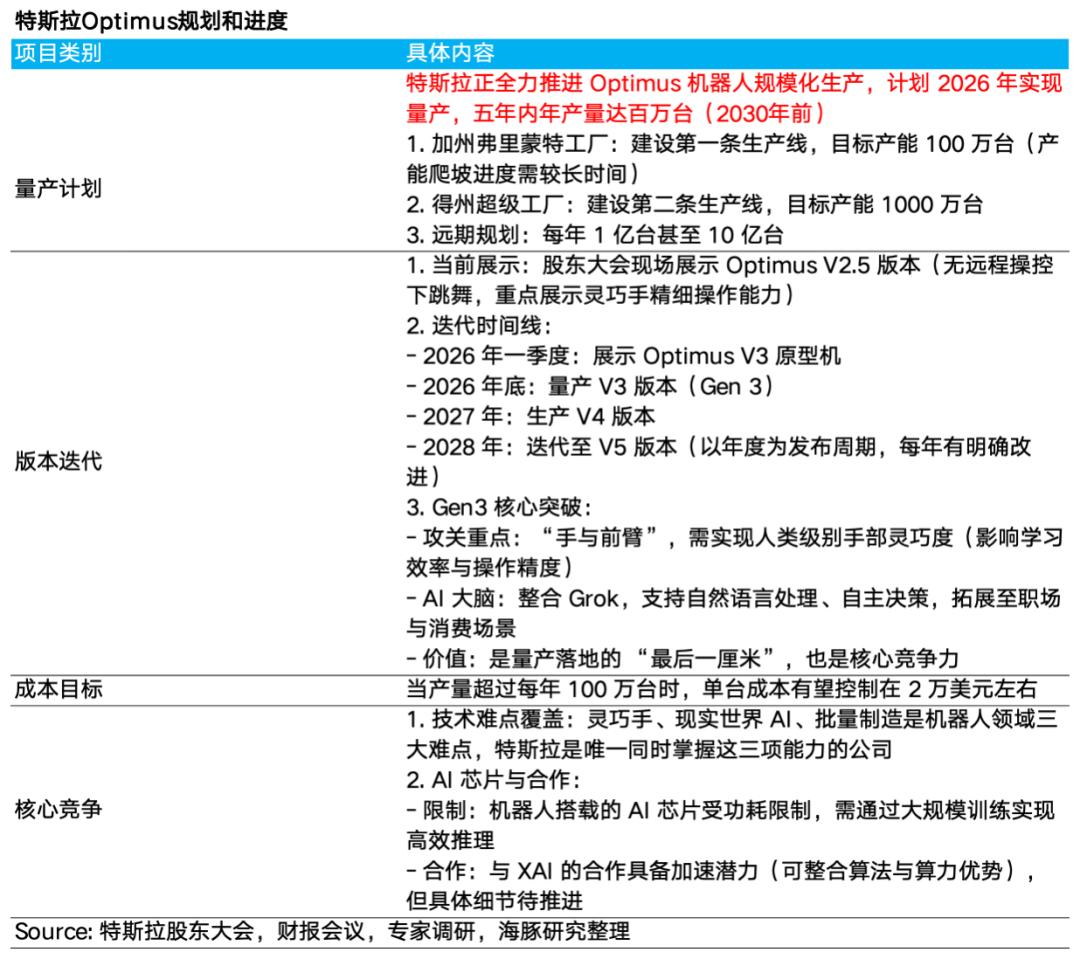
① Optimus: The debut of V3 is postponed to mid - year, and 2027 will be the year of large - scale mass production
a. The debut of the V3 version is postponed and strictly kept secret: Elon Musk said that the system design of the V3 version is basically ready, and currently, aesthetic details are being refined. It is planned to be unveiled in the middle of this year. The reason for the postponement is to prevent competitors from conducting frame - by - frame analysis and copying the technology, so Tesla prefers to make it public closer to the mass - production stage.
b. Initial mass - production schedule and capacity ramp - up: The Fremont factory is preparing to start production. Management expects production to begin around late July or August.
Since this is a new product with over 10,000 unique components and a new supply chain, the initial production speed will be very slow. It is expected that the capacity will increase to an appreciable level next year.
c. In - depth reconstruction of the production line: To make room for Optimus production, Tesla is dismantling the Model S/X production line (the last production is scheduled for early May). It will take about four months to remove the old line and reinstall and test the new Optimus production line, which is considered a challenging but amazingly fast - paced project.
d. Tesla is building a second Optimus factory at the Giga Texas, which is expected to start production next summer. In the application aspect, Optimus will initially perform simple tasks in the factory and is expected to play a role outside Tesla at some point next year. The newly taped - out AI5 chip is also confirmed to be installed in Optimus.
② Robotaxi: Safety first leads to restrained expansion, and the substantial financial contribution is postponed to 2027
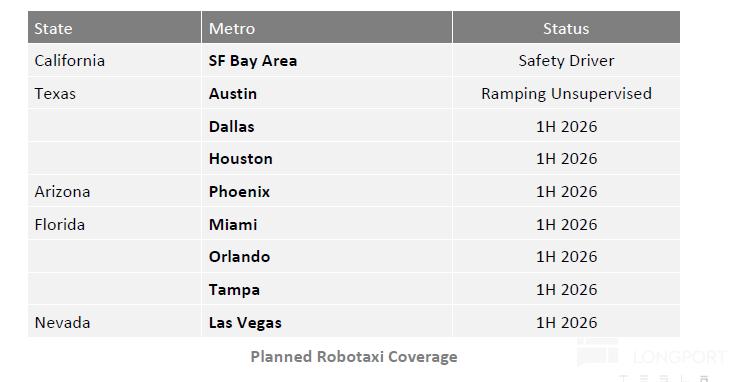
a. Steady regional expansion: Robotaxi has expanded to Dallas and Houston, with the goal of achieving unsupervised operation in more than a dozen states by the end of the year.
b. Prolonged verification cycle: Constrained by strict safety requirements, the company is accelerating testing by expanding the QA (quality assurance) fleet. Elon Musk clearly indicated that Robotaxi and unsupervised FSD will not make significant contributions to the financial statements in 2026, and the financial breakthrough point is set for 2027.
c. Constraints of the underlying architecture: The current test fleet still runs on the v14.3 variant. Before the release of the V15 reconstructed version, which significantly improves the safety ceiling, management believes that large - scale deployment of Robotaxi is not reasonable.
③ FSD: Unsupervised features will be gradually released to the customer fleet starting from Q4
a. Push plan for unsupervised FSD: It is expected that the unsupervised features will be gradually released to the customer fleet starting from the fourth quarter of 2026. The push will be carried out gradually according to geographical locations, provided that specific areas (without complex intersections or adverse road - sign weather conditions) are confirmed to be absolutely safe.
b. Elon Musk confirmed that the memory bandwidth of Hardware 3 (HW3) is only one - eighth of that of HW4, and it does not have the ability to support unsupervised FSD. Therefore, Tesla will offer a replacement discount for HW3 owners who have purchased FSD or provide an upgrade service for replacing the computing platform and cameras.
To efficiently complete this upgrade, Tesla plans to establish "micro - factories" in major cities. At the same time, for HW3 owners, Tesla plans to push a digital streamlined version based on v14 at the end of June.
c. Evolution of the underlying architecture V15: The current v14.3 is considered the last piece of the puzzle of the current architecture. The V15 version, expected to be launched at the end of this year or early next year, will thoroughly overhaul the software architecture, running entirely on AI, aiming to improve safety far beyond the human - level safety standard.
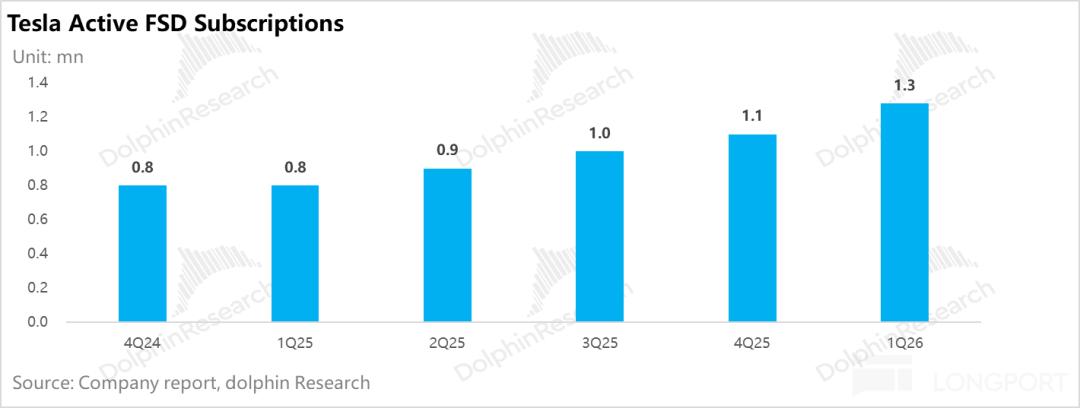
d. Number of FSD subscribers: The number of global paying FSD customers is now close to 1.3 million. Since February 15, 2026, Tesla has cancelled the one - time purchase option for FSD globally and fully switched to the monthly subscription model (currently priced at $99 per month), which has made subscription users the main driving force for growth.
The ratio of new FSD users/new sales volume this quarter increased from 24% in the previous quarter to 50% this quarter. The proportion of FSD paying users in the global Tesla existing fleet is about 14%. As high - margin software revenue, it also contributed to the sequential increase in the average selling price of the automotive business and the better - than - expected performance of the core automotive gross profit margin.
e. Overseas expansion: In Europe, it has been approved in the Netherlands. It is expected to submit an application to Brussels for EU review in May and hopes to obtain broader approval in Q2. In China, partial approval has been obtained, and the company is working with regulators, aiming to get broader permission in Q3. With these developments, the company's sales strategy has evolved to emphasize that FSD is the core product, and the vehicle is just a delivery vehicle.
Overall, although Tesla's vehicle sales business performed well in this earnings report, and with the rise in oil prices and the stimulus of the entry - level Model 3/Y, there are signs of recovery in the demand for the main business, which helps to stabilize the company's fundamentals.
However, in the most valuation - elastic AI segment, the postponed release of Optimus V3, the delay of the commercial contribution of Robotaxi to 2027, and the need to wait for FSD V15 to cross the technological gap undoubtedly prolong the market's realization of expectations.
An even more severe test is on the capital side: The company has sharply increased its 2026 capital expenditure guidance from "over $20 billion" to "over $25 billion" to fully expand the construction of six new factories (including lithium refineries, Cybercab, and Optimus factories) and AI computing clusters (Cortex training clusters, Terrafab).
Although the company has more than $44 billion in cash and investments on its balance sheet, with an annual "cash - burning intensity" of about $25 billion, the company's dependence on the operating cash flow of the automotive business has extremely increased. The AI grand plan must quickly establish a commercial closed - loop and achieve self - financing; otherwise, the company may face real financing pressure in the next one to two years.
Dolphin Research believes that the delay in the AI process and the pressure of heavy capital expenditures may cause short - term fluctuations in the stock price. However, from a long - term perspective, Tesla's AI narrative is truly moving from a "conceptual PPT" to the "eve of profit realization", and the long - term track space is still extremely broad.
Detailed analysis of the earnings report content
I. Tesla: A report card that is apparently strong and actually quite resilient
1.1 The automotive business unexpectedly "exceeded expectations", and the average selling price of vehicles finally stopped falling and increased sequentially
The total revenue for this quarter was $22.4 billion, a year - on - year increase of 16%, significantly exceeding the market's general expectation of $20.7 - 20.9 billion. Although the total revenue included a positive foreign exchange impact (FX impact) of approximately $900 million, even after excluding this one - time factor, the adjusted revenue of $21.5 billion still exceeded the market expectation.
The main reasons for the out - performance are: ① The average selling price (ASP) of the automotive business increased sequentially for the first time after several consecutive quarters of decline; ② The revenue of the service and other businesses increased.
Specifically:
① Automotive business: Core vehicle sales revenue became the biggest source of out - performance
The total revenue of the automotive business this quarter was $16.2 billion, a year - on - year increase of 16%, exceeding the market expectation of $15.3 billion. Among them:
The carbon credit revenue with pure gross profit was $380 million, a sequential decrease of $160 million. This decline was within the market's expectation, mainly due to the adjustment of previous carbon emission regulations.
However, the core automotive sales revenue (excluding carbon credits and leasing revenue) was $15.5 billion, exceeding the market expectation of $14.5 billion, which was the core source of the out - performance. This was mainly because the average selling price of vehicles increased by $2,500 sequentially to $43,600, ending the previous continuous decline.
Even under the extreme assumption that all the $900 million in exchange gains are attributed to vehicle sales, the adjusted per - vehicle revenue is still the same as that of the previous quarter (about $41,100, and actually higher). In fact, the exchange gains will be shared among different businesses, so the real sequential increase in per - vehicle revenue after excluding the exchange impact will be higher.
Dolphin Research believes that the increase in per - vehicle revenue may be due to: a) Optimization of the product mix, with an increased proportion of high - priced models (such as Model S/X and Cybertruck); b) Reduction of promotional discounts; c) Increased recognition of deferred revenue from FSD full - self - driving software (the number of new FSD subscriptions this quarter reached a record high).
② Energy business: Constrained by demand pre - emptive installation and