Glory wins the championship. UBTECH, Unitree and others cause an upset. Does embodied intelligence have no moat?
Recently, there was a huge upset in the Beijing Yizhuang Humanoid Robot Half Marathon!
The previous champion robot, Tiangong, led by Ubtech, which was highly anticipated by everyone, as well as the popular robot at the Spring Festival Gala, Unitree H1, all lost the race. Finally, the Glory robots, which came from a cross - border field, achieved the perfect results of the champion, runner - up, and third - place finisher in the event.
The net times were 50 minutes and 26 seconds, 50 minutes and 56 seconds, and 53 minutes and 01 second respectively, directly breaking the world record for the human half - marathon.
As soon as this result came out, it immediately caught the attention of many investors.
“Why did Tiangong, which won the championship last year, end up being just a spectator this year?”
“Is it because Glory, which is mainly in the mobile phone business, is too strong, or is the moat of the current robot industry too low?”
“Will there be a major change in the robot industry?”
Undoubtedly, the performance of Ubtech and others this time was really unexpected. But will Glory's victory bring a huge impact on Ubtech and others, or even change the existing industry pattern?
The result tends to be: There is an impact, but it is not as direct as people imagine.
Glory's victory in this marathon indicates that Glory robots are more outstanding in terms of sports ability. Ubtech and others need to step up their efforts to catch up.
However, after all, robots are not humans. A strong sports ability does not mean they can complete substantial production tasks such as sorting and handling.
In this regard, Ubtech, Unitree and others have already delved into more complex work - doing stages.
The different focuses of the two may have led to the difference in the results of this competition.
From an industry perspective, Glory's overtaking in the race also sends out a market signal in return - the current technological competitive advantage of Ubtech and others does not seem to be as unshakable as imagined.
Since Glory has set a good example, is it possible for other “waiting” Internet giants to stage a “Pearl Harbor Incident”?
Did Glory's victory “disenchant” the star robots?
What impact will Glory robots' “coming from behind to take the lead” have on the embodied intelligence industry?
The answer does not lie in the outcome of a single marathon. Instead, it lies in the fact that it has shaken the market's certain expectations of the long - term technological barriers and commercialization paths of “native robot players” such as Ubtech and Unitree.
After all, on the one hand, according to public information, Glory officially established its humanoid robot department in February 2025, and then its business covered the entire chain of links, including the whole machine, hardware, motion control, perception, embodied AI, and testing...
In September last year, the Glory robot team officially launched the project to participate in this half - marathon. It only took a little over half a year to achieve the top three results in the event.
The speed and performance of this cross - border overtaking have shocked the entire industry!
Of course, after Glory's “Lightning” won the championship, some industry insiders pointed out that from the physical structure of this robot, it is a robot very suitable for running.
In other words, “Lightning” is born for running, which means it has some specialized optimization in ability.
Moreover, Glory robots were developed from scratch in one year. Most likely, they were developed using the supply - chain integration idea of the mobile phone business.
In contrast, Ubtech, Unitree Technology and others have been more inclined to the self - research route from the beginning.
So even though Glory has won the championship now, the market competitiveness of this route may still be far inferior to the latter...
So is this really the case? It's hard to say.
Just like Xiaomi in the automotive industry, did Xiaomi and Lei Jun have much experience before entering the automotive field? No.
But now, Xiaomi cars, relying on the integration route of core self - research + supply - chain procurement, have still brought a huge impact to many established automakers.
The same is true for AITO. Huawei's innovative technologies such as intelligent driving + Seres' supply chain have also defeated the BBA brands.
So regardless of how the robots are developed, the key is that if Glory and others can develop robots through supply - chain integration and win the first place, then they will definitely bring a market impact to Ubtech and others.
In the past, the capital market gave a valuation premium to Ubtech, Unitree and others because they thought that “long - term self - research” could build high barriers.
But now, Glory has demonstrated that cross - border giants can quickly catch up and even overtake in some individual aspects by virtue of supply - chain management, capital, and talent - scheduling capabilities.
This undoubtedly weakens the strategic scarcity of Ubtech and others to a certain extent.
From another perspective, it seems that Ubtech and others have not established a strong advantage barrier in actual implementation scenarios such as industrial manufacturing.
According to the Tianyancha APP, in 2025, Ubtech, the “first humanoid robot stock in the Hong Kong stock market,” achieved a revenue of 2.001 billion yuan, a year - on - year increase of 53.3%.
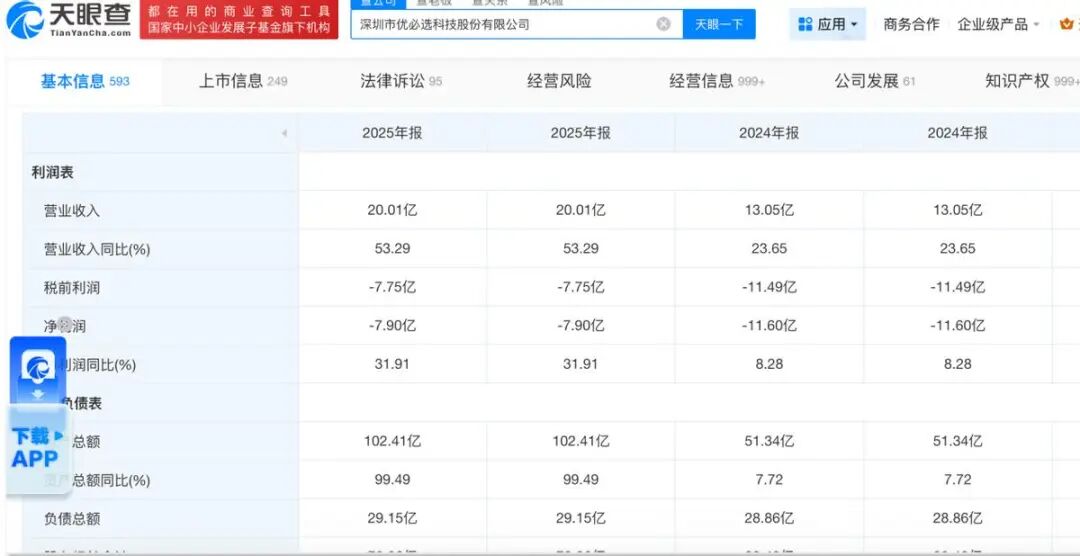
Among them, the “full - size embodied intelligent humanoid robot products and solutions” achieved an income of about 820 million yuan, accounting for 41.1% of the total revenue, a year - on - year increase of 2203.7%; the sales volume reached 1,079 units, a year - on - year increase of 35,866.7%.
In 2024, the income from this business was only 35.619 million yuan, accounting for about 2.7%.
The humanoid robot business has changed from a supporting role to a leading role, and its overall performance is indeed good.
So who bought these robots?
According to public data, in 2025, Ubtech received a total of nearly 1.4 billion yuan in orders.
Among them, many large - scale orders were purchased by the “Embodied Intelligence Data Collection and Testing Centers” led by local governments.
For example, in November last year, Ubtech successively won the bids for the Humanoid Robot Data Collection and Testing Center and the Artificial Intelligence Science and Innovation Education Demonstration Project in Fangchenggang City, Guangxi, with a winning bid amount of 264 million yuan; and the Humanoid Robot Data Collection and Training Center Project in Jiujiang City, Jiangxi, with a winning bid amount of 143 million yuan...
Local governments usually buy robots not to directly improve productivity and reduce labor costs, but to collect real - scene data, build industrial demonstration bases, and respond to the national embodied intelligence industry policy.
The main task of these robots after being purchased is to be “trained,” rather than “go to work.”
Of course, there are also orders for Ubtech robots to enter factories. For example, its commercial cooperation with Dongfeng Liuzhou Motor, BYD, Geely and others verifies the productivity value of humanoid robots in a real industrial environment, which is also the most imaginative story for Ubtech and others.
However, overall, in Ubtech's nearly 1.4 - billion - yuan order portfolio, the data collection center projects led by the government still account for a large proportion...
The performance of Unitree Technology is similar.
According to the prospectus and inquiry letter, its revenue in 2025 is expected to exceed 1.7 billion yuan, and the net profit after deducting non - recurring gains and losses will exceed 600 million yuan; the proportion of humanoid robot revenue has increased from 1.88% to 51.53% in two years...
Among them, in the first three quarters of 2025, in Unitree's humanoid robot revenue, scientific research and education accounted for about 73.6%, commercial consumption accounted for 17.39%, and the much - anticipated industry application only accounted for about 9.01%.
That is to say, Unitree's current customers are mainly universities, scientific research institutions, and technology companies.
They buy robots mainly for development and scientific research, rather than putting them on the production line to achieve a new productivity revolution...
So does this mean that Ubtech, Unitree Technology and others have not really won wide - spread market recognition in the most core “work - doing” scenarios?
If so, is the gap between the cross - border Glory and the established robot players, who have been in the field for a long time, really as large as imagined?
How far are Ubtech and others from becoming “medium - sized enterprises”?
Looking back, Glory robots' victory in this competition has forced the entire embodied intelligence industry to re - examine an old question:
When large enterprises start to seriously enter the robot field, what should startups do?
There are simply too many giants eyeing the embodied intelligence track now, and each has its own advantages.
For example, in the automotive industry, there are Tesla and XPeng; in the home appliance industry, there are Dreame, Haier, and Midea; in the mobile phone industry, there are Glory, Xiaomi, and vivo...
Recently, AutoNavi has also officially entered the embodied intelligence track and unveiled its quadruped robot.
As for more powerful players such as Meituan, ByteDance, Alibaba, and Huawei, they are still in the investment and layout stage.
That is to say, even though the embodied intelligence track is already a bit crowded, there may be more giants entering the competition in the future...
So in this context, how can robot startups break the deadlock?
Han Fengtao, the founder of Qianxun Intelligence, once gave an idea when communicating with LatePost: “When starting a robot business in China, you must turn yourself into a medium - sized enterprise before large enterprises enter the field.”
In a narrow sense, this medium - sized enterprise refers to “selling at least 100,000 robots a year”; but in a broad sense, it means that you must evolve into a medium - sized company with scale and barriers as soon as possible to be qualified to compete with large enterprises...
In this regard, in March this year, the 10,000th general - purpose embodied robot of ZHYUAN was just officially offline;
Wang Xingxing of Unitree Technology said that the company's annual target for shipments this year is around 10,000 - 20,000 units;
As for Ubtech, which went public earlier, it only sold 1,079 full - size embodied intelligent humanoid robots and 12,759 non - embodied intelligent humanoid robot products and solutions in 2025. It still has a long way to go to reach the standard of a medium - sized enterprise.
So, in the context where there is no substantial difference in technology and commercialization scenarios among companies, the next thing to look at is the financial resilience.
If we only look at the revenue scale, Ubtech is undoubtedly better. However, in terms of net profit, Ubtech is under much greater pressure than Unitree Technology.
Mainly because Unitree achieved profitability in 2024 and achieved a net profit after deducting non - recurring gains and losses of about 430.6 million yuan in the first nine months of last year, and the reviewed net profit after deducting non - recurring gains and losses in 2025 was about 600 million yuan.
In contrast, Ubtech has suffered losses for six consecutive years, with a total loss of over 5.6 billion yuan, and there is still no obvious trend of turning losses into profits.
This is mainly due to their different business layouts.
Unitree has a very simple product line and focuses on in - depth development, while Ubtech is a robot group with multiple business lines.
Before the humanoid robot business became the main revenue source, in 2024, Ubtech's core revenue segments were “other intelligent robot products and solutions” and “other intelligent hardware devices.”
The former mainly includes conventional intelligent robots for education, logistics, etc., and the latter refers directly to consumer appliances.
Ubtech is involved in product fields such as intelligent lawn mowers, pool robots, intelligent vacuum cleaners, and intelligent pet litter boxes.
The advantage of this layout is strong risk - resistance ability, but the disadvantage is that each business line will disperse the company's strategic resources.
The cost structure is the most direct proof.
In the past three years, Ubtech's expenses on three major items (sales, management, and R & D) alone reached 1.396 billion yuan, 1.372 billion yuan, and 1.3141 billion yuan, accounting for 132.2%, 105.13%, and 65.67% of the total revenue in the same period...
Another point that cannot be ignored is: Many of Ubtech's orders come from government and large - enterprise customers, and it is normal for the payment collection cycle to be long. In contrast, Unitree Technology targets universities and scientific research institutions, which are funded by the government, so the payment collection is more certain. Therefore, the accounts - receivable pressure and even the potential bad - debt risk faced by the two are also very different.
In the first nine months of last year, Unitree Technology's accounts receivable were only about 79 million yuan.
But last year, Ubtech's total accounts receivable were 1.842 billion yuan, a year - on - year increase of 40%. Among them, the bad - debt provision was 539 million yuan, with a provision ratio of 29%.
At the same time, the company made a credit impairment loss provision of about 151 million yuan, mainly due to the delayed payment of accounts receivable from individual government - related customers...
It can be seen that on the way to evolving into medium - sized enterprises, Ubtech and Unitree have similarities, but there are also differences in their paths.
The former wants to occupy various commercialization scenarios first and then wait for the arrival of the final technological stage; the latter first makes money from robot hardware and then supplements the “brain” and scenarios...
One pursues breadth, and the other pursues depth. Both are accumulating the power to break the deadlock at their own paces.
So, as the saying goes, the marathon of humanoid robots is far from over. Glory's finish line is just a reminder to all participants: the track is changing, the opponents are changing, and the only constant is the pursuit of long - term value.
Time will surely reward those who can both work hard and look ahead...
Disclaimer: This article is based on the company's legally disclosed content and publicly available information for comments. However, the author does not guarantee the completeness and timeliness of this information. In addition, the stock market is risky, and you need to be cautious when investing. This article does not constitute an investment recommendation, and you must make your own decision on whether to invest.
This article is from the WeChat official account “Internet Jianghu” (ID: VIPIT1), written by Evin and edited by Liu Zhicheng. It is published by 36Kr with authorization.