2026 Automotive Industry Survival Observation: Slight Growth, Significant Differentiation
Have you noticed that the price - cut posters of car companies in the Moments are no longer eye - catching?
Three years ago, a poster saying "Instant discount of X0,000 yuan for a limited time" could trigger a wave of reposts. Nowadays, users scroll past these posters faster than car companies adjust their prices. Price cuts have changed from being news to being the norm, and from the norm to being something that people are numb to. In the first quarter of 2026, 16 car companies and nearly 70 models were involved in the price war, and the industry's profit margin was squeezed to 2.9%. The flagship model of BMW had a direct discount of 300,000 yuan, and the price of Accord dropped below 140,000 yuan - but the market was not impressed. In March, the retail sales of passenger cars decreased by 15% year - on - year, and the profit plummeted by 30%.
The more the price is cut, the less people buy; the less people buy, the more the price is cut. This vicious circle is reshaping the entire industry.
Amid all this noise, the automotive industry has quietly entered a new stage of "high sales volume but low growth". The China Association of Automobile Manufacturers predicts that the total annual sales volume will reach 34.75 million vehicles, with only a slight year - on - year increase of 1%. However, behind these dull figures, a profound transformation regarding users, content, and channels is taking place - some have found a new growth curve in the live - streaming room, some have rebuilt brand connections in content communities, and some have opened a second battlefield in overseas markets.
Minor growth, major differentiation
Selling 30,000 vehicles per month seems to have become the new survival line for new energy vehicle companies.
The China Association of Automobile Manufacturers predicts that the sales volume of new energy vehicles in China will reach 19 million in 2026, with the penetration rate exceeding 54.7%. However, the growth rate has slowed down from 21.7% in 2024 to 15.2%. While the market "cake" is getting smaller, the number of players is increasing. In 2025, the total sales volume of the top 10 companies accounted for more than 80% of the total automobile sales volume. The remaining dozens of brands have to fight tooth and nail for the remaining 20% of the market share.
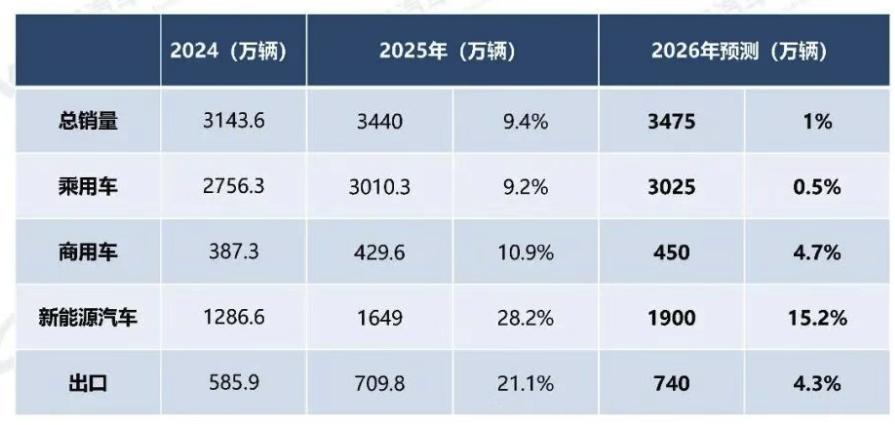
The competition among the top players is also intensifying. XPeng Motors aims to sell 600,000 vehicles in 2026, Xiaomi Motors 550,000 vehicles, and Leapmotor even aims for 1 million vehicles. Against the backdrop of the overall market's minor growth, these ambitions mean that they have to snatch market share from their competitors.
What's even more worth celebrating is the rise of domestic brands. In 2025, the market share of Chinese - brand passenger cars rose to 69.5%, reaching a new high since 2018. Chinese consumers are voting with their feet and choosing domestic brands. However, this also means that the competition among domestic brands will be more intense than ever before.
Meanwhile, a "foreign - cycle" growth curve is accelerating upwards. In 2025, China exported 8.32 million vehicles, a year - on - year increase of 30%. Among them, 3.43 million new energy vehicles were exported, a year - on - year increase of 70%, and the export of plug - in hybrid models soared by 252%. In the first quarter of 2026, the export volume reached 2.226 million vehicles, a year - on - year increase of 56.7%.
This is the real picture of China's automotive industry in 2026 - the domestic growth rate is slowing down but the competition is intensifying, the momentum of going global is strong but the profit is under pressure, and the industry pattern is being rewritten.
The price war fails, and the value war has just begun
The price - cut storm has been raging from last year to this year.
Data from the China Passenger Car Association shows that in the first quarter, the price - cut intensity of new energy vehicles reached 13.7%, and that of fuel - powered vehicles even reached 14.3%. However, the price cuts did not lead to a rebound in sales but a collapse in profits. From January to February, the revenue of the automotive industry decreased by 0.9% year - on - year, while the profit plummeted by 30%. The industry's profit margin was only 2.9%, far lower than the average level of 5.8% of downstream industrial enterprises.
What worries car companies even more is that the market is becoming "desensitized" to price cuts. In March, the retail sales of passenger cars decreased by 15% year - on - year, and the cumulative decrease in the first quarter was 17.4%. Some experts have bluntly stated that consumers have formed a fixed expectation of price decline, and the decision - making cycle for car purchases has generally been lengthened.
A paradox is playing out: the entire industry has almost fallen into a vicious circle of "increasing sales volume but not increasing revenue, increasing revenue but not making a profit". Even BYD, a strong player, saw its revenue exceed 800 billion yuan in 2025, but its net profit decreased by nearly 19% year - on - year, which was the first time in the past four years.
Li Bin, the founder of NIO, made a sharp reflection: "It's normal for a car model to waste hundreds of millions of yuan. The manufacturer doesn't make money, the supply chain doesn't make money, and the users don't benefit either." This "lose - lose - lose" situation is forcing the industry to find a way out.
Where is the way out? The Central Economic Work Conference has set the tone. In 2026, we should "strive for progress while maintaining stability and improve quality and efficiency". The "involution" centered solely on price cuts is being reversed by policy guidance and collective reflection of enterprises. The "value war" centered on technological innovation, product iteration, and experience optimization is being comprehensively upgraded.
In other words, when price is no longer a weapon for differentiation, what can really impress users is returning to the product itself and brand storytelling.
When the decision - making no longer happens at the 4S store
If the failure of the price war exposes the ineffectiveness of the old model, then a brand - new marketing logic is emerging.
In the past thirty years, the path of car sales has hardly changed: users enter the 4S store, the sales consultant gives an introduction, the user takes a test drive, negotiates the price, and then makes a purchase. The core of this path is "interception" - using persuasive words to complete the conversion at the last step of the user's decision - making process.
However, this path is no longer effective today. Because the user's decision - making process has been advanced to before they enter the 4S store. They will search and compare on social platforms, watch product reviews in short videos, lock in benefits in the live - streaming room, and get influenced by recommendations in content communities. By the time they enter the showroom, they already know everything about the product, price, and even the competitors.
This change is forcing car companies to rethink the essence of marketing.
The Douyin live - streaming room is the most intuitive window for this transformation. During the Double 11 period in 2025, more than 10 car companies brought more than forty popular car models to the live - streaming room. Mainstream car companies such as FAW Audi, Cadillac, Hongqi, Buick, Chery, and Changan have gone beyond simple brand exposure and established a complete link from locking in online benefits to offline experience and transaction.
Interestingly, car companies are not "selling whole cars" in the live - streaming room. They have found a more ingenious approach - "inflatable deposit". Users can spend a few hundred or a few thousand yuan in the live - streaming room to lock in car - purchasing benefits worth thousands or even tens of thousands of yuan, and it is promised that "the deposit can be refunded at any time if you don't buy the car, and it will be automatically refunded if it expires". This design precisely caters to consumers' psychology of "getting the discount first and then making a decision".
What's even more worth noting is that the "professional live - streaming" led by car company employees is becoming an important supplement. They will talk about their experiences of being torn between range and space when choosing a car, and they will also candidly share their usage feelings. This "authenticity" is exactly what the traditional sales model lacks the most.
The same logic has also been verified in content communities. In October 2025, the third "Car - Playing Festival" on Xiaohongshu was held in Shenzhen, attracting car enthusiasts with real stories of people and cars. A new - force car brand built a KOS matrix on Xiaohongshu. Within two months, the number of operating accounts increased to 55, and 100 orders were successfully converted, with the completion rate of the established sales target exceeding 200%.
When the user's decision - making path changes, the way car companies acquire users must also change accordingly.
Jutou Finance's thinking: meaning is the track
On the surface, we are discussing the price war, minor growth, going global, and selling cars through live - streaming - these are all the changes happening in the automotive industry. However, if we take a broader view, a more fundamental logic is at work.
Cars are changing from being "means of transportation" to being "expressions of lifestyle". Ten years ago, people considered engine displacement and wheelbase when buying a car; today, people talk about intelligent cockpits, camping modes, and even whether the car can take good - looking photos. When the functional boundaries are blurred, what a car carries is no longer just "getting from A to B", but the user's imagination of a certain lifestyle.
This means that the logic of impressing users is also changing: it's not about "how good this car is", but about "what kind of person this car can make me become". When technology becomes more and more homogeneous, the real difference between brands will be increasingly reflected in their storytelling ability - the one who can tell a story that touches the users' hearts will be able to gain a foothold. The one who can understand users more deeply will be able to find a new growth point in the era of a saturated market.
This is not only an iteration of the marketing model but also the starting point for the entire industry to rethink the "relationship between people and cars".
This article is from the WeChat official account "Jutou Finance" (ID: jutoucaijing), written by the Jutou Editorial Board, and is published by 36Kr with authorization.