The "Rashomon" of Geely Auto's Valuation: Is There Really a Gap with BYD?
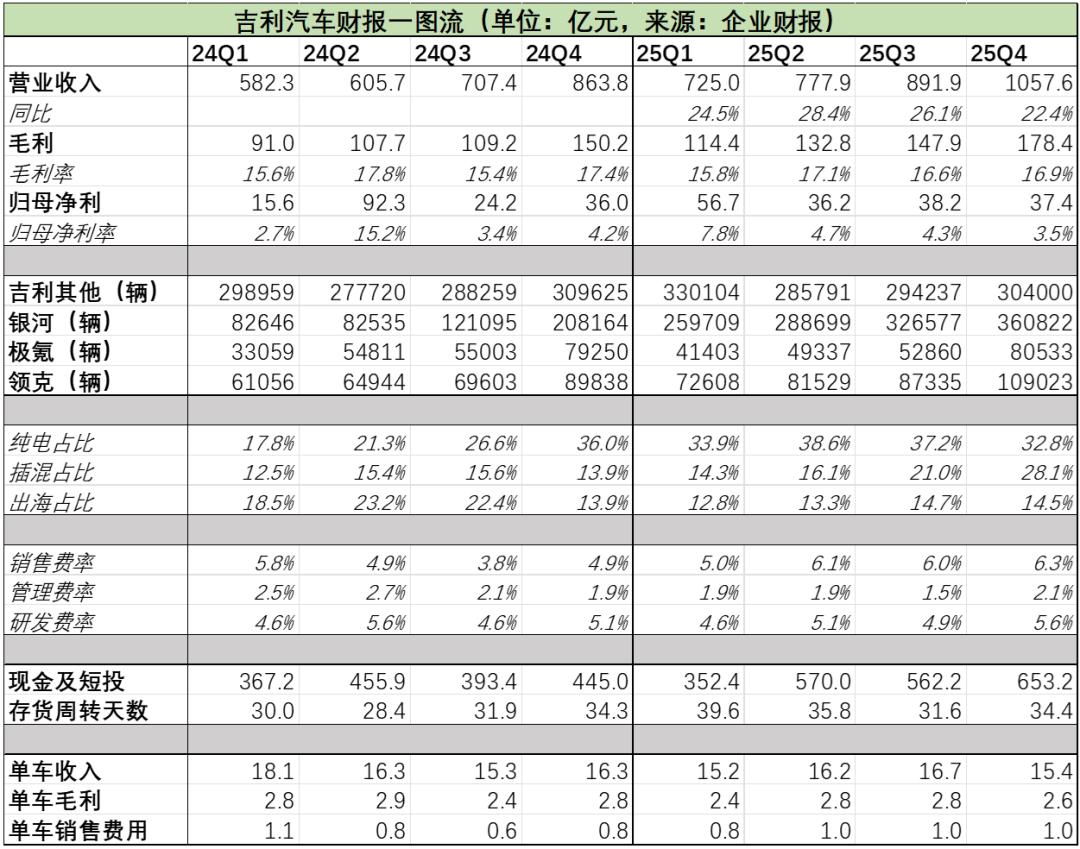
Geely Auto's full - year financial report for 2025 shows that its operating revenue reached 345.2 billion yuan, a year - on - year increase of 25%. Among them, the revenue in the fourth quarter was 105.8 billion yuan, a year - on - year increase of 22.4%, slightly higher than analysts' expectations. The net profit attributable to the parent company in the fourth quarter was 3.74 billion yuan, and the net profit margin attributable to the parent company was only 3.5%. The one - page financial report is shown in the following figure (unit: billion yuan. All data sources below are from the company's financial reports).
Since the "Taizhou Declaration", Geely has significantly accelerated its capital market integration. During the reporting period of the 2025 annual report, ZEEKR delisted from the New York Stock Exchange and was incorporated into the Geely parent company. The distribution channels of Zhejiang Geometry were also incorporated into the main body through frequent acquisition actions. Overall, Geely became more powerful in 2025. However, at the same time, the disclosure caliber of the financial statements also changed. The financial data before 2024 was not restated. Therefore, today we mainly use the financial data between 2024 and 2025 to discuss Geely's performance.
For market investors, Geely's most obvious problem lies in its own valuation. In 2025, Geely's overall sales volume was about 3.02 million vehicles, ranking fourth among domestic automakers, only after BYD, SAIC, and FAW, and second among private enterprises. The overall sales volume was about two - thirds of BYD's, and the growth rate was 39%, significantly higher than BYD's. However, its valuation multiple was only half of BYD's, and there was an obvious valuation gap on the surface.
So, through the financial report today, we try to answer two questions: First, is there really a valuation gap between the two? Second, what is the cause of the obvious valuation gap?
The core viewpoints are as follows:
1. Geely's revenue performance is quite good, and its annual sales volume precisely meets the target.
2. The penetration rate of new energy vehicles has significantly increased. Among them, the growth rate of plug - in hybrid models is more stable than that of pure - electric models. Geely's overseas expansion has improved compared with its own previous performance, but compared with its peers, the pace is significantly slower.
3. The gross profit per vehicle has decreased, but the gross profit margin per vehicle is above the market median and relatively stable. The sales expenses have increased significantly due to channel expansion, and capital expenditures are also accelerating.
4. Excluding the impact of one - time income and exchange gains and losses, Geely's profit in 2025 matches the revenue growth rate and is relatively healthy.
5. Excluding the differences in accounting policies, the valuation gap between Geely and BYD is not large. Based on the recorded data, the current valuation gap between the two is mainly because Geely is relatively less certain in new energy expansion, overseas expansion, and the synergy effect of asset structure.
The specific financial report analysis is as follows:
Quarterly revenue hits a new high, and the annual sales target is precisely met
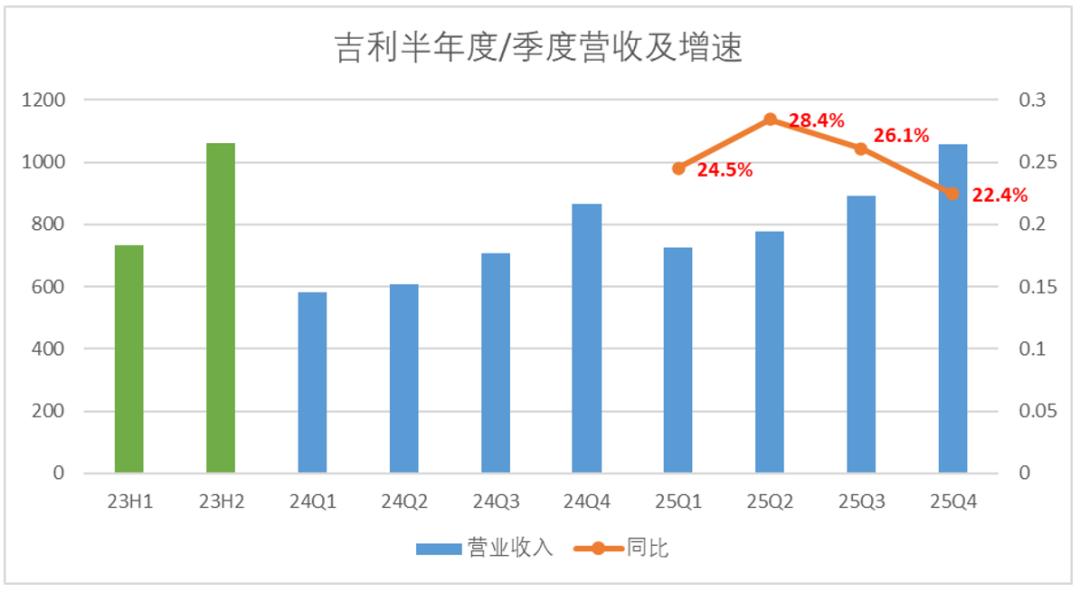
In 2025, Geely's full - year revenue reached 345.2 billion yuan, a record high. Among them, the revenue in the fourth quarter was 105.8 billion yuan, with a year - on - year growth rate of 22.4%. It was the first time since listing that the quarterly revenue exceeded 100 billion yuan. Judging from the revenue performance alone, Geely's report card in 2025 was perfect.
The main contribution to this was the sales volume growth of Geely's main brand, especially the Galaxy models. As a brand focusing on cost - effectiveness, the Xingyuan has long occupied the top position in the small car sales list. According to data from Dongchedi, the average selling price of Xingyuan is significantly lower than that of its main competitor, the Dolphin.
Of course, price - sensitive models are relatively more affected after the subsidy withdrawal. In the first quarter of 2026, the growth rate of the Galaxy series dropped to the 33% range. However, compared with other brands in the market, the price of Galaxy models is still very competitive. Even if the growth rate drops, it can still maintain positive growth at least within a single quarter. As Geely's brand for boosting sales volume, there is no doubt that the Galaxy series has completed its phased task.
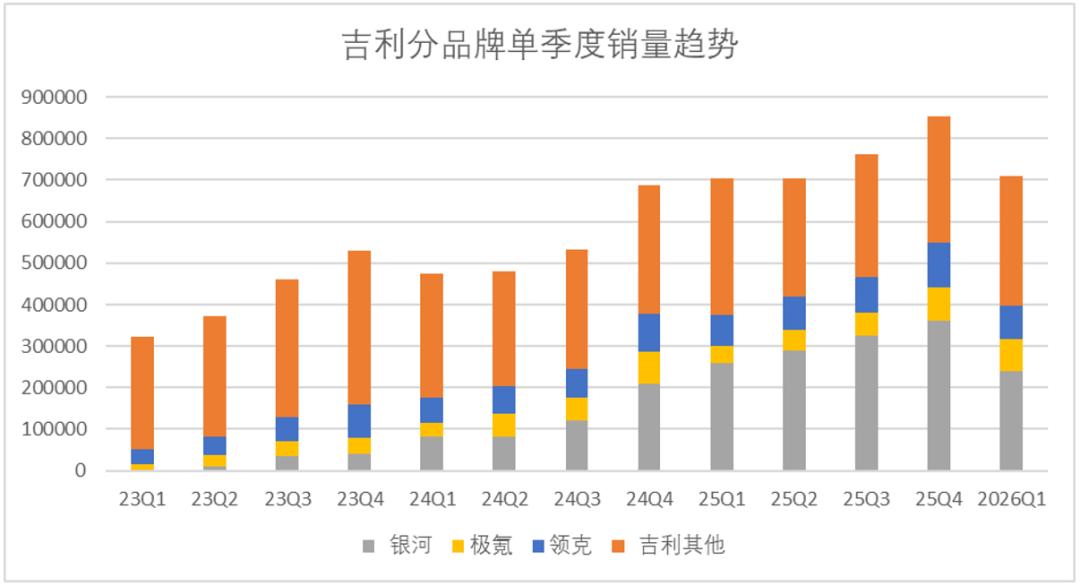
In the mid - year report period of 2025, Geely actively raised its sales target from 2.71 million vehicles to 3 million vehicles. Judging from the results, Geely's control over channels and sensitivity to the market are still very high. The actual sales volume at the end of the year was 3.02 million vehicles, exactly meeting the target, making it one of the few automakers that achieved their sales expectations in 2025.
The penetration rate of new energy vehicles has significantly increased, but the export performance is average
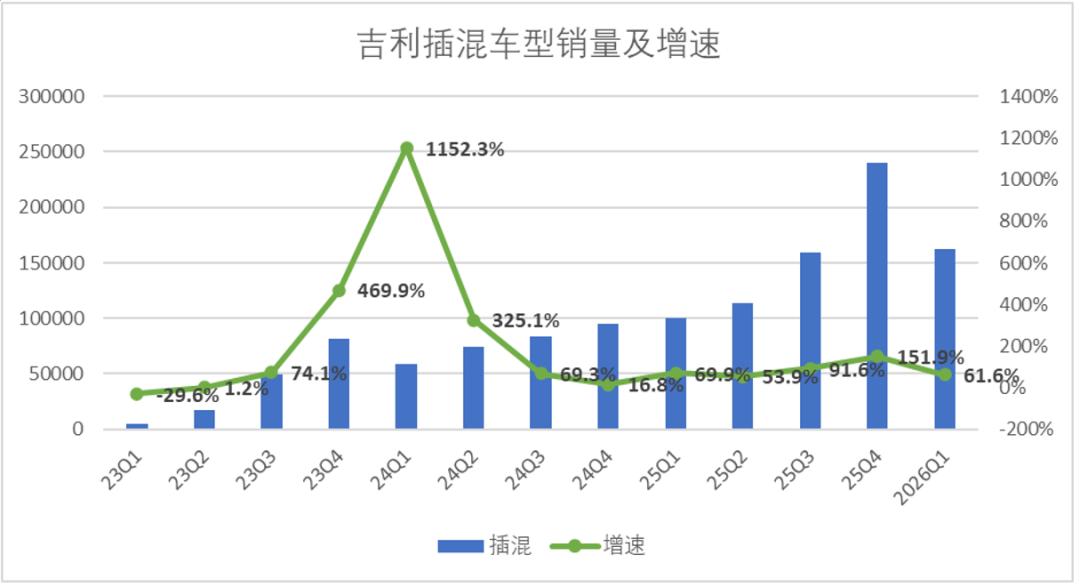
Looking at different categories, 2025 was the year when Geely's new energy vehicle sales volume increased most significantly. As mentioned above, the Galaxy series, as Geely's main model for boosting sales volume and seizing market share, performed quite well, driving Geely to quickly transform into a new energy vehicle manufacturer. In the fourth quarter of 2025, the sales volume of Geely's pure - electric models accounted for 32.8%, and the sales volume of plug - in hybrid models accounted for 28.1%. The two together accounted for 61%, and the proportion of new energy vehicles in general has reached about 60%.
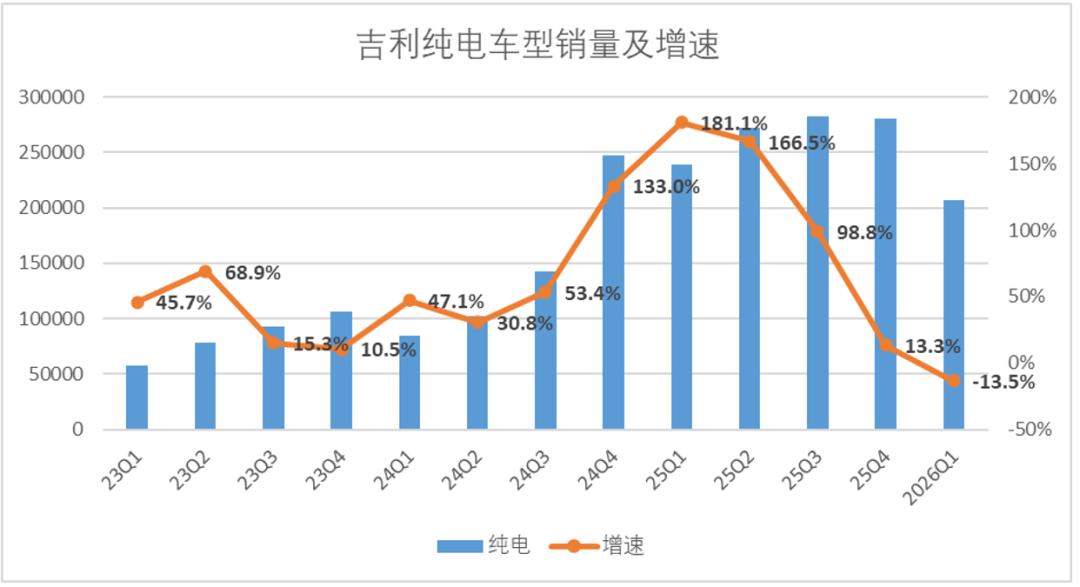
Compared with pure - electric models, Geely's plug - in hybrid models are significantly more stable. Since the first quarter of 2025, the growth rate of Geely's plug - in hybrid models has never been lower than 50%. Even in the first quarter of 2026 when the subsidy was withdrawn, Geely's pure - electric models had a slight negative growth, but the plug - in hybrid models still maintained a growth rate of over 60%, supporting Geely's new energy vehicle market. Therefore, in a horizontal comparison, plug - in hybrid models are relatively less dependent on subsidies.
In terms of overseas expansion, Geely's performance in 2025 was hardly excellent. The annual export sales volume was about 420,000 vehicles, a slight year - on - year increase of 1.3%. In the same period, private enterprises such as BYD and Great Wall, which had pre - arranged overseas channels, recorded export growth rates of 140% and 12% respectively in 2025.
Through the financial report, we believe there are two reasons for Geely's slow overseas expansion:
First, after capital expansion, some high - quality overseas assets were not consolidated. For example, well - known brands such as Volvo, Lotus, and Proton in Southeast Asia have been independently operated after Geely's acquisition and have not directly driven the sales volume data of Geely's listed entity.
Second, it is the drawback of the capital expansion model. Geely has relatively shallow knowledge of overseas channels. Previously, Lynk & Co's overseas expansion in Europe adopted a subscription system instead of a dealer system, which was due to Geely's insufficient understanding of the European sales market. Moreover, the independently operated overseas brands have not formed a positive channel interconnection with Geely's main brand. Therefore, it is not difficult to understand why the implementation progress of the "Taizhou Declaration" has become the core for the market to evaluate Geely's valuation at this stage.
However, we can also see the management's determination to reshape overseas channels. With the reconstruction of the overseas channel network, Lynk & Co has switched back to the dealer system for more than a year. At the beginning of 2026, Geely's overseas sales data was quite good, and the overall growth rate in the first quarter reached 126%, showing an obvious warming trend.
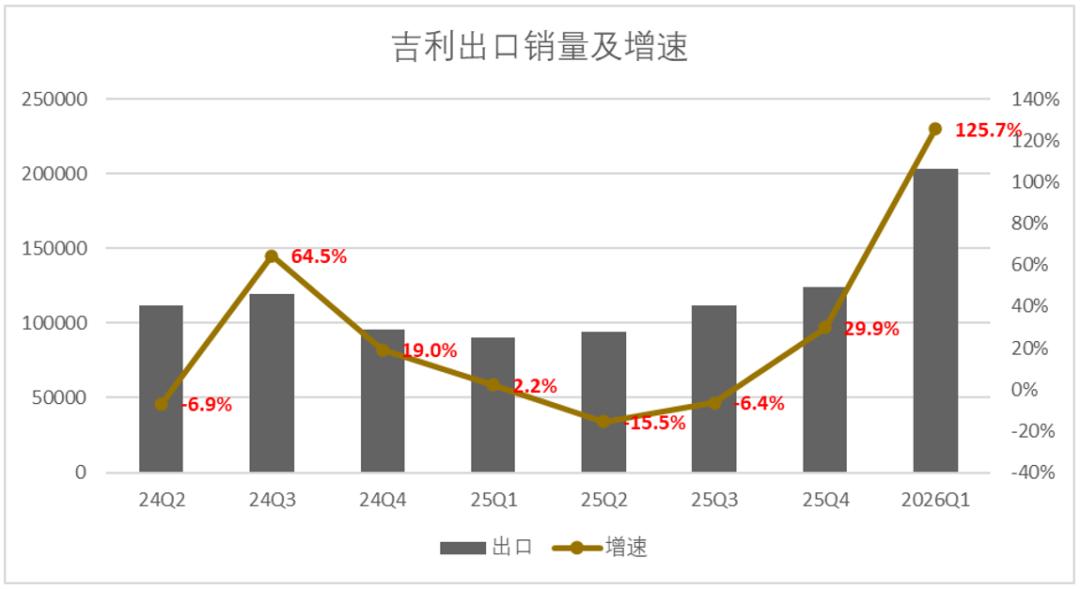
Previously, when analyzing the top ten trends of new energy vehicles in 2026, we emphasized the opportunities for overseas expansion. Geely's layout of overseas brands combined with the large cycle of overseas expansion is expected to achieve rapid growth in overseas sales volume in 2026.
Affected by the price war, Geely's gross profit per vehicle has declined significantly
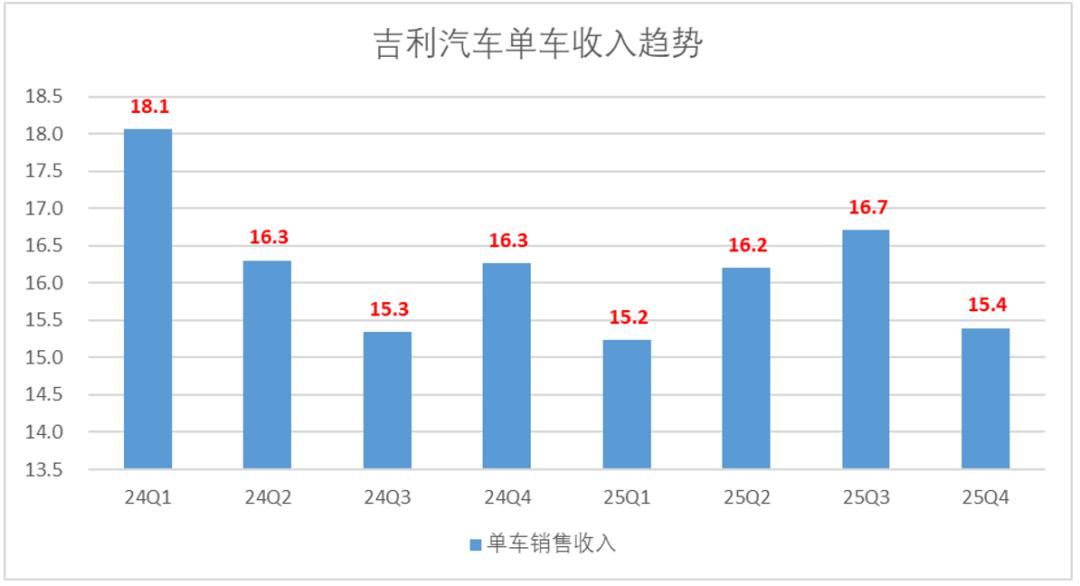
Some high - end models of ZEEKR also performed well in their respective market segments (such as the high - priced ZEEKR 9X and ZEEKR 009), offsetting the partial decline in the sales amount per vehicle. The average selling price (ASP) remained stable as a whole, and the sales revenue per vehicle was maintained above 150,000 yuan. Moreover, in the second and third quarters, there was a relatively obvious increase compared with 2024.
However, the performance on the profit side was relatively average. Although the Galaxy brand quickly exceeded the one - million - unit level, there were relatively many SKUs. The selling price of the main sales - boosting model, Xingyuan, was not high, and the profit margin was relatively thin. As a result, Geely's overall gross profit per vehicle declined significantly in 2025. The gross profit margin per vehicle in the fourth quarter dropped to 16.9%, a year - on - year decrease of 50 basis points.
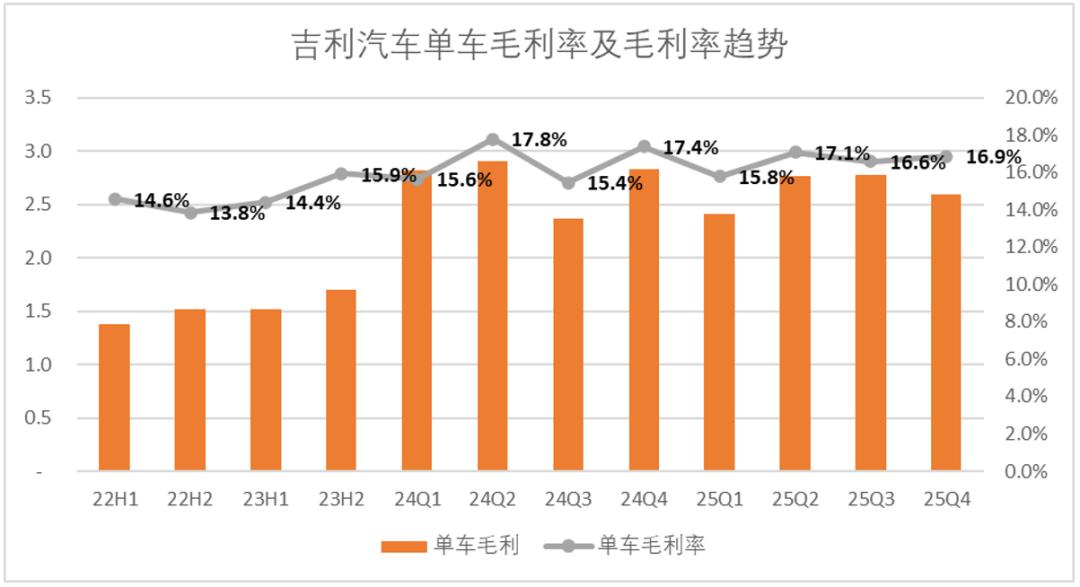
Of course, in a horizontal comparison, in the current domestic market with relatively fierce price wars, Geely can maintain a gross profit margin per vehicle of 16% - 18%, which is already a good performance among automakers.
If the overseas sales volume in 2026 can meet the expectations, it will probably drive the growth of ASP. We estimate that Geely's gross profit margin per vehicle will be repaired in the short term.
The cost control performance is average, and capital expenditures are gradually accelerating
Let's take a look at Geely's cost performance. In 2025, Geely's overall cost control performance was relatively average. Especially in the fourth quarter, the cost rate increased significantly. In the fourth quarter, the sales expenses, management expenses, and R & D expenses were 6.7 billion, 2.2 billion, and 5.9 billion yuan respectively, and the three cost rates were 6.3%, 2.1%, and 5.6% respectively.
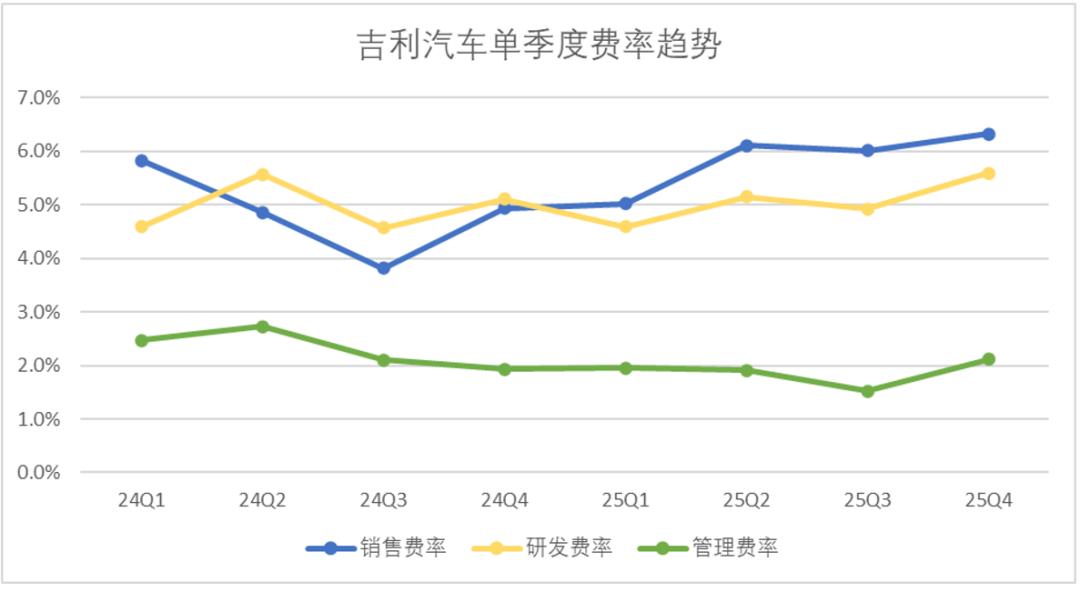
Compared with the fourth quarter of last year, the management cost rate and R & D cost rate increased by 20 basis points and 50 basis points respectively. Since the second quarter of 2025, the sales cost rate has remained at a high level above 6%, with increases of 130 basis points, 220 basis points, and 140 basis points in three quarters respectively, showing a very obvious increase.
Judging from the results, the core reason for the increase in sales expenses is still the channel transformation. Both pure - electric models and ZEEKR high - end models rely on separate sales channels to maintain pre - sales and after - sales services. Investment in the network channel is an inevitable path for late - entering new energy vehicle manufacturers. Previously, when analyzing Great Wall Motors, the increase in sales expenses was also due to channel reshaping. At the beginning of the year, when analyzing the new energy trends in 2026, we also emphasized that channels might become the key word for new energy vehicles in 2026, and it seems that our judgment was quite correct.
Geely Auto's overall capital expenditures in 2025 were on an upward trend, which can also prove this point. In 2025, the growth rate of Geely Auto's capital expenditures reached 35%. Part of it was invested in channels, and the other part was invested in overseas channels and production capacity construction. It is clear that Geely's management is very aware of Geely's relative weaknesses at this stage.
Like Great Wall, although the sales expenses have increased significantly, Geely's overall expenditure rhythm is relatively controllable, and the cost per vehicle has not increased significantly. This can also confirm again that as long as the brand is in its own hands, the benefits brought by scale will surely offset the expenditure on the cost side.
