After the breakdown of social order, Wang Tao, the founder of DJI, learned to admit defeat.
At 8 p.m. on April 16th, the DJI Pocket 4 was officially launched. It sold out instantly on multiple platforms, and the spot price had a premium of nearly 600 yuan.
This is a major new product launched by DJI on the occasion of its 20th anniversary, and the market has voted with real money, showing its trust.
After a hit product comes an improvement in performance. In recent years, DJI's sales have been soaring: its sales revenue exceeded 80 billion yuan in 2025 and is expected to exceed 100 billion yuan in 2026.
Just one week before the launch of the Pocket 4, Wang Tao, the founder of DJI, gave an interview to the media again after "disappearing" for 10 years.
He admitted that he used to be too eager to win and that he didn't know how to manage. In order to prevent the "tree" from falling, he spent nearly a decade pruning its roots - reorganizing the system, unifying the rules, and putting the user experience in an important position in product decision - making.
Interestingly, ten years ago, he said, "The world is incredibly stupid." At that time, he only believed that as long as the product was good enough. This kind of paranoia made DJI the absolute leader in the global consumer - grade drone market, but it also led to the emergence of corruption within the company.
But ten years later, as DJI is about to reach 100 billion in sales, he added the second half of the sentence, "So am I."
The word 'I' is poison
It took Wang Tao ten years to add the second half of the sentence "The world is incredibly stupid."
In 2016, DJI was at its peak. Its global market share in the consumer - grade drone market exceeded 70%. Its revenue soared from 5.98 billion yuan in 2015 to 9.78 billion yuan, approaching the 10 - billion - yuan mark.
In the mid - to - high - end price range (above 1,500 yuan), DJI accounted for over 90% in both sales volume and profit. The media commented that "DJI is the Apple of the drone industry."
At that time, Wang Tao only cared about the product.
He rarely participated in public activities and even missed DJI's most important product launches several times. Instead, he devoted himself to the product details and had strict regulations on the tightness of a single screw.
It was also in this year that DJI launched its ace consumer - grade drone, the Phantom 4, and the foldable drone, the Mavic Pro. The former consolidated DJI's leading position in the industry, and the latter had an order volume of over six digits and was in short supply.
However, this kind of paranoia also planted hidden dangers within the company.
In 2019, a corruption case that shocked the industry broke out. At that time, DJI's R & D team had great decision - making power. Corruption emerged in the procurement process, and different departments acted independently.
The investigation found that the procurement price of a large amount of materials was about 25% higher than the industry's fair price. This corruption cost DJI over 1 billion yuan. 45 employees were dealt with, and another 29 were fired.
Even worse, there was a brain drain. From 2019 to 2020, a group of early R & D backbones of DJI left to start their own businesses.
Wang Tao used words like "the collapse of social order", "fiefdoms everywhere", and "vassal states" to describe the company at that time. "The difficulty of making products is 1 point, while the difficulty of management is 10 points. We used half of our energy to make up for this shortcoming."
He admitted that he was only obsessed with making products back then and ignored the supervision, rules, and cultural construction of the organization.
"When people are overly inflated by a little success, they will get addicted. The word 'I' is poison."
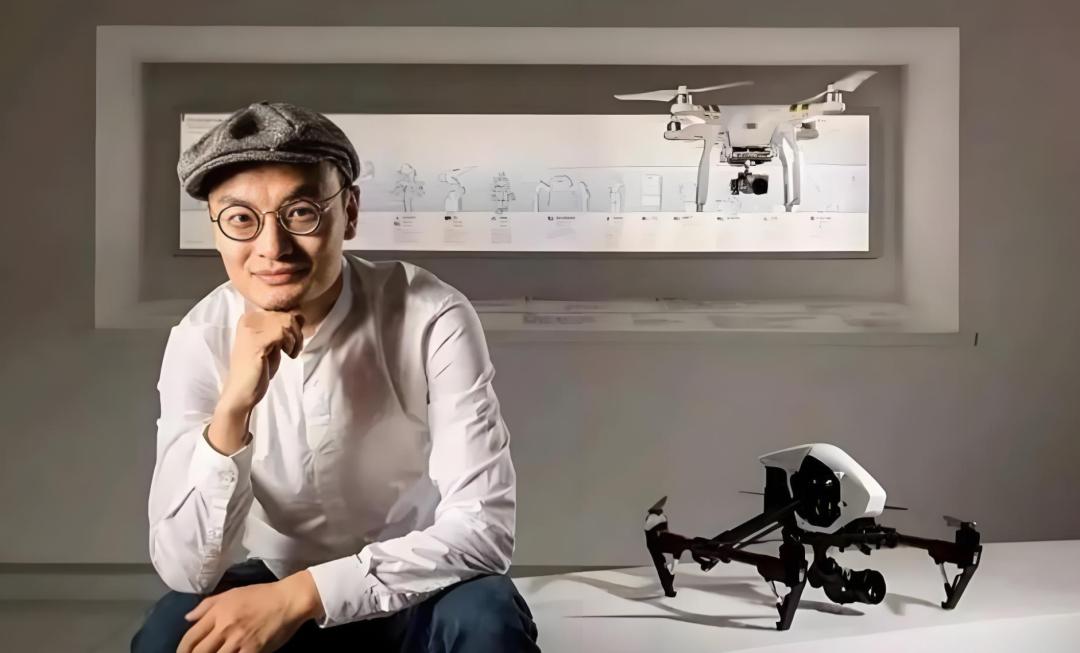
In 2025, DJI's sales revenue will most likely exceed 100 billion yuan. The leap from 10 billion to 100 billion is a crucial watershed for an enterprise.
After ten years of silence, Wang Tao chose to speak up at this juncture: "I've been transforming, like a soft - shelled crab. Now that I've shed my shell, it's time to come out and refresh people's perception."
Ten years later, Wang Tao added the second half of the sentence he said ten years ago: "The world is incredibly stupid, and so am I."
This change is ultimately reflected in the products.
How do products speak?
It's no exaggeration to describe DJI's position in the consumer - grade drone market as "Mount Everest". Its global market share has been maintained above 70% for a long time, and no company can shake it in the short term.
However, there is never a shortage of climbers at the foot of Mount Everest. According to Wang Tao, there are mature competitors facing each of DJI's dozens of business lines.
Take Insta360 as an example. This company, founded by former DJI employees, focused on panoramic cameras in the early days and occupied over 60% of the global market share. In 2025, Insta360 officially announced its entry into the drone market, directly targeting DJI's core territory.
Wang Tao used to believe in a principle: either don't do it, or do something that doesn't exist in the world.
This almost paranoid pursuit made DJI's first - generation drones a miracle in the industry, but it also led to the suspicion of "incremental innovation" for its later product lines.
So, he changed his thinking and shifted from "subverting the world" to "making professional - grade products accessible to ordinary people".
The first landmark result of this transformation was the Osmo Pocket 3 launched in 2023.
The highlight of this product is that it didn't create a new category. It just made a comprehensive upgrade from the inside out in the gimbal camera track that DJI pioneered five years ago: a 2 - inch OLED touch screen, a 140 - minute battery life, full - pixel phase - detection autofocus... Every upgrade hit the users' hearts.
The market's response even surprised DJI itself.
According to Leifeng.com, before the launch of the Pocket 3, the internal initial expectation was to sell only 300,000 to 400,000 units. However, the annual sales volume in 2024 exceeded 5 million units, and as of the third quarter of 2025, the global cumulative sales volume of this product exceeded 10 million units.
More importantly, this product made the proportion of female users of DJI exceed 50% for the first time. The product was out of stock for a long time, and the price on third - party channels had a premium of over 30%. It was jokingly called the "electronic Moutai" by netizens.
With the success of the Pocket 3, two years later, Wang Tao applied the same logic to the Pocket 4.
On April 16, 2026, the Osmo Pocket 4 was officially launched. The standard version is priced at 2,999 yuan, and the all - in - one version is 3,799 yuan. This product is a direct reflection of Wang Tao's transformation.
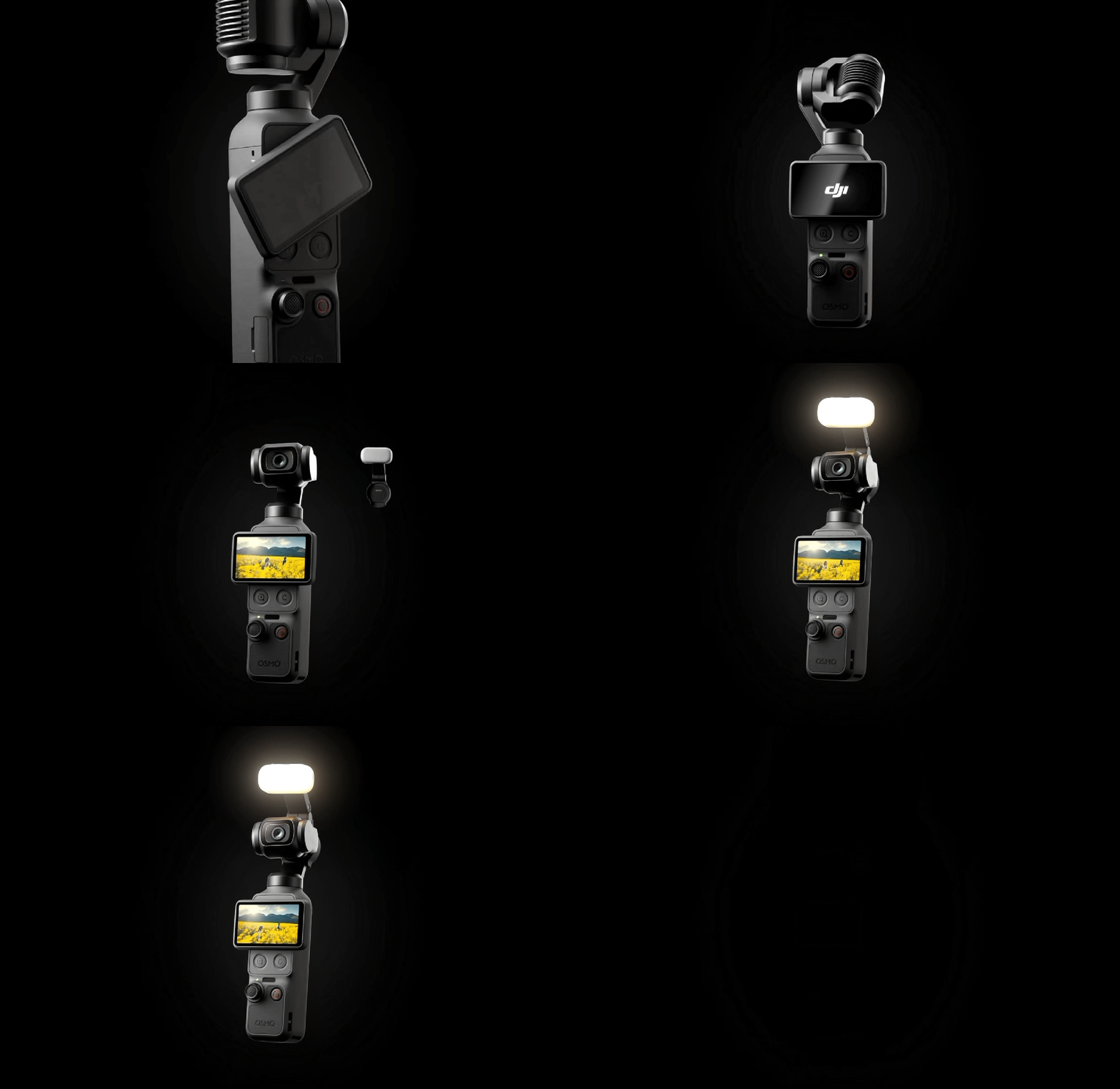
(Image source: DJI official website)
The product doesn't force in so - called "black technology". The R & D team retained the 1 - inch sensor, increased the dynamic range to 14 stops, upgraded the video specification to 4K/240fps, and built - in 107GB of storage space. The battery capacity is also larger than the previous generation.
After the upgrade, the whole machine weighs 190.5 grams, about a dozen grams heavier than the Pocket 3, but the actual holding feeling is almost the same, and the portability is not affected at all.
DJI has a clear definition of this product: It precisely solves four pain points: image quality, portability, storage, and battery life. Each pain point comes from the real feedback of a large number of users.
The market gave a warm response: after the official launch, it sold out instantly on multiple e - commerce platforms. Within an hour of the launch, the spot price on the Dewu APP soared, reaching a maximum of 3,528 yuan, with a premium of nearly 600 yuan compared to the official price of 2,999 yuan.
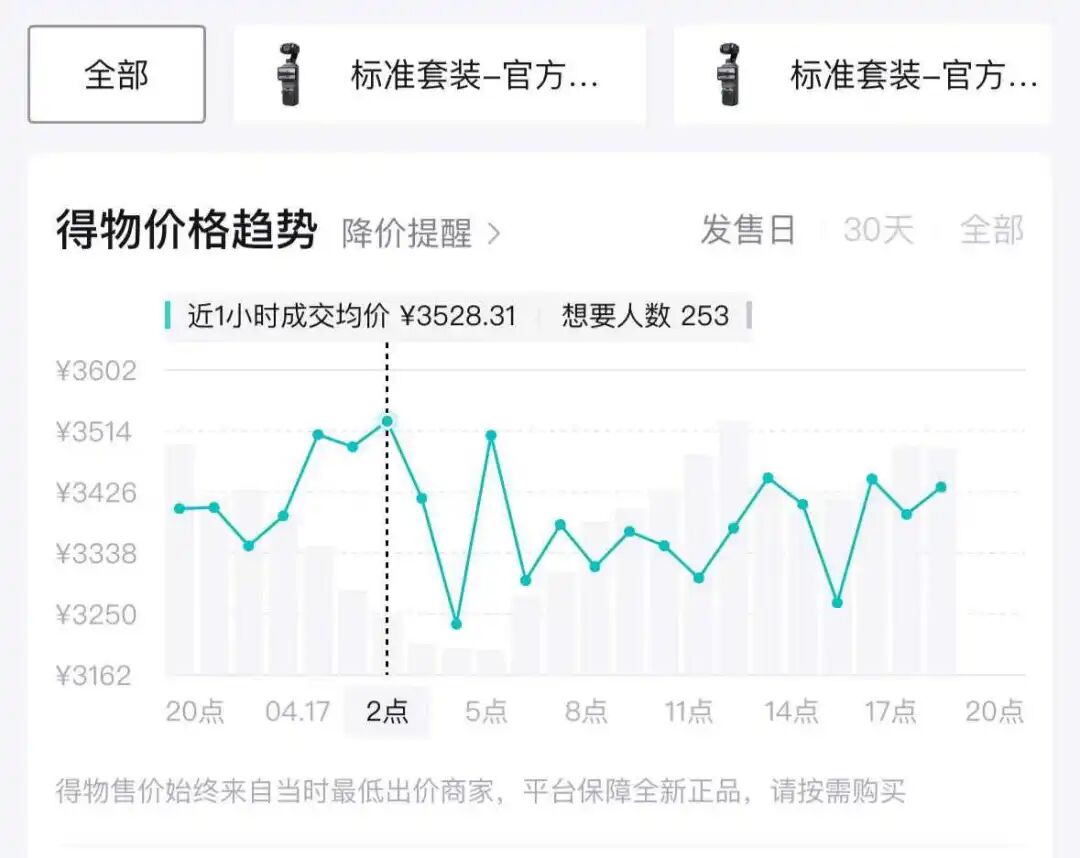
(Image source: Dewu APP)
It addresses pain points precisely rather than making a revolution. The same logic is also reflected in other products.
On July 31, 2025, DJI launched its first panoramic camera, the Osmo 360, with a starting price of 2,999 yuan. When entering this field, there were already mature competitors in the market.
DJI didn't try to crush its competitors with disruptive technology. Instead, it chose to transfer its core technologies such as image processing, stitching algorithms, and high - density miniaturized hardware design, and continued its consistent high - cost - performance strategy.
As a result, within less than three months, the Osmo 360 captured 49% of the market share in the Chinese e - commerce channel and 43% in the global market. Although this market share is controversial, it's an undeniable fact that it has captured a part of the market.
A newcomer has rewritten the pattern of the entire panoramic camera market with a single product.
Moreover, DJI has also transferred its drone capabilities to new tracks such as sweeping robots and e - bikes. These product categories are of moderate scale and highly compatible with DJI's sensing, navigation, and control technologies.
The instant sell - out of the Pocket 4, the counter - attack of the Osmo 360, and the cross - border expansion of the sweeping robot... Behind these product - level changes is the mindset adjustment and management improvement that Wang Tao has achieved over the past ten years.
He let go of the obsession of "I want to win" and learned how to make an organization operate healthily. After cultivating its internal strength, the market will naturally give an answer.
DJI's present
The feedback from data is the most intuitive.
A report from Jiuqian Consulting shows that in 2025, DJI captured 55% of the global market share in the handheld intelligent imaging device market, ranking first in terms of revenue. Its market share is nearly twice that of the second - ranked company (30%).
These figures don't come out of thin air.
In the interview, Wang Tao compared the company to a tree that naturally tends to be in chaos: the leaves represent the continuously expanding product lines, and the roots of the tree are the management system. If the leaves grow too fast, the roots will be overloaded, and the whole tree will collapse at any time.
To prevent this chaos, Wang Tao spent nearly a decade pruning the roots and called this process "entropy - reduction practice".
The result of this pruning is reflected in the R & D logic of the Pocket 4.
In the past, Wang Tao's final decision - making power on products was almost unchallengeable. If he was not satisfied with a plan, he would scrap it and start over.
Now, the R & D team conducts a large amount of user research in the early stage and upgrades the four core pain points: image quality, portability, battery life, and storage.
The instant sell - out and high premium in the market verify the rationality of this decision - making mechanism.
Wang Tao summarized this mechanism as "the first cosmic velocity of management".
Put simply, the CEO only needs to firmly grasp the strategic direction and cultural foundation and let the team handle other matters. If a company can continuously cultivate management talents, not only for its own use but also to send out, then this mechanism is truly mature.
The implementation of this concept relies on Wang Tao's reconstruction of the organizational system over the past ten years.
The space for corruption has been compressed, the cost of a large amount of materials has returned to a normal level, and unified rules have replaced the previous fiefdom - like situation. DJI has transformed from a company driven by paranoid technology into a mature organization operating based on systems and rules.
Behind this, there is a key factor - people.
Wang Tao accepted the outside world's description of DJI as a "military academy". In terms of the incentive system, his attitude is straightforward: "The money must be in place. Talking about incentives without money is just PUA."
Therefore, DJI has established a set of mature product methodology systems and a systematic talent training mechanism. The entrepreneurs who have left DJI in batches have become an important force in China's science and innovation circle.
This talent spill - over, in turn, injects new vitality into DJI's ecosystem.
DJI forms a deep - seated bond with former employees and external teams through a combination of internal incubation and external investment.
DJI's external investments cover multiple fields such as the upstream and downstream of drones, AR, chips, and biopharmaceuticals, with at least 12 companies in total. Last year, DJI also invested in the consumer - grade 3D printing enterprise, SmartPie.
Moreover, DJI continuously supports the entrepreneurial groups from the "DJI ecosystem".
Statistics show that since 2025, nearly 20 companies founded by former DJI employees have successfully obtained financing. Some business leaders only expressed their intention to leave, and they received an angel - round financing valuation of up to 20 million yuan.
Wang Tao said: "People at DJI don't only have the option of going to work. They can also have other choices. We invest, empower our supply - chain capabilities, and even send some talents."
From products to systems, from systems to people, and from people to the ecosystem, Wang Tao has completed this step - by - step transformation over the past ten years.
Twenty years ago, Wang Tao wanted to send drones into the sky; twenty years later, he learned to "pull himself back to the ground" first.
This may be the best coming - of - age gift for DJI's 20th anniversary.
This article is from the WeChat official account "Business Data School" (ID: business - data), written by Duan Zeyu and edited by Guo Mengyi. It is