As oil prices rise, the prices of second-hand electric vehicles in Europe have soared, and Chinese automakers have made profits.
On April 10, Michael Lohscheller, the CEO of Polestar, told Reuters that the growth rate of the used electric vehicle market has now outpaced that of new cars. "The sales of used Polestar vehicles increased by 47% this quarter. The overall sales rose by 7% to 13,126 units," said Michael.
The reason behind this is not hard to guess - the escalating situation in Iran has led to a sharp rise in gasoline and diesel prices, causing great distress to Europeans. Many car buyers have become "price - sensitive" consumers. Considering the high fuel costs after purchasing a car, they have turned to more affordable electric vehicles. However, surprisingly, the sales of used electric vehicles are higher than those of new electric cars.
Used Electric Vehicles Are Gaining Speed in Europe
The impact of rising oil prices has first led to an overall increase in the attention and sales of electric vehicles. German automotive media Autogazette reported that in the first two months of 2026, a total of 1.66 million new passenger cars were registered in the EU, among which the registration volume of pure - electric vehicles increased by 22% against the trend.
But even more astonishing data comes from the used electric vehicle market. According to Reuters, multiple European online car platforms show that the sales of used electric vehicles have soared due to rising oil prices.
On Finn.no, Norway's largest used - car trading platform, electric vehicles overtook diesel models in March to become the best - selling fuel type. An analyst on the platform told Reuters that the current used - car market is experiencing an "electric vehicle boom." In France, the online search volume for electric vehicles increased by 160% from early March to early April. French online used - car retailer Aramisauto reported that the proportion of electric vehicle sales almost doubled from 6.5% in the week of February 16 to 12.7% in the week of March 9. Correspondingly, the proportion of gasoline - powered vehicle sales on the platform dropped from 34% to 28%, and that of diesel - powered vehicles dropped from 14% to 10%.
The person in charge of the platform said that when energy prices rose due to the Russia - Ukraine conflict in 2022, the company also observed similar market changes. He pointed out that once the gasoline price exceeds 2 euros per liter, it will leave a lasting impression on consumers, significantly increasing website traffic and translating into orders for electric and hybrid vehicles. Similarly, the search volume for electric vehicles on the Danish used - car platform Bilbasen has also increased. The automotive analyst on the platform attributed the main reason to the rising gasoline prices. Data from Germany's largest online car market, mobile.de, also confirms this trend: since early March, the proportion of electric vehicle searches on its website has increased from 12% to 36%, a three - fold increase. At the same time, the number of inquiries about electric vehicles received by used - car dealers has increased by 66% compared to February. The platform said that the current high oil prices are driving up the demand for electric mobility.
So, how much has the oil price risen? The tense situation in Iran that started on February 28, 2026, cut off a key channel for about 20% of the world's oil supply, directly causing a sharp rise in global gasoline retail prices. According to statistics from the European Commission, from February 23 to mid - April, the average gasoline price in the EU has risen from about 1.55 euros per liter to nearly 1.80 euros per liter, a cumulative increase of about 16%, showing a typical price curve of geopolitical conflicts with a "sharp rise in the early stage and a slowdown in the later stage." This means that in some parts of Europe, it may cost dozens of euros more to fill up a tank of gas.

In the past few years, the appeal of electric vehicles to European consumers has mainly been reflected in environmental protection campaigns and substantial policy subsidies. However, when the oil price suddenly soared, the psychological balance of consumers with money ready to buy a car was instantly disrupted - the long - term cost advantage of electric vehicles became immediately obvious.
So, why do consumers prefer used electric vehicles rather than new ones? Behind this is a more practical consumption logic. If the same situation occurred in China, people would probably be more willing to buy new electric vehicles directly. On the one hand, the price of new electric vehicles in China is more affordable than in Europe (this is due to the strong supply - chain strength of China's new - energy vehicle industry and the fierce competition among car manufacturers). On the other hand, Chinese consumers have a stronger preference for new cars. However, in Europe, although electric vehicles have an advantage in long - term use costs, the initial purchase cost is still relatively high. Although the sharp rise in oil prices has enhanced the appeal of electric vehicles, it has not changed the reality that many people "can't afford new cars." Therefore, used electric vehicles have become a more reasonable choice - they can reduce fuel costs without the price pressure of new cars.
Some industry insiders pointed out that during the energy crisis in 2022, a similar shift also occurred in the European car market, and it is expected that this car - buying boom will continue. Some experts also believe that this growth may be just a temporary surge and will decline later, but it will stabilize at a higher level and benefit from the improvement of charging infrastructure and the decline in electric vehicle prices.
Opportunities for Chinese New - Energy Vehicles Are Here
The wave of European consumers' enthusiasm for electric vehicles has quickly spread to the other end of the global supply chain - China. While rising oil prices are driving Europeans to turn to electric vehicles, the export volume of Chinese new - energy vehicles has also reached a high level.
According to data from the Passenger Car Market Information Joint Committee of the China Automobile Dealers Association, in March 2026 alone, Chinese new - energy passenger vehicle manufacturers exported 349,000 vehicles, a year - on - year increase of 139.9% and a month - on - month increase of 29.6%. This has directly led to an export volume of 908,000 new - energy passenger vehicles by Chinese manufacturers in the first quarter of this year, a year - on - year increase of 123.7%.
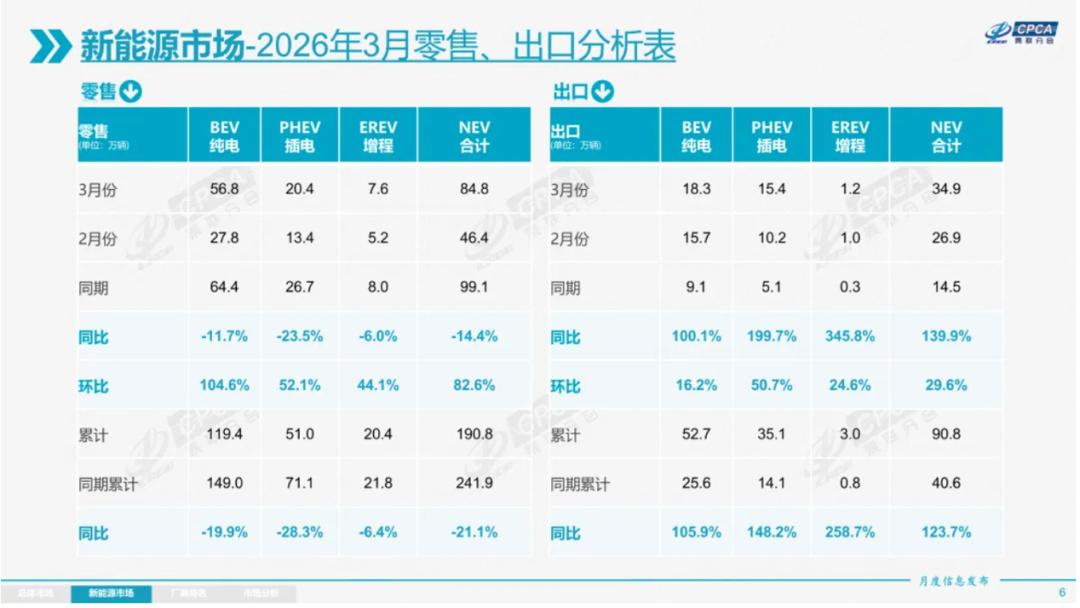
According to the latest data from the Passenger Car Market Information Joint Committee, the leading car manufacturers in new - energy vehicle exports in March were: BYD (116,882 vehicles), Geely (52,186 vehicles), Chery (40,837 vehicles), Tesla China (29,563 vehicles), SAIC Motor Passenger Vehicle Company (20,274 vehicles), Leapmotor (16,609 vehicles), Changan (12,740 vehicles), and Dongfeng (12,569 vehicles). In terms of export destinations, the top five countries for Chinese new - energy vehicle exports from January to February 2026 were: Brazil (78,611 vehicles), the UK (52,517 vehicles), Belgium (48,563 vehicles), the UAE (48,494 vehicles), and Italy (30,277 vehicles). Among them, the top five countries with the largest year - on - year increases were: Brazil (62,461 vehicles), the UAE (31,701 vehicles), the UK (30,943 vehicles), Italy (25,197 vehicles), and Germany (18,037 vehicles).
Interestingly, the Chinese market itself presents a completely different picture. Compared with the explosive growth in exports, the domestic car market is still under pressure, and sales have been declining for several months. Even the new - energy vehicle market, which had been growing rapidly, has shown a phased slowdown. According to retail data from the Passenger Car Market Information Joint Committee, in March 2026, the retail volume of the national passenger car market was 1.648 million vehicles, a year - on - year decrease of 15.0% and a month - on - month increase of 59.4%. Since the beginning of this year, the cumulative retail volume has been 4.226 million vehicles, a year - on - year decrease of 17.4%.
This contrast of "hot overseas and cold domestic" reflects two completely different driving logics. The domestic market is more affected by the reduction of subsidies, insufficient consumer confidence, and price wars, while the overseas market has been quickly activated by the single variable of oil prices. For Chinese car manufacturers, this structural change is driving them to more firmly accelerate their overseas expansion.
"During the Strait of Hormuz crisis, Chinese car manufacturers quickly expanded their global market share," said Cui Dongshu, the secretary - general of the Passenger Car Market Information Joint Committee of the China Automobile Dealers Association. He pointed out that this situation is exactly the same as the logic in the 1970s when Japanese cars quickly captured the European and American markets with their low fuel consumption during the oil crisis.
In the past few years, environmentalism and subsidy policies have been the most important driving forces for the development of electric vehicles in Europe; in 2026, oil prices have become the more direct "switch." On one hand, consumers are voting with their money, and on the other hand, Chinese car manufacturers are accelerating to seize the market. For European local car manufacturers, the question is no longer "whether to produce electric vehicles" but how to quickly re - position themselves in a car market that is constantly being pulled by oil prices, wars, and the macro - environment.
This chain reaction triggered by the situation in Iran may just be the beginning.
(Source: reuters.com, autonews.com, o - abroad.com)
This article is from the WeChat official account "Automobile Observation Autoobserver". Author: Wei Bihui. Republished by 36Kr with permission.