A Chinese tycoon spent nearly $90 million on eight private equity funds from Goldman Sachs, and all $3 million invested in a European "battery champion" project was lost. How can one avoid risks in international private equity investments?
A Chinese billionaire has invested nearly $90 million in total since around 2021, purchasing 8 private equity products from Goldman Sachs, a world - renowned top Wall Street investment bank. However, the returns in the past five years have been a bit unexpected.
At the end of February this year, the billionaire Fang Cheng (a pseudonym used in this article to protect the investor's privacy) told a journalist from National Business Daily (hereinafter referred to as the journalist) that 5 out of the 8 products had suffered losses. Among them, the value of a product invested in the Nordic Battery Project, a so - called "battery champion" in Europe, was written down to zero, and his $3 million investment went down the drain. Although one product with an investment of nearly $39 million yielded a return of $6.7 million, the total return on the $90 million investment was less than 0.5%, not even taking into account the cost of capital.
Why did the Nordic Battery Project fail? How can one avoid risks when making overseas private equity investments?
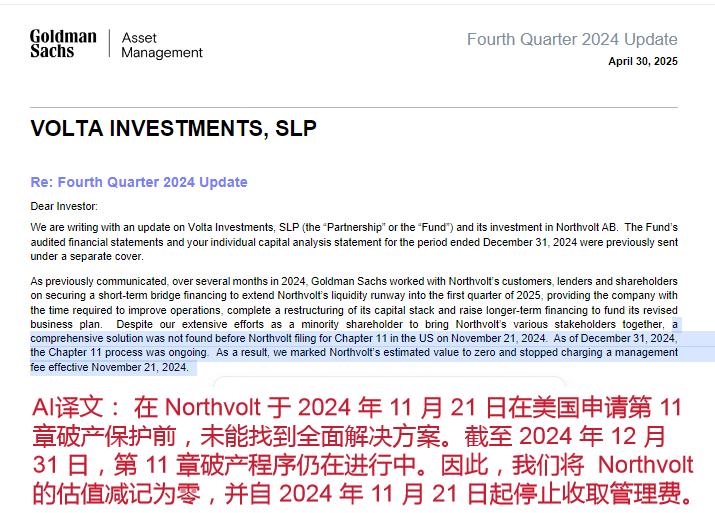
Source of the picture: Notification from Goldman Sachs to the investor in this article about the write - down of the Nordic Battery Project's value to zero
1
A Billionaire Gets Caught in an International Private Equity Investment Trap
The Value of a Project with a $3 Million Investment Is Written Down to Zero
At the end of February this year, just after the Spring Festival, when one should have been in a good mood, the billionaire Fang Cheng was rather frustrated. He told the journalist that he had accidentally invested in several private equity funds of an international investment banking giant. "In 2021, I had just exited from a Chinese concept stock and had a large sum of money on hand. I wanted to make some long - term asset allocations. At that time, I was attracted by the bright prospects painted by Goldman Sachs' salespeople."
As an investor who had caught the wave of the Internet in the early days and completed his initial capital accumulation during the boom of Chinese concept stocks, Fang Cheng admitted that he had never been exposed to alternative assets such as private equity (PE) before. "Around 2020, when our company went public in the United States, Goldman Sachs contacted us, helped us open an account in their private banking department, and then promoted their products to us." Fang Cheng said that under the repeated promotion of Goldman Sachs' salespeople and the endorsement of "the credibility of a century - old investment bank", he signed 8 fund subscription agreements around 2021, with a total committed investment of over $140 million. As of now, the actual capital contribution is $89,932,549.
Fast forward to 2026, about five years have passed since Fang Cheng signed the first fund contract. When he asked his assistant to summarize the latest performance of the 8 funds in a table, he only saw that the total net return rate was less than 0.5%.
"I did some calculations. Even without considering the cost of capital, this return is worse than putting the money in a US dollar money market fund. Not to mention that the Federal Reserve has been raising interest rates since 2021. If I had deposited the money as a fixed - term deposit, I could have earned several million more by now."
The journalist from National Business Daily noticed that on the performance table provided by Fang Cheng, 5 funds were marked in prominent yellow - these were the products currently in a loss - making state. Among them, the Nordic Battery Special Fund named "NORTHVOLT INVESTMENTS, SLP": the total capital contribution was $3 million, and the return was - $3 million. Now, Goldman Sachs has notified that its value has been written down to zero.
"When making this investment, the Goldman Sachs salesperson only said that it was related to electric vehicles and that Goldman Sachs itself had also invested. But now the project company has gone into bankruptcy protection, and all the money is gone." Fang Cheng said. "I later found out that this so - called PRE - IPO fund was actually a high - risk startup project that was still burning money."
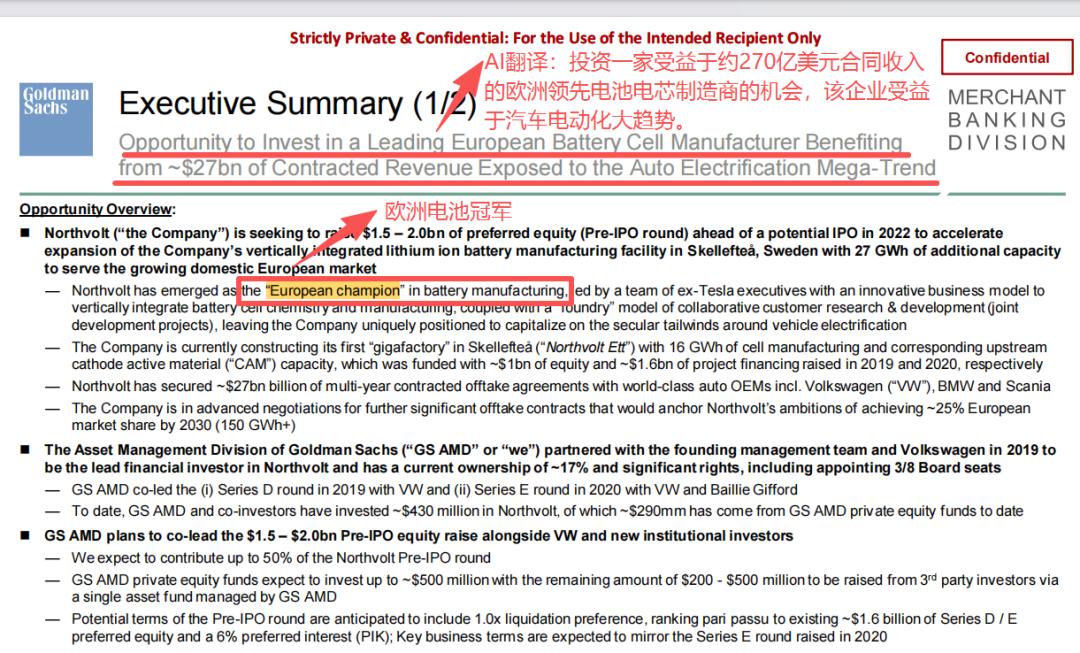
Source of the picture: Introduction document of the European "battery champion" electric vehicle battery project sent by Goldman Sachs to the investor in this article
The performance of other loss - making funds was also lackluster:
The net return multiple of DST OPPORTUNITIES IV was only 0.69, which means that for every $1 invested, only 69 cents were recovered;
The net return multiples of PVC IV, RIVERSTONE INVESTMENTS EUROPE, and WEST STREET CAPITAL VIII were also all below 1, at 0.84, 0.84, and 0.95 respectively.
Three funds achieved profitability. The net return of DRAGONEER OPPORTUNITIES VI was 1.25 times, DST OPPORTUNITIES V was 2.02 times, and WSGGP was 1.17 times. However, due to the losses of other funds and the erosion of management fees, the overall return was diluted. The return rate on the nearly $90 million investment did not even reach 0.5%.
The investment and return situations of these funds are as follows:

Source of the picture: Screenshot of an email sent by Goldman Sachs to the investor in this article
"These funds charge a fixed management fee of 1.5% - 2% per year, and it is calculated based on the total committed investment, not the actually paid - in capital." Fang Cheng said. "I've paid a large amount in management fees over the past five years, and I've hardly made any money. Instead, I've lost the bank interest."
What's even more unacceptable to him is the lack of liquidity. "I thought I could exit the investment in at most five years. Later, I found out that the lock - up periods of these funds are mostly 7 or 10 years. In 2022, due to the sharp decline in the stocks I held, I was short of funds. I wanted to transfer part of my share in a fund (WEST STREET CAPITAL VIII) in which I had invested a relatively large amount. As a result, I transferred $50 million of the fund subscription quota in the secondary market of Goldman Sachs and lost $5 million. In fact, when buying such funds in the secondary market, you can get a discount and have a shorter lock - up period." But this was not clearly communicated when I first bought the product.
Facing such an outcome, Fang Cheng said: "We should not blindly trust the so - called 'big foreign investment banks' and should not easily believe in verbal promises, especially in areas we don't understand. Even the biggest names may hide invisible risks."
2
Products of Star Institutions Are in Abundance
Why Do They Fail to Meet Investors' Expectations?
So, the question is: What kind of products did Fang Cheng buy, and how did he get into such an embarrassing situation?
Based on the fund promotion materials and fund documents provided by Fang Cheng, the journalist found that the 8 funds he bought were all long - term closed - end US dollar private equity products, which could be divided into two categories: Goldman Sachs' own products and funds distributed by leading institutions.
Among them, the own products included 2 own equity funds under Goldman Sachs and a special fund led by Goldman Sachs Asset Management and invested in Northvolt, a Nordic battery manufacturer. The distributed funds were PVC IV Access under Primavera Capital, Dragoneer Opportunities VI Access under Dragoneer Investment Group, 2 funds from the "Opportunities" series under the well - known investment institution DST Global, and Riverstone Investments Europe SLP under the private equity institution Riverstone.
In terms of net return multiples, among these 8 products, only one fund under DST Global achieved a multiple of 2 and presented a good performance. The performance of the other non - troubled products was relatively mediocre.
At least from the relevant data, the performance of these funds did not meet the investors' initial expectations. In Fang Cheng's view, he bought fund products issued by leading institutions. Both the strength of the fund managers and their past performance in the promotion materials were very impressive. But why did the actual performance fall short of expectations? And what is the overall industry level?
We can refer to the fund performance benchmarks (Benchmark) regularly released by third - party institutions. Take the private equity fund performance benchmark released by the China Venture Capital Research Institute every year as an example. This benchmark mainly focuses on RMB private equity funds, but also includes some US dollar (or other currency) funds with China as the main investment destination. Let's take a look at the TVPI (Total Value to Paid - In Capital) situation of these funds in 2024:
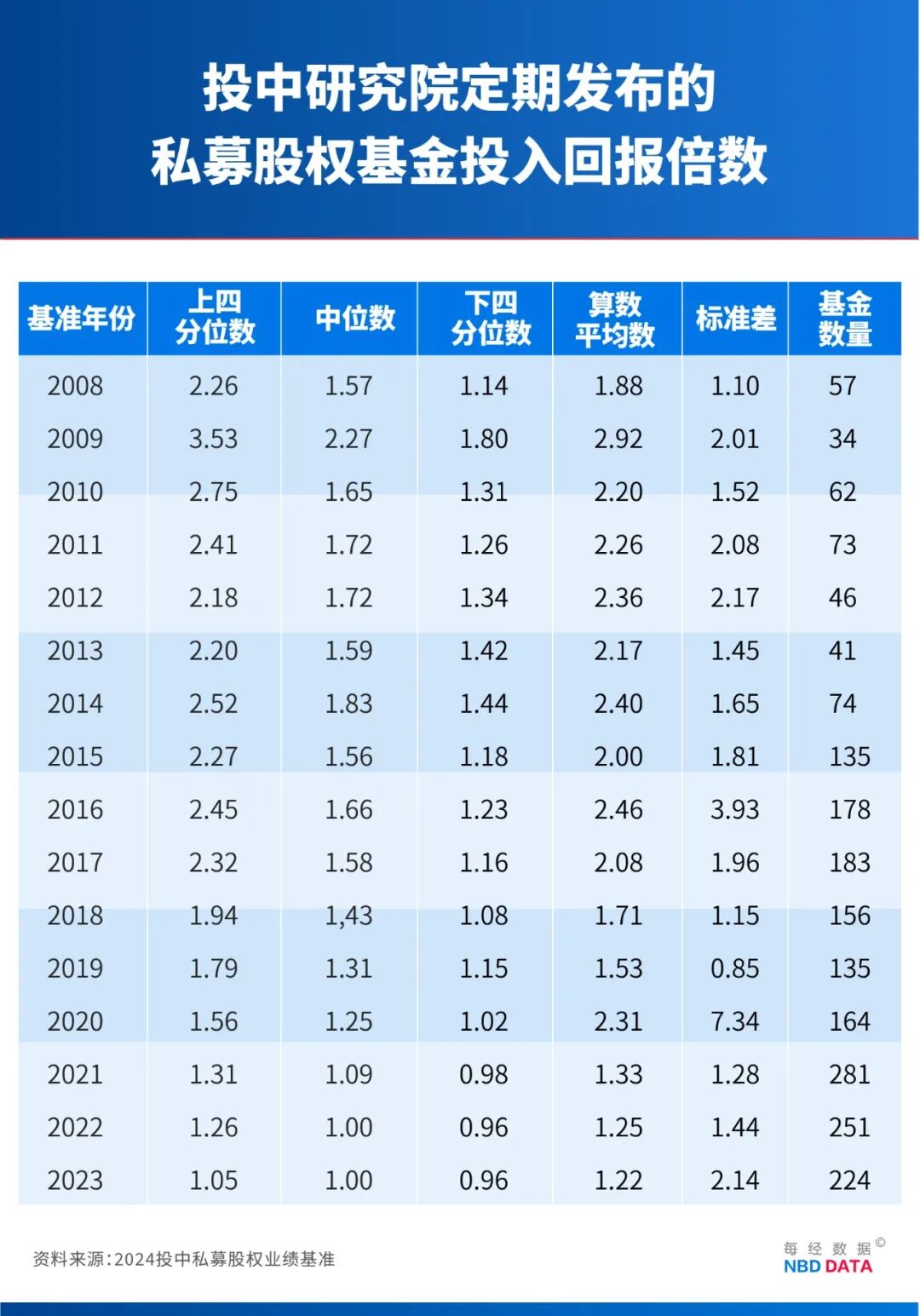
According to the data statistics from the China Venture Capital Research Institute, from 2008 to now, the TVPI of the private equity funds included in the statistics has shown a downward trend in recent years. The arithmetic average from 2021 to 2023 was 1.2 - 1.3. This means that the overall industry is at the critical point of break - even, which is significantly lower than the previous level of generally over 2 times.
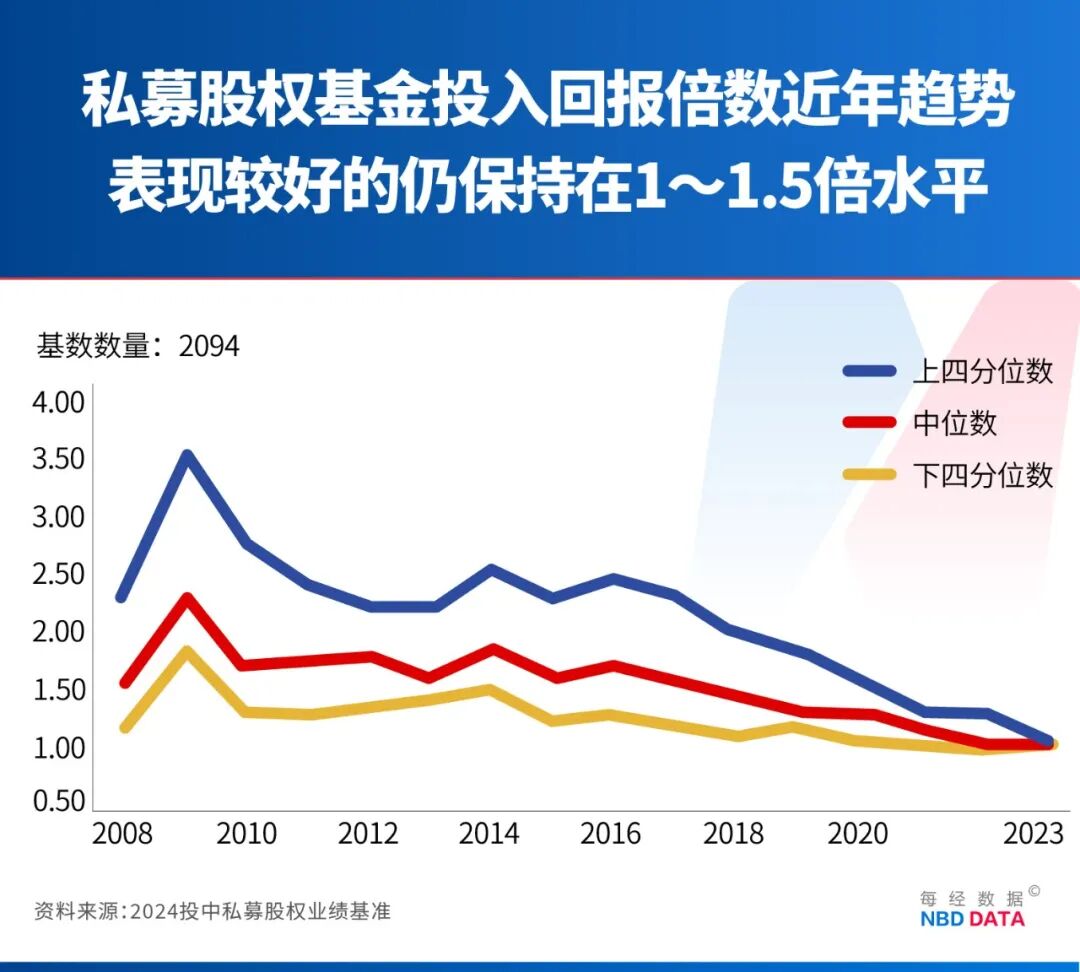
Looking at the better - performing funds, that is, the upper quartile, the level has been maintained at 1 - 1.5 times in recent years. This means that although the overall profit margin of private equity funds has been significantly narrowed compared with the previous return level of more than 2 times, the top 25% of high - quality private equity funds in the industry can not only fully preserve the principal but also achieve a capital appreciation of 0 - 50%.
It should be noted that although this performance benchmark is mainly based on the statistics of RMB private equity funds, it still has reference value for judging the investment performance of these US dollar funds.
On the one hand, the challenges faced by the current private equity industry, such as valuation adjustments and narrowing exit channels, are global. The performance trends of RMB and US dollar funds are affected by these common industry factors and show a consistent downward feature. On the other hand, this benchmark also includes some US dollar funds with China as the main investment destination, which has a certain degree of compatibility with the market background of this investment. In addition, as a general core indicator for measuring the returns of private equity funds, the numerical changes of TVPI reflect the overall profitability of the industry and are an important basis for comparing the performance of funds in various currencies.
Since the net return rate needs to deduct other costs such as management fees, performance fees (Carry), and custody fees compared with TVPI, the relevant figures will further decline. From this perspective, the overall performance of the products under several star institutions bought by Fang Cheng is about at the industry median level.
3
The Dispute May Lie in the Serious Mismatch between Fund Performance and
the Lock - up Period Agreement
Recently, the journalist from National Business Daily interviewed several people in the wealth management industry regarding the above - mentioned incident.
In the view of a relevant person in charge of the wealth management department of a foreign - funded securities firm, "When Goldman Sachs made such an asset allocation for him at that time, it may have been because they saw that he had already achieved a diversified allocation in other financial institutions, so they focused on their characteristic products."
However, Fang Cheng told the journalist that before buying the above - mentioned private equity products from Goldman Sachs around 2021, he had never been exposed to private equity products. "I can definitely say that I had never touched private equity products before. And Goldman Sachs recommended me to allocate all high - risk products with long lock - up periods, without diversifying the risk by allocating some medium - and low - risk products."
However, even a professional institution like Goldman Sachs can make mistakes. According to Fang Cheng's assistant's recollection: "When I communicated with a Goldman Sachs staff member in February this year, regarding the huge loss of the Northvolt project, a Goldman Sachs staff member responded that the external reasons for the project's failure were the harsh environment in the Arctic Circle with almost no sunlight in winter, increased competition from Chinese enterprises, and the shrinking European market. We tried to rescue the company, but finally gave up. So in the future, we at Goldman Sachs should avoid investing in projects such as energy and batteries, as these are not our strong suits. This is a big lesson for us, and we need to be more cautious in these fields in the future."

There is almost no sunlight in the severe Arctic winter, and dog sleds were once the traditional means of transportation. What would happen if electric vehicles were used here? Source of the picture: Generated by AI
However, such a response did not convince Fang Cheng.
The journalist learned that 5 out of the 8 products bought by Fang Cheng charge an annual management fee of 1.5% - 2% based on the committed capital (i.e., the subscribed scale), resulting in a considerable annual management fee expenditure for him.
"The mainstream charging method for current US dollar private equity funds is the paid - in system, which only charges management fees on the capital actually invested in the project. The model of charging based on the subscribed scale has gradually withdrawn from the market." He Jun, a senior partner at Yingke Law Firm, analyzed to the journalist. Even if a small number of products use the subscribed system, the industry - wide average fee rate is generally below 1.5%. The fee rate of the products invested by this investor is significantly higher than the industry convention. Li Na, a partner at Shanghai Hansheng Law Firm, further added that in the projects she has been involved in in the past five years, 99% use the paid - in system, and state - owned enterprises and state - backed capital clearly reject the subscribed system clause.
However, some industry insiders told the journalist that in the PE products of large foreign investment banks serving ultra - high - net - worth clients, it is quite common to pay management fees based on the committed investment amount, and a management fee rate of 1.5% - 2% is also within a normal range.