When Li Xiang swore, the "stealth battle" among Chinese automakers was completely laid bare.
If we look at two recent events in the automotive industry together, most people will notice a hint of "abnormality".
On one hand, almost all car companies have chosen to manufacture "larger-sized models" at the same time. Six-seater SUVs and flagship MPVs are equipped with refrigerators, color TVs, and large sofas in their interiors, becoming more and more luxurious. It seems that overnight, Chinese cars have collectively entered the "land first-class cabin era".
On the other hand, the public opinion field is getting more and more out of control. There are things like black water armies, smear campaigns, attacks and defenses in the comment sections, and even the founders of car companies personally getting involved in "verbal battles".
On April 11th, Li Xiang's obviously emotional WeChat Moments post completely broke the ice. He directly pointed out that some brands organized black water armies, fabricated information, and systematically attacked the comment sections. This is not an ordinary complaint, but a landmark moment - the competition in the Chinese automotive industry has been upgraded from a battle of production capacity and product strength at the manufacturing level to an all-round and three-dimensional battle without boundaries.
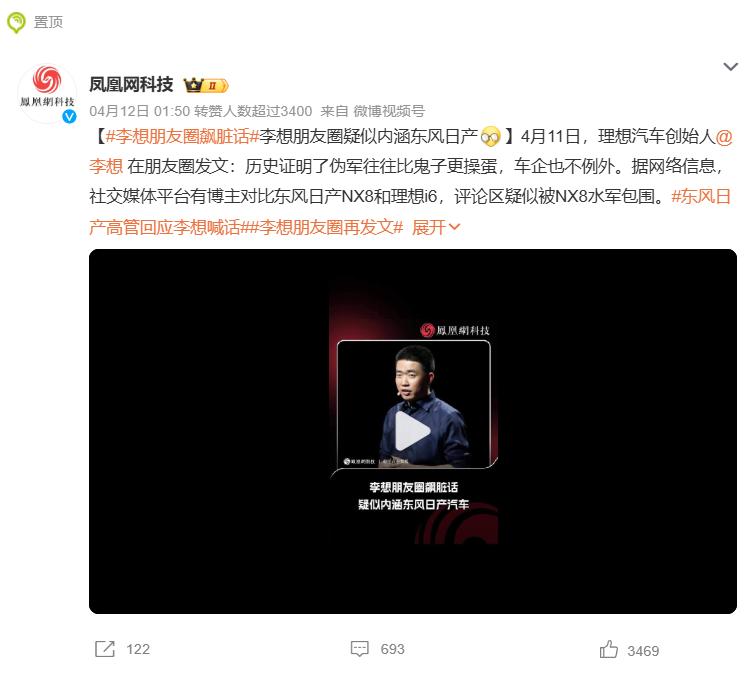
Image source: Weibo
Many people will wonder: Why is the industry making more and more high-end and rational products on one hand, while using more and more "irrational" competitive means on the other hand? In the eyes of users, the products of car companies are getting more and more advanced, but the competition between car companies is getting more and more "low"?
These two things seem contradictory, but in fact, the answer is almost obvious. That is, in the area of homogeneous competition on the product side, car companies seem to be unable to find better marketing breakthrough points or more attractive product highlights. They can only compete by showing their worst sides, making potential users think that the other side is worse.
01 Bigger is Better
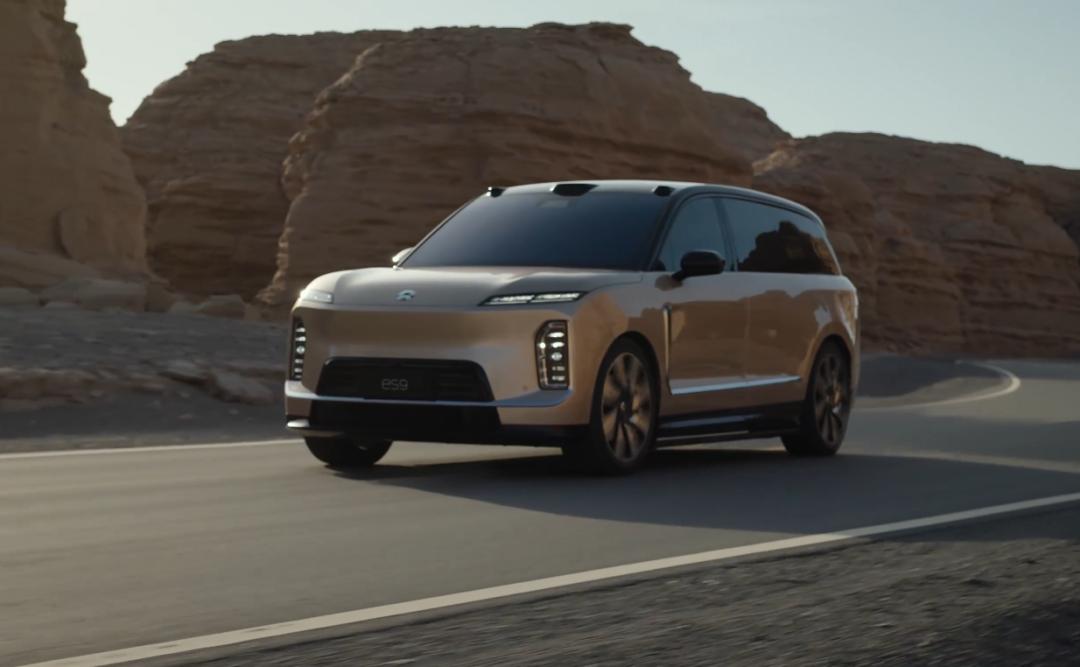
When models like the Wenjie M9, Li L9, and the upcoming NIO ES9, as well as the possible large SUV from Xiaomi, appear intensively, most consumers understand it as a consumption upgrade. However, if we consider the three factors of technology, business, and user needs together, we will find that producing larger-sized smart cars is almost the ultimate solution for all electric vehicle companies.
In the era of electric intelligence, it is becoming more and more difficult for small-sized models to form a stable profit model. Larger-sized models mean higher gross profit margins. Because the costs of vehicle batteries, intelligent driving, lidar, and high-computing chips cannot be significantly reduced under the current technological background.
Small-sized models are destined not to be able to accommodate more "non-essential items" such as "refrigerators, color TVs, and large sofas" that can increase added value. As a result, no matter which manufacturer produces small-sized electric intelligent models or how they are modified, it is impossible to sell them at a high price of nearly 400,000 RMB like the Ultimate E jointly launched by smart and Brabus.
More importantly, if someone is willing to spend 400,000 RMB to buy a micro-electric vehicle that can accelerate from 0 to 100 km/h in 10.9 seconds and has a range of 125 km today, it would be as funny as spending 40,000 RMB to buy a feature phone that can only make calls and send text messages and claiming that this is the end of technological progress.
Even the most basic version of the Wuling Hongguang Mini EV can have a range of 120 km. Although there is no official data on its 0 - 100 km/h acceleration, public data shows that it may be around 15 seconds. The key is that its starting price is less than 40,000 RMB. Vertu, which once sold feature phones for tens of thousands of RMB each, now only launches smart phones. Who in the world would be willing to accept technological regression?
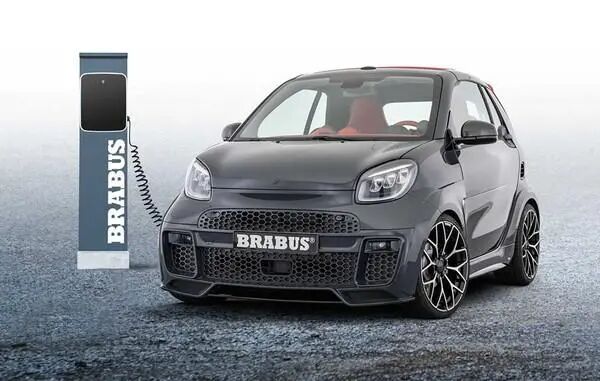
Image source: Internet
It can be seen that the inability to increase the unit price of small-sized models is a major drawback. Developing such models is destined not to increase the company's gross profit margin. Moreover, with the unremitting efforts of car companies in recent years, the skateboard chassis of electric vehicles has released more space. Motors with greater power and better stability have solved the problem of insufficient power when the size of traditional fuel vehicles is slightly increased.
It can be said that in the era of electric motors, large cars are no longer a burden, but have become a synonym for efficiency and the foundation for car companies to achieve higher gross profit margins. Even smart, which is fond of small-sized models, has released a CG image of a large car, which has been widely reposted by many bloggers.
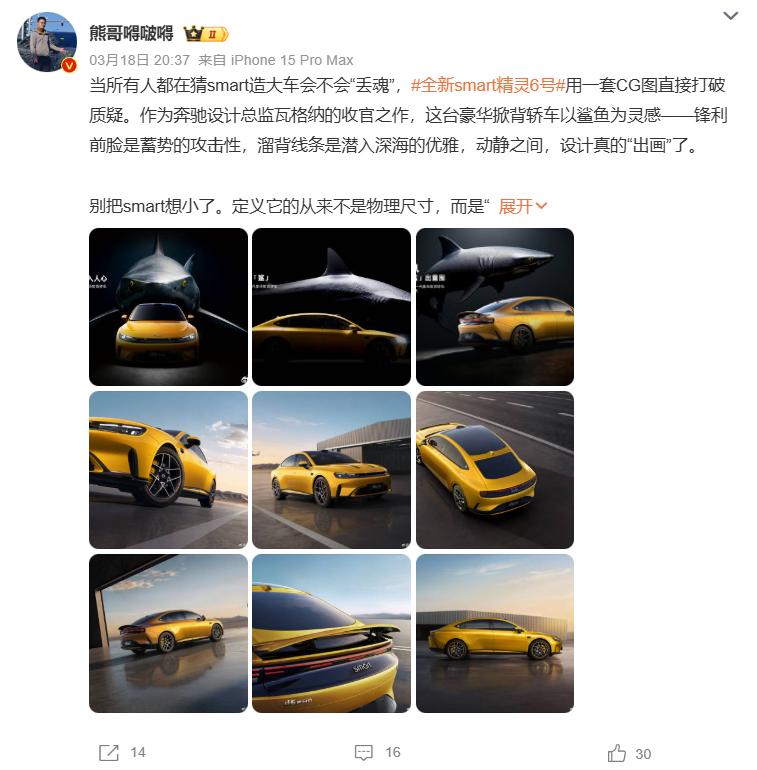
Image source: Weibo
Finally, from the perspective of user needs, the trend that larger-sized models are more popular is irreversible. The family structure in China is changing rapidly. It has become normal for families with two or three children to travel with their parents, and the demand for long-distance travel has increased significantly. A five-seater car is starting to seem cramped, while a six-seater SUV or MPV can solve all the problems of space, comfort, and functionality at once.
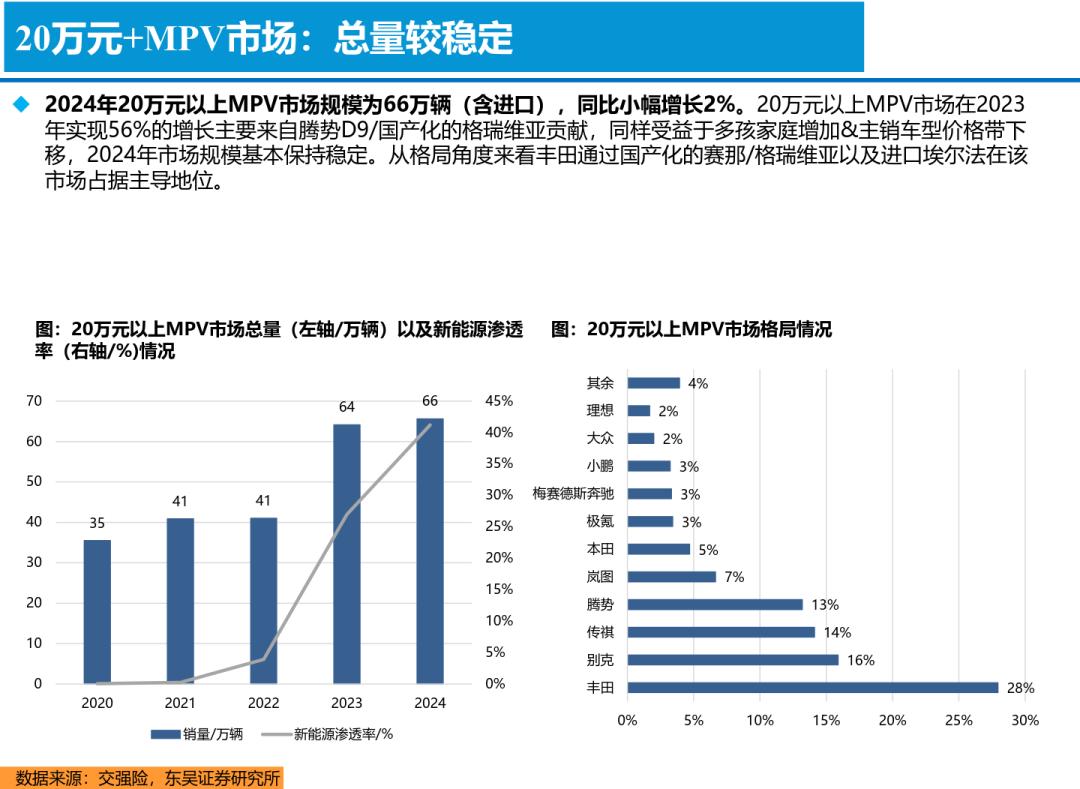
More importantly, users attach great importance to the rear-seat experience - the seats should be able to recline, and it is best to have a screen, a refrigerator, a sound system, and a sense of privacy. These needs can only be met by large cars in essence. Thus, the "three-row space" has gradually changed from an initial marketing concept to a real rigid demand.
However, when all car companies launch larger-sized models from the perspective of users, new problems also emerge - the differentiation rate of all "large cars" is approaching zero.
02 Similar Configurations Make It Hard to Tell the Winners, and Cognition Dominates the Outcome
After looking at several large-sized models, it is not difficult to find that most of them have almost the same interior except for "obvious" differences in appearance.
They all have six or seven-seater layouts, rear large screens, zero-gravity seats, high-level assisted driving, and they all like to use the marketing narrative of "mobile living rooms". The configurations of large-sized models are becoming more and more similar, the user experiences are on par, and it is becoming more and more difficult for ordinary users to perceive the differences.
When the differences of a type of product cannot be objectively reflected through data, users need to make subjective judgments to distinguish. As a result, the basis for users' decision-making begins to change, shifting from "functional comparison" to "cognitive judgment".
Cognition, as a purely subjective judgment standard, is the most easily manipulable variable. This is why the public opinion war has become extremely important, and it is also the important reason why Li Xiang, the founder of Li Auto, couldn't help but speak out his mind even by swearing in his WeChat Moments.
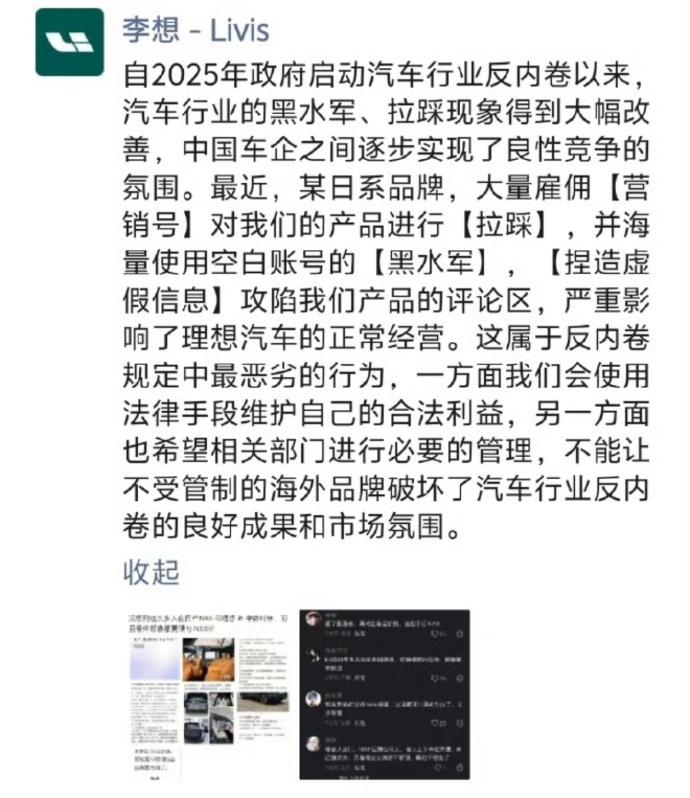
Image source: Internet
When the product differences are not enough to make a significant gap, influencing users' cognition is equivalent to directly influencing sales. A wave of organized negative information can change the judgment path of potential users in a short time; a "malicious rhythm" in the comment section can significantly reduce the conversion rate of car companies' marketing; once a label (such as "unsafe", "false advertising", "unreliable intelligent driving") is planted, it will germinate in consumers' minds and thus affect the sales of the brand.
From this perspective, Li Xiang's anger is actually a "industry signal" - the competition has expanded from the product level to the level of public opinion and cognition, and it is becoming more and more intense and systematic.
If we switch the perspective to the capital market, this pressure will be more intuitive. Since the Reuters photo of the NIO ES9 was released in September 2025, the stock price of Xiaomi Group has fallen by 41.99%, Li Auto has fallen by 17.41%, XPeng Motors has fallen by 20.49%, and NIO has almost remained flat.
This is not a simple market fluctuation, but a clear repricing process. That is, capital is no longer willing to pay for "stories", but has begun to examine the "fulfillment ability" of car companies with more stringent standards.
And the cruel part is that all four of these companies have firmly done what they think is right.
03 No Company Has Taken the Wrong Path, but Some Companies May Be Eliminated First
Looking back at the above companies, Xiaomi has quickly leveraged the market with its brand power and traffic ability, making its cars a hot topic. This is something that many traditional car companies cannot do. However, the problem is that the expectations for each new car are set too high. Once the product rhythm, delivery performance, or subsequent models fail to meet expectations, the stock price will quickly correct. In essence, it is still going through a difficult transition from the "Internet logic" to the "manufacturing logic".
More importantly, there were Reuters photos of the NIO ES9 and Xiaomi's recall incident in September last year. Xiaomi did not focus on how to solve the negative impact brought by the recall incident in each of its press conferences. There will be an opportunity to elaborate on this part later.
Li Auto with its L9 has precisely defined the family car in China and has taken the concept of "larger-sized models = the best solution for families" to the extreme. This shows strong product insight and brand marketing labels. However, its problem is that it is overly concentrated in a single track. When all competitors enter the large car market at the same time, it will become the most prominent "target" and the most easily besieged and replaced one.
XPeng has continuously made heavy investments in intelligent driving, with a clear technical route. It is one of the few players that truly regards software capabilities as the core barrier. However, so far, XPeng's technological advantages have not been fully translated into user perception, resulting in a discounted market value judgment.
NIO has established long-term advantages in brand, service, and system capabilities, especially in the battery swapping system, which has formed a differentiated moat. However, its challenges are also obvious - the cost structure is too heavy, and the profit pressure persists. In the stage when capital becomes more rational, this problem will be continuously magnified.
Looking at these four companies together, it is not difficult to find that they are almost all doing the "right thing" in the context of their own company's narrative. However, in a highly homogeneous track, doing the "right thing" can no longer guarantee that a company can survive or thrive. What really determines the outcome is who has fewer weaknesses and who can withstand long-term high-pressure competition.
And this is exactly the soil for the frequent occurrence of "dirty tricks".
When the product differences are insufficient, user growth slows down, and capital expectations tighten, the boundaries of competition will be continuously broken. From price wars, to configuration wars, to public opinion wars, and even more hidden gray means, all will become part of the "toolbox". This is not a problem of a single company, but a pain that the entire industry must go through after entering the "stock competition" stage.
In other words, the Chinese automotive industry is experiencing a transition from the "incremental dividend" to the "competition for the stock". In the incremental era, everyone was competing on who could run faster; in the stock era, the competition is on who can survive longer.
The fact that car companies have all entered the "large car strategy" is the core carrier of this transition. Because it simultaneously bears profits, brands, and technologies, and is one of the few optimal solutions that can solve multiple problems at the same time. However, precisely because everyone has chosen this path, the competition has been extremely compressed into the same space. Any small difference will be infinitely magnified, and any mistake may be exploited by opponents.
This also explains why consumers can see two extreme scenarios at the same time: on one hand, there are more and more luxurious, comfortable, and "rational" products; on the other hand, there are more and more intense, and even emotionally charged, competition methods. This is not a contradiction, but two results under the same logic.
In the future, this trend will only be further strengthened. Consumers will see more larger-sized SUVs, more high-end MPVs, and more exaggerated configurations. At the same time, they will also see more intense price games, more complex public opinion attacks and defenses, and more frequent market fluctuations.
For users, this is a golden age of "excessive configuration and upgraded experience"; but for car companies, this is a life-and-death stage with extremely low tolerance for mistakes.
So, instead of asking "What's wrong with the automotive industry?", we might as well ask: When everyone is doing the same right thing, where will the competition take place? The answer is clear - everywhere outside the product.
Li Xiang's WeChat Moments post is just a concentrated manifestation of this change. The real change is that the Chinese automotive industry is no longer just a simple manufacturing industry, but a complex battlefield that integrates technology, capital, public opinion, and brand. On this battlefield, building cars is just an admission ticket, and the real competition has just begun.
Conclusion
The competition has actually changed the moment all car companies started making "large cars".
On the surface, the size is increasing, the configurations are getting more abundant, and the prices are rising; but at a deeper level, a more cruel fact is happening - the products are becoming more and more similar, but the outcome is increasingly determined by factors outside the product. So, on one hand, we see the continuous evolution of "mobile living rooms" like the Wenjie M9 and Li L9; on the other hand, Li Xiang has to personally get involved to fight the invisible public opinion and cognitive war.
This is not that the industry has "gone bad", but that the rules of the game have changed.
When the differences disappear, cognition becomes a weapon; when the growth slows down, slander will appear; when everyone is running on the same "large car + high-end + intelligent" path, what really makes the difference is no longer who is bigger or more luxurious, but who can control users' minds and who can withstand long-term consumption.
This is also why, even though they have all bet on the right direction, Xiaomi Group,