The "profitability" of 15 automakers has diverged, with 4 reporting net profits exceeding 10 billion yuan.
As of April 13th, major domestic listed automobile manufacturers have disclosed their annual reports for 2025.
In the past year, competition in the automotive industry has become increasingly fierce. Among the listed automobile manufacturers that have released their annual reports, BYD continued to lead the industry in terms of revenue and net profit. In 2025, it achieved a revenue of 803.96 billion yuan; the net profit attributable to the parent company was 32.62 billion yuan. However, due to intensified industry competition and R & D investment of 63.4 billion yuan, the net profit attributable to BYD's parent company decreased by 18.97% year - on - year compared with last year.
Great Wall Motor and Changan Automobile also saw an increase in revenue but a decrease in profit. Great Wall Motor's revenue in 2025 was 222.82 billion yuan, a year - on - year increase of 10.2%. However, the net profit attributable to the parent company was 9.87 billion yuan, a year - on - year decrease of 22.07%. Changan Automobile's revenue was 164 billion yuan, a year - on - year increase of 2.67%, but the net profit attributable to the parent company decreased by 44.34% to 4.08 billion yuan.
In addition, in 2025, GAC Group and Li Auto recorded a decline in both revenue and profit. Although NIO and XPeng achieved single - quarter profitability, they have not yet emerged from the annual loss.
In 2025, the profitability of automobile manufacturers showed differentiation. Chery Automobile, SERES, Geely Automobile, SAIC Group, VOYAH, and Leapmotor recorded double - digit growth in both revenue and profit. Among them, Chery Automobile, which disclosed its annual report for the first time after listing on the Hong Kong Stock Exchange, became a dark horse thanks to its outstanding overseas business. Its annual revenue last year was 300.29 billion yuan, and its overseas revenue reached 157.42 billion yuan; the net profit attributable to the parent company was 19.51 billion yuan, a year - on - year increase of 36.1%.
Yang Jing, a director of corporate ratings in the Asia - Pacific region at Fitch Ratings, told Time Finance: "The reasons for the differentiation of automobile manufacturers' profits are complex, stemming from the superposition of multiple structural factors. The profits of traditional automobile manufacturers are related to the degree of new - energy transformation and the exposure to overseas markets: Automobile manufacturers with a large - scale new - energy vehicle business and a relatively high proportion of overseas sales have relatively better profitability. Some state - owned automobile groups with significant losses in their new - energy vehicle business or whose joint - venture automobile manufacturers are dragged down by the sharp decline in fuel - vehicle sales and thus have a sharp reduction in investment income have a relatively large decline in overall profitability. The profitability of new - force automobile manufacturers is more affected by technology routes, sales volume, cost control, and diversified profit sources, with large individual differences and high volatility."
Profits of Many Automobile Manufacturers Lag Behind Revenue Growth
In 2025, four automobile manufacturers had revenues exceeding 300 billion yuan, and four also had net profits attributable to the parent company exceeding 10 billion yuan.
Among them, BYD had the highest revenue. Its annual revenue increased to 803.96 billion yuan, reaching a new high, a year - on - year increase of 3.46%. SAIC Group's revenue in 2025 was 656.24 billion yuan, a year - on - year increase of 4.57%. Geely Automobile's revenue in 2025 was 345.23 billion yuan, a year - on - year increase of 25%. Chery Automobile's annual revenue was 300.29 billion yuan, a year - on - year increase of 11.3%.
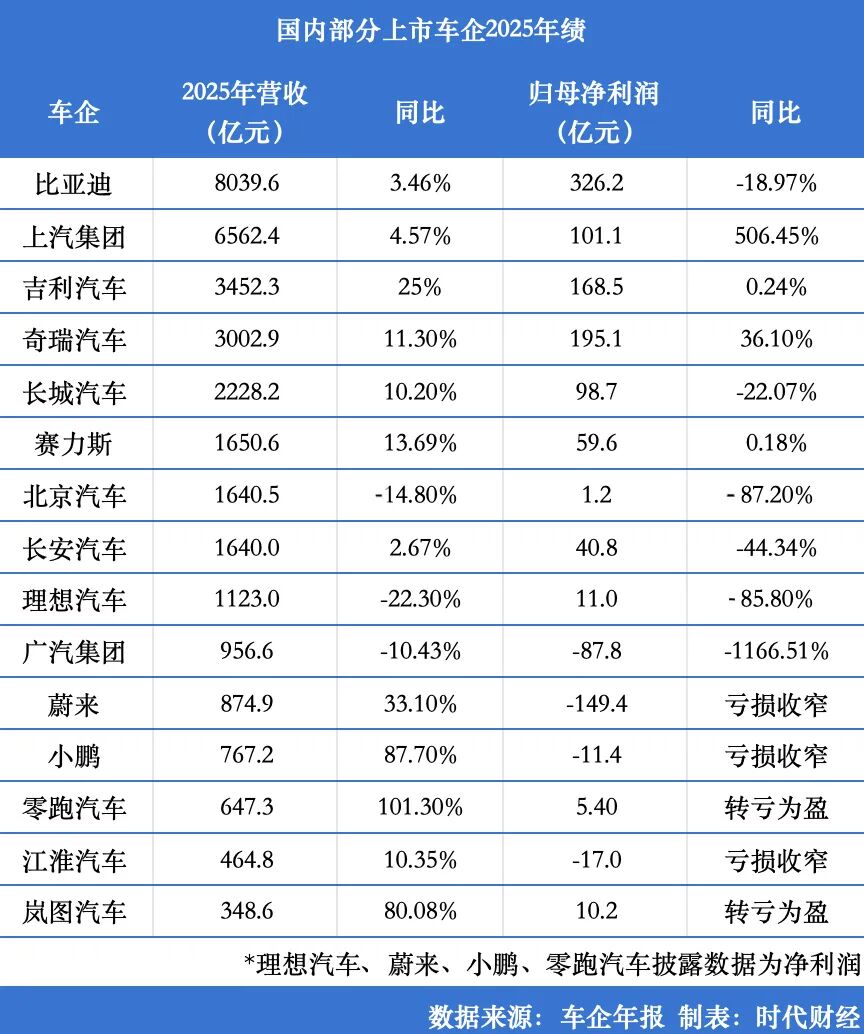
In addition, among the listed automobile manufacturers counted by Time Finance, except for the above - mentioned four, Great Wall Motor, Changan Automobile, SERES, NIO, XPeng, Leapmotor, etc. all achieved year - on - year revenue growth. However, not many automobile manufacturers saw their profit growth outpace revenue growth. The reality faced by most automobile manufacturers is that while the revenue scale continues to expand, the growth rate of net profit slows down, or even declines instead of rising.
For example, Great Wall Motor's revenue in 2025 was 222.82 billion yuan, a year - on - year increase of 10.2%. However, the net profit attributable to the parent company was 9.87 billion yuan, a year - on - year decrease of 22.07%.
Great Wall Motor stated in its annual report that in 2025, the company achieved year - on - year growth in sales volume and operating income. At the same time, it accelerated the construction of a new channel model to directly connect with users and increased the publicity of new models and technologies and brand promotion. The increased investment led to a decline in profits.
In addition, BYD's net profit attributable to the parent company decreased last year, reaching 32.62 billion yuan, a year - on - year decrease of 18.97%.
Geely Automobile's net profit attributable to the parent company in 2025 was 16.85 billion yuan, a slight year - on - year increase of 0.24%.
During the same period, SERES' net profit attributable to the parent company was 5.96 billion yuan, a slight year - on - year increase of 0.18%.
The reasons include not only the intensified competition in the new - energy vehicle market, the rising costs of the supply chain, and the concentration of profits in upstream core component enterprises, but also the large - scale R & D investment of the above - mentioned automobile manufacturers, which has affected their profitability.
In 2025, BYD's R & D investment was 63.4 billion yuan, a year - on - year increase of 17%. Geely Automobile's R & D expenses were 17.6 billion yuan, a year - on - year increase of 28.75%. SERES' R & D investment was 12.51 billion yuan, a year - on - year increase of 77.4%.
"The strategy of leading self - owned brand automobile manufacturers to increase R & D investment and adhere to full - stack self - research may put pressure on short - term profitability," Yang Jing said. "However, in the medium and long term, compared with enterprises that rely on third - party supplier solutions, these enterprises will have stronger control over supply - chain costs, which is beneficial to their medium - and long - term profitability. The key to profitability is the platform - based reuse of technology and the expansion of production and sales scale, so as to reduce the R & D amortization per vehicle."
NIO and XPeng Achieved Quarterly Profitability for the First Time
In terms of new - force automobile manufacturers, in 2025, NIO, XPeng, Li Auto, and Leapmotor spared no effort in the pursuit of profitability.
Specifically, in 2025, Li Auto achieved annual profitability for the third consecutive year, Leapmotor achieved annual profitability for the first time, and NIO and XPeng achieved quarterly profitability for the first time in the fourth quarter of last year.
Li Auto led the new - force automobile manufacturers in terms of revenue and profit. In 2025, it recorded a revenue of 112.3 billion yuan, but a year - on - year decrease of 22.3%. The net profit was 1.1 billion yuan, a significant contraction compared with the net profit of 8 billion yuan in 2024.
Li Xiang, the CEO of Li Auto, reflected on sales during the 2025 earnings conference call. He said, "Our biggest problem in the past was managing the direct - sales system in the way of dealer management. The core of the direct - sales system is to manage stores with the store as the core. Without dealers, store management should be our own responsibility."
In 2025, Li Auto delivered 406,300 vehicles, a year - on - year decrease of 18.8%. To boost sales, since the third quarter of last year, Li Auto has explored how to open stores of higher quality, how to manage stores well and motivate store managers, and how to effectively empower and train the team.
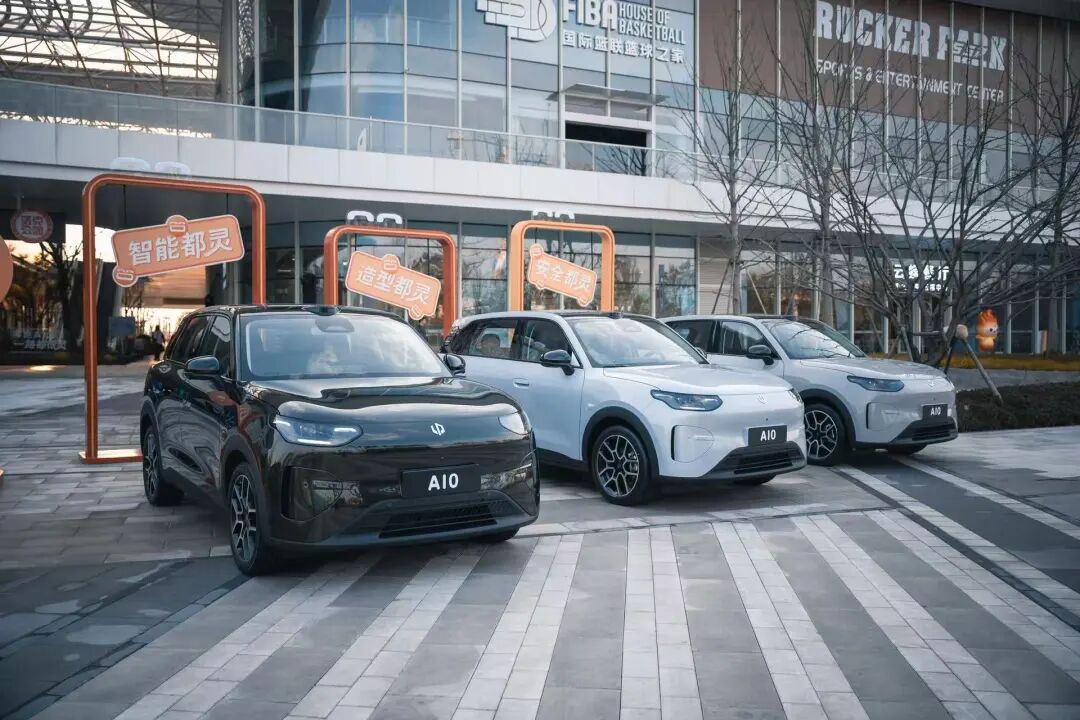
Leapmotor became the second new - force automobile manufacturer to achieve annual profitability. Last year, its revenue reached 64.73 billion yuan, and its net profit turned positive for the first time, reaching 540 million yuan.
Source: Leapmotor
Leapmotor sold 597,000 vehicles last year. This year, Leapmotor has set a goal of selling 1 million vehicles and achieving a net profit of 5 billion yuan. This means that with the sales volume nearly doubling compared with 2025, the net profit needs to increase nearly nine - fold.
Zhu Jiangming, the founder, chairman, and CEO of Leapmotor, told Time Finance in an interview in March: "In terms of profit, the effect brought by the scale of any company is obvious. Because many regular expenses are basically fixed. For example, Leapmotor needs more than 4 billion yuan in R & D expenses every year, which was brought by 600,000 vehicles in 2025. If the target in 2026 is 1 million vehicles, it doesn't mean that our R & D expenses will increase proportionally. The scale effect it brings can reduce R & D expenses, marketing expenses, and general management expenses, and these will not increase proportionally. The space brought by these is our opportunity for profit."
NIO, which achieved quarterly profitability for the first time (with a net profit of 280 million yuan in the fourth quarter of 2025), also aims to achieve annual profitability in 2026. In 2025, NIO's revenue was 87.49 billion yuan, a year - on - year increase of 33.1%. The net loss was 14.94 billion yuan, narrowing compared with the previous year.
In 2025, NIO implemented the CBU (full - staff operation mechanism), and the cost control achieved remarkable results. NIO stated in its annual report that the company's organizational optimization led to a decrease in the cost of R & D function personnel, and due to the different development stages of new products and technologies, the design and development expenses decreased accordingly.
In the fourth quarter of 2025, NIO's R & D expenses were 2.03 billion yuan, a year - on - year decrease of 44.3% and a quarter - on - quarter decrease of 15.3%.
XPeng also turned a profit in the fourth quarter of 2025, recording a net profit of 380 million yuan. In 2025, XPeng's revenue was 76.72 billion yuan, a year - on - year increase of 87.7%. The annual net loss was significantly narrowed to 1.14 billion yuan.
In the view of He Xiaopeng, the chairman and CEO of XPeng Group, XPeng's phased profitability stems from a business model driven by technological leadership, which is a different profit path from traditional automobile manufacturers.
The cooperation with Volkswagen brought XPeng 8.34 billion yuan in service and other revenues, a year - on - year increase of 65.6%, and achieved a service and other profit margin as high as 68.2%.
Yang Jing believes that the profitability of new - force automobile manufacturers is greatly affected by the new - car product cycle, technology - route selection, and changes in market preferences, with high volatility. This year, new - energy automobile manufacturers will face the dual pressures of a slowdown in the growth rate of domestic new - energy vehicle demand and rising supply - chain costs (such as chips and batteries), and there is still some uncertainty about the continuous improvement of profitability.
Searching for the Second Growth Curve
Currently, the downward pressure on the profitability of the automotive industry continues.
Data disclosed by Cui Dongshu, the secretary - general of the China Passenger Car Association, shows that the profit margin of the automotive industry in 2025 was 4.1%. Compared with the average profit margin of 5.9% of downstream industrial enterprises, the profit margin of the automotive industry is still relatively low. From January to February this year, the profit margin of the automotive industry was only 2.9%, still at a historical low.
In the past three years, the fierce price war in the automotive industry has suppressed the industry's profitability. Whether to pursue sales volume or profit has also been a question that automobile manufacturers have been thinking about for a long time.
In an interview in March, He Xiaopeng talked about the strategic change in internal thinking: from "scale is important" to "sales volume is important, but sales volume alone cannot lead to success."
He further said: "I think that starting from last year, in the next four or five years, it will be the most critical four or five years for the transformation of the Chinese automotive industry. Scale is important. However, scale is not absolute. There is not much value in a lot of scale. High - quality scale is the most valuable." He believes that different enterprises may choose different paths. Some enterprises may need to achieve scale first to achieve high - quality development, while others may start with high - quality development from the beginning.
Against the background of pressure on car - selling profits, automobile manufacturers are also actively looking for a second growth curve.
He Xiaopeng said bluntly: "I think that current automobile companies do not have a good business model. They are all in a highly competitive model. In essence, the automotive industry is not a particularly good business model in the hardware field, which is also a fact I have seen in recent years." He believes that now we need to think more about how an automobile company can become a technology company in the future.
XPeng chose to bet on physical AI. In 2025, XPeng's R & D investment in AI reached 4.5 billion yuan. In 2026, in addition to vehicle R & D, XPeng's R & D investment related to physical AI will increase to 7 billion yuan.
According to XPeng's vision, XPeng's physical - world AI base model will evolve rapidly and can support AI cars, Robotaxis, and humanoid robots across domains. "In my opinion, R & D in AI not only helps to improve the company's advantages but also will create huge business returns in the short, medium, and long terms," He Xiaopeng said.
Li Xiang also mentioned during the 2025 earnings conference call that 2026 will be a crucial year for Li Auto to evolve into an "embodied - intelligence" enterprise. "Facing the increasingly competitive new - energy vehicle market, we will strive to raise the technological moat and complete the transformation from a smart - electric vehicle company to an embodied - intelligence enterprise to establish a competitive advantage in the next stage."
In 2025, Li Auto's R & D investment reached 11.3 billion yuan, of which 50% was related to AI. This investment strategy will continue in 2026.
In addition, more automobile manufacturers have jointly pinned their hopes for profit growth on the overseas market.
In 2025, Chery Automobile was the automobile manufacturer with the largest number of exported cars. Its overseas car sales reached 1.294 million, accounting for 49.2% of the total annual sales of 2.631 million.
It is worth mentioning that Chery Automobile's overseas revenue reached 157.42 billion yuan, accounting for 52.4% of the total revenue, supporting half of the company's business. Chery Automobile's total revenue was 300.29 billion yuan, a year - on - year increase of 11.3%. During the same period, the net profit attributable to the parent company was 19.51 billion yuan, a year - on - year increase of 36.1%. It is one of the few listed automobile manufacturers with double - digit growth in both revenue and profit.
BYD also performed well in the overseas market. In 2025, BYD's vehicle exports