One-person companies start making money quietly: Expected annual income of 10 million yuan
On April 10, the 2026 Zhongguancun Artificial Intelligence OPC Ecosystem Conference was held in Haidian, Beijing. This article was co - created by Pencil News and Krypton Star Innovation Service, the organizer of the conference, to explore new entrepreneurial opportunities in OPC.
One - person companies are radically rewriting the way of entrepreneurship.
Medvi, an online medical service platform, with only two people, has a revenue of $400 million, and its expected revenue in 2026 can reach $1.8 billion, becoming a "one - person unicorn".
On Alibaba.com, 30% - 40% of the merchants are already "one person running a company": using AI agents to handle customer service, operations, and marketing, and machines have taken over more than half of the daily work.
This is what is happening with one - person companies, or OPC (One Person Company).
"The good OPC companies I've seen can already achieve annual revenues of millions." Zhou Ming, the CEO of Lanzhou Technology, told Pencil News. Another company, Suyuan Matrix, with a team of seven people, is expected to have an income of 10 million this year.
A decade ago, the slogan of "mass entrepreneurship and innovation" has taken on a new form today: OPC has become the first step in entrepreneurship.
Especially in Haidian, Beijing, at the 2026 Zhongguancun Artificial Intelligence OPC Ecosystem Conference, it was announced that funds would be invested, computing power would be supplemented, and orders would be allocated, breaking through the barriers to entrepreneurship.
Pencil News recently interviewed three guests at the conference to discuss the greatest opportunities in OPC at present. The following are the highlights.
1. Which OPCs are making money?
Those selling courses, those deeply involved in industrial scenarios, and those developing super - individual products.
2. What are the specific business directions of OPC?
AIGC, productivity tools, smart hardware, and educational products.
3. How do OPCs find customers?
Look for small, niche scenarios that are very specific but have clear value (customers are willing to pay).
4. What is the current income situation of domestic OPCs?
The best - performing ones have an annual income of millions, and 10 million is a threshold.
5. Why hasn't the domestic OPC industry exploded yet?
People with needs can't find the technology, and those with technology don't know where the needs are.
Good OPC entrepreneurs: Annual income of millions
Zhou Ming, CEO of Lanzhou Technology, a natural language processing scientist, and former deputy dean of Microsoft Research Asia
Lanzhou Technology provides an operating base for intelligent agents and offers off - the - shelf standardized products such as think - tanks and intelligent meetings.
Is OPC just hype, or is it a historical inevitability? In my opinion, the answer is the latter - the core reason lies in the real improvement of AI capabilities.
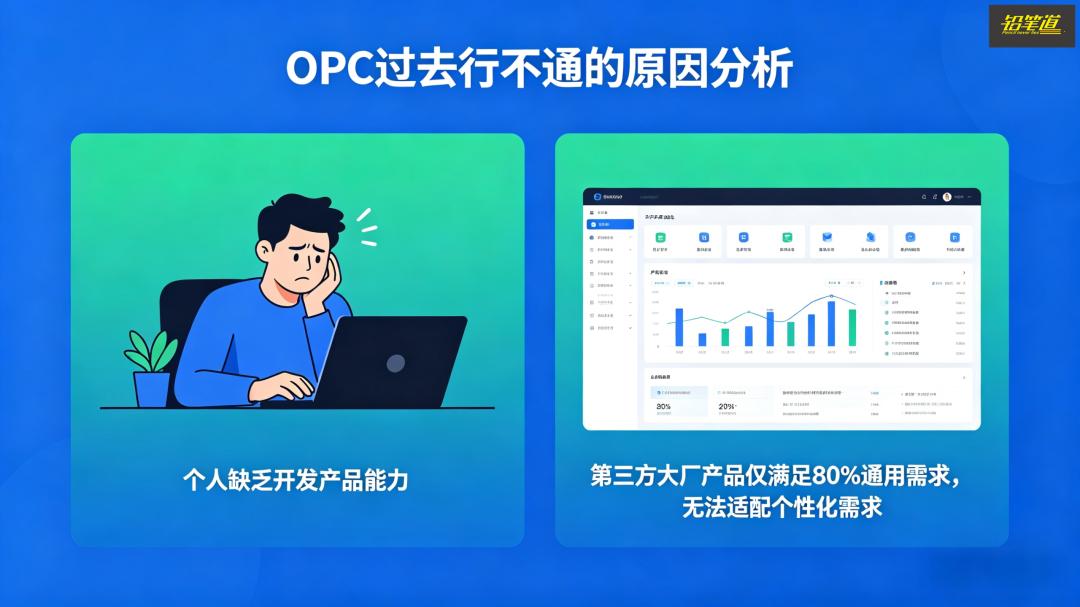
Many people will ask, why didn't OPC work in the past? In the past, either individuals lacked the ability to develop products; or they cooperated with large third - party companies, but the products of large companies often only met 80% of general needs and could not adapt to personalized needs.
But now, with the support of large models and intelligent agents, as long as you have an idea, you can truly "form an army alone".
However, it's necessary to clarify a misunderstanding here: OPC doesn't really mean there can only be one person. Its core is a concept - forming an army alone: using a small team of one or a few people to implement things.
This doesn't necessarily have to be a small thing; it's possible to develop large - scale projects. Just like the recently popular Cursor, many of its core capabilities actually come from a small team.
Now, as long as a person has a clear concept and knows the steps and skills required for innovation, they can connect various skills through tools like "Xiaolongxia" to form a complete workflow and then accomplish a major task.
Many people compare OPC with the "mass entrepreneurship and innovation" in 2014. I think there are obvious differences between the two.
First, the capabilities of tools are vastly different. In the past, when starting a business, one had to recruit HR, sales, and R & D personnel separately, and also find senior executives like a CTO, which made the cost of entrepreneurship extremely high; while now, one person can start a business project.
Second, the logic of track selection is opposite. In the past, people's entrepreneurial directions were highly convergent, all flocking to visible popular tracks, and the competition was extremely fierce, making it difficult to stand out; while OPC entrepreneurs can either enter the mainstream tracks or deeply explore highly specialized fields - such as those fields that only they understand best and few others pay attention to.
In the past, these specialized fields were neglected because people were influenced by the Internet thinking and pursued rapid profits; while in the era of large models and intelligent agents, we have the ability to penetrate into many subtle corners of the ToB field and do truly valuable things.
Since the development logic of OPC is feasible, then at what stage are domestic OPC companies currently, and which directions are worth paying attention to?
Before the Spring Festival, I organized the first OPC Conference of the China Computer Federation (CCF) in Suzhou. More than 600 people participated in the conference, and more than 100 OPC entrepreneurial teams brought their own projects, covering almost all possible entrepreneurial directions. Later, I also visited several OPC communities in Shenzhen and observed several promising entrepreneurial directions:
The first is the AIGC direction. A small team of one or a few people can engage in short - drama creation, small - advertisement production, video marketing and other businesses, accept orders online, and make a profit without leaving home. For example, a company called "Huazong" in Suzhou uses AI to create short dramas, achieving the goal of "forming an army alone". It has not only received strong support from the government, obtained a venue of thousands of square meters, but also joined hands with more entrepreneurs to deeply explore the field of AI short dramas.
The second is the direction of productivity tools/small SaaS. Different from large SaaS platforms like UFIDA and Kingdee, these products mainly solve specific single problems of enterprises, such as bidding assistants for small and medium - sized enterprises.
Many small and medium - sized enterprises lack professional bidding capabilities and cannot afford to hire professional personnel. With these tools, enterprises only need to input their own information and product introductions, and the tools can automatically analyze bidding requirements, generate bidding documents, conduct compliance checks, and even complete automatic bidding.
The third is the smart hardware direction.
Dagongfang iMakerbase in Bao'an District, Shenzhen, is an OPC entrepreneurship park that has attracted a large number of entrepreneurs. Here, small teams of a few people, relying on Shenzhen's well - developed hardware supply chain and combining their own creativity, install small models behind hardware, assemble products such as cat and dog toys and children's learning - companion toys, and sell them through platforms like JD.com. With just a few people, they have achieved a closed - loop from creativity to profit.
The fourth is the education field. I know a college student who teaches at a Sino - American joint - venture university in Zhuhai. The school requires all - English teaching, but many Chinese students have difficulty understanding. It is understood that there are about 100,000 such students in China.
So, he and three other classmates developed an English class assistant - it can quickly translate the teacher's teaching plan into Chinese, provide explanations when clicking on terms, and answer students' questions about homework. This product has been recognized by the school, and the school actively helps promote it, and the project is gradually growing.
After talking about the entrepreneurial directions, let's talk about the income stages of these OPC teams.
Frankly speaking, there is still a certain gap between China and the United States in this area. In the United States, for example, the well - known Cursor, with a team of only 20 - 40 people, can achieve an annual recurring revenue (ARR) of $2 - 4 billion.
As far as I've observed, there are no such high - income cases in China. The best project I've seen only has an annual income of millions, and cases with an income of over ten million are rare.
The key reasons behind this are, on the one hand, that the domestic OPC industry has just emerged and is still in its infancy; on the other hand, domestic OPC entrepreneurs' marketing capabilities are relatively weak, and many tracks are already occupied by large companies, resulting in extremely fierce competition.
In addition, due to recent economic reasons, customers' budgets have also been compressed, making it more difficult for OPC entrepreneurs to raise funds or obtain order revenues.
For OPC entrepreneurs, there are actually two development paths in the future: one is to be "content with small gains", and the other is to "become large and strong". In my opinion, the most rational choice is to take the individual as the core, control costs, achieve a self - sufficient life, and while pursuing ideals, let the project develop gradually.
In fact, more than 90% of OPC entrepreneurs will choose to be "content with small gains", just like opening a steamed - bun shop on the street corner, making a small profit with their skills and living a stable life; but there are also some entrepreneurs who start from "selling steamed buns" with the ambition of building a chain and becoming a catering giant, and strive in the direction of "becoming large and strong".
However, many OPC entrepreneurs are prone to fall into positioning misunderstandings, mainly in two situations: one is that they are actually suitable for being "content with small gains" but forcefully pursue to "become large and strong", ultimately leading to the unsustainable development of the enterprise; the other is that they have the conditions to "become large and strong" but are restricted by the mindset of being "content with small gains" and miss development opportunities.
Actually, OPC can definitely be the first step in entrepreneurship. Currently, relevant policies to support OPC entrepreneurship have been introduced in various places. It doesn't matter if you can't find like - minded people at the beginning. As long as you have clear ideas, first deeply explore niche scenarios, do them thoroughly, and then consider financing after the project forms a certain scale and a commercial closed - loop.
Otherwise, it will be very difficult for you to raise funds. Because everyone has ideas and can make PPTs. Only by forming an end - to - end commercial closed - loop can you form a differentiated advantage over other entrepreneurs.
Now OPC is very popular, but the difficulties are also very real. So, how should all sectors of society rationally promote OPC? I think there are four points.
First, entrepreneurs should abandon the mentality of "following the trend in entrepreneurship", rationally evaluate their own abilities and resources, focus on niche tracks, do them thoroughly, not blindly pursue to "become large and strong", and not be easily influenced by short - term interests.
Second, at the industry level, a more complete platform for communication and cooperation needs to be built to promote the sharing of experience and resource linkage among OPC entrepreneurs and avoid vicious competition.
Third, at the policy level, local governments can further refine support measures by not only providing basic support such as venues and funds but also building service systems such as technical guidance and marketing training to help OPC entrepreneurs reduce trial - and - error costs.
Fourth, at the market level, capital should remain rational, give more patience to early - stage OPC projects, focus on long - term value rather than short - term returns, and jointly cultivate a healthy OPC ecosystem.
In addition, how can OPC entrepreneurs empower themselves with technology? I'll share two points.
First, talent is the foundation. The core of OPC is to "accomplish great things with a small team", which requires entrepreneurs to be E - type talents - having both professional depth (vertical ability) and cross - field innovation and execution ability (horizontal ability), and also understanding technology, needs, operations, and the market.
Second, technology is the lever. Intelligent agent technology is the key support for "forming an army alone". Taking tools like "Xiaolongxia" as an example, entrepreneurs don't need to master all - field skills. They only need to clarify their needs, and then they can connect tools and integrate resources through intelligent agents to efficiently promote the process from idea to implementation. Intelligent agents can replace repetitive work and allow entrepreneurs to focus on core innovation.
I've also been thinking: How can I really help OPC entrepreneurs?
In the future AI track, large - language models will continue to develop, but the technology will become more and more accessible. The real potential lies in intelligent agents, which will flourish.
However, there is currently no unified standard for intelligent agent development - unlike software engineering, which has mature specifications. For the same requirements, the effects and costs of different teams vary greatly. Therefore, I want to build "intelligent agent engineering": establish a set of standardized methods to enable everyone to develop intelligent agents step by step in the simplest, most cost - effective, and most reliable way.
This system consists of two parts: one is at the specification level, such as writing textbooks and operation manuals to clarify development guidelines; the other is at the process level, clarifying the specific operation path for each step.
Currently, companies like Anthropic and OpenAI are also exploring, but most of their work remains at the experience level and has not been systematized. If this can be achieved, its importance may exceed that of software engineering in the past.
Once this "fool - proof" method is available, it can enable people to quickly implement intelligent agent projects, which is of great significance to OPC entrepreneurs.
7 people, expected income of 10 million
Han Jiale, founder and CEO of Suyuan Matrix
Suyuan Matrix provides R & D and production optimization solutions for the materials industry through AI.
The essence of OPC is for a small organization to leverage small scenarios and create irreplaceable value.
What we initially did was very small, just cement quality prediction. But because the methodology is universal and there is an underlying mechanism model, we gradually expanded to formula optimization, process decision - making, quality management, and then to other industries such as chemicals and new materials.
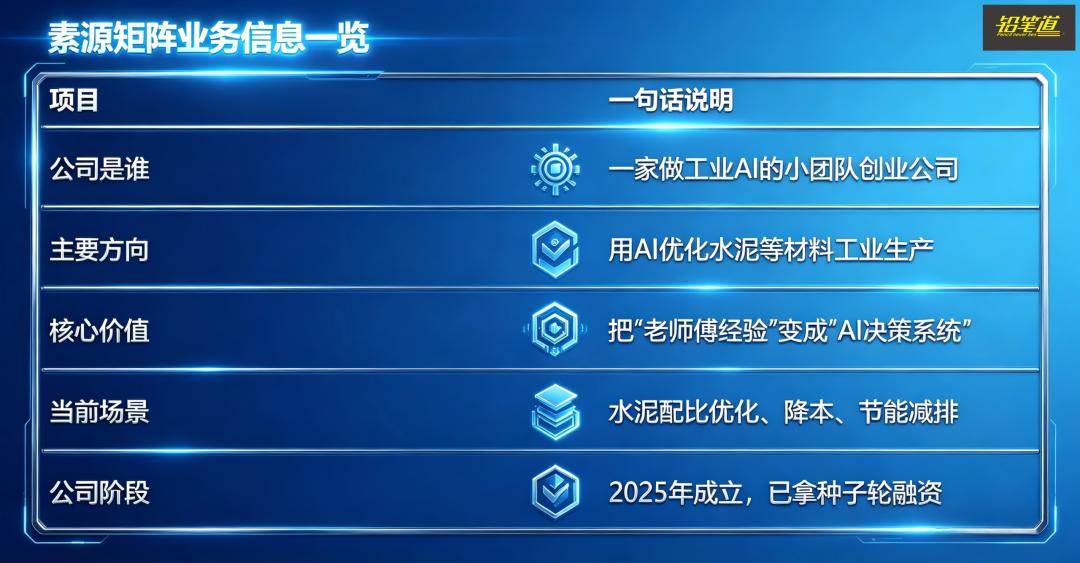
After contacting many industrial customers, we found a very interesting phenomenon: in some very specific scenarios, the demand is extremely strong. For example, when is the equipment most efficient, how to process materials with the least loss, and how to adjust the mill to reduce power consumption.
However, companies like Alibaba Cloud, Tencent Cloud, and Huawei Cloud, although they have also entered the industrial scenario, mainly focus on building platforms, doing data management, equipment management, and model management. They won't go down to the specific decision - making level because it's not cost - effective.
But the real value actually lies in these small - scale decisions.
You need to look for those very specific, small but clearly valuable scenarios. The things you do don't need to be large, but they must be "real" - as long as someone is willing to pay for it, the thing is viable.
For example, when we started with cement, we started from a very small point of quality prediction. But after you do this point well, customers will naturally give you a second, then a third demand. If you don't work on small scenarios, you won't even be able to contact customers, and all subsequent opportunities won't happen.
From a business perspective, small scenarios have another advantage: they require small investment but have a high output - to - input ratio. It may not make a lot of money from a single scenario, but as long as it can reach 70% standardization, it can be replicated to multiple customers and finally be scaled up.
Moreover, some small scenarios, which seem small in one place, can be replicated across the country. For example, a problem in a cement plant may exist in hundreds of cement plants, so it can be