Behind the 2.67 million urban NOA vehicles: The top five contenders are vying for the lead, and the first-tier players in intelligent driving are being ranked.
Regarding autonomous driving technology, some suggest skipping Level 3 (L3) and directly advancing from the current Level 2 (L2) to Level 4 (L4). Others believe that L3 is a necessary stage towards full autonomous driving at Levels 4 and 5. Safety needs to be quantified by public data, and users also need a process to understand it.
Anyway, the intelligent development of new energy vehicles is like an arrow shot from a bow with no turning back. It's something that must be carried through to the end.
In 2025, the number of newly insured vehicles equipped with Urban NOA (Navigate on Autopilot) reached 2.67 million, accounting for 11.6% of the total number of newly insured domestic passenger cars (23.05 million) that year. That is, about 1 in every 9 new cars is equipped with Urban NOA.
The industry predicts that the penetration rate of L2 combined driving assistance is expected to exceed 70% in 2026. Among them, the penetration rate of the Urban NOA function is also rising rapidly.
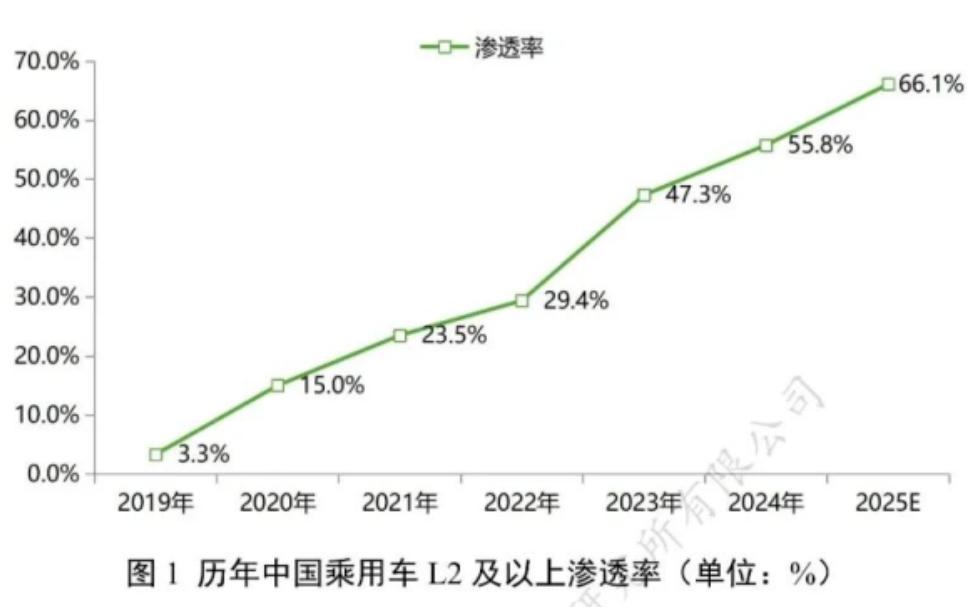
Figure/Historical Penetration Rates of L2 and Above in Chinese Passenger Cars Source/Screenshot from Internet and New Energy Outlook
Jin Yuzhi, the Senior Vice President of Huawei and the CEO of Yinwang, revealed at the 2026 High - level Forum on the Development of Intelligent Electric Vehicles that by the end of 2025, Huawei's Qiankun Intelligent Driving system had been installed in 1.4 million vehicles in total. When the pre - sale price of the Huajing S, which comes standard with Huawei's Qiankun Intelligent Driving ADS 4.0 and Hongmeng Cockpit, is below 200,000 yuan, Huawei's "equal access to intelligent driving" strategy has started to gain momentum.
XPeng Motors' second - generation VLA (Vision - Language - Action) model has achieved "direct output of driving actions from visual signals", aiming to provide ordinary users with a smooth and reassuring driving experience.
There is also the latest news about Tesla's FSD (Full - Self Driving): Tesla's FSD V14.3 version has completed localization adaptation for the Chinese market and is expected to be pushed to domestic users via OTA in the first half of May 2026, competing with domestic intelligent driving technologies.
So, in the current new energy vehicle industry trend of "intelligent driving" for all, who can be considered in the first echelon of intelligent driving? Or even take the lead? And what are the evaluation criteria? These are worthy of our discussion.
1. Three Hard Criteria to Select the First Echelon of Intelligent Driving
In the current highly competitive intelligent driving market, although most vehicles are at the L2 level of intelligent driving, "having intelligent driving" and "having good - to - use intelligent driving" are two different things. To enter the first echelon, at least three hard conditions must be met.
First, the functions should be comprehensive. Highway NOA, Urban NOA, and full - scenario parking are all indispensable.
Highway NOA has been basically popularized, while Urban NOA is the real dividing line. If an automaker has not implemented Urban NOA or can only use it in a few cities covered by high - precision maps, it is still some distance from the first echelon. By the end of 2025, nearly 150 models from about 35 brands had been equipped with the Urban NOA system.
Urban NOA has become the core standard to measure the level of intelligent driving. Some brands claim that their vehicles can be driven across the country, but in reality, they may only cover dozens of major cities. Currently, only a few can achieve large - scale coverage and stable usability. This is the "primary qualification" to be verified for entering the first echelon.
Second, it should run stably. Technical maturity is a hard indicator.
The ability of map - free intelligent driving is the current key dividing line. Getting rid of the dependence on high - precision maps and achieving "drivable across the country" tests the system's perception and decision - making ability on unfamiliar roads. High - precision maps are not only slow to update and costly but also do not cover many remote roads. If users can't use intelligent driving when traveling to other cities, the experience will be greatly reduced.
The map - free solution relies on the vehicle's own perception and real - time mapping ability, which requires extremely high algorithms. Currently, Huawei, XPeng, Li Auto, etc. are all promoting map - free intelligent driving, but their actual performances still vary. Running stably also includes the frequency and quality of OTA upgrades. The intelligent driving system needs continuous iteration. If it is not updated for a quarter, it may be left behind by competitors.
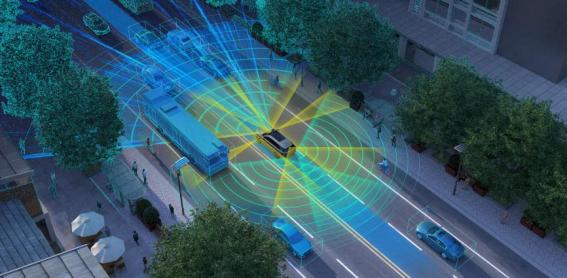
Figure/Map - Free Solution of the Sensor System of Wei brand Lanshan Source/Screenshot from Internet and New Energy Outlook
Third, the hardware should be solid. Lidar, high - computing - power chips, and multi - sensor fusion perception are the physical basis to support high - order algorithms.
Of course, the key for hardware is not the quantity but whether it can support the effective operation of algorithms. Some models are equipped with 3 lidars and 4 Orin - X chips with a computing power of over 1000 TOPS, but the actual experience may not be better than a 200 TOPS solution. On the contrary, some models reduce the key sensors to cut costs, resulting in a significant decline in intelligent driving ability.
Enterprises in the first echelon will not blindly pile up hardware but will definitely ensure redundancy to leave room for algorithm upgrades. Tesla's pure vision route represents another technical philosophy, but most of the mainstream first - echelon players in China are equipped with lidars.
China divides driving automation into six levels from L0 to L5. Among them, L0 to L2 belong to "driving assistance", and L3 to L5 are "autonomous driving" in the true sense. The "high - order intelligent driving" currently discussed in the market is still in the category of L2 combined driving assistance in terms of technical level.
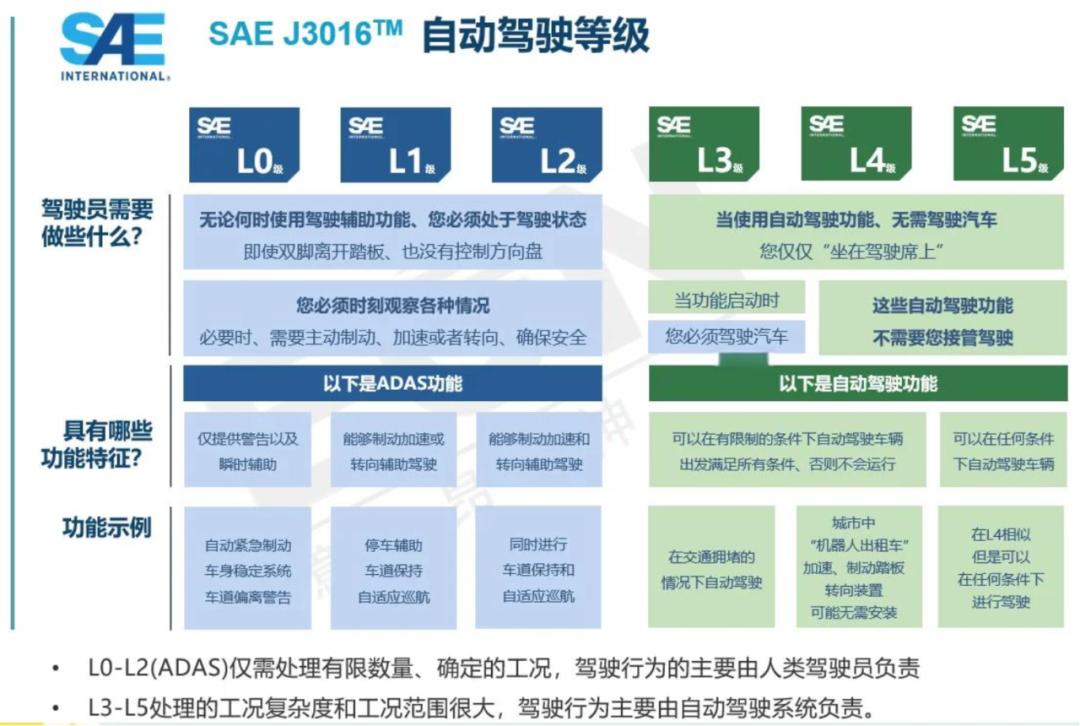
Figure/Autonomous Driving Levels Source/Screenshot from Internet and New Energy Outlook
The L2 level requires the driver to always pay attention to traffic conditions and be ready to intervene at any time, while the L3 level allows the driver to take their eyes off the road during system operation. Although the experience of intelligent driving functions such as Urban NOA has been greatly improved, it still has not broken through the boundaries of L2 in legal definition.
It should be clear that many models in the 100,000 - yuan range claim to have "L2 - level intelligent driving", but their actual experience is far from that of high - order NOA. The so - called "L2 - level" they mention is actually very basic driving assistance such as adaptive cruise control and lane - keeping. Models of this level are still far from meeting the threshold of the first echelon.
2. One Dominant and Many Strong: Analysis of the Strengths of Five Major Players
As mentioned before, the so - called high - order intelligent driving currently is still at the L2 level. Some people use L2+ to describe the first - echelon enterprises, some use L2.9+, and even 2.9999, but it is definitely not up to L3. The driver still needs to supervise the whole process. Urban NOA can autonomously complete complex operations such as traffic lights and unprotected turns, but it is still legally defined as "driving assistance".
Currently, the first echelon has generally achieved map - free intelligent driving and no longer relies on high - precision maps. The so - called "map - free" means that the vehicle can rely on real - time perception and mapping and can be activated when entering an unfamiliar road for the first time without waiting for map updates. Therefore, the players in the first echelon definitely don't need to "open up cities one by one". More advanced end - to - end large models and world models enable the vehicle to understand the scene and deduce the trajectory like a human, truly achieving "drivable on any road".
Intelligent driving technology is evolving and iterating rapidly. From the current market pattern, the first echelon presents a pattern of "one dominant and many strong", and the five major players each have their own unique skills.
The Huawei ecosystem is the current leader in the field of intelligent driving. In 2025, Huawei's Qiankun Intelligent Driving ADS continued to top the market with 745,000 Urban NOA installations, accounting for about 28% of the market share.
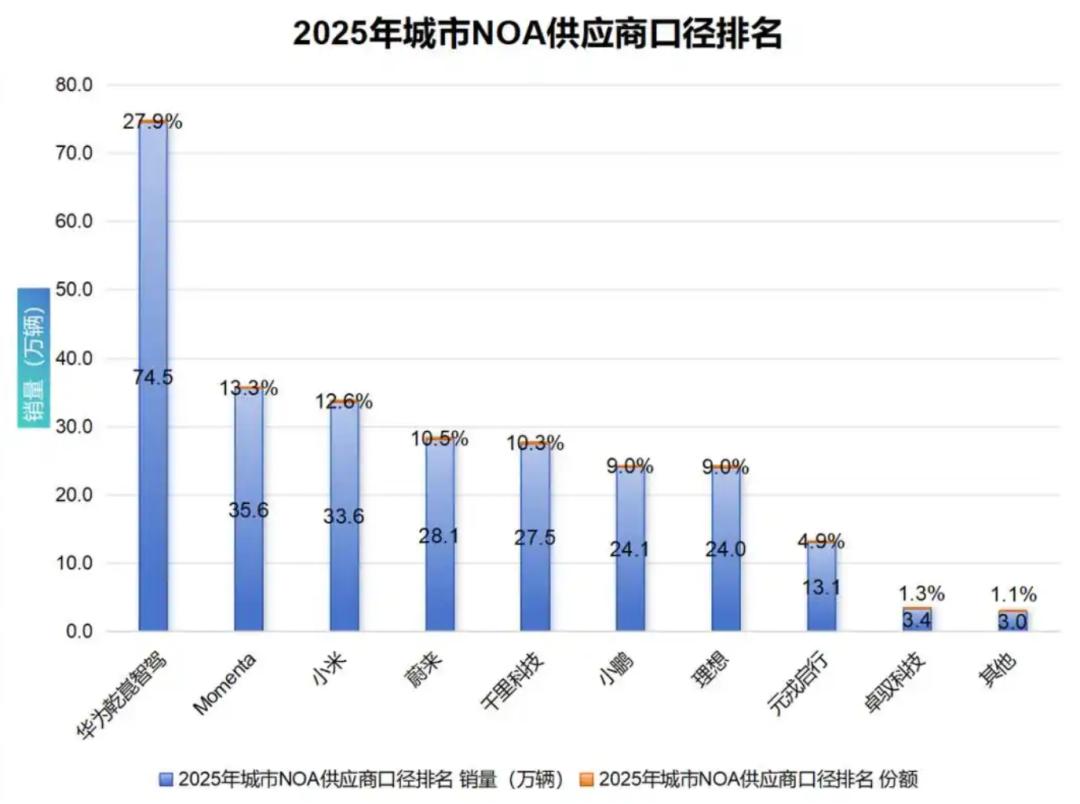
Figure/Ranking of Urban NOA Suppliers in 2025 Source/Screenshot from Internet and New Energy Outlook
Huawei's advantage lies in full - stack self - development. It has full control over everything from chips, operating systems to algorithms and sensors. ADS 3.0 uses end - to - end large models and map - free intelligent driving ability, covering highways and urban roads across the country. Users' actual experience and evaluation are extremely high. Some car owners shared that the Wenjie M9 can independently choose the most reasonable lane on the complex overpasses in Chongqing, with almost no need for takeover.
At the same time, Huawei is accelerating the popularization of technology by optimizing hardware costs. It has reduced the number of millimeter - wave radars from 6 to 3 and the computing power of chips from 400 TOPS to 200 TOPS, bringing high - order intelligent driving into the 200,000 - yuan and even 150,000 - yuan markets.
XPeng Motors has also been deeply involved in the field of intelligent driving for many years. XPeng is one of the first automakers to advocate "full - stack self - development". It launched the Highway NGP in 2021 and was the first in the industry to implement the Urban NGP in 2022. Currently, XPeng's XNGP uses end - to - end technology and has achieved "drivable across the country". Urban NOA covers all cities in the country, and AI intelligent driving can be used wherever navigation is available.
A testing institution conducted an urban intelligent driving test on the XPeng G6. In a 50 - kilometer route, it only needed manual takeover twice, showing stable performance. XPeng has a deep foundation in self - development, with early implementation and wide coverage of Urban NOA. However, its hardware cost is relatively high, and the speed of popularizing high - order intelligent driving to mid - and low - end models is relatively slow.
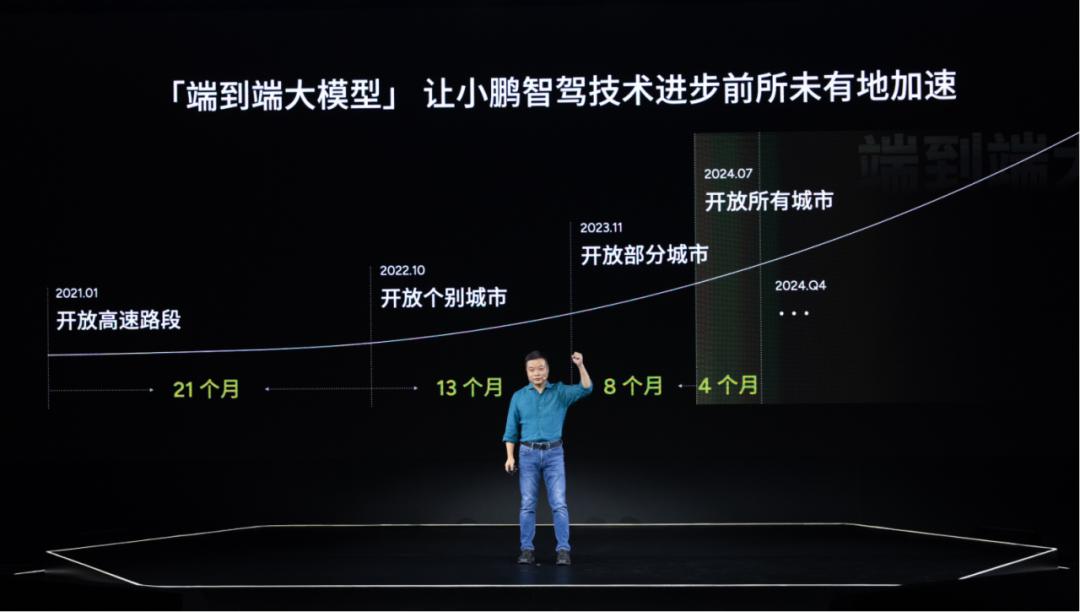
Figure/XPeng XNGP End - to - End Large Model Source/Screenshot from Internet and New Energy Outlook
Li Auto takes the route of "optimizing the family scenario". Li Auto's AD Max system performs stably on Highway NOA and is easy to use. Mr. Li, the owner of a Li L9, said that he drives on the Beijing - Tianjin Highway every week and turns on NOA for the whole journey, with almost no need for intervention. The system is very decisive in lane - changing and overtaking.
It is worth mentioning that Li Auto will launch the embodied intelligent flagship Li L9 Livis in the second quarter. From terms like "4 lidars", "Mach 100 chip", "full - by - wire chassis", and "800V fully active suspension", you can feel that it may bring greater surprises to consumers in terms of perception, thinking, and action.
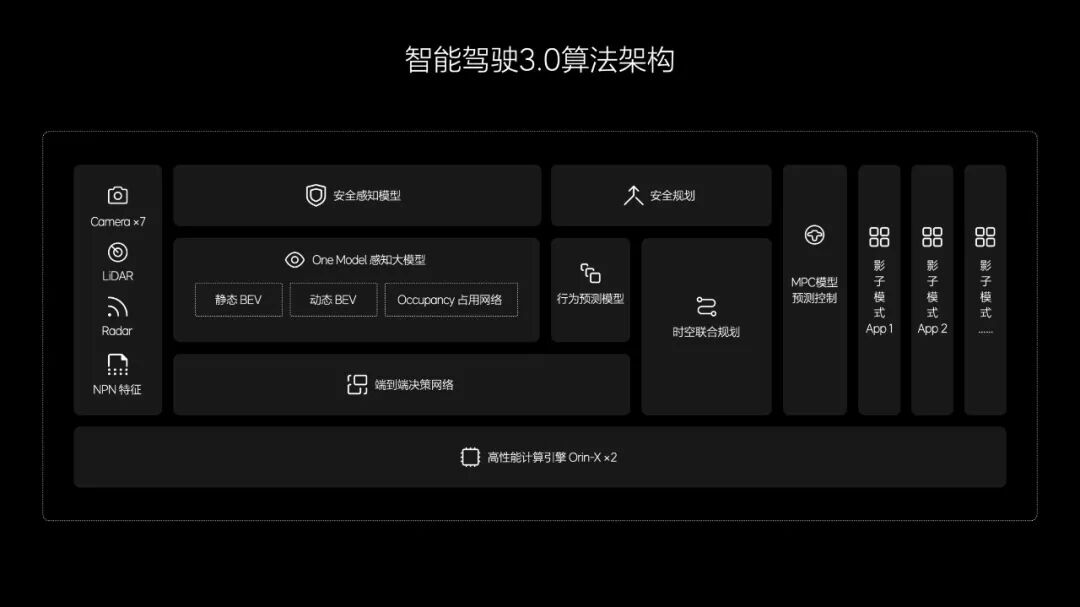
Figure/Algorithm Architecture of Li Auto AD Max Intelligent Driving 3.0 Source/Screenshot from Internet and New Energy Outlook
NIO's intelligent driving is like installing a "veteran driver's brain" in the car. It doesn't rely on rote - learning traffic rules but can understand the current traffic situation, imagine what might happen in the next few seconds, and make predictions. This is NIO's world model.
Now, NIO's intelligent driving has entered a new stage of "world model + closed - loop in - depth learning". On the basis of high - end and even redundant hardware, the vehicle can build a more accurate environmental model and make longer - term trajectory predictions, thus achieving a smoother driving experience like that of a "veteran driver", making driving easier and safer.
Tesla's FSD has attracted wide attention globally, with obvious advantages in its pure vision route and data accumulation. Tesla has pushed the FSD V14.3 version in North America, showing obvious improvements in driving logic, automatic learning, and safety strategies. Some car owners said it "feels more like a veteran driver". However, in China, although there is a schedule for implementation, it still needs to be verified. Therefore, although Tesla is technologically advanced internationally, it is still in the "promising" stage in the domestic market.
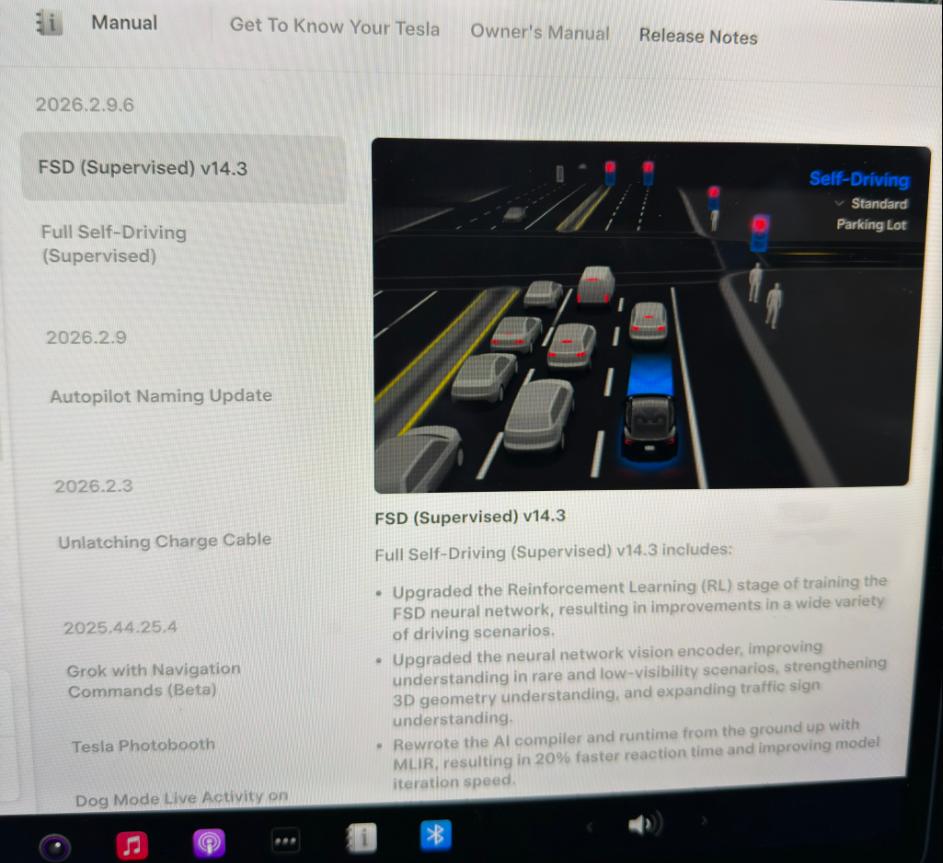
Figure/FSD V14.3 Push Source/Screenshot from Internet and New Energy Outlook
3. Next Stop: Four Key Areas for the First Echelon to Compete
In 2026, the focus of competition in the first echelon of intelligent driving is changing. Whoever can make breakthroughs in the following four dimensions first will take the initiative in the next - stage ranking.
Compete on cost to make high - order intelligent driving enter the mainstream market.
From the release of