36Kr Exclusive | A Doctor from The Chinese University of Hong Kong and a Former Head of DJI's Intelligent Manufacturing Start a Business to Create "Personalized Lego" in the AI Era
Author | Zhang Ziyi
Editor | Yuan Silai
36Kr learned that the personalized manufacturing brand UNICUS (formerly Fangzai Photo Studio, Shenzhen Qianzhi Technology Co., Ltd.) recently completed a new round of financing. The financing amount reached millions of US dollars. This round was led by Linear Capital, followed by Jiukun Venture Capital and Skyline Capital. Yuanyi Capital served as the exclusive financial advisor. The company's founding team and the founders of leading companies in the Maker track participated in the follow - on investment in their personal capacities.
The funds from this round will be mainly used for the training of the large model for building block generation, the R & D of AI Agents, and the expansion of overseas markets, to continuously build the core competency system of "AI - driven personalized manufacturing".
In the past two years, the explosion of generative AI has mostly been concentrated in the digital world, while UNICUS chose to bring AI into physical factories. Based on its self - developed fully automated design and production system, UNICUS was the first to explore a technology - driven path for the large - scale mass production of customized toys.
For a long time, the global building block market has been dominated by giants such as LEGO, with an annual revenue scale of up to 70 billion yuan. However, traditional building blocks are essentially an "IP - driven standardized industry". Whether it's the Disney Castle or the Star Wars series, users are buying cultural symbols within a predefined framework.
In the view of Xu Hao, the founder and CEO of UNICUS, the high - light moments, unforgettable memories in everyone's life, and the precious moments spent with family and pets are the most real and unique "personal IPs".
(Image source/Enterprise)
However, there is a paradox in the customization industry: personalization means "anti - scale". Traditional customization highly depends on manual work. Before the emergence of large models, after users uploaded photos, designers often had to spend one to two days manually correcting and matching the material library in the background, and the expressiveness of the final product was often limited by the designer's personal experience. The high time cost and the uncertainty of the results made it difficult for customized products to reach the mass consumer market.
In the past five years, through long - term market education and continuous technological refinement, UNICUS has deeply integrated AI generation and flexible manufacturing, enabling users to obtain an exclusive physical work by simply uploading a photo, recording important moments in everyone's life.
In the middle of last year, UNICUS' self - developed building block large model, LEGO Maker, was officially put into use. It is the first large model to use an autoregressive network for the generation of general LEGO building block models. The relevant results have been published in the world's top computer graphics journal, Transactions on Graphics. This model encodes each building block assembly into tokens for individual prediction, can support thousands of types of building block parts, and can directly generate a structurally stable, physically manufacturable and assemblable building block model from pictures and text, realizing the large - scale customization of personalized products.
With the help of the LEGO Maker large model, UNICUS' products will no longer be limited to the single mode of "generating customized building blocks based on photos". Instead, through conversations with users and picture input, it can understand the stories and characteristics behind the characters and further generate richer and more exclusive scene - based effects.
For example, if a user inputs "She likes skiing and is a journalist...", the AI will combine the picture characteristics and language description to automatically plan a three - dimensional building block scheme with a skiing scene and specific professional accessories. This also evolves UNICUS' products from single dolls to "3D stereoscopic portraits" with a stronger sense of scene and narrative.
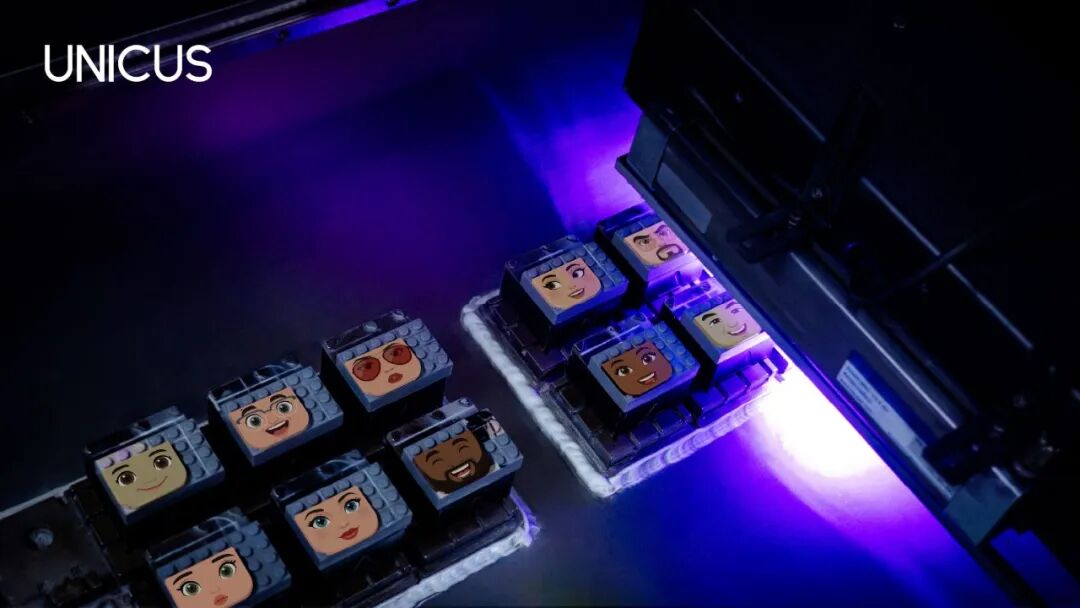
In terms of backend production, UNICUS chose to build its own flexible factory. The difficulty of customized manufacturing lies not in injection molding, but in sorting and printing. UNICUS has about 1,700 types of standard building block parts. How to quickly and accurately assemble hundreds of components for each different order from these parts is a well - recognized problem in the industrial circle. On the printing side, the real challenge is that the shapes, curvatures, and arrangement methods of different surfaces of building blocks are different, but the production line still needs to efficiently complete personalized printing for each different order. This places high requirements on the generation of printing schemes, equipment control, and production rhythm.
In the early stage, UNICUS went through a stage of manual part - grabbing, with extremely low efficiency. Subsequently, the team solved this pain point through a self - developed flexible sorting system and a vibrating disk device. The system will automatically distribute the required parts from thousands of channels according to the instructions generated by the AI. In addition, for the diverse patterns, UNICUS developed an automated printing and machine vision quality inspection system, achieving the delivery capacity of nearly 10,000 different products per day and the fastest delivery within 18 hours, with the overall efficiency increased by about 10 times compared with the traditional model.
After this round of financing, UNICUS will continue to dig deep into the field of "AI for CAM" (Computer - Aided Manufacturing), allowing AI to directly generate manufacturing solutions and further strengthening its moat in the field of personalized manufacturing.
In terms of the team, Xu Hao, the founder and CEO, is a doctor in computer graphics from the Chinese University of Hong Kong. He has been deeply involved in the field of 3D generative design algorithms for more than a decade and has published multiple papers as the first author in top international graphics conferences such as SIGGRAPH. The team has accumulated more than 50 domestic and international patents. Li Cheng, the co - founder, is a doctor in automation from the Hong Kong University of Science and Technology, a student of Professor Li Zexiang, and the former R & D leader of the intelligent production line of DJI drones. He is responsible for the construction of hardware equipment and the flexible manufacturing system.
Founder's Q&A:
Hard Kr: In 2022, the company faced great pressure. At that time, you decided to change the image from "square - faced" to "round - faced". What was the consideration behind this decision?
Xu Hao: It was really difficult at that time. The R & D investment was large, but the sales didn't keep up. We were almost unable to pay the next month's salary, and we laid off half of the staff. I realized at that time that for a technical team like ours, although the automation process, algorithm ability, and production efficiency are of course important, what users ultimately pay for is whether the product itself is good - looking enough and meets their aesthetic standards. The "square - faced" scheme that we were proud of at that time was technically well - done, but it didn't conform to the mainstream aesthetics of most Chinese consumers.
So, changing to a "round - faced" design was actually a very difficult decision. Because this was not simply changing a model, but meant that the entire chain, from factory mold - opening, algorithm reconstruction, to front - end content and marketing expression, had to be redone, with almost no turning back. At that time, the team managed to hold on by borrowing money on personal credit. Fortunately, after the "round - faced" version was launched, it quickly became popular on Xiaohongshu. Half a year later, the company finally achieved self - sufficiency.
Hard Kr: As a team with a scientific background, what was the most profound experience when you built your own factory and explored the supply chain?
Xu Hao: The biggest experience is that there is really no shortcut to "flexible manufacturing". Traditional factories are only willing to take large orders for standard products. No one is willing to adjust the production line for each of your different orders. So, from the very first day, we were "manually building" the factory.
We designed the drawings ourselves, wrote the control codes, and optimized the sorting equipment. For example, the building block particles are very small, and the parts required for each order are completely different. We had to make a vibrating disk device ourselves to replace manual labor. This transformation from writing codes to tightening screws on the production line and managing workers allowed us to accumulate in - depth business know - how, which is difficult for pure software companies to make up for.
Hard Kr: What was the original intention of self - developing the building block large model LEGO Maker? What core problems does it solve compared to general models?
Xu Hao: We decided to self - develop in 2024 because the general large models on the market were still unable to directly generate building block structure layouts that met physical constraints. We needed to define each building block particle as a Token and train an autoregressive network with the millions of 3D model data we had accumulated, so that AI could "write" a structure that could be assembled in the physical world and would not collapse, just like writing an article.
The biggest change brought by AI is the conversion rate. In the past, out of 100 people entering the store, only 3 were willing to pay first and then wait for us to adjust the renderings for one or two days. Now, within 20 seconds, AI can produce a rendering that impresses you. This "what you see is what you get" experience significantly improves the user conversion rate.
Hard Kr: What more far - reaching plans do you have for the combination of future products and AI technology?
Xu Hao: We are currently researching and developing a multi - modal AI Agent for CAM (Computer - Aided Manufacturing). In the future, AI will not only generate a good - looking 3D model, but also directly generate manufacturing instructions that factory machines can understand - how to sort, how to print, and how to generate the corresponding manufacturing process path.
At the product level, we are moving towards "3D portraits". In the future, you can chat with AI, and it will understand your characteristics, such as the pattern of your kitten and your favorite dressing scenarios. What we want to do is not just building blocks, but three - dimensional, composite - material "digital portraits" that allow everyone to freeze their important moments in the most exquisite physical form.
Investor's View:
Linear Capital said: "We have always been highly concerned about the implementation opportunities of Generative AI in real - world scenarios. UNICUS uses AI to reconstruct personalized design and manufacturing capabilities, precisely targeting the application of customized consumption scenarios. After the team keenly captured the market demand, it was the first to connect the full - stack closed - loop from generative algorithms to flexible factories, not only achieving the integration of design and production but also running through the early business verification. We believe that as AI makes personalized design and manufacturing scalable and feasible, there is a huge opportunity to create a 'LEGO of the AI era' behind this. We look forward to UNICUS continuing to define the new consumer product paradigm driven by AI."