With 30 billion yuan in hand and earning 8 billion yuan from a single project, he has invested in brands such as Dongpeng Special Drink, Laoxiangji, and Chando.
In the venture capital circle, Jiahua Capital is an outlier.
Having been established for nearly 20 years, it invests less and less frequently, perhaps only in one project a year. Managing tens of billions of RMB in assets, it is not content to be just an "asset management institution." It even actively reduces external funds and increases the proportion of its own funds. In the era when everyone is chasing AI and hard technology, Jiahua Capital defies the trend and adheres to the consumer sector, and has achieved high - return cases through "slow investment." Behind this is a different understanding of China's income structure and consumption logic.
Song Xiangqian, the helmsman of this institution, has an air of a scholar and a practical nature. He is well - versed in China's income structure, Gini coefficient, and county - level economy. He has invested in a number of national brands such as Dongpeng Special Drink, Babimantou, Laoxiangji, Xiaocaiyuan, and Chando. He maintains a "calm" rhythm - playing more than 100 rounds of tennis a year and spending a lot of time reading and thinking.
In a conversation with Tianxia Wangshang, Song Xiangqian dissected the underlying logic of his consumer investment. In his view, China's consumer market is far from being defined by the prosperity of Beijing, Shanghai, Guangzhou, and Shenzhen. What really determines the future is the broader "Rural China," the rigid and high - frequency needs of 80% of the population in the county - level markets.
Song Xiangqian's confidence in consumption stems from his insight into China's economic structure.
"China has a population of 1.4 billion, making it the world's largest single market. In developed economies, the contribution of final consumption to economic growth is usually between 60% and 70%. Currently, in China, it is just over 50%, leaving room for improvement," Song Xiangqian mentioned.
He emphasized that China is in a critical period of transitioning from a "production - oriented society" to a "consumption - oriented society." The current consumption potential has not been fully released, and the core proposition in the future is to increase per capita disposable income. Only when people have money in their pockets and are willing to spend can domestic demand be truly stimulated.
Song Xiangqian acutely pointed out that the core trend of China's consumer market is "consumption equalization."
With the power reversal between consumers and brands, brands are no longer the high - handed dominators. They need to truly respect consumers and create benefits for them.
Behind this trend is the observation of the income structure. Song Xiangqian pointed out that, in his view, the prosperity of Beijing, Shanghai, Guangzhou, and Shenzhen obscures the broader real China. Among China's 740 million employed population, 100 million are included in the individual income tax statistics, and hundreds of millions have a monthly income of less than 3,000 yuan (data from the State Council in 2020). In such a structure, only talking about high - premium and luxury consumption is divorced from the reality of the vast majority of consumers.
Therefore, Jiahua Capital's investment logic is very clear: rigid demand, high frequency, and people's livelihood.
"Rigid demand determines basic consumption, high frequency brings high turnover, and people's livelihood means a huge market capacity," Song Xiangqian pointed out. The core of investment is not to chase high gross profit but to pursue return on equity (ROE), among which turnover is the key.
Take Dongpeng Special Drink, in which Jiahua Capital invested in 2017, as an example. Dongpeng achieved rapid growth and success in the segmented market, not because it was more expensive, but because it served the group ignored by mainstream brands with half the price and twice the quantity.
"Red Bull is positioned for urban elites and sports enthusiasts, but are they the only ones who drink functional drinks?" Song Xiangqian said that Dongpeng's success is essentially a victory of consumption equalization, allowing consumers to enjoy products of the same quality at a more affordable price.
Public information shows that as of 2024, Jiahua Capital has achieved a huge return of over 8 billion RMB from its investment in Dongpeng Beverage, with a return on investment of up to 24 times.
In the catering field, Jiahua Capital's investments in Laoxiangji and Xiaocaiyuan also adhere to the people's livelihood positioning of "delicious, affordable, healthy, and hygienic."
Xiaocaiyuan has an average per - capita consumption of about 60 yuan. All of its nearly 800 stores adopt the direct - operation model. Through standardized management, it has solved the difficult management problem in the Chinese catering industry. Laoxiangji adheres to information transparency. During the controversy over pre - made dishes, it clearly informed consumers about the product sources. Even after facing the storm, its stores still have a large flow of customers.
In terms of post - investment empowerment, Song Xiangqian positions himself as an "off - the - books CEO" or a "business partner" of the enterprise. Jiahua Capital, with its team, delves into the daily operations of the enterprise, participating in the entire chain from production, supply, and sales, to human resources, finance, strategy, brand, channels, and digitalization.
In the investment case of Babimantou, the enterprise once faced the choice between direct operation and franchising. Jiahua Capital suggested the direction: focus on franchising, retreat to build a central factory and an excellent supply chain, and provide standardized products and services for the front - end stores. This strategic adjustment enabled Babimantou to rapidly expand its scale and become the leader in the segmented field.
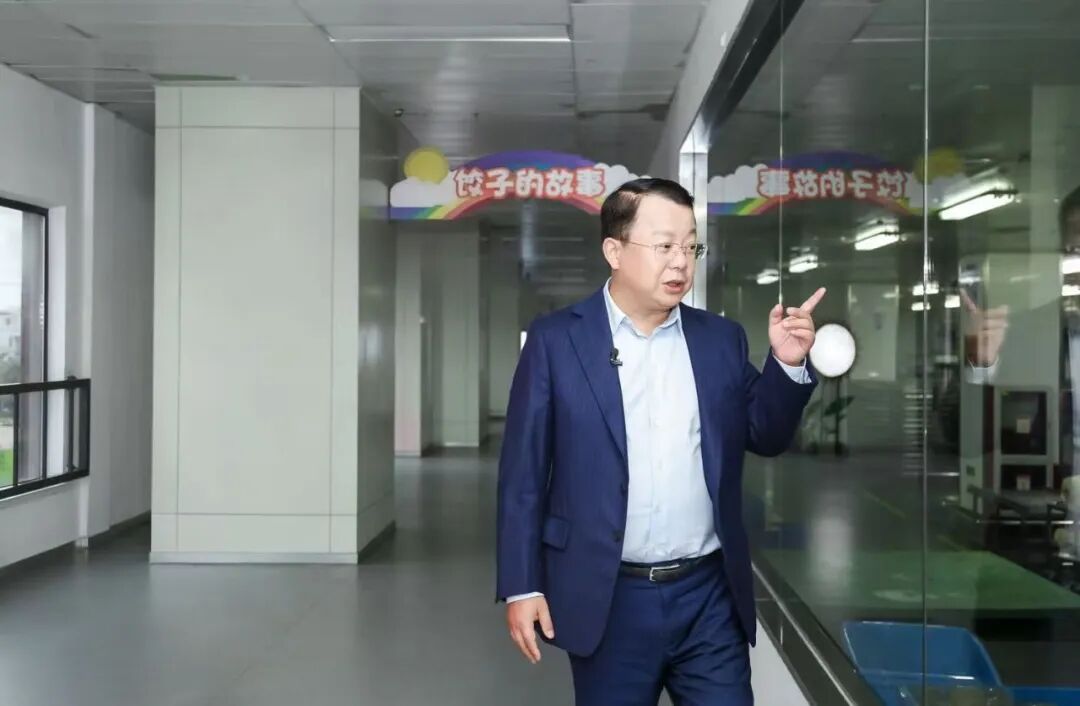
Song Xiangqian in the Babimantou factory
Song Xiangqian uses the story of Sisyphus pushing the rock to describe enterprise competition: enterprises keep climbing, cross a mountain peak, roll down like a snowball, and then face a new peak. It is a game without an end. All he can do is to find entrepreneurs who are willing to learn for life and constantly iterate themselves, and with a calm attitude, dream, pursue dreams, and realize dreams together. He believes that only by becoming a creator of enterprise value can one win respect and trust, which is more important than simple financial support.
Jiahua Capital's exit logic reflects long - termism.
Song Xiangqian said bluntly that there is a common mismatch in the current investment industry. "The enterprise life cycle, product cycle, and economic cycle are all complex and changeable. Using a fixed time to determine the exit timing is itself a mismatch."
Therefore, Jiahua has chosen a less - traveled path: actively reducing the asset management scale and increasing the proportion of self - operated investments. "When you invest your own money, you will have real patience," Song Xiangqian explained. This adjustment allows Jiahua not to be eager to cash out to meet the exit requirements of LPs but to accompany the long - term development of enterprises.
Jiahua Capital believes that the sign of successful investment is not necessarily to exit through listing. If an enterprise has a good cash flow and continuously creates profits and taxes, even if it does not list, holding its equity and enjoying compound growth is also a form of success.
"Do the right thing, and the economic results will be self - evident. Time is the weighing scale of enterprise value, and profit is a by - product of doing the right thing," Song Xiangqian mentioned.
At the end of the interview, Song Xiangqian talked about his professional ideal: "Help create more national brands so that in the lives of Chinese people, high - quality products we support can be seen everywhere."
He mentioned that when taking his son to the supermarket and seeing the shelves filled with products of the enterprises he had served, the sense of achievement made him extremely proud.
Slow is fast. Only slow - growing companies can produce good brands. Looking for national brands that can withstand economic cycles in the hustle and bustle of life and making business return to the origin of creating benefits for people is Jiahua Capital's investment philosophy.
The following is a conversation between Tianxia Wangshang and Song Xiangqian, the founder of Jiahua Capital, edited and organized:
Consumption is the "ballast stone." We need to make people have money to spend and be willing to spend.
Tianxia Wangshang: Jiahua Capital focuses on consumer - sector investments, and the state has also mentioned boosting consumption several times. What do you think is the current situation of China's consumer market?
Song Xiangqian: China has a population of 1.4 billion, making it the world's largest single market. When the economy develops to a certain stage, the core driving force, stabilizer, and ballast stone of the entire economy must be consumption and domestic demand. The contribution of final consumption to economic growth will account for 70%, but currently, it is only a little over 50%, which is far from enough.
The state has taken boosting consumption and adhering to domestic - demand leadership as key tasks. Our consumption and domestic demand are crucial for digesting excess production capacity and promoting economic structural transformation. In the future, there will inevitably be a transition from a production - oriented society to a consumption - oriented society, from over - emphasizing manufacturing, production, and production capacity to caring about people's basic needs.
Consumption is a function of income. Your consumption is someone else's income, and it is also a function of employment. So the fundamental lies in increasing per capita income, making people willing to spend, having spare money, and being willing to do so. In the future, we will surely focus on stabilizing employment, improving the economic development level, and improving per capita income.
Tianxia Wangshang: Jiahua Capital was established in 2007 and has been focusing on consumer - industry investments for nearly 20 years. How do you select investment targets?
Song Xiangqian: We don't invest in early - stage companies. We are neither VC (venture capital) nor angel investors. We are more like a "star - picking movement" - investing in enterprises that already have strong competitiveness, a certain management level, great growth elasticity and space, and good comprehensive competitive strength.
It's like selecting high - quality athletes on the track and field who have the potential to become industry champions, national champions, or even participate in global competitions. We deeply participate in enterprise operations and do solid post - investment empowerment and value creation.
Tianxia Wangshang: Jiahua Capital is a PE (private equity) investment institution, but the investment in projects like Laoxiangji lasted for 8 years, longer than that of VC. How do you define this?
Song Xiangqian: We never look at it from the perspective of time but rely on enterprise value. Because investment is a very energy - consuming thing, both parties must be suitable. Companies that can achieve excellent results in the end must meet several conditions:
First, entrepreneurs themselves must have the drive. They should have the dream of becoming champions, the will to become entrepreneurs, and strong learning abilities. No one is born with these skills, but lifelong learning is a basic quality that entrepreneurs must maintain.
Second, entrepreneurs should have the spirit and pattern to become industry leaders. Entrepreneurs and businessmen are different. To be a good entrepreneur, one must have a big pattern.
Third, it is very important to examine whether entrepreneurs can complete self - iteration and self - renewal in the process. So investing in people is an important part of our evaluation.
In the projects where we have achieved good results, there is basically a conclusion: the founders and core teams have a relatively high degree of trust in us, and this degree of trust determines the quality of the final result. So we are different from general VCs and PEs. We will be deeply involved in the daily operations of enterprises, integrate into their business, exert our capabilities, create positive value in the operation process, and accompany enterprises to grow and become stronger.
In a word, it is a process of jointly dreaming, pursuing dreams, and realizing dreams. You must be a participant and one of the creators of the overall enterprise value. Only by creating can you be qualified to share and win respect and trust.
Respect and trust do not come from giving someone a sum of money. Instead, you use the money as a stepping - stone and, beyond capital, also provide strategic, brand, channel, human - resource, financial, operational, insight, trend - judgment, and macro - economic - analysis re - creation on all value chains.
Pay attention to the majority in Rural China
Tianxia Wangshang: Jiahua has invested in brands like Dongpeng Special Drink and Babimantou, which are all cost - effective brands. What are your main investment directions?
Song Xiangqian: Many people only look at Beijing, Shanghai, Guangzhou, and Shenzhen and the total GDP, thinking that China has entered the high - income threshold - actually, it hasn't.
China has more than 700 million laborers, more than 200 million are flexibly employed, and more than 400 million are urban - employed. Those who have paid individual income tax and are included in the statistical scope are only about 100 million. There are still hundreds of millions of people with a monthly income of less than 3,000 yuan. This shows that the Gini coefficient of our income structure is large.
Those with a high propensity to consume are low - income and middle - income groups. The consumption propensity of the rich is relatively low because they have a large amount of savings and buy capital goods, and the proportion of consumption in their income is actually very low. This is the concept of "marginal propensity to consume." However, for low - and middle - income groups, whatever money you give them, they will spend it on rent, food, transportation, medical treatment, and education, and basically consume it all. So for low - and middle - income groups, we should provide more income - growth plans, subsidies, and tax cuts, and also provide them with good supplies.
We talk about rigid demand, high frequency, and people's livelihood because if you only look at Beijing, Shanghai, Guangzhou, and Shenzhen, you will be misled. If you go to the county towns a few hundred kilometers away, China has more than 2,800 county - level administrative units. In quite a number of county towns, the economy is still dominated by transfer payments and the public sector, and the industrial foundation is relatively weak. Most county towns neither have decent industries nor an industrial structure and lack the ability for economic development.
The development of the county - level economy is far from as strong as people think, and hundreds of millions of people live in these more than 2,000 counties. This is an important part that cannot be ignored - the real "Rural China."
You need to deeply understand the development environment, social and people's livelihood environment, and consumer market of the county - level economy. This is consumer insight and a basic understanding of the economic structure, per capita purchasing power, development environment, and social situation.
Tianxia Wangshang: There is another track in China that cannot be ignored, which is the tea - beverage track, but Jiahua has not made an investment. Why is that?
Song Xiangqian: Every investor has their own choices. We didn't invest because offline chains that rely on opening stores to do tea - beverage business are limited by time and trading places, and there is a ceiling. The trading time is limited, and the delivery and fulfillment costs are high. This business model is not very attractive.
From a long - term health perspective, the high - sugar problem of milk tea will be a challenge in the future. It is a product of a specific era. In the future, it needs product upgrades, adjustments in sugar - free, sugar - reduced, and low - sugar aspects, and optimization in the supply chain. Some use non - dairy creamer, and some use fresh milk, all of which need to be upgraded. The ingredient list should be cleaner, and the products should be healthier for the industry to develop better.
Tianxia Wangshang: If offline chains are limited by time and trading places, why did Jiahua invest in Xiaocaiyuan and Laoxiangji?
Song Xiangqian: In the field of Chinese popular and convenient catering, Xiaocaiyuan is relatively rare. It has reached its current position through on - site preparation, on - site cooking, and relatively modern management and operation, maintaining an average per - capita consumption of about 60 yuan, which is very remarkable.
Chinese consumers have a strong attachment to the "smell of the world" in stores, so pre - made dishes are not very popular. Xiaocaiyuan has higher requirements than pre - made dishes. The higher the standard process, the greater the management difficulty.
