New forces' sales volume in March: Leapmotor sold 50,000 units, Li Auto and NIO rebounded, and there are new cars like Xiaomi and AITO.
At the end of the first quarter of 2026, the domestic auto market fully recovered.
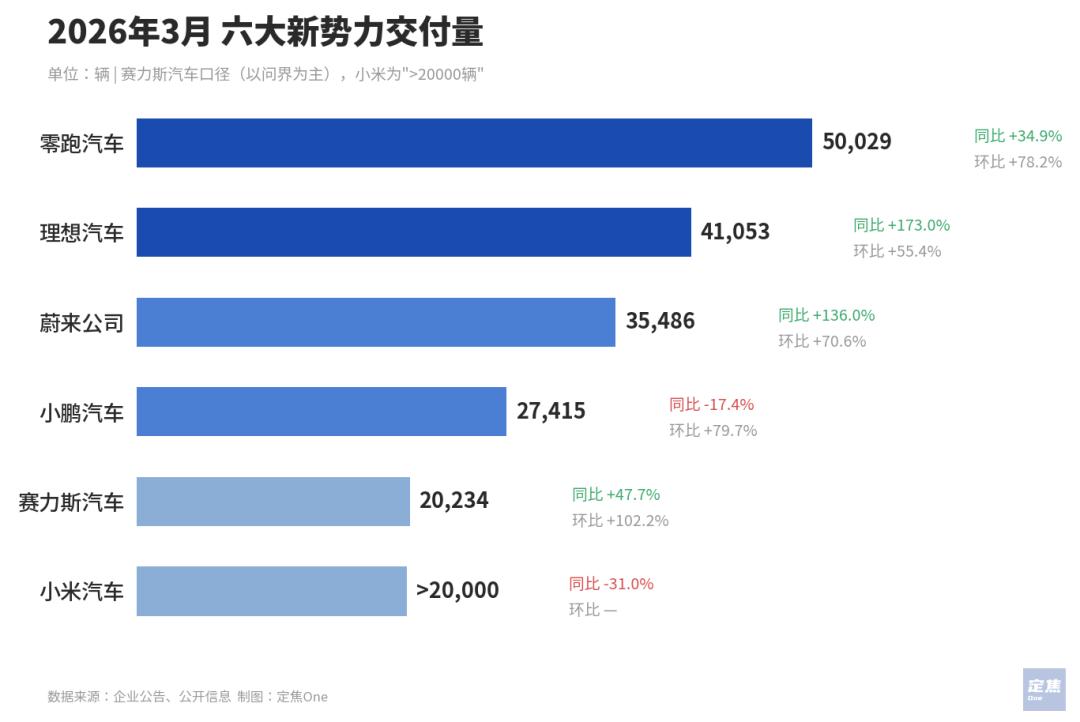
In March, the month at the end of the quarter for sales volume boost, it is still the new - force automakers that best reflect the intensity of competition. Leapmotor firmly held the top position with 50,029 vehicles sold; Li Auto returned to over 40,000 vehicles (41,053 vehicles), and its year - on - year growth rate (173%) was the highest among the six. For the first time in two years, it exceeded the upper limit of the quarterly guidance. NIO (35,486 vehicles) ranked third, with a year - on - year increase (136%) second only to Li Auto; XPeng (27,415 vehicles) saw a decline both in the monthly and quarterly sales. According to the data of Seres Automobile, the sales volume of AITO was about 20,234 vehicles; Xiaomi sold over 20,000 vehicles, basically the same as the previous month.
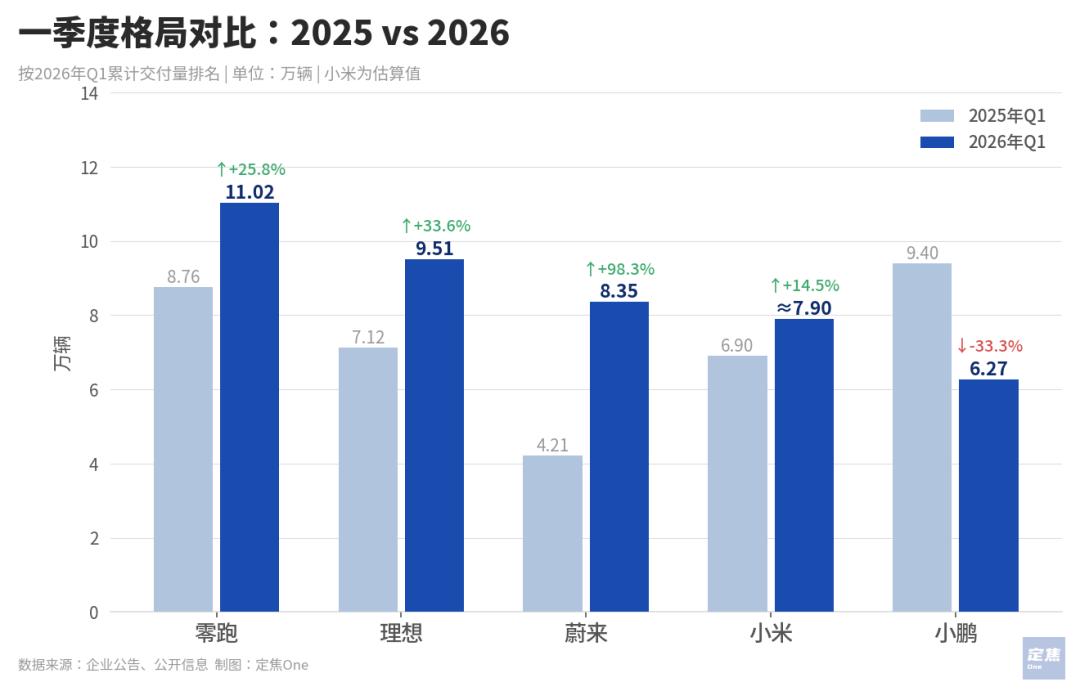
Ranked by the cumulative delivery volume in Q1, the six new - force automakers reshuffled again: In Q1 last year, XPeng and Leapmotor firmly held the top two positions, Li Auto followed closely, and NIO was at the bottom. This year, Leapmotor took the top spot, Li Auto and NIO overtook XPeng, and Xiaomi's ranking remained unchanged.
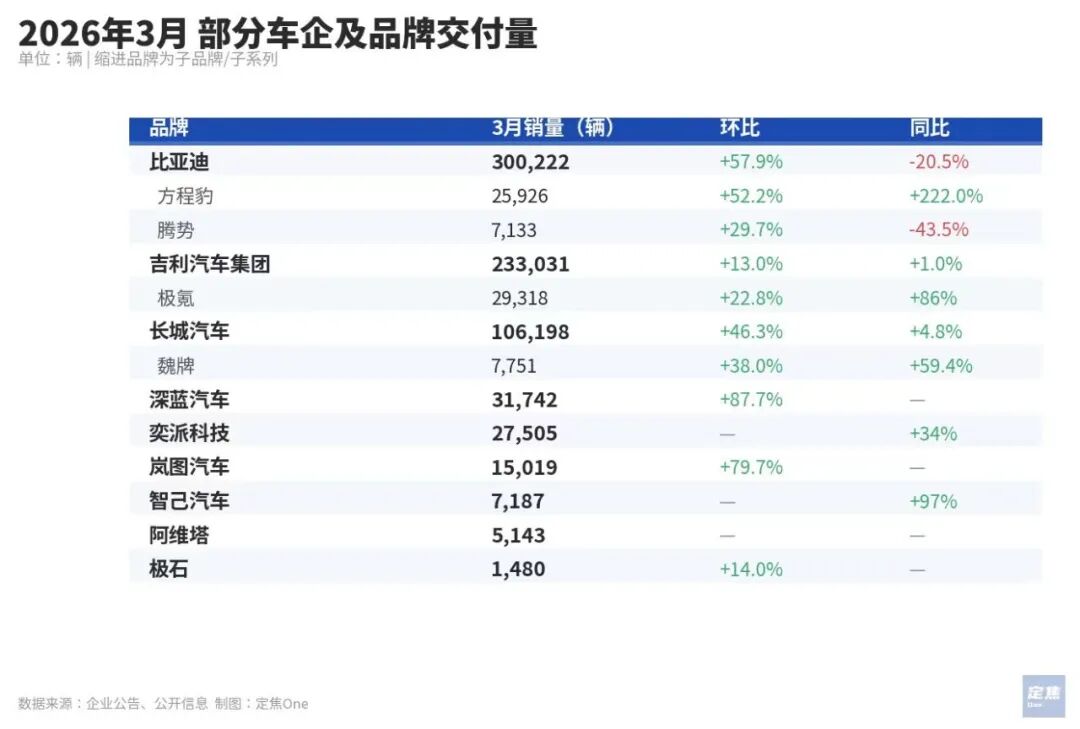
Of course, the overall market in March was still supported by traditional giants. BYD sold 300,200 vehicles in March, a month - on - month increase of 57.9%. The cumulative delivery volume in the first quarter reached 700,000 vehicles, firmly holding the first place in the industry. Among them, the Dynasty and Ocean networks remained the mainstay. Fangchengbao and Denza delivered 25,926 and 7,133 vehicles respectively in March. Geely followed closely with 233,000 vehicles. Its ZEEKR brand delivered nearly 30,000 vehicles (29,318 vehicles) in a single month. Great Wall Motor also began to recover, with a monthly sales volume of 106,000 vehicles, among which Wei brand contributed 7,751 vehicles.
Among the "second - generation" camps of traditional automakers, Deepal under Changan delivered 31,700 vehicles in a single month; Yipai Technology, a new - energy brand under Dongfeng, sold 27,500 vehicles. The presence of these two brands is gradually increasing; VOYAH (15,000 vehicles) exceeded 10,000; IM (7,187 vehicles), Avatr (5,143 vehicles), and Jishi (1,480 vehicles) were left behind.
Judging from the performance in Q1, the competition in the auto market this year has entered the next stage. An investor who focuses on new - energy vehicles analyzed to "Dingjiao One" that the price war is still going on, but it is no longer the only factor determining the outcome. The pace of new vehicle launches, channel capabilities, technology implementation, and overseas progress are all variables. In addition to the new - force automakers, traditional large manufacturers are also accelerating to fill the gaps. It is very likely that the auto market this year will continue to differentiate and reshuffle.
1
Leapmotor Continues to Boost Sales
Li Auto Finds Its Rhythm
In the new - force ranking in March, Leapmotor and Li Auto occupied the top two positions. Leapmotor continued to move forward, and Li Auto caught up. Liu Feng, an investor who focuses on new - energy vehicles, said, Currently, the most popular models are those that can fully meet the needs of mainstream families.
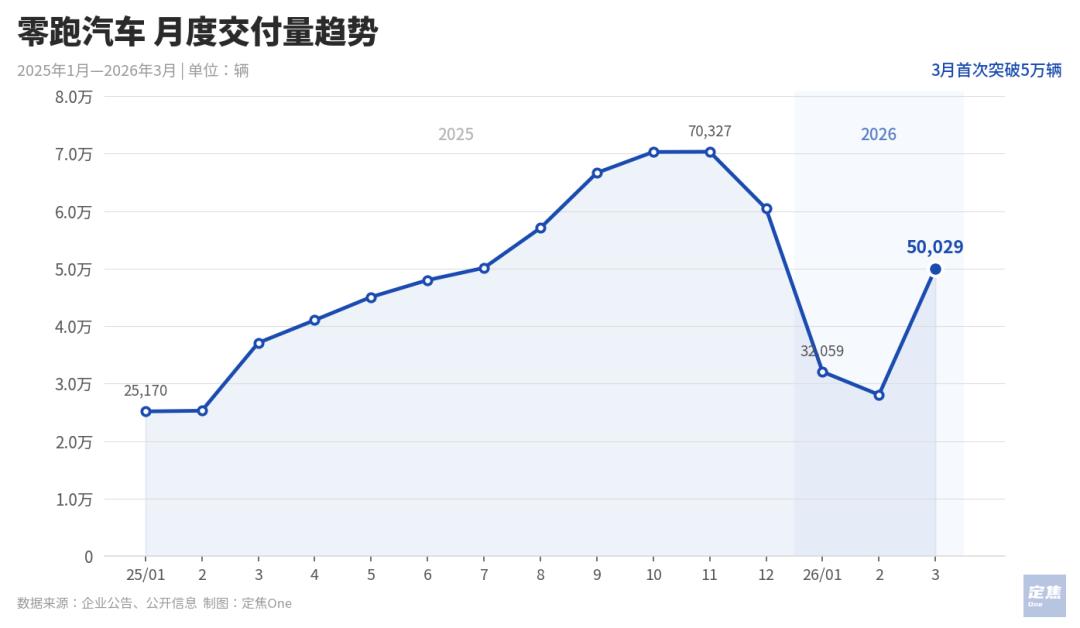
Looking at Leapmotor's data, it was the first time this year that its monthly sales exceeded 50,000, a month - on - month increase of 78% and a year - on - year increase of 35%.
Behind this, in addition to the market recovery, the core is that Leapmotor's new models and channel adjustments have met the market demand. The A10, which was launched on March 26, is a smart - driving SUV with a price range of 65,800 - 86,800 yuan, about 4,000 yuan cheaper than the market expectation. According to media reports, the total number of large - order reservations in the two - day weekend after the release exceeded 9,000, directly driving the deliveries at the end of March and in April.
A channel insider told "Dingjiao One" that after the launch of the A10, the store traffic and the average store orders increased significantly. "Most people came to see the A10", and its competitors were highly concentrated. Almost half of the customers compared it with the Xingyuan, and the other half compared it with the Yuan UP.
However, for a vehicle like the A10 targeting the sinking market, cost - effectiveness alone is not enough, and the channels also need to keep up. Leapmotor has been expanding its stores in fourth - and fifth - tier cities. As of the end of 2025, the number of domestic sales stores reached 950, and the goal for 2026 is to exceed 1,500.
An easily overlooked operation of Leapmotor is: From Q4 in 2025 to January - February this year, it has been actively reducing the dealer inventory. On the one hand, it was to cope with the weak demand in the first quarter, and on the other hand, it was to make room for the A10 and subsequent new models to ensure that the channels could respond quickly.
At the beginning of 2026, the new - energy vehicle purchase tax policy was restored to a 5% levy, and the subsidy method for trading in old cars for new ones was adjusted. The combination of these two policies put some pressure on the price - sensitive market below 150,000 yuan. Leapmotor's management clearly stated at the previous earnings conference that the suppressed demand from January to February would be released later. Judging from the performance in March, this judgment was partially verified.
In 2026, Leapmotor's management maintains an annual sales target of 1 million vehicles. However, the general expectation of institutions is around 705,000 vehicles. There is a difference of nearly 300,000 vehicles. Next, on the one hand, it depends on whether the popularity of the A10 can continue; on the other hand, it depends on whether the D19 can raise the price range. In addition, the progress in the overseas market is also a variable.
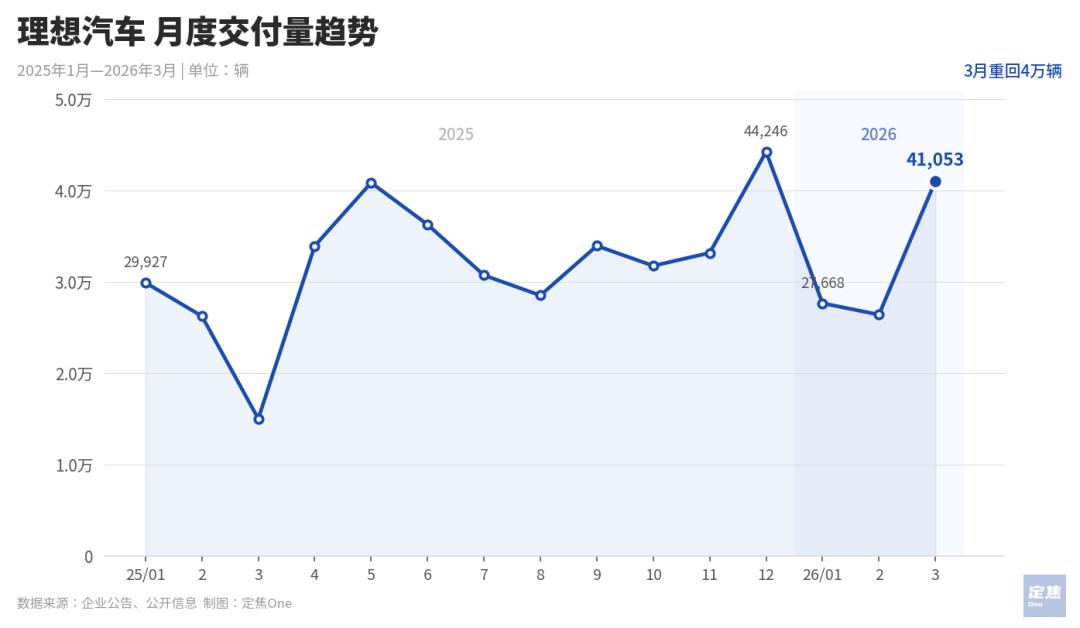
As in February, Li Auto ranked second. Only the gap in delivery volume with the first - ranked Leapmotor widened from less than 2,000 to nearly 10,000 vehicles. However, its delivery volume in March returned to over 40,000 vehicles (41,053 vehicles), which still relieved the practitioners who pay attention to Li Auto. Li Auto achieved double - growth again this month, and the cumulative delivery volume in Q1 reached 95,100 vehicles. This was the first time since 2024 that it exceeded the upper limit of the quarterly delivery guidance (85,000 - 90,000 vehicles).
From the perspective of models, this is attributed to the production capacity release of the pure - electric model i6 (the monthly production reached 20,000 units) and the recovery of i8 orders. Among them, the i6 delivered over 24,000 vehicles, contributing nearly 60% of the sales volume. As for the i8, according to the management, its order volume in March increased by more than 100% month - on - month.
The old - generation L - series extended - range models still face relatively great sales pressure. In order to make room for the launch of the new - generation L9, Li Auto carried out a large - scale inventory clearance promotion for the L - series in Q1 this year, including direct price cuts, purchase tax subsidies, 7 - year low - interest car purchase plans, and inventory clearance at the dealer level starting in mid - March.
This directly lowered the terminal selling price, which will drag down the overall average selling price and gross profit margin. Li Auto's vehicle gross profit margin has long been maintained above 20%, which is one of the most valued financial indicators by the capital market among new - force automakers. However, in Q4 last year, its average selling price (ASP) decreased by 7.1% year - on - year to 250,000 yuan, and the vehicle gross profit margin dropped to 16.8%. For Q1 this year, the management's guidance for the vehicle gross profit margin is about 5%.
The continuous decline in the gross profit margin is not only affected by the L9 inventory clearance but also by the purchase tax subsidy and the increase in raw material costs. An investor who focuses on Li Auto said that the company has set an annual vehicle gross profit margin target of about 15%. "It focuses on sales volume in the first half of the year, and the market will focus on how Li Auto can increase its gross profit in the second half of the year."
In the view of this investor, Li Auto is in the transition period of the product cycle, and inventory clearance promotion is a necessary cost. What is more worthy of attention for this company is whether the new - generation L9 can drive sales and relieve the gross profit margin pressure after its launch in Q2 2026, and whether the "store partner plan" launched by Li Auto at the channel terminal can activate the channel terminal in Q3.
2
NIO Turns Things Around with Large Vehicles
XPeng's Crisis Is Not Resolved
In addition to Li Auto, NIO and XPeng also met their quarterly delivery volume guidance. Among them, NIO delivered 83,465 vehicles in Q1, and its ranking among the six new - force automakers rose to third. In the same period last year, it was at the bottom among the six.
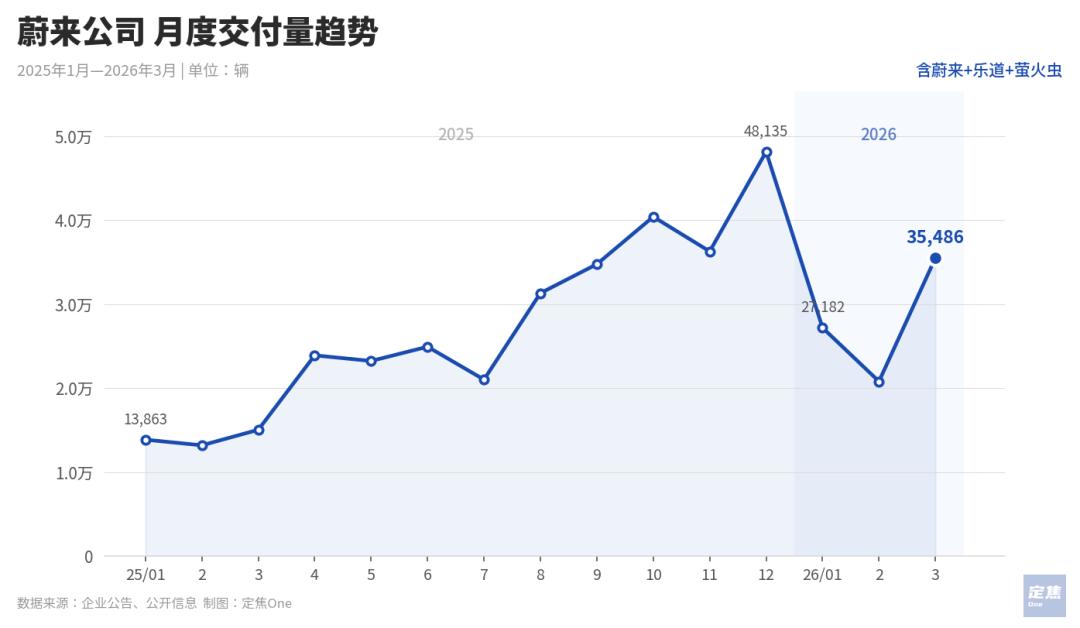
In March, NIO delivered 35,486 vehicles, a year - on - year increase of 136%. Among the six new - force automakers, its year - on - year increase was second only to Li Auto. This is related to the low base in the previous year, but it also shows that the large - vehicle strategy is effective.
In terms of brand composition, the NIO brand delivered 22,490 vehicles in March, LeDao 6,877 vehicles, and Firefly 6,119 vehicles, with a rough ratio of 6:2:2.
NIO's sales recovery this time still relies on the main brand, to be precise, high - gross - profit large pure - electric SUVs. In March, the delivery volume of the new ES8 reached 16,255. That is to say, for every 10 NIO vehicles sold, at least 7 were ES8s.
Since the end of last year, the sales volume of this model has accounted for a very high proportion in the main brand. The outside world's judgment on NIO is: First, use high - gross - profit models to increase the gross profit margin, and then gradually increase the sales volume through the sinking market and sub - brands. NIO achieved single - quarter profitability for the first time in Q4 2025, with the vehicle gross profit margin increasing to 18.1%. Its cash reserve also supports it to continue to launch products, expand channels, and make organizational adjustments.
This logic continued into March. LeDao and Firefly also began to gradually increase their sales volume. The much - anticipated LeDao is still far from "taking on the task of driving sales volume". However, after a significant decline in the delivery volume in January and February, it increased by 130.7% month - on - month in March. Among them, the L90 model delivered 3,360 units in March, and its proportion decreased.
Li Bin revealed a data at the earnings conference: In the second half of 2025, the sales volume of pure - electric three - row SUVs increased by more than 350% year - on - year, while the sales volume of extended - range models decreased by 6%. When the entire industry is focusing on extended - range and small cars, NIO has bet its resources on large pure - electric SUVs. At least for now, the market still has high expectations for the ES8 and the subsequent large - vehicle matrix.
However, NIO still faces sales pressure. In March, the ES8 launched a purchase tax subsidy, and LeDao launched a 7 - year low - interest plan. Next, the launch of new models must be compact: the ES9 will be launched in early April, the 2026 LeDao L90 at the end of April, and the L80 in May is a model that has attracted a lot of market attention.
The market competition is fierce. For NIO to achieve a 40% - 50% sales growth throughout the year, the monthly sales volume in the following months cannot return to the level of over 20,000 vehicles. In particular, the orders for the ES8 cannot slow down, the LeDao L80 needs to drive sales volume, and the SKY stores need to develop the sinking market.
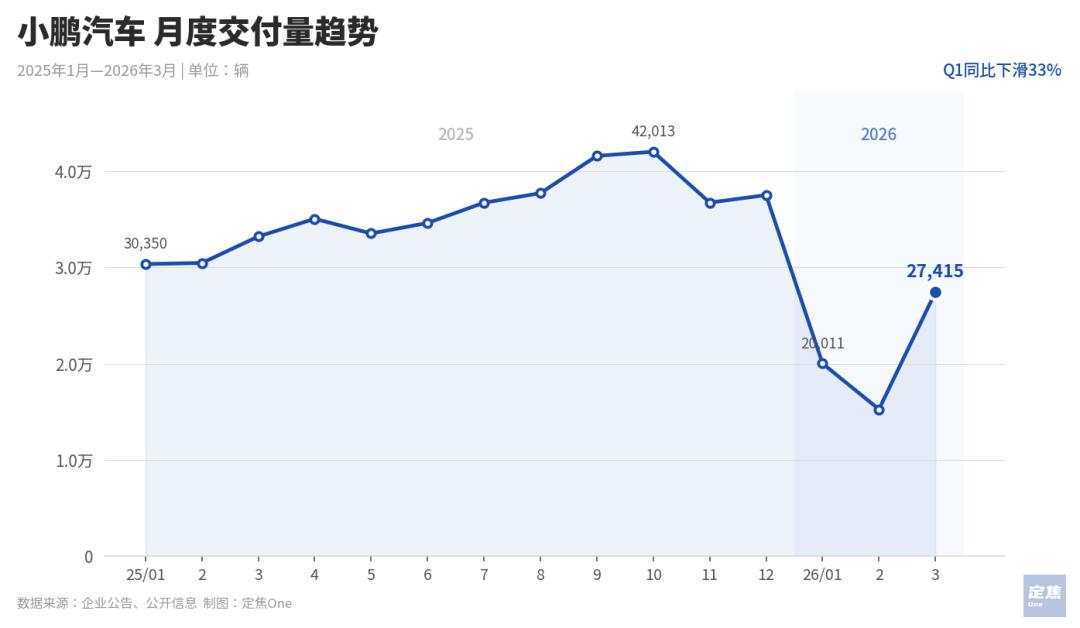
Like NIO, XPeng's monthly ranking is also rising. In the first two months of this year, its monthly delivery volume ranked last among the six new - force automakers. In March, XPeng delivered 27,415 vehicles, a nearly 80% increase from February and a 17% decrease year - on - year, and its ranking rose to fourth.
The sales composition