Robotaxis in China and the US: Sharing the Same Challenges Globally
Even though there is an entire Pacific Ocean between them, sometimes the concerns of the Chinese and American people are similar. Just as the people in San Francisco have just realized that Waymo's self-driving cars need to stop when there are no traffic lights, the people in Wuhan have experienced the temporary halt of the local Luobo Kuaipao vehicles.
According to reports from multiple media outlets, on the evening of March 31st, multiple Luobo Kuaipao vehicles in Wuhan temporarily halted while in motion. The vehicles had their hazard lights on, either remaining stationary or pulling over to the side. The incident did not cause any casualties, and the traffic returned to normal that evening.
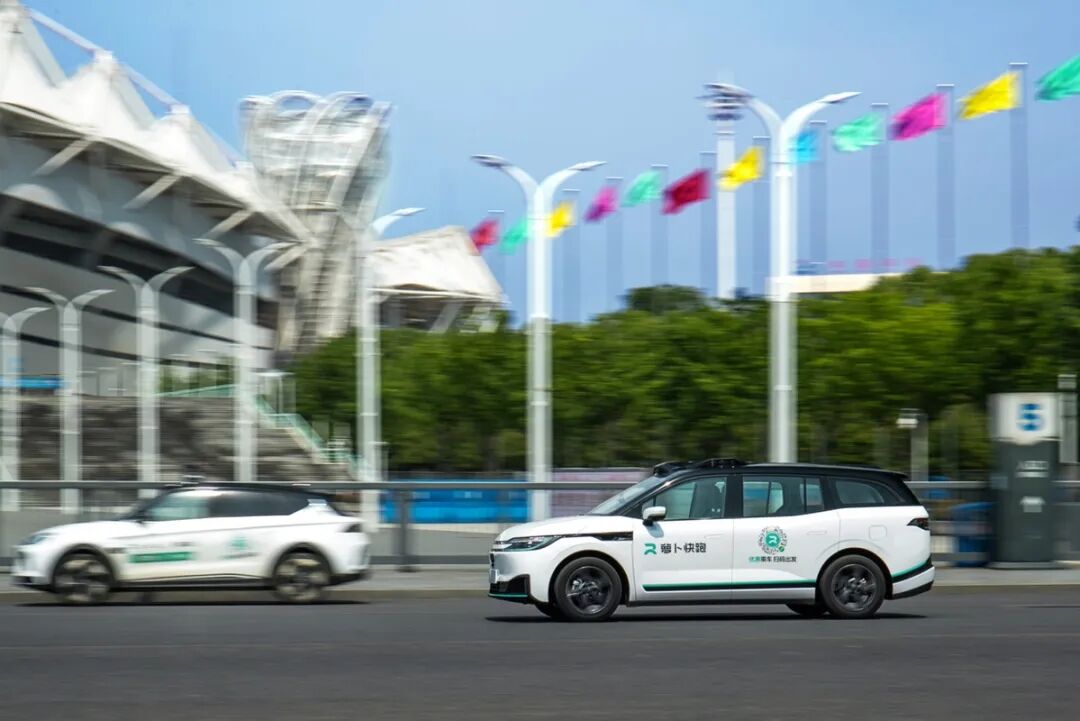
The sixth-generation vehicles of Luobo Kuaipao put into operation in Wuhan
Considering that Luobo Kuaipao and Waymo belong to two AI giants, Baidu and Google respectively, and are both star leading enterprises in the Robotaxi field in China and the United States, yet they have both experienced vehicle halt incidents in the short term. It can be said that the situation is similar across the globe.
Even the reporting tones of Chinese and American media on the incidents are quite similar. Everyone is emphasizing the severity of the incidents and the potential safety risks, and calling for stricter supervision of the Robotaxi industry.
Many reports also refer to the halt of Robotaxi vehicles as a malfunction, and the act of parking itself is regarded as a manifestation of system failure. Some even start to criticize that Robotaxi should not be deployed on a large scale.
It's not that we shouldn't pay attention to the safety risks of Robotaxi. It's always right to be cautiously skeptical about the implementation of any new technology, especially since Robotaxi is directly related to people's driving and personal safety.
However, simply equating vehicle halt with system malfunction and regarding parking as system failure is a bit one-sided. In fact, in the autonomous driving industry, vehicle halt is more of an active strategy for system safety. Pulling over to the side is also the last safety redundancy measure of the system.
The autonomous driving industry has a specific term for this, called "Minimal Risk Condition". When the autonomous driving system determines that there are safety hazards in continuing to drive, the vehicle needs to take active remedial measures, such as actively decelerating, pulling over to the side, or even temporarily halting in the lane, to ensure the safety of passengers and the surrounding environment, and wait for manual intervention or for the conditions to improve.
This is also a hard standard in regulatory regulations. When the Society of Automotive Engineers first formulated the autonomous driving grading standard, it clearly put forward this concept, which has since become a mandatory safety requirement in the autonomous driving industry. In the current domestic industry standards and local regulatory regulations, it is also stipulated that L4 and above autonomous driving systems need to have the ability to automatically execute the minimal risk strategy.
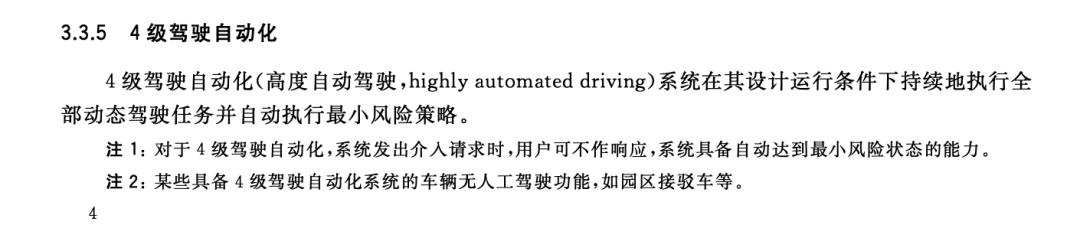
The current domestic grading standard for automotive driving automation, GB/T 40429 - 2021
Previously, Waymo's vehicles had to halt on the road after a large-scale power outage in San Francisco caused the traffic lights to fail. The reason was also the automatic execution of the minimal risk condition.
Waymo responded externally that its system presets the failed traffic lights as a "Four-way stop" scenario. However, due to the unexpected scale of the power outage, it took too long for the vehicles to confirm the safety status of the intersection, which ultimately triggered the minimal risk condition.
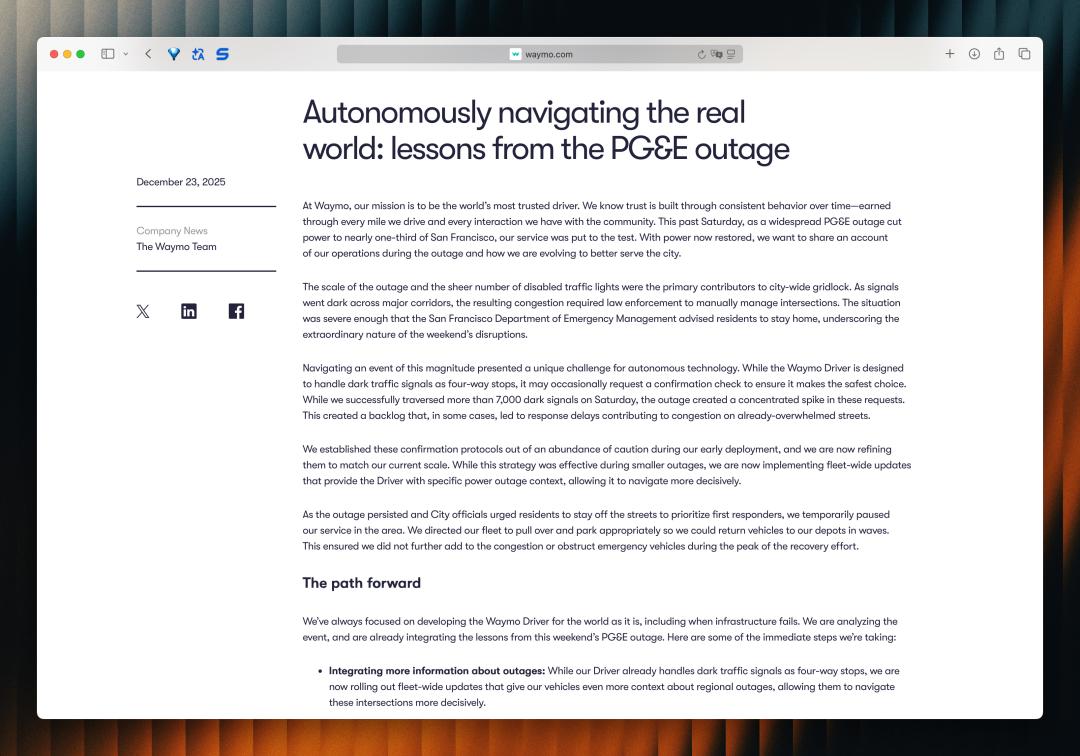
Waymo's official website response
It's really difficult for Waymo. Because the California Department of Motor Vehicles also mandates that vehicles need to automatically enter the minimal risk state after the autonomous driving system fails.
Ordinary people may find it hard to understand why parking is the safest and lowest-risk choice for the autonomous driving system?
You can recall your own experience of driving a car. When encountering an emergency or a vehicle malfunction while driving, the safest thing to do is actually to pull over or even stop directly. When the engine of a traditional car malfunctions, the vehicle will also automatically limit the speed or shut down to protect itself. The minimal risk state of the autonomous driving system is similar.
Autopilot in civil aviation also follows the same design concept. Nowadays, large airliners are generally equipped with autopilots. However, once the system detects sensor abnormalities or encounters situations beyond its processing capacity, the system will automatically downgrade and hand over control to humans. This strategy has been used in the aviation field for decades.
But perhaps Robotaxi is still in the stage of technical verification and large-scale implementation exploration. The industry standards like the minimal risk strategy are not well-known to people, which is why parking is misunderstood as a malfunction or system failure.
Some industry experts have tried to explain the reasons to the public. Zhu Keli, the executive director of the China Information Association and the dean of the New Economy Research Institute, said, "Whether it was Waymo's self-driving cars halting in place when the traffic lights failed last year or Luobo Kuaipao's active halt this time, they all belong to the safety mechanism of the minimal risk strategy operation, which reflects that the autonomous driving system chooses the most conservative exit strategy in the face of uncertainty."
However, in the emotional public opinion field, such voices are often drowned out. People always warmly welcome the arrival of technological innovation with open arms, but often are not willing to give it room to make mistakes. However, the application and implementation of new technologies have never been achieved overnight. We always have to go through continuous trial and error, attempts, and even setbacks.
The power industry has developed for hundreds of years, and there are still occasional power outage malfunctions. Even though the Internet is so popular nowadays, network services still go down from time to time. The autonomous driving industry is still in its early stage of development. Objectively speaking, one or two accidental incidents without casualties are within the understandable range.
People's attitudes towards autonomous driving on the Internet are often polarized. Some think it is completely reliable, while others think it is a complete failure. But in reality, the situation is often in the middle. Autonomous driving is not that reliable, but it is not that much of a failure either. In the past few years, Robotaxi has encountered many unexpected situations during operation, but there have been few serious accidents. Most of them are just short halts or abnormal parking under the minimal risk strategy.
In fact, compared with Waymo in the United States, which often makes headlines due to accidents, domestic autonomous driving companies have been quite cautious in terms of safety. However, even so, technological iteration cannot be smooth sailing. The more cutting-edge the technology is, the more it needs to be tested on real roads and continuously corrected in accidental scenarios.
At a time when the competition in autonomous driving between China and the United States is becoming increasingly fierce, this is particularly important. Waymo has deployed more than 2,500 self-driving cars in the United States, covering several cities such as Los Angeles, San Francisco, Phoenix, and Austin. According to the data released by Waymo, its weekly fully driverless service volume has reached 450,000 orders, and it plans to reach one million orders this year.
Luobo Kuaipao has provided more than 20 million services globally so far. In addition to achieving fully driverless commercial operations in Wuhan, Chongqing, Shenzhen and other places, it has also entered international markets such as Hong Kong, Dubai, and Abu Dhabi.
The competition in the autonomous driving field is far from just about the competition for market share in the transportation market. Behind the global competition between these two star companies is the technological contest between China and the United States in this field. Whoever can achieve large-scale commercial implementation first will gain an advantage in the future technological standards of the physical world.
In this race, perhaps a short halt of either side is not worth being magnified infinitely. Waymo resumed normal services in the San Francisco area the day after the large-scale halt, and recently officially launched the passenger service to and from San Francisco International Airport.
To maintain China's leading position in this key field, what is needed may not be the over - magnification of a single event, but continuous policy support and social tolerance, allowing the technology to continuously iterate and evolve rapidly in real scenarios.
In 1999, when the Internet was not yet so popular, Douglas Adams said in his article "How to Stop Worrying and Love the Internet":
"Another problem with the Internet is that it is still a 'technology'. And as the computer scientist Bran Ferren's classic definition goes, 'technology' is 'something that doesn't quite work yet'."
"We no longer regard chairs as technology; we just see them as chairs. But there was a time when we didn't know how many legs a chair should have, how high it should be, and often had problems sitting on them."
"It won't be long before computers will be as common and unremarkable as chairs, and we won't even be aware of their existence."
In the near future, we may get used to the arrival of autonomous driving just as we have gotten used to the Internet, and we won't even be aware of their existence.
This article is from the WeChat official account "Shangshan". Author: Wang Bin. Republished by 36Kr with permission.