The delivery cycle has dropped to 7 weeks. The myth of Xiaomi YU7 has come to an end, and the new demand is running out of steam.
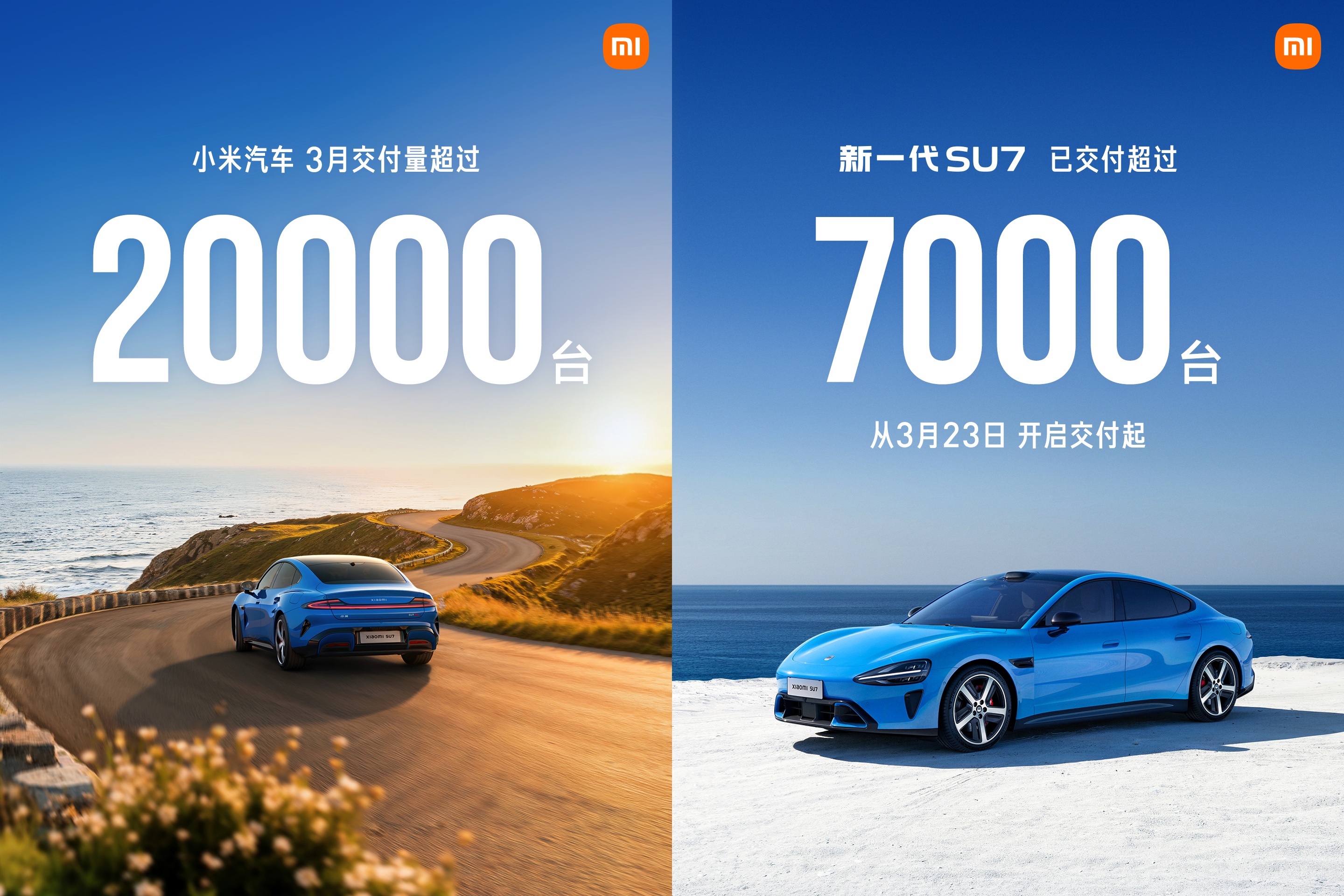
On April 1st, Xiaomi Auto announced its delivery data for March 2026. The cumulative deliveries of all models exceeded 20,000 units, similar to the delivery results in February. Among them, the new-generation SU7, which started deliveries on March 23rd, performed impressively, with cumulative deliveries exceeding 7,000 units in 9 days.
(Image source: Xiaomi Auto)
The YU7, which once delivered 37,869 units in a single month in January this year, has fallen into a dilemma of declining deliveries. The doubts about "not enough YU7 orders" have continued to intensify, and Xiaomi fans and critics have been arguing fiercely.
In February this year, Xiaomi Auto only delivered more than 20,000 vehicles. The explanation given by the media and netizens is that the production of the previous-generation SU7 was stopped, and the Spring Festival holiday affected the production and delivery of Xiaomi Auto.
In March, after the Spring Festival, Xiaomi Auto's sales remained sluggish. Even though the new-generation SU7 delivered more than 7,000 units in 9 days after its launch, the overall sales were the same as in February, dropping out of the top three among new energy vehicle manufacturers. It can be seen that the main problem is not the production stop of the previous-generation SU7 and the Spring Festival, but that there may really be not many YU7 orders left.
Some netizens even believe that Xiaomi recruited Kong Yanshuang, the former general manager of Tesla China, to solve the problem of insufficient vehicle orders.
The initial launch bonus has been exhausted, and there are really not many orders for Xiaomi YU7
The Xiaomi YU7 was launched on June 18th, 2025. Relying on Xiaomi's ecological user base, a starting price of 253,500 yuan, and Lei Jun's marketing support, the orders for this car increased explosively. Three minutes after the YU7 was launched, the large orders exceeded 200,000 units, reaching 289,000 units in one hour and exceeding 240,000 units in 18 hours.
Supported by a large number of orders, the delivery volume of the YU7 climbed rapidly. In January 2026, taking advantage of the Spring Festival consumption peak season, it delivered 37,869 units in a single month, ranking first in the sales of mid - to large - sized SUVs in the domestic market and helping Xiaomi rank among the top three in the sales of new energy vehicle manufacturers.
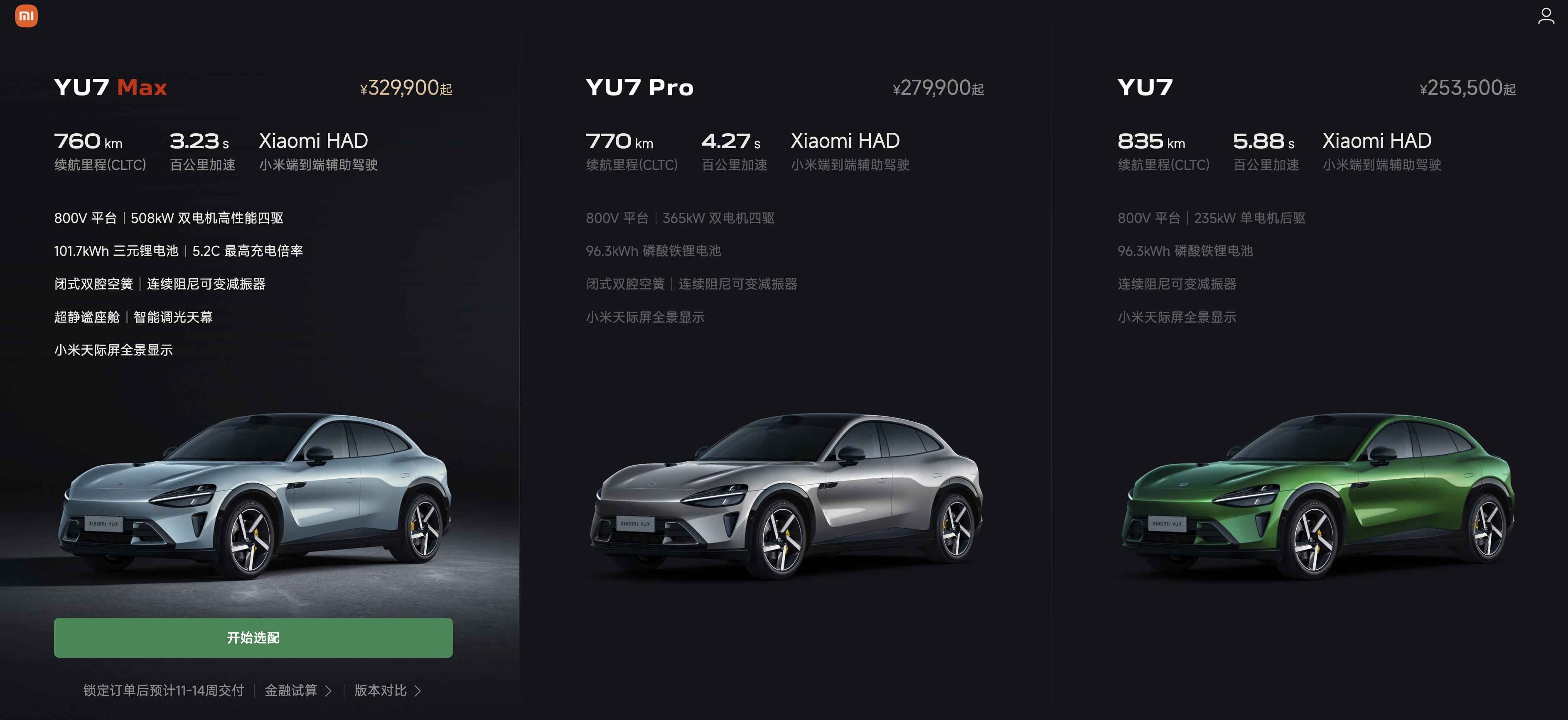
At the beginning of its launch, the estimated delivery cycle of the standard version of the YU7 was as long as 53 - 56 weeks, the Pro version was 48 - 51 weeks, and the Max version was 33 - 36 weeks. Now, the official website of Xiaomi Auto shows that the delivery cycle of the standard version of the YU7 is 7 - 10 weeks, the Pro version is 9 - 12 weeks, and the Max version is 11 - 14 weeks. Behind the significant shortening of the delivery cycle, it may be affected by Xiaomi's production capacity ramp - up, but it is more likely that there are not many orders left.
(Image source: Xiaomi Auto)
According to the data announced by Xiaomi Auto, around February this year, the cumulative deliveries of the Xiaomi YU7 exceeded 200,000 units, and there are few orders left from the first batch of locked - in orders.
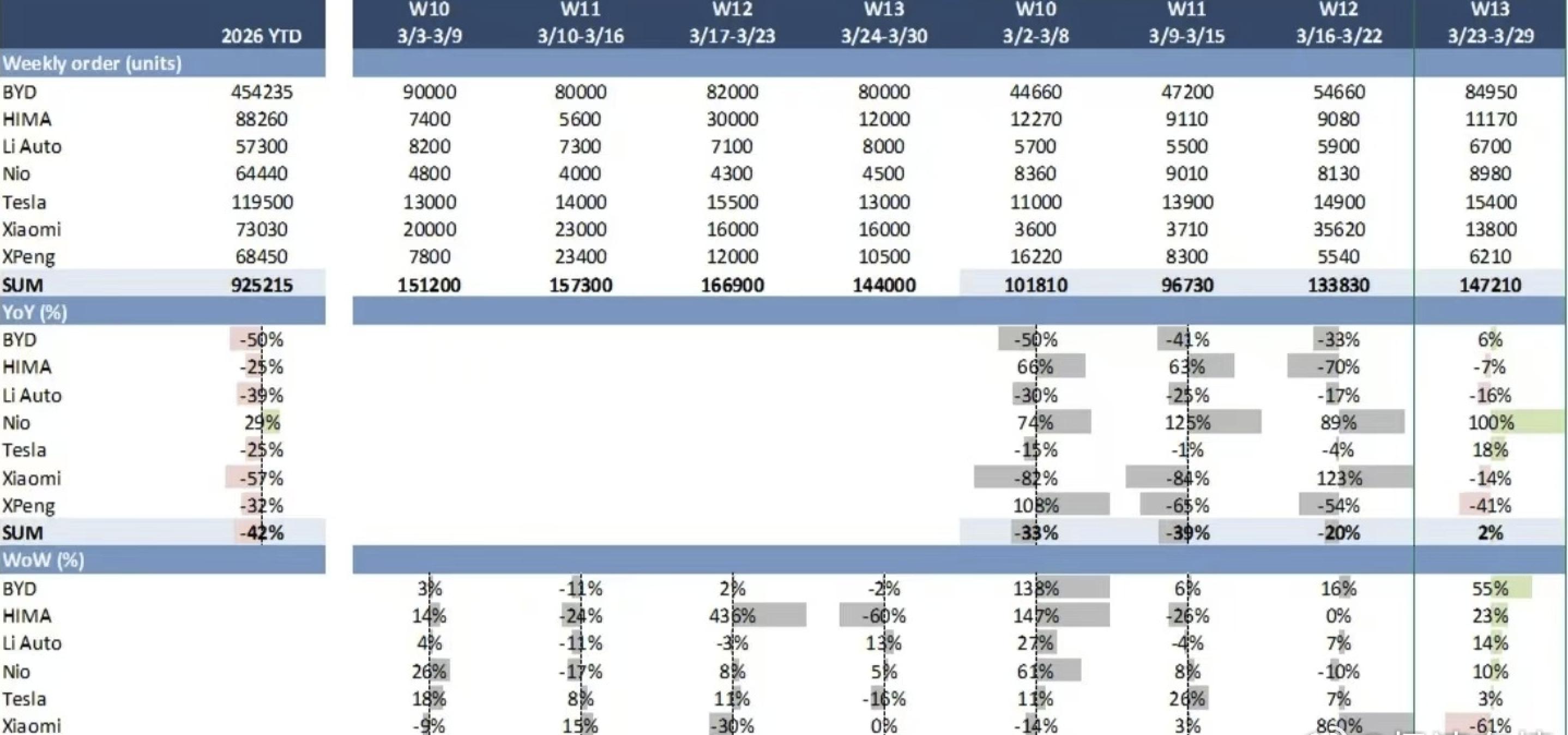
According to the data released by Goldman Sachs, at the beginning of March, the weekly orders of Xiaomi Auto dropped back to around 4,000 units. Even if we consider that the previous - generation Xiaomi SU7 has stopped production and all these orders are for the YU7, the monthly orders of this car are only less than 20,000 units, which is significantly different from the peak monthly sales of nearly 38,000 units.
The Xiaomi YU7, which created a myth at its initial launch, has only completed the delivery of the initial launch orders, and there has been a serious decline in sales, obviously lacking in stamina. Some people may think that the Xiaomi SU7, which took over from the YU7 and delivered more than 7,000 units in 9 days after its launch, can help Xiaomi support its sales. But is it really that simple?
The SU7 alone is hard to support, and the annual target is hanging
The new - generation Xiaomi SU7 performed impressively at its initial launch. It locked in 15,000 orders in 34 minutes, exceeded 30,000 orders in 3 days, and delivered more than 7,000 units in 9 days. However, relying solely on this model, it is difficult for Xiaomi to achieve its annual target of delivering 550,000 vehicles. The limitations of a single blockbuster are becoming more and more obvious in the stock competition.
The most crucial thing is that the new - generation SU7 may still not be able to get rid of the "dependence on initial launch orders". According to the data released by Goldman Sachs, in the 13th week of 2026 (from March 23rd to March 29th), the order volume of Xiaomi Auto was 13,800 units, a 61% decrease from the previous week and a 14% decrease year - on - year.
(Image source: Goldman Sachs)
The month - on - month decline is understandable, after all, the new - generation Xiaomi SU7 was launched in the previous week. However, the year - on - year decline in weekly orders compared with the 13th week of 2025 indicates that the newly launched Xiaomi SU7 has already shown signs of lacking stamina even when its popularity is high.
At the end of 2025, Lei Jun clearly stated that the delivery target for 2026 was 550,000 vehicles, a 33.5% increase compared with 412,000 vehicles in 2025. This is the key for Xiaomi to compete among the top new energy vehicle manufacturers. However, from January to March 2026, Xiaomi's cumulative deliveries were about 80,000 units, only 14% of the target. In the remaining 9 months, it needs to deliver about 470,000 units, with an average monthly delivery volume of more than 52,000 units, which is extremely difficult.
Xiaomi Auto, which has been established for a relatively short time, has not yet expanded its product line. Currently, its product sales rely on blockbusters and initial launch orders. It can even be said that the core competitiveness of Xiaomi Auto is not its product strength, but Lei Jun's influence in China and the value of the Xiaomi brand.
Just as the identity of a family car has trapped Li Auto and the battery - swapping model has restricted NIO, Xiaomi needs a major transformation to break the shackles of its identity.
Expand the product matrix to break the dependence on blockbusters
Facing the pressure of orders and the hanging target, Xiaomi has long realized the disadvantages of relying on a single blockbuster. It is making efforts in two aspects: expanding the product matrix and upgrading the marketing system. The intensive launch of new models in 2026 and the joining of Kong Yanshuang are the keys to breaking the deadlock.
Xiaomi's current core shortcoming is a single product matrix. There are only two models, the SU7 (including the Ultra version) and the YU7, covering a limited customer group and price range. Therefore, Xiaomi plans to launch 4 - 6 new models in 2026, covering pure - electric/extended - range, sedans/SUVs, 5 - seat/7 - seat, and a price range of 200,000 - 550,000 yuan, forming a dual - track layout of "pure - electric + extended - range" to fundamentally solve the problem of insufficient subsequent orders.
(Image source: filmed by Electric Vehicle News)
In the pure - electric sedan camp, Xiaomi Auto will add an executive extended - wheelbase version of the SU7 (with an estimated price of 300,000 - 350,000 yuan). The body is extended by 150mm to optimize the rear - seat comfort, targeting the Audi A6L and Tesla Model S, and aiming at business and high - end family users. In the pure - electric SUV camp, the YU7 GT high - performance version (with an estimated price of 450,000 - 500,000 yuan) will be launched. This car has completed the declaration with the Ministry of Industry and Information Technology, is equipped with a dual - motor four - wheel drive system, and has a comprehensive system power of up to 738kW, targeting performance enthusiasts.
The extended - range SUV camp is a new layout for Xiaomi. It plans to launch 3 models: the YU5 (internal code name "Kunlun N1", with an estimated price of 250,000 - 300,000 yuan, a mid - sized 5 - seat SUV), targeting the Li L7 and Wenjie M7; the YU7 extended - range version (internal code name "Kunlun N2", with an estimated price of 350,000 - 400,000 yuan, a mid - to large - sized 5 - seat SUV), targeting the Li L8 and Wenjie M8; the YU9 (internal code name "Kunlun N3", with an estimated price of 450,000 - 550,000 yuan, a full - size 7 - seat SUV), targeting the Li L9 and Wenjie M9.
In addition, Xiaomi previously exposed a model named SU5. Judging from the naming, this car is most likely an affordable version of the SU7, belonging to a B - class pure - electric sports sedan, and the price may be around 200,000 yuan.
This full - matrix layout can form order complementarity through different models. Extended - range models can solve the range anxiety, 7 - seat models can meet family needs, and low - priced models can expand the user base.
The joining of a Tesla executive makes up for the shortcoming of "emphasizing products and neglecting marketing"
For a long time, Xiaomi Auto has relied on "Lei Jun's promotion + Xiaomi fans' purchases" and lacks a mature sales system and channel layout. This is an important reason for the insufficient orders after the initial launch bonus is exhausted.
Kong Yanshuang, who once served as the general manager of Tesla China and was responsible for the layout of the sales system and brand promotion, joined Xiaomi Auto in March this year, replacing the former Xiaomi Auto director Li Xiaorui and being responsible for the work related to car sales. Maybe she can make up for this shortcoming of Xiaomi Auto.
Electric Vehicle News believes that Kong Yanshuang needs to help Xiaomi achieve the following three major goals.
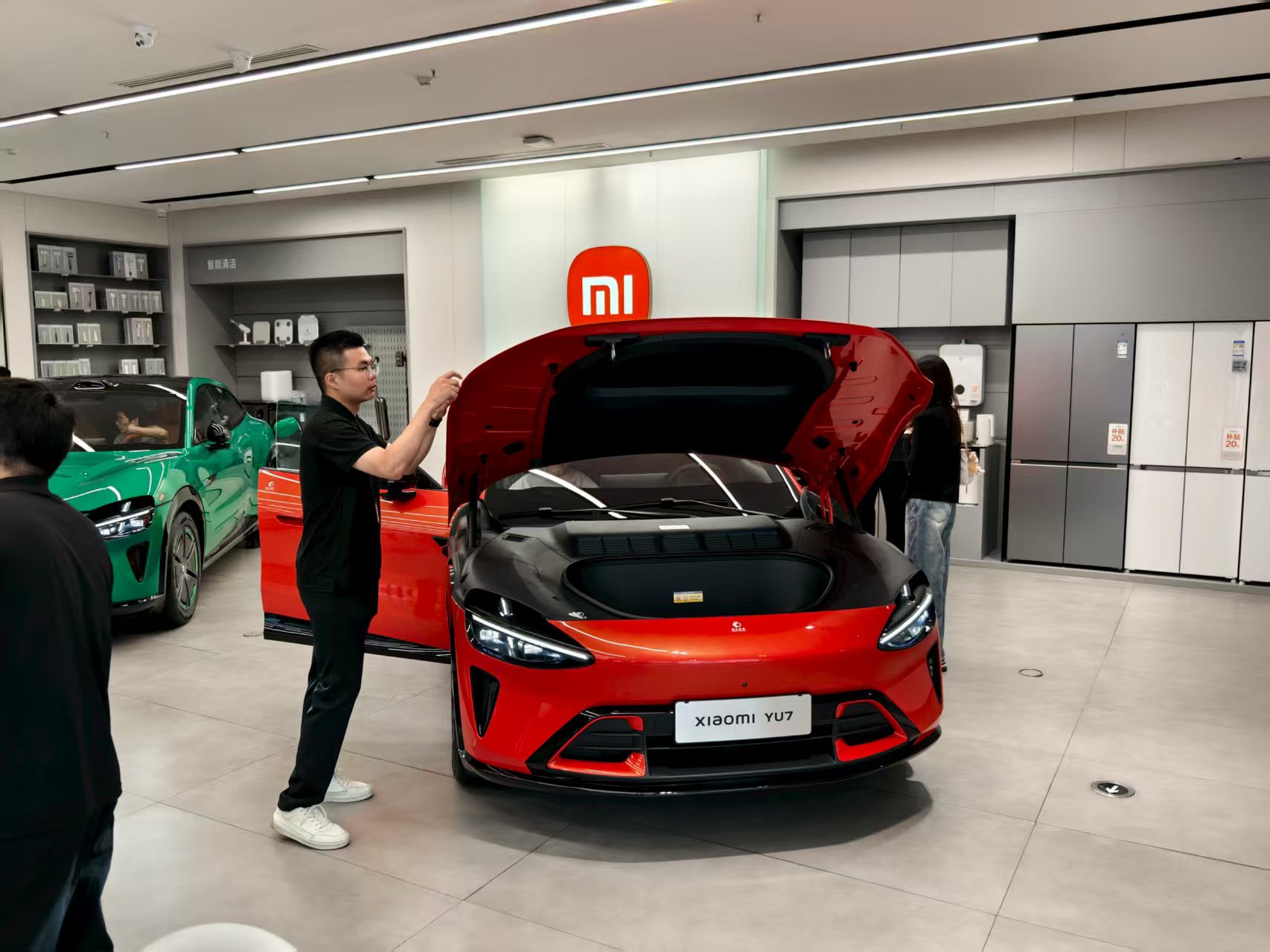
First, standardize the sales system to improve terminal conversion. Kong Yanshuang will replicate Tesla's experience and establish a full - process standard for "customer acquisition - test drive - placing an order - delivery - after - sales service", standardize the sales pitch and assessment, and strengthen sales training to solve the problem of "many customers visiting the store but few placing orders".
(Image source: filmed by Electric Vehicle News)
Second, accelerate the sinking of channels to expand the coverage area. According to Xiaomi's official information, as of March 2026, Xiaomi Auto only had 274 service outlets, covering 160 cities, and the coverage in third - and fourth - tier cities and county - level markets was insufficient. Kong Yanshuang will lead Xiaomi Auto to lay out a large number of offline outlets on a large scale, using the stores as the center of offline influence to improve the effect of breaking into new markets.
Third, promote the brand to break into new markets and reach the general public. According to the data released by the research institution Jielanlu, the average age of Xiaomi YU7 owners is only 27.7 years old, and most of them use Xiaomi or Apple mobile phones. Being young and wealthy is a common feature of current Xiaomi car owners.
Kong Yanshuang is expected to promote the transformation of the brand from "tech geeks" to "family - oriented technology and mass intelligence". Through scenario - based experiences, exclusive configurations for women, and cooperation with shopping malls, she can improve public awareness and reduce the dependence on Xiaomi fans.
Automobile manufacturers need time to develop. Since Xiaomi officially announced its entry into the automobile industry, it has only been five years, and its sales system is not yet perfect.
Kong Yanshuang has been in the automobile industry for a long time and has the ability to build a mature sales system and carry out marketing promotion. On the basis of the strong influence of the Xiaomi brand, she is expected to replicate Tesla's success in the Chinese market.
Say goodbye to the dependence on blockbusters, and Xiaomi's long - term battle has just begun
Xiaomi's current dilemma is obvious. The decline in YU7 orders is due to the exhaustion of the initial launch bonus and insufficient subsequent customer acquisition. The limitations of a single blockbuster are prominent, and it is difficult for the new - generation SU7 alone to support the target of 550,000 vehicles.
However, Xiaomi's direction to break the deadlock is clear. On the product side, it relies on a full - matrix coverage to break the dependence on blockbusters. On the marketing side, it relies on Kong Yanshuang to optimize the system and promote the brand to break into new markets.
The new energy vehicle market has entered the era of "systematic competition" from "single - product blockbuster competition". The days of relying on a single model and a wave of bonuses to gain a foothold are gone. Leading manufacturers such as Tesla, BYD, Li Auto, and XPeng are all accelerating the improvement of their product matrix and optimizing their systems. If Xiaomi wants to stand out, it must completely say goodbye to the dependence on blockbusters and build a perfect product, marketing, and service system.
For Xiaomi, the dilemma of the YU7 is an opportunity for transformation, and the target of 550,000 vehicles is the driving force for upgrading. The glory of the YU7 proves Xiaomi's product strength and ecological advantages, and the current dilemma forces Xiaomi to accelerate