Is it time to reevaluate Meituan?
On March 26, Meituan released its full - year and fourth - quarter financial reports for 2025. Just one day before the release of the financial reports, the regulatory authorities reposted an article titled "The Food Delivery War Should End" from Economic Daily. The fierce "food delivery war" finally came to an end.
There was no real winner in this food delivery war. The participants in the industry burned through more than 150 billion in profits in total, but there was no substantial transformation in the industry's business model. Meituan also paid a heavy price for this: its performance turned from profit to loss, with an annual net loss of 23.4 billion yuan. The core local business segment, which is the cornerstone of the company, exhausted all its profits, recording an operating loss of 6.9 billion yuan.
However, this financial report did not cause any fluctuations in the stock price. On the one hand, the previous performance forecast had prepared the capital market psychologically. More importantly, the market had already shifted its focus to the post - war situation. The regulatory stance put the brakes on the price war again. Under this clear regulatory stance, Meituan's stock price soared by 14% at one point, and the market voted in favor of the end of the war.
So, what other key points in Meituan's financial report are worth paying attention to? How will the company's investment logic unfold in 2026?
01
The Core Local Business Withstood the Pressure
Reviewing Meituan's data for the fourth quarter of 2025, after the fierce food delivery war in Q3, Meituan, as the defending party, successfully stabilized its position.
First, on the revenue side, the performance growth rate saw a mild recovery. The financial report shows that in the fourth quarter of 2025, Meituan achieved a cumulative operating revenue of 92.1 billion yuan, a year - on - year increase of 4% (better than the 2% in the third quarter). Further analysis reveals that the revenue of the core local business decreased slightly by 1% year - on - year, an improvement compared to the 2.8% decline in the third quarter, which was the main reason for the recovery of the revenue growth rate.
However, the decline in the revenue of the core local business was in contrast to the market's perception of "exploding food delivery orders". The core reason lies in the financial treatment of subsidies. Part of the food delivery subsidies issued by the platform is included in the sales expenses, and the other part directly offsets the operating revenue (such as delivery service revenue and commissions).
According to statistics from CICC, the number of Meituan's food delivery orders in the fourth quarter increased by as much as 11% year - on - year. However, due to the drag of subsidy offsets, the actual recognized delivery service revenue decreased by 10% year - on - year, leading to a decline in the revenue of the core local business. Therefore, from the perspective of operating revenue, if the impact of subsidy offsets is not considered, Meituan could actually achieve a higher performance growth rate.
The market share also provides data support: Calculated by the GTV (Gross Transaction Value) standard, the company still occupies more than 60% of the market share.
On the profit side, Meituan also significantly reduced its losses in the fourth quarter. In the fourth quarter, the operating loss of the core local business was 10 billion yuan, a significant narrowing compared to the 14.1 billion yuan in Q3. Considering that the revenue of the core local business in the fourth quarter (64.8 billion yuan) was basically the same as that in Q3 (67 billion yuan), this more than 4 - billion - yuan reduction in losses on a quarter - on - quarter basis fully demonstrates that the narrowing of the operating loss is not simply due to scale expansion but is a direct result of the company's active efforts to improve operating efficiency.
Beyond the financial data, Meituan's business layout in instant retail was not affected by the food delivery war. Through innovative models such as brand official flagship lightning warehouses and self - operated front - end warehouses, it promoted the expansion of the "30 - minute everything home" service from food delivery to various categories such as daily necessities and 3C digital products.
At the earnings conference, Meituan disclosed that its alcohol business achieved rapid growth through close cooperation with top - tier alcohol brands. In the field of medical and health, the company continued to strengthen the local supply of commonly used household medicines and medical devices, supported the online launch of many innovative drugs, and further expanded the coverage of 24 - hour pharmacies, online consultations, and home testing services.
At the same time, Meituan still adheres to the concept of ecological win - win and continues to increase efforts to protect the rights and interests of riders, merchants, and consumers. For merchants, Meituan vigorously promotes the construction of "transparent kitchens" and continuously encourages merchants to open live - streaming of their kitchens through hardware subsidies and cash incentives. For riders, Meituan has taken the lead in providing endowment insurance subsidies for riders across the country and launched the industry's first endowment insurance plan covering all types of riders.
02
The New Business Broke Through the 100 - Billion Mark
While the market was focused on the subsidy war in the core local business, Meituan's new business segment quietly achieved a historic breakthrough.
The financial report data shows that the annual revenue of Meituan's new business segment (mainly overseas expansion and Xiaoxiang Supermarket) reached 104 billion yuan, a year - on - year increase of 19%, breaking through the 100 - billion mark for the first time.
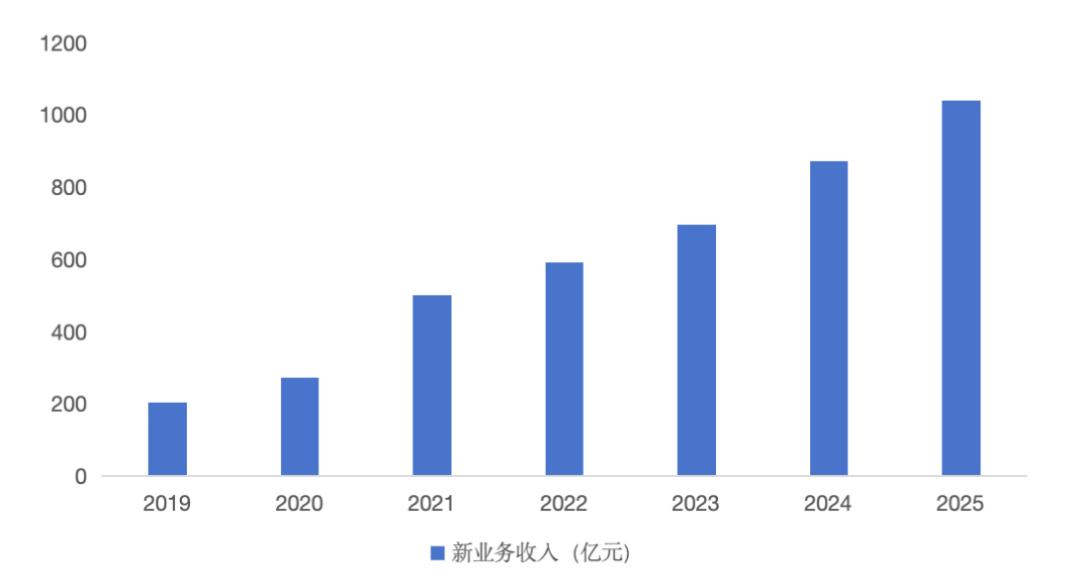
The achievement of this milestone is inseparable from the accurate grasp of industry trends. In recent years, the return to offline and near - field retail has gradually become a consensus in the retail industry. Whether it is Walmart's launch of community stores, Dongfang Zhenxuan's announcement of opening offline stores, or the accelerated layout of offline stores by Qixian and Hema, all these confirm this trend. In this wave of near - field retail, Xiaoxiang Supermarket is not only a core participant but also a key part of Meituan's grand "everything home" blueprint.
According to the disclosure, Xiaoxiang Supermarket has been continuously deepening its underlying supply chain. While continuously strengthening the moat of fresh produce quality, it is accelerating its national expansion. As of the end of 2025, it has successfully covered 39 core cities across the country. From a strategic perspective, with the high - frequency fresh produce business as its foundation, Xiaoxiang Supermarket can expand its product categories to standard product fields such as snacks, daily cleaning products, personal care and beauty products, alcoholic beverages, and even some 3C home appliances, effectively complementing the supply depth of instant retail in self - operated products.
If Xiaoxiang Supermarket is taking root in the domestic retail market, then Keeta's all - round expansion is reaching out to the overseas market. In terms of overseas expansion, Keeta's global layout is accelerating. After entering the Hong Kong Special Administrative Region of China and Saudi Arabia, in the second half of 2025, Keeta further entered Qatar, Kuwait, and the United Arab Emirates, covering the major countries in the Middle East Gulf region, and also started operations in Brazil.
While expanding rapidly in scale, Keeta's business model is also continuously being optimized. According to the company's disclosure, in the fourth quarter, Keeta successfully achieved positive UE (Unit Economic) in the Hong Kong market; in Saudi Arabia, Keeta's orders grew at a high speed throughout the year, making it one of the most popular platforms in the local area. Keeta is expected to achieve positive single - month UE in Saudi Arabia by the end of 2026, taking less time than the 29 months in Hong Kong.
03
The Imagination Turns to AI
Since 2026, the popularity of OpenClaw has greatly promoted the commercialization process of AI, and "Token economics" has swept the global market. However, when the public's attention is generally focused on cloud providers and independent large - model enterprises, Meituan is often still regarded as a traditional consumer - internet platform, thus ignoring its layout in the AI field. In fact, AI is also the key to breaking through Meituan's future valuation ceiling.
Meituan's AI strategy is not just empty talk. According to the earnings conference call, since 2023, the company has made large - scale investments in capital expenditure and the recruitment of top AI talents. In 2025, Meituan's R & D investment reached a new high, increasing by 23% year - on - year to 26 billion yuan, and the R & D expense ratio has exceeded 7%.
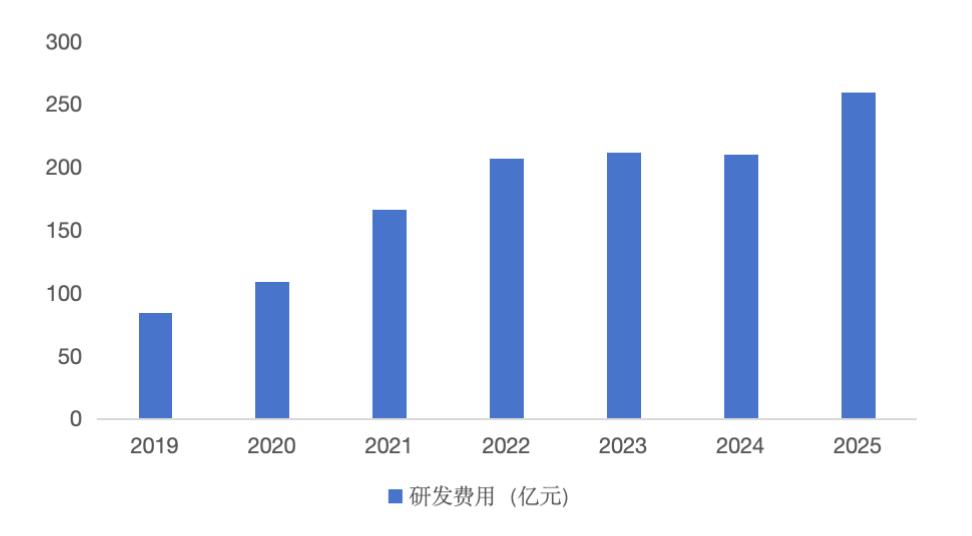
Figure: Changes in Meituan's R & D expenses. Source: Wind, 36Kr compilation
Different from many current enterprises keen on building "Token factories" or general large models, Meituan's AI path is unique: It is committed to building an AI foundation and action capabilities in the physical world. This strategy is not deliberately seeking differentiation but is based on the reality of the local service industry, which is "highly non - standard and complex in delivery".
In the local life scenario, a large amount of merchant information is extremely scattered, and a large amount of data has not been effectively digitized. At the same time, the platform also needs to conduct fine - grained control over offline fulfillment and delivery. This means that Meituan's AI not only needs a "brain" to understand the complex needs and data of the real world but also needs "limbs" to execute complex offline tasks.
To this end, Meituan has built deep - seated ability barriers at both the software and hardware levels:
At the software level, it promotes the in - depth integration of large models with real - world physical data. Relying on a large amount of merchant POI data, dynamic operation data, and real local service user evaluations, combined with the self - developed multi - modal LongCat series of large language models and open - source models, Meituan has launched the AI assistants "Xiaomei" and "Xiaotuan" for users, enabling AI technology to be truly applied in real consumption scenarios.
Taking "Xiaotuan" as an example, it can quickly extract high - value information from a large number of online evaluations, accurately infer and meet users' personalized needs. Data shows that during the Spring Festival in 2026, more than 100 million users planned their food, entertainment, and consumption through "Xiaotuan". "Xiaotuan" verified 700 million times of national merchant information in total and carried out secondary calibration based on 1.3 billion real user evaluations, driving offline consumption growth.
At the hardware level, it continuously increases investment in fulfillment technology to empower offline delivery with AI. Meituan has been continuously increasing its investment in fields such as drones and robots. As of the end of 2025, Meituan's drones have opened 70 routes in multiple cities at home and abroad, with a cumulative number of completed orders exceeding 780,000. The exclusive "meal delivery for the elderly" route recently opened in Ting Kok Village, Hong Kong, has reduced the original 1.5 - hour cross - sea and mountain - entering journey to 10 minutes. In cities such as Guangzhou, Shenzhen, Shanghai, and Suzhou, low - altitude medical delivery routes are in regular operation, efficiently transporting test samples and emergency supplies.
Overall, Meituan has built a deep AI moat around its local life business. As Wang Xing said at the financial report conference call, in the future, Meituan will continue to deepen the integration of "Xiaotuan" with the Meituan App and strive to upgrade it to an "AI - powered App" first, making it a super AI entry for future local life needs. In this AI wave, Meituan is not only present but also one of the most hardcore in - depth participants.
04
Entering a New Narrative
Overall, under the extreme pressure of the 2025 food delivery war, Meituan not only firmly defended the foundation of its core business but also pushed its new business into the "100 - billion club". The "everything home" and overseas expansion blueprints are advancing simultaneously.
Looking forward to 2026 or the longer term, the company's investment and valuation logic are expected to change:
First, the market's negative expectations for the food delivery war have been fully priced in. Under the dual effects of clear regulatory signals and stable financial data, the intensity of industry competition is no longer the primary contradiction suppressing the valuation. According to the company's guidance in the conference call, the average loss per order of food delivery in the first quarter of 2026 is expected to continue to narrow, which further confirms that the old performance burden is being gradually removed.
With the removal of the old suppressing factors, the market will naturally shift its focus to the new variables that determine the company's long - term value - that is, the opportunity for industry model reshaping brought by AI technology. When Meituan's AI assistant is more deeply embedded in the consumption scenario in the App, the company's valuation system is also expected to shift from focusing on the short - term operating performance of the core local business to evaluating the matching degree between AI and real - world consumption scenarios and long - term commercialization potential.