Research on the origins of Chinese unicorns: 64% are from independent entrepreneurship, and 32% are incubated by large enterprises/central state-owned enterprises.
If there is no restriction on the establishment time of companies, and only the criteria of reaching a valuation of $1 billion, receiving external equity investment, and being unlisted are considered - as of 2025, there are 469 unicorn enterprises on the list in China, with a total valuation of $2.05 trillion. This data shows the huge capital capacity and market potential of China's innovative economy.
When we shift our focus from the valuation figures to the "origins" of these enterprises, a map of the evolution of China's innovation and entrepreneurship genes unfolds:
64.6% of the unicorns are independently founded by entrepreneurial teams, 32% are hatched or spun off from large enterprises and central state - owned enterprises, and 3.4% are from university laboratories.
This is not just a simple numerical distribution, but a four - act drama of China's economic transformation from "grassroots entrepreneurship" to "systematic innovation".
In this article, IT Juzi will analyze the establishment background of Chinese unicorn enterprises.
Origin Distribution: A Ternary Structure
An enterprise starts from its establishment, gets support from the capital market through equity investment, and after rounds of financing, reaches a valuation of $1 billion to become a unicorn enterprise. Although they are all star enterprises in the capital market, their "backgrounds" are different.
From the perspective of the distribution of enterprise establishment backgrounds, the Chinese unicorn ecosystem presents a ternary structure characterized by "market - led, organizational supplementation, and academic follow - up".
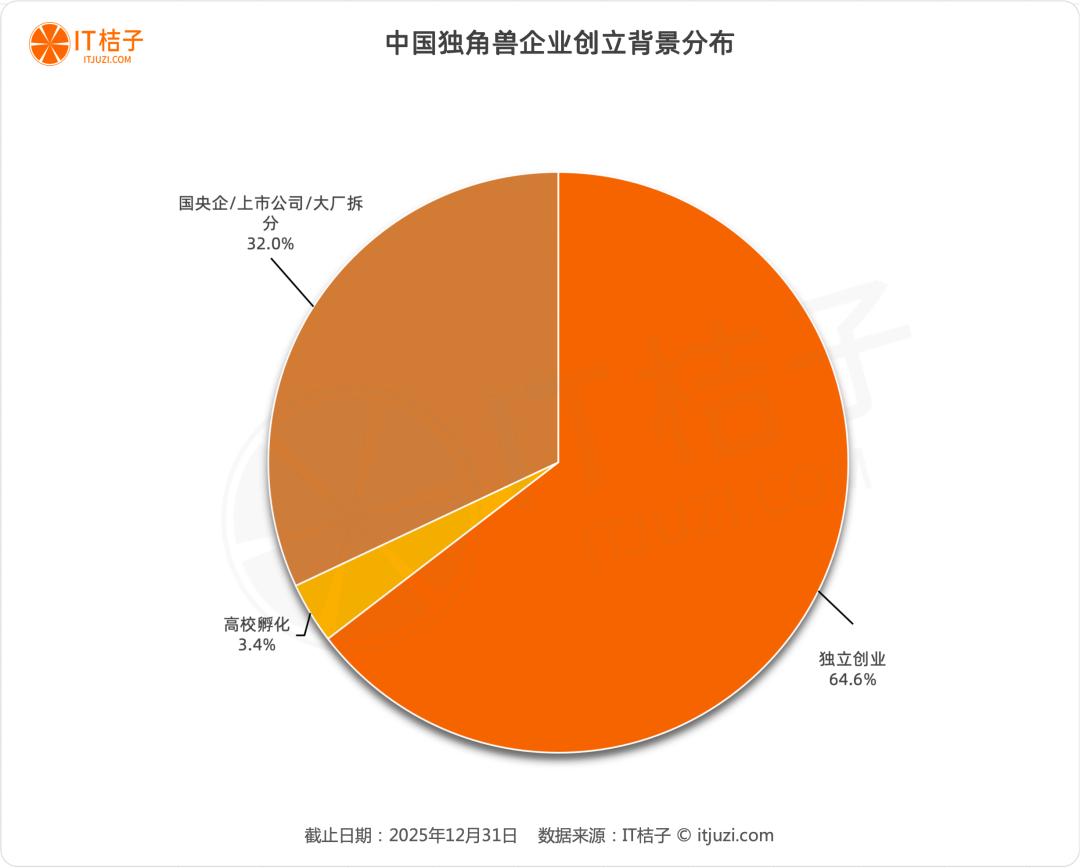
IT Juzi data shows that among the unicorns on the list in 2025, 64.6% were independently founded by entrepreneurial teams. This proportion indicates that despite the tightening capital environment, the original innovation based on individual entrepreneurship is still the mainstream incubation path for China's new economy. Especially in light - asset sectors such as consumer Internet, cross - border e - commerce, and enterprise service SaaS, independent entrepreneurial teams still have significant competitive advantages with their agile decision - making mechanisms and keen capture of terminal demand.
What deserves in - depth attention is the 32% proportion of large - enterprise incubation/spin - off, which includes both Internet technology companies and the incubation and spin - off of state - owned and central state - owned enterprises. This data reveals the rise of China's unique "organizational entrepreneurship" ecosystem.
Behind it is the superposition of three logics: First, the internalization advantage of scenarios and data - Internet giants and central state - owned enterprises (such as State Grid and AVIC) control closed scenarios and massive data, and internal incubation has become the shortest path for technology monetization (such as the spin - off of Alibaba Cloud and the independence of Cainiao Network); Second, regulatory arbitrage and the dividend of mixed - ownership reform - With the encouragement of the Science and Technology Innovation Board and the Beijing Stock Exchange for the spin - off listing of state - owned enterprises, and the relaxation of the transformation of state - owned scientific research achievements in the "Science and Technology Reform Demonstration Action", state - owned research institutes and listed companies have re - evaluated their valuations by spinning off hard - technology subsidiaries, which has become an important source of the increase in unicorns in the past two years; Third, the defensive layout of venture capital - Facing the "talent density" and "computing power/funding moat" of large enterprises, independent entrepreneurial projects face higher competitive barriers. Investment institutions are more inclined to bet on spin - off enterprises with the ability to "bring their own orders" to reduce market verification risks.
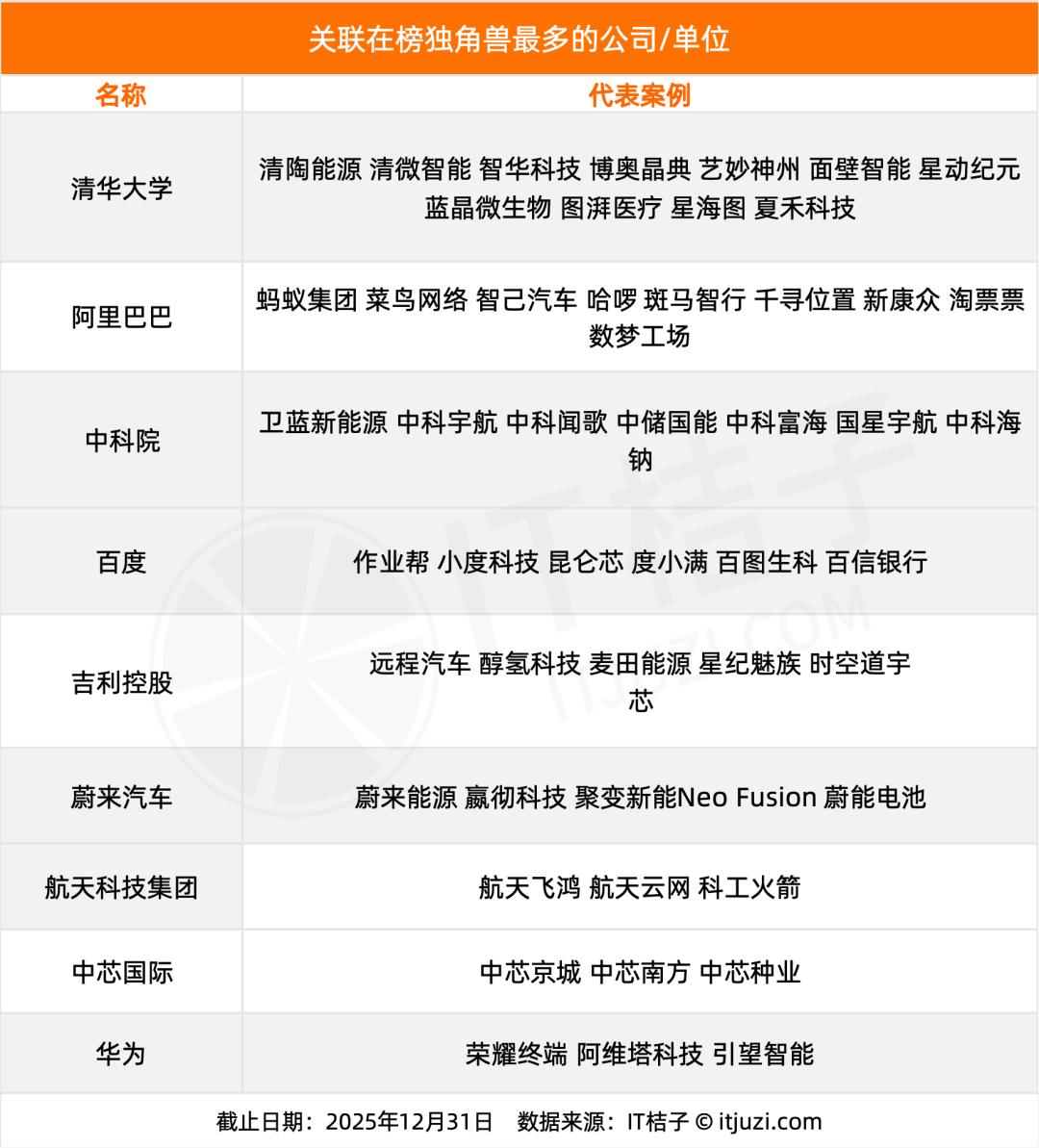
In addition, 3.4% of the unicorns are from the transformation of university scientific research achievements. This proportion is relatively low among the current unicorns on the list. IT Juzi observed that there are 16 unicorn enterprises transformed from university scientific research achievements, among which Tsinghua University has hatched the most unicorns, such as Qingtao Energy, Qingwei Intelligence, Zhihua Technology, Xinghaitu, etc.
Analysis by Time Period: From "Grassroots Entrepreneurship" to "Organizational Entrepreneurship"
We know that the macro - background of the venture capital market has changed significantly over the years. Therefore, the changing trends of the establishment backgrounds of unicorns in different periods are also worth studying.
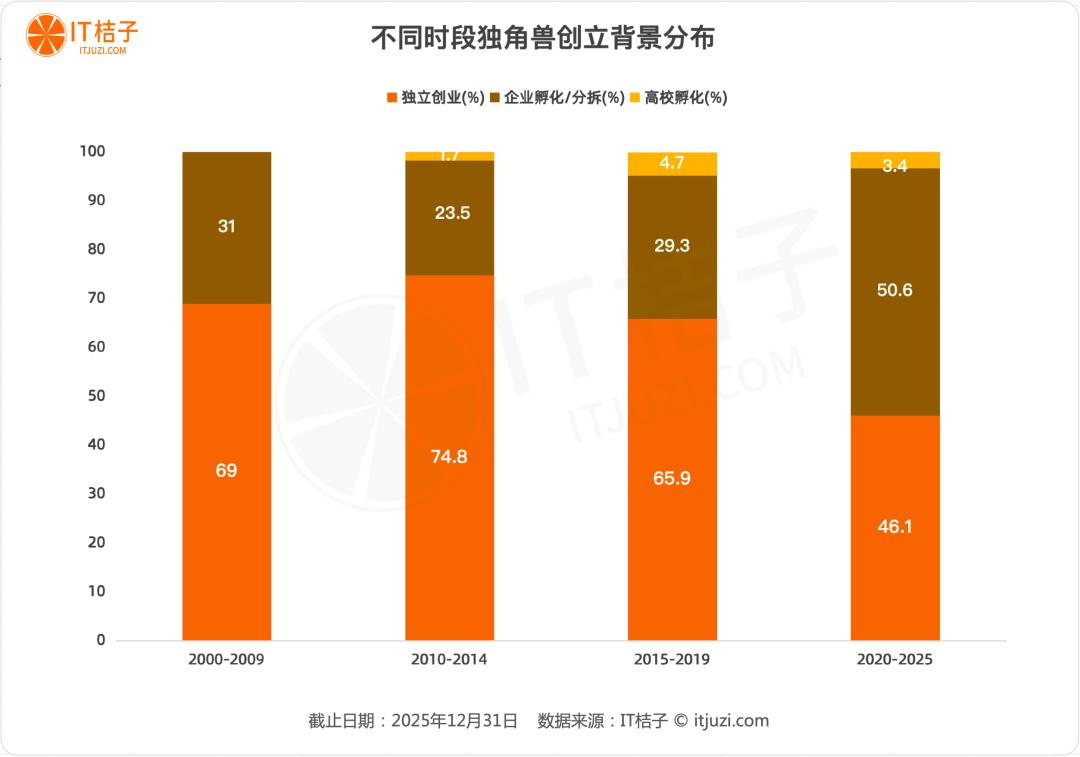
Based on data statistics, the establishment backgrounds of Chinese unicorns present significant generational replacement characteristics, gradually transitioning from the early dominance of "grassroots entrepreneurship" to the rise of "organizational entrepreneurship", and a structural reversal occurred after 2020.
Stage 1 (2000 - 2009): The Internet Pioneering Period - The Original Accumulation of Independent Entrepreneurship
During the transition from Web 1.0 to 2.0, the proportion of independent entrepreneurship reached 69%, which was the absolute mainstream. During this period, enterprise incubation was mainly carried out by listed companies and central state - owned enterprises, and Internet giants had not yet formed an ecological closed - loop. Most of the independent entrepreneurs in this stage were technology geeks (such as early webmasters and software developers), who completed their original accumulation with their technological sensitivity and first - mover advantage, forming China's first - generation Internet infrastructure.
Stage 2 (2010 - 2014): The Explosion Period of Mobile Internet - The Peak of Independent Entrepreneurship
This was the golden window of "mass entrepreneurship and innovation". The proportion of independent entrepreneurship reached a historical peak of 74.8%, and the proportion of enterprise incubation dropped to a trough of 23.5%. The popularization of smartphones lowered the threshold for entrepreneurship. The cost of App development was much lower than in the PC era. With abundant capital and high risk appetite, individual teams could quickly verify business models. The unicorns incubated during this period were mostly concentrated in light - asset fields such as O2O, tool - based applications, and vertical e - commerce, with the typical feature of a "small team + large capital" barbaric growth model.
Stage 3 (2015 - 2019): The Transformation Period of Industrial Internet - The Rise of Organizational Entrepreneurship
The proportion of independent entrepreneurship showed an obvious decline for the first time (dropping to 65.9%), and the proportion of enterprise incubation rebounded to 29.3%. More importantly, there was a structural switch in the incubation subjects: The proportion of central state - owned enterprises in enterprise incubation jumped from 33.3% in the early stage to 55.9%, while Internet giants and listed companies each accounted for 22.1%.
The logic behind this change is the rise of the hard - technology track. With the peak of mobile Internet traffic, fields such as AI, chips, new energy, and intelligent manufacturing have become the main battlefields for unicorns. These tracks are characterized by high capital thresholds, long R & D cycles, and strong scene dependence. Internet giants began to spin off their internal AI Labs and cloud computing businesses, and central state - owned enterprises entered the incubation field with their scene advantages and policy resources (such as internal entrepreneurship within the State Grid and AVIC systems). At the same time, the proportion of university incubation reached a peak of 4.7% during this stage, reflecting the initial attempt at the combination of industry, academia, and research.
Stage 4 (2020 - 2025): The Period Dominated by Hard - Technology and State - owned Capital - Structural Reversal
There was a historic turning point during this period: The proportion of enterprise incubation exceeded that of independent entrepreneurship for the first time, reaching 50.6%, while independent entrepreneurship dropped to 46.1%. This was the first time in twenty years that "organizational entrepreneurship" exceeded "original entrepreneurship".
Within enterprise incubation, central state - owned enterprises continued to dominate (55.6%), and Internet giants and listed companies each accounted for 22.2%. The formation of this pattern is due to three forces: First, the establishment of the Science and Technology Innovation Board and the Beijing Stock Exchange provided a securitization channel for central state - owned enterprises to spin off hard - technology subsidiaries; Second, in the context of tackling "bottleneck" technologies, the data, scenarios, and licenses controlled by central state - owned enterprises have become scarce resources (such as AI training data, satellite remote sensing, and industrial software application scenarios); Third, Internet giants entered the "cost - reduction and efficiency - improvement" period, and internal entrepreneurial projects were more inclined to spin off for financing rather than being supported by burning money.
The Special Nature of University Incubation: Always on the Margins but with Cyclical Fluctuations
University incubation only accounts for 3.4% overall, but after reaching a relative high of 4.7% from 2015 to 2019, it dropped back to 3.4%, showing an "inverted V - shaped" trend. This is closely related to the policy cycle - The revision of the "Law on Promoting the Transformation of Scientific and Technological Achievements" in 2015 released the entrepreneurial vitality of universities, but later it was found that professors faced bottlenecks such as identity conflicts (institutional establishment and market - based compensation), complex intellectual property rights confirmation, and the disconnection between laboratory technology and engineering, resulting in a drop in the conversion rate. It is worth noting that after 2020, the proportion of university incubation has stabilized at 3.4%, indicating that a few top universities (such as Tsinghua University, Zhejiang University, and Huazhong University of Science and Technology) have established mature conversion mechanisms and formed a stable "professor entrepreneurship" channel.
The data by time period reveals the "de - grassroots" trend of China's entrepreneurial ecosystem. The low - threshold dividend of the mobile Internet from 2010 to 2014 cannot be replicated. As the technological complexity increases and capital becomes more rational, "bringing one's own resources" has become a standard requirement for entrepreneurship.
Appendix: The Incubation Parents Associated with the Most Unicorns on the List
This article is from the WeChat official account "IT Juzi" (ID: itjuzi521), written by Judy, and published by 36Kr with authorization.