Users who have been let down by the quality control of Onyx are starting to miss Kindle.
Three years have passed since Amazon's e - reader brand Kindle officially exited the Chinese market. However, the e - reader market, once jokingly referred to by netizens as the "instant noodle lid", has not become quiet with the departure of the giant. Instead, it has unexpectedly gained new life. A large number of domestic e - ink screen device manufacturers have sprung up like mushrooms after rain, eager to divide up the huge market left by Kindle.
Among the new entrants, Onyx Boox Technology Co., Ltd. (hereinafter referred to as "Onyx") is undoubtedly the one that has attracted the most attention from the market and capital. In January 2026, Onyx officially submitted its prospectus to the Hong Kong Stock Exchange. With the glorious title of "the second - largest in the world and the largest in China", it is trying to tell a story of a "Chinese - style Kindle" making a comeback in the capital market.
However, a closer look at Onyx's prospectus and recent market feedback reveals that the story is not as appealing as it seems.
In the past few months, there has been no more news about Onyx after it submitted its prospectus to the Hong Kong Stock Exchange, as if it had been put on pause. But the controversy surrounding it has never stopped. From seizing the great opportunity brought by Kindle's exit to the concentrated outbreak of quality control problems caused by the "product - ocean strategy", Onyx's rise and troubles are intertwined.
When users start to miss the simple and durable Kindle, can Onyx continue to tell its story of high - end productivity tools?
Seize the "Great Opportunity" Left by Kindle
Onyx's rise is indeed the result of "favorable timing, geographical advantages, and good human relations".
On June 30, 2023, Amazon Kindle officially shut down its e - bookstore operations in the Chinese market, marking the end of the reading era that had accompanied domestic readers for many years. However, for domestic brands such as Onyx, iReader, and Hanwang, the golden development period for domestic e - ink screen devices has just begun.
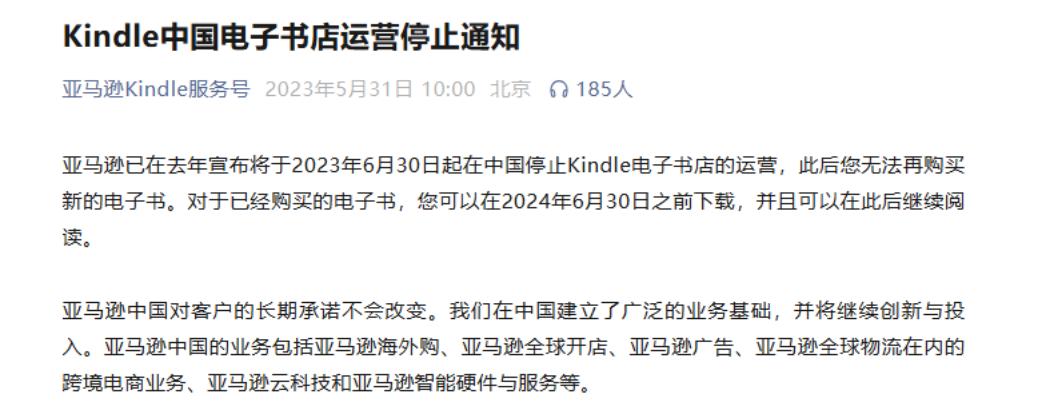
Image source: Amazon Kindle's notice of ceasing operations
According to data from Frost & Sullivan, from 2020 to 2024, the market size of the global knowledge - focused productivity tool market increased from 1.07 billion yuan to 2.91 billion yuan, with a compound annual growth rate of approximately 28.4%. According to data from LOTU Technology, in 2024, the global shipments of e - paper tablets reached 17.203 million units, a year - on - year increase of 37.2% compared to 2023.
In other words, both the so - called productivity tool market and the e - paper tablet market have shown good growth. Tan Yuting, the founder of Onyx, who has been in the display screen industry for many years, happened to seize this wave of industry dividends.
According to Tianyancha, Onyx was established in 2008. It is an enterprise focusing on consumer - grade e - ink screen products. Its products are mainly divided into three categories: high - speed readers, productivity tablets, and other products and services.
The so - called e - ink screen is a display screen built on e - ink technology. With core advantages such as a paper - like reading experience, low energy consumption, and eye protection, it is more user - friendly for readers compared to conventional electronic screens such as those on mobile phones and computers.
Before founding Onyx, Tan Yuting had long been engaged in the OEM production of reader - related products for overseas brands, accumulating solid technical R & D and production capabilities. After establishing her own brand, Onyx initially focused on the overseas market and accumulated mature overseas operation experience early on.
After Kindle's exit, Onyx quickly changed its strategy and replicated its overseas market experience back to the domestic market.
Compared with Kindle's conservative approach of adhering to a closed - system, Onyx's market strategy seems smarter. It has completely adopted an open - ecosystem approach and jumped out of the traditional product positioning of readers, defining its own devices as "knowledge - focused productivity tools".
Although this positioning is a bit of a mouthful, it directly opens up the premium space for the products.
After all, under the influence of Kindle, people have become accustomed to e - readers priced at a few hundred yuan. But Onyx tells you that its products can not only be used for reading but also for handwriting, installing apps, and watching videos. It is an "eye - protecting iPad". As a result, an e - ink screen device can be sold for two or three thousand yuan. According to the prospectus, in the first three quarters of 2025, the average selling price of Onyx's productivity tablets reached 2,253 yuan, directly competing with iPads of the same size in terms of pricing.
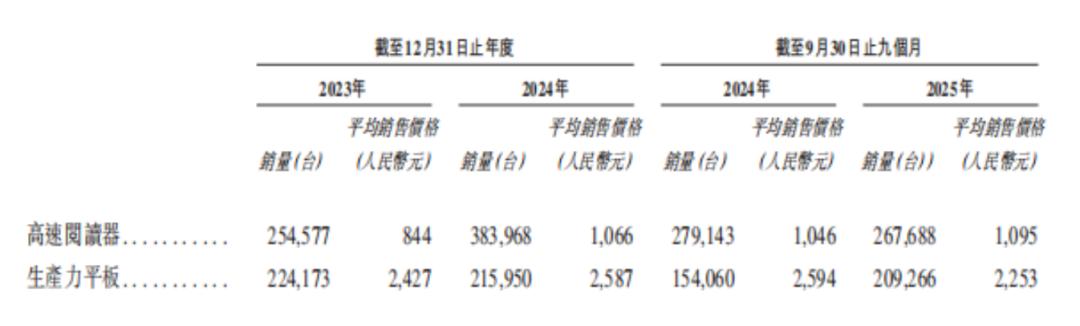
Image source: Onyx's prospectus
These high - premium productivity tablets are precisely Onyx's core source of income. The prospectus shows that from 2023 to the first three quarters of 2025, Onyx's revenues were 804 million yuan, 1.018 billion yuan, and 799 million yuan respectively. Among them, the productivity tablet business contributed 67.7%, 54.9%, and 59% of the revenue respectively, firmly occupying half of the market share.
In addition, the early - stage advantage in the overseas market has also allowed Onyx to avoid the extreme involution in the domestic market. Compared with other domestic brands deeply involved in domestic market competition, nearly 60% of Onyx's revenue comes from the overseas market, with Europe and the United States being the core revenue - generating regions.
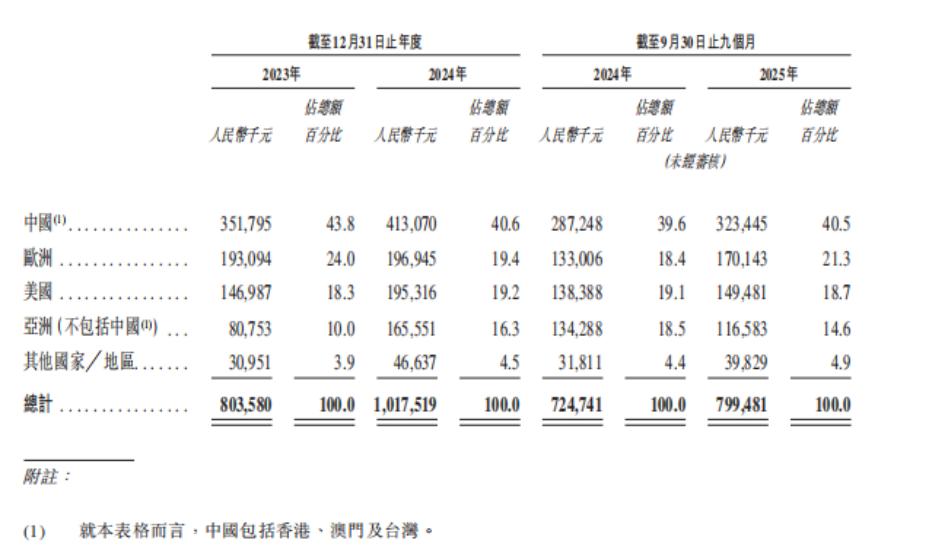
Image source: Onyx's prospectus
Supported by high - premium products and a stable overseas market, Onyx has successfully entered the top ranks of the industry. According to Frost & Sullivan data, in terms of retail revenue, Onyx became the second - largest global and second - largest Chinese brand of knowledge - focused productivity tools in 2024.
The "Product - Ocean Strategy" Fails
In addition to seizing the right opportunity, Onyx has another trump card for quickly occupying the market - the "product - ocean strategy".
Looking through the prospectus, Onyx's product line is extremely complex. In 2023, it launched 14 new products, 13 in 2024, and by the first three quarters of 2025, 9 new products had been launched. From 6 - inch portable readers to 25.3 - inch large - screen office tablets, from black - and - white screens to color screens, Onyx tries to fill every niche market with its products, aiming to cover the entire price range and all sizes.
Of course, Onyx is not the only one using this strategy. Domestic peers such as Hanwang Technology and iReader also adopt the same approach. According to statistics from LOTU Technology, in 2024, the number of new product launches in the Chinese e - paper tablet market reached 60, an increase of 20 compared to 2023.
This all - covering strategy of "there must be one that suits you" was indeed very effective in the early stage of market development, helping Onyx quickly build brand awareness and capture various niche user groups.
However, this situation did not last long. The seemingly all - powerful "product - ocean strategy" soon failed. Data shows that in 2024, Onyx launched only one less new product than in 2023, but the revenue contribution from new products dropped from 36.9% to 26.3%. The disconnection between product launches and revenue growth gradually revealed the drawbacks of blind expansion.
There are two main core reasons for this. On the one hand, under the impact of smartphones and tablets, the living space of e - readers has been squeezed.
According to the national reading survey data released by the China Academy of Press and Publication, in 2024, the proportion of domestic adult nationals reading on mobile phones was nearly 80%, while the proportions of reading on e - readers and tablets were only 23.9% and 23.6% respectively. In terms of usage time, in 2024, the average daily mobile phone usage time of adult nationals reached 108.76 minutes, while the reading times on e - readers and tablets were only 10.29 minutes and 9.62 minutes respectively. Comparing these two core data, the usage proportion and time of e - readers have both declined, while those of mobile phones and tablets have increased steadily. The market situation of e - readers has become increasingly embarrassing.
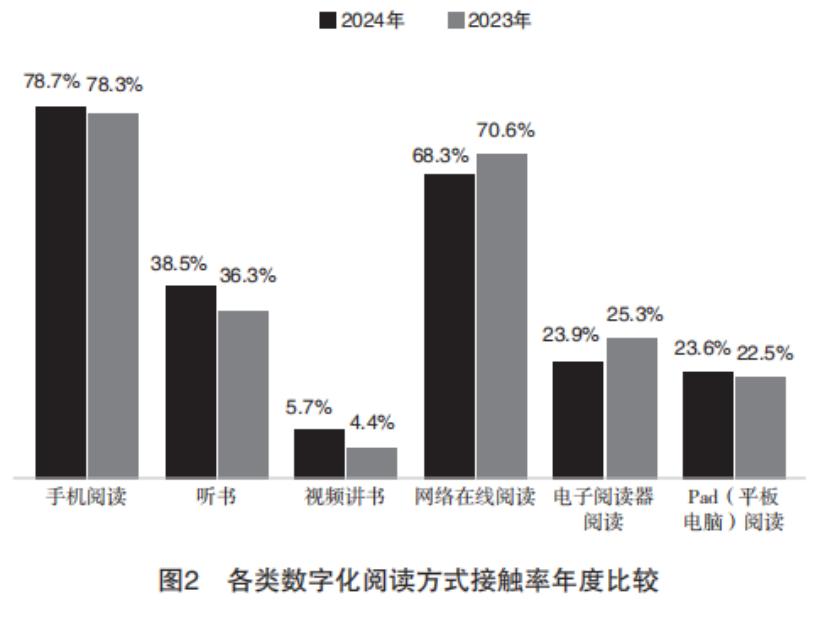
Image source: China Academy of Press and Publication
On the other hand, the "encirclement and suppression" from domestic peers is becoming more and more intense. Hanwang Technology focuses on handwriting recognition, iFlytek makes full use of its AI voice technology, and iReader builds a moat based on its own content ecosystem. Each company plays to its own strengths, and Onyx's "all - around" features do not give it an absolute advantage.
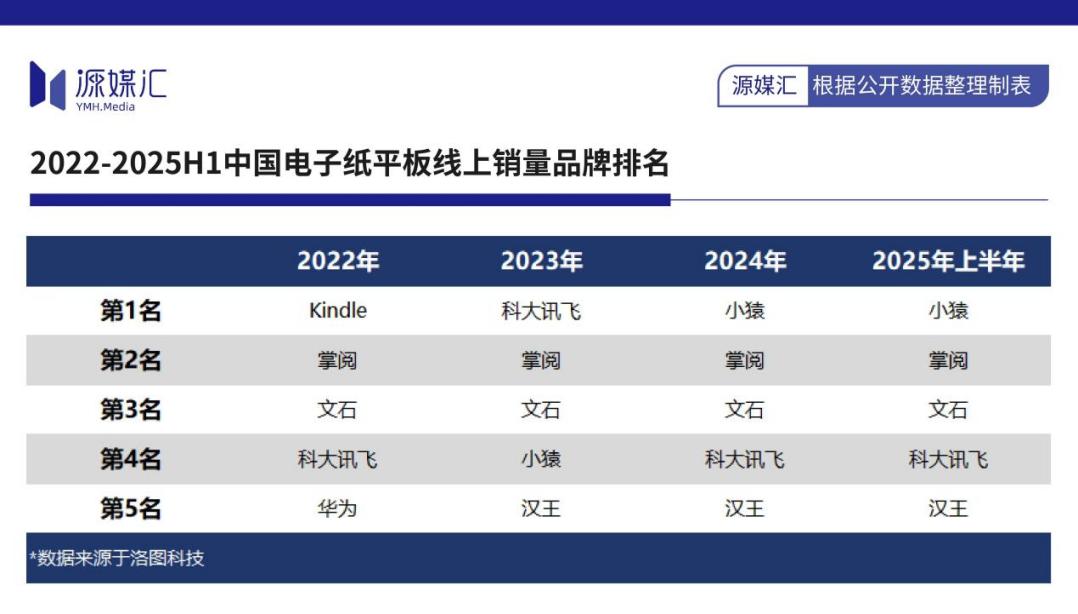
Data from LOTU Technology also confirms this. From 2022 to the first half of 2025, in the domestic e - paper tablet online market, Onyx has long ranked third, always being suppressed by iReader. The first position in the industry has been alternately occupied by iFlytek and Xiaoyuan, and Onyx has never been able to break through.
Quality Control Issues Trigger a Trust Crisis
What is more fatal than the intensifying market competition is that Onyx has frequent quality control problems of its own, which may lead to a user trust crisis.
On various social platforms and complaint channels, many users have complained about the quality problems of Onyx's e - ink screen devices. Problems such as fragile screens and sudden damage are common.
Recently, it was found on the Heimaotousu platform that a user reported that the Onyx reader they purchased only lasted for half a year, and the screen broke for no reason without any bumps or external damage. Another user encountered the same problem, with the device suddenly showing a flower - screen or black - screen and being completely unusable.
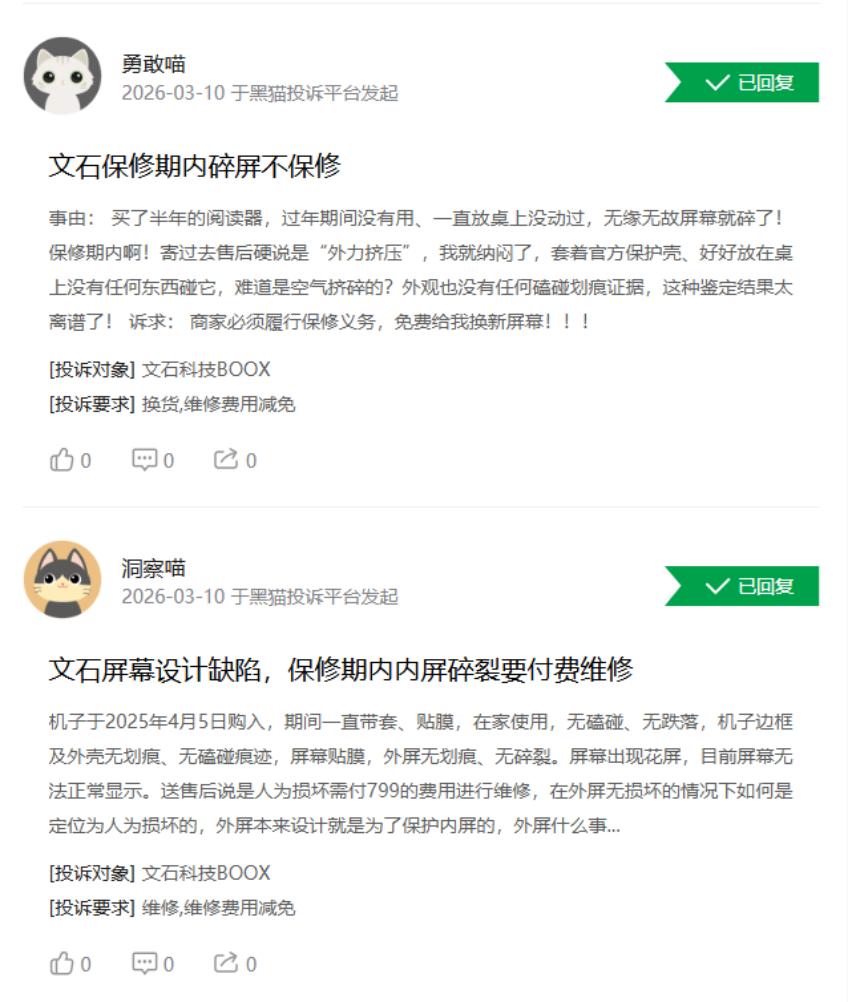
Image source: Heimaotousu
In addition, on social platforms such as Xiaohongshu, there are also many users who have been disappointed by Onyx's products. Some users admitted that they had strongly recommended Onyx products to their friends before, but the screen malfunctioned for no reason just a few days after purchase. Another user said that they returned an iReader product due to light leakage on the side and then chose Onyx Leaf5, but found that Onyx's quality control was even worse than iReader's in actual use.
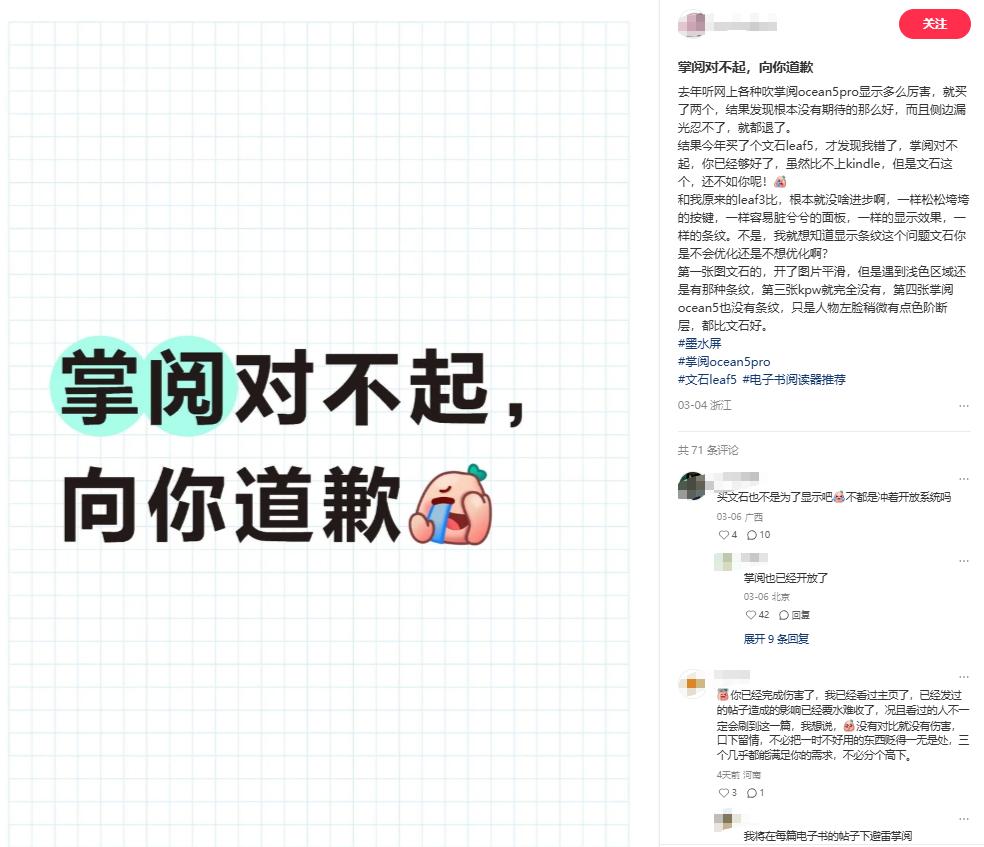
Image source: Xiaohongshu
The product quality control is substandard, and the after - sales service experience is also widely criticized. Based on the complaints and feedback from users on various platforms, for problems such as screen breakage and flower - screen, Onyx's official customer service mostly offers to replace the screen, and the after - sales maintenance cost is not low.
Some users said that their Onyx devices were still within the three - year warranty period, but they were asked to pay 500 yuan out of their own pockets to replace the screen when contacting the after - sales service. Another user reported that after the device had a flower - screen problem, the after - sales service determined that it was an abnormal damage to the display component, and the repair and replacement cost was as high as 799 yuan. Or they could choose to trade in the old device at a discounted price. The trade - in price for Onyx Leaf5 was 1,200 yuan, and for Leaf5c it was 1,400 yuan, and the stylus was not included. Whether it is self - paid repair or trade - in, users have to bear high costs and do not enjoy the corresponding after - sales guarantee at all.
Regarding the problems of fragile screens and after - sales service of e - reader products, an inquiry letter was sent to Onyx, but as of the time of publication, no reply was received.
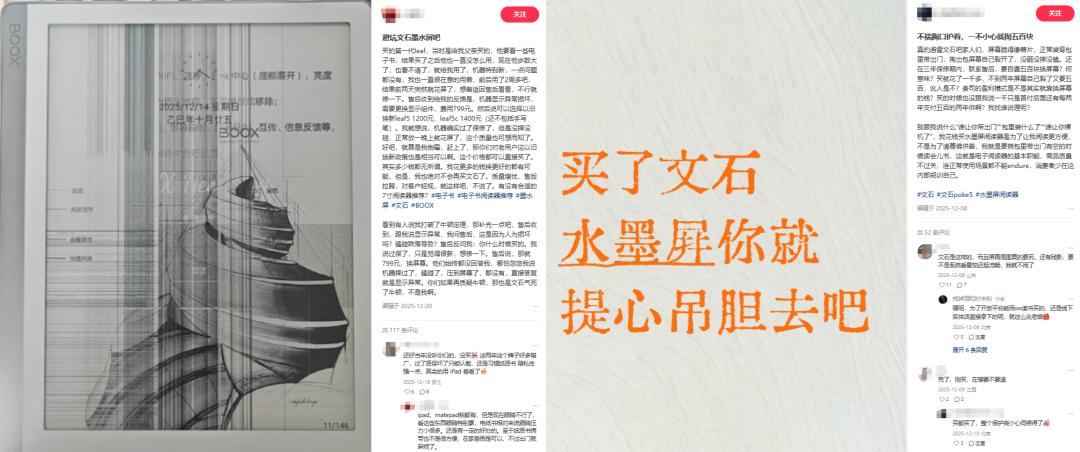
Image source: Xiaohongshu
Fundamentally, Onyx's out - of - control quality control and pressure on after - sales service are largely due to blind inventory hoarding and production capacity expansion.
The prospectus data shows that in the first three quarters of 2025, Onyx's inventory amount soared from 242 million yuan in 2023 to 435 million yuan, and the inventory turnover days also increased from 153 days to 208 days.
Originally, in order to deal with the problem of tight supply chain, Onyx adopted a defensive inventory hoarding strategy and stocked up a large amount of raw materials. However, this also directly exposed the management loopholes in