Creation·Inquiry | SONG Jiayin of Juewu Technology: Building "Transformers" Robots in Xinjiang's Farmlands
What does an excellent enterprise look like, and what characteristics do successful entrepreneurs have? On their journey of struggle, what "pitfalls" need to be avoided, and what is the most important change?
Chuang·Wen poses questions to some outstanding Huachuang entrepreneurs, investors, and industry experts, and also hopes to share their ideas with you.
The protagonist of this issue is Song Jiayin, the founder and CEO of Juewu Technology. Founded in September 2020, Juewu Technology is a hard - tech company focusing on large - load all - terrain robots. The core technology has applied for more than 120 patents, and it is a national high - tech enterprise and a specialized and sophisticated enterprise. Juewu Technology has abandoned the idea of traditional special - purpose equipment. Relying on the innovative concept of "deformable chassis + modular load", it has independently developed a globally - first modular deformable robot system for field scenarios.
Huachuang Capital led the Series A financing of Juewu Technology.
Different from the robots optimized for parameters in the laboratory, the robots of Juewu Technology "grew" from the deserts and Gobi in Xinjiang.
After 6 years and 1 million kilometers of field tests, Juewu Technology has built a "Transformer" with tens of thousands of parts in the fields - a chassis system that can "transform" by installing different modules: it can be equipped with a spraying module to spray pesticides in large fields, or it can be replaced with a mowing module to mow grass in orchards.
In the view of Song Jiayin, the founder and CEO of Juewu Technology, this is not a simple machine, but a complex engineering system. It benefits from the genes of Juewu's technical team - people who used to build rockets and satellites at the European Space Agency have crossed over to the agricultural field to develop robots.
It is the repeated refinement of technology and scenarios that has made Juewu the only company in the industry that has achieved mass production, realizing the large - scale application of large - load all - terrain robots in the agricultural field.
Not long ago, Juewu Technology announced the completion of the Series A financing led by Huachuang Capital. From Xinjiang to the inland and then to Europe and the United States, Juewu's robots are moving into broader areas.
After completing this round of financing, Song Jiayin accepted an exclusive interview from the editorial department of Huachuang Capital's "Chuang·Wen". Beyond the mainstream narrative in the current AI field, this team has chosen a path that seems more clumsy and laborious: plunging into the farmland, repeatedly refining the products, and believing that there will be rewards for efforts.
The full - text sharing is as follows:
Q: Huachuang Capital
A: Song Jiayin, founder and CEO of Juewu Technology
"Counter - consensus choice"

Huachuang Capital: "Agriculture" and "Xinjiang" seem far from the current hot narrative of embodied intelligence. Your previous backgrounds have little to do with agriculture. Why did you choose to start a business in this field?
Song Jiayin: Initially, we were invited by friends in Xinjiang to visit the cotton fields in Xinjiang. On the one hand, we saw that the people in the fields were mostly middle - aged and even elderly, and felt that the shortage of labor in the agricultural field seemed inevitable; on the other hand, we saw that modern agricultural production relied on inputs such as pesticides and fertilizers, but long - term overuse might cause soil compaction and groundwater pollution. At that time, a farmer told us: "If this continues, in twenty or thirty years, this land may not be able to grow edible things."
This sentence touched us quite a lot. Life is about experiences, and starting a business should be about doing something that can benefit the world to some extent. Agriculture seems to need new technologies and new ideas, and we happen to be good at them.
Huachuang Capital: Based on what judgments do you think there are opportunities in the agricultural field?
Song Jiayin: At the beginning of starting the business, we conducted a large number of field surveys. My team and I traveled from Kashgar to Aksu, Alar, and then to Wujiaqu, Changji, and Shihezi. We judged that Xinjiang's agriculture is one of the most representative regions of agricultural mechanization in China.
Different from the fragmented land in many inland areas, large - scale agriculture is actually a systematic project. In essence, it is an open - air factory. Although the production process has approached standardization, agricultural machinery and equipment still remain in the diesel - engine era, and electrification, intelligence, and digitalization are still blank. This made us realize that the agricultural scenario may contain the same huge opportunities as the electrification and intelligence of the automotive industry.
However, at that time, there were very few startups in the world engaged in agricultural robots, especially those targeting precision agriculture. So, in fact, the starting point of our business was a highly counter - consensus choice.
At that time, the public's perception of agriculture still remained in the memory of the previous era. I remember that when I first returned to Shenzhen, many friends in the startup circle, including investor friends, didn't understand when they heard that we were going to develop agricultural robots: "You have such solid technology, why do you want to engage in farming?"
On the contrary, if we can do well in something that few people are willing to do, it may be an opportunity. We are not very willing to chase the trend. Many times, not being in the limelight is actually healthier and even safer for the team and the company's development.
In addition, for the application scenarios of robots, compared with urban scenarios, the outdoor environment is still a relatively untapped market. So we decided to develop a large - load, deformable robot for the outdoor non - road environment and let it start with farming.
Huachuang Capital: There are so many agricultural scenarios in China. Why did you choose to start from Xinjiang?
Song Jiayin: We chose Xinjiang because it is remote. We believe that true innovation occurs in solitude.
A more practical consideration is that Xinjiang is a miniaturized full - sample space. The base for our R & D and testing over the years is at the edge of the desert. The environment is a bit harsh, but it has many irreplaceable advantages: First, the soil is diverse, including clay, gumbo, sandy, saline - alkaline, and sandy land. Any difficult - to - handle land conditions can be found in Xinjiang; second, there are drastic temperature changes. The temperature difference between day and night in Xinjiang is very large, and there will be dew condensation. The temperature difference between winter and summer ranges from minus thirty degrees to forty or fifty degrees above zero. In addition, there are extreme climate scenarios such as rain, snow, hail, and sandstorms. These environments allow us to fully refine our products.
Every March, Juewu's R & D team takes the prototypes to the cotton fields in Xinjiang and doesn't return until the autumn harvest in October. Our founding team originally liked nature. Although it is hard work, we enjoy it.
I remember that in August 2019, we brought a sample of compacted soil from the cotton fields in Shizongchang, Shihezi, back to Shenzhen. Many times when we encountered difficulties, it was that lump of soil that supported us.
Huachuang Capital: Compared with other fields, what are the difficulties in agricultural robots?
Song Jiayin: Different industries have different barriers.
We have encountered many difficulties over the years. First, the outdoor environment, such as high temperature, low temperature, and sand and dust, poses great challenges to the lubrication and protection of mechanical parts and the thermal management of electronic devices; second, the large load further magnifies many problems. Due to the large size and weight of the robot, the inertia of each joint of our 26 - degree - of - freedom robot becomes very large, while the power of the driving mechanism is limited, so motion control is very difficult.
In addition, when such a multi - rigid - body system is working in the fields, in fact, many degrees of freedom need to be autonomously identified and controlled according to the field conditions. This makes the operation of the robot a problem of real - time perception, decision - making, and control of a multi - degree - of - freedom robot in a three - dimensional complex space. At the same time, the large and complex size also poses great challenges to the selection, arrangement, and communication of sensors.
There is an intuitive figure that can reflect the complexity of the problems we face to some extent. Our robot has gone through more than 40 iterations in 6 years. The number of parts in the currently mass - produced robot model is about 12,000, which is comparable to that of a car in terms of complexity.
Huachuang Capital: When it comes to parts, you are in a new field. How did you solve the initial supply - chain problems?
Song Jiayin: Currently, all our parts have basically been localized.
We jokingly call "Juewu's robot a product developed using a textbook - style systems engineering method". As a robot designed and developed based on the first - principles, there was initially a lack of a reference system. Because the solution was too special, we initially "made the wheels by hand" to develop the product.
In terms of the supply chain, we could only use our imagination to find suppliers according to the performance and size parameters we selected and calculated. But many times, because there was no mature supply chain, we had to do the underlying work ourselves or optimize the solutions.
As the product gradually matured, in 2025, we crossed a key node - achieving mass production and becoming one of the few companies capable of mass - producing and delivering large - load all - terrain deformable robots.
After mass production, we have established obvious advantages in production management, product development pipeline, and cost control.
"Transformer"

Huachuang Capital: Juewu initially entered the market through the cotton category. What pain points and needs were considered?
Song Jiayin: As a strategic reserve material of the country, cotton is widely planted in Xinjiang, and there has always been market demand, and the pain points have not been solved.
Normally, when cotton enters the boll - opening stage, defoliants need to be sprayed to promote leaf shedding, reduce impurities in the cotton wool, and improve the quality of cotton. Many farmers use drones to spray defoliants. However, the height of cotton is about 1.2 - 1.3 meters. When drones are operating, they can only penetrate the upper leaves, and the middle and lower leaves are often ignored. They have to spray twice, which leads to a decrease in the consistency of cotton fibers and an increase in the impurity content.
Not only cotton, but also high - value cash crops such as peppers and tomatoes are more vulnerable to pesticide damage, so they are more cautious in choosing spraying methods and equipment.
Our robot's air - assisted technology is equipped with a high - speed fan array. By driving droplets through wind pressure and eddies, it can achieve uniform pesticide application on both sides of the leaves.
Huachuang Capital: In addition to pesticide application, what other scenarios and links does the company's product cover?
Song Jiayin: Juewu's current core products are mainly the "Hechu T3000" for large fields and the "Jilu G3000" for orchards.
The "Hechu T3000" is the robot mode for large - field scenarios. It is a combination of a platform and a large - field spraying load, mainly targeting the problem of excessive pesticide use. In addition to spraying defoliants, it can also spray pesticides precisely in the early growth stage of crops. It can adaptively deform by adjusting the wheelbase and ground clearance to adapt to different growth cycles of different crops such as cotton, soybeans, tobacco, and Chinese herbal medicines.
The basic version is equipped with a 21 - meter - long spray boom, and a single operation can cover 9 rows of cotton, with an operating area of 100 mu per hour; the enhanced version is equipped with a 26 - meter - long spray boom, and the efficiency is further increased by 24%.
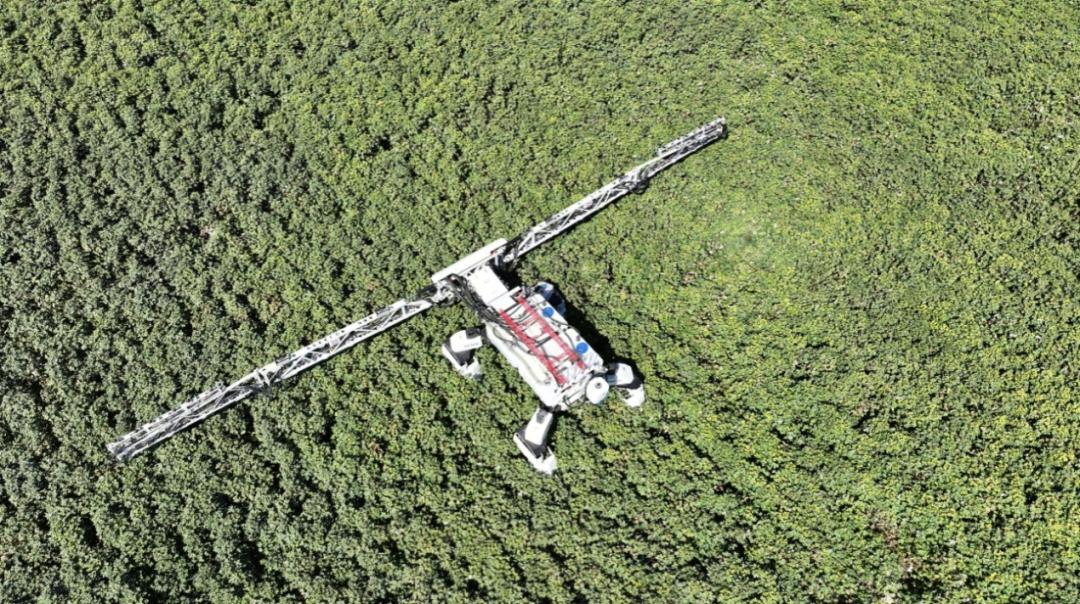
(Photo of Hechu T3000 operating in Xinjiang)
The "Jilu G3000" is the robot mode for orchard scenarios. It is a combination of a platform and an orchard spraying load. It can deform and narrow to adapt to the row spacing of different orchards. The profiling spray boom can adapt to fruit trees of different heights and types and can automatically adjust the water consumption according to the size of the tree and the degree of pests and diseases. In addition, in addition to spraying pesticides, the robot can also cover the entire process of operations such as fertilization, pruning, and orchard cleaning.
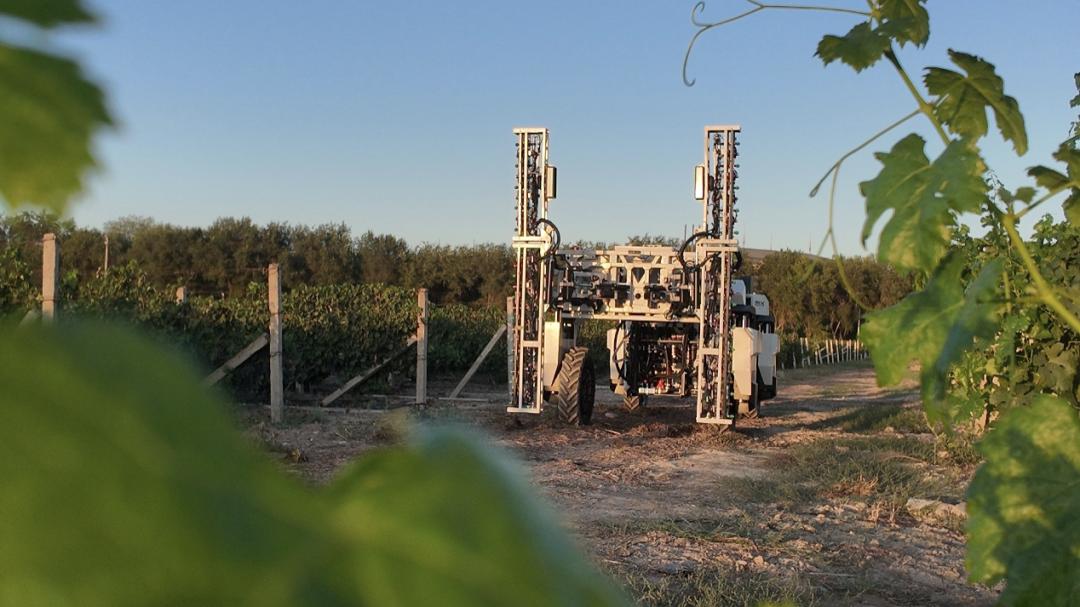
(Photo of Jilu G3000 operating in a vineyard)
These two robots seem to be two products, but in fact, they are a combination of the same chassis platform and different operating loads. This is also a feature of our robots - they can "transform" by replacing different modules. For example, in large fields, they can be equipped with a spraying module to spray pesticides; in orchards, they can be replaced with a mowing module to mow grass.
So what we have developed is not an ordinary robot, but a "Transformer" that can "transform".
Huachuang Capital: In the agricultural scenario, it is usually "single - machine for single - use", but Juewu has chosen a different model. What are the considerations behind this?
Song Jiayin: Our idea is to make the process simpler and the cost lower. So we have constructed a mRaaS (modularized Robot as a Service) model - separating the chassis platform and the operating load. It can be understood as a "Transformer": the same core system can be reused in multiple scenarios through module replacement.
During our research, we found that traditional agricultural machinery is used for ten years, but it is idle after being used in specific scenarios each year. We hope that our products can cover the four links of plowing, sowing, management, and harvesting in the farmland, so as to achieve low input costs but high ROI.
When designing the product, we first need to consider the transportation cost because the transfer cost of traditional agricultural machinery is very high. If the robot provides full - process services in the farmland, the transportation link must be considered. So our thinking is completely different from that of traditional agricultural machinery.
The principle of deformation is to adapt to the width of different farmland tractor roads. Whether it is planting corn in spring or wheat in winter, one