"Rongsu Technology" Completes Nearly 100 Million Yuan Series A Funding | Exclusive Report by 36Kr. Production speed increased by four times, desktop metal 3D printer launched.
Text | Zhang Bingbing
Editor | A Zhi
36Kr learned that Suzhou Rongsu Intelligent Manufacturing Technology Co., Ltd. (hereinafter referred to as "Rongsu Technology") announced the completion of a nearly 100 million yuan Series A financing. The investors are Henan Yuzi Group and Suzhou High - tech Rongxiang Fund. The funds will be used to further optimize product technology and production line construction, and improve delivery capacity and production scale according to market demand.
"Rongsu Technology" was established in 2020. Its founder, Xu Fangda, is a post - doctorate from the University of Bath in the UK and is mainly engaged in research in the field of large - scale additive manufacturing. "Rongsu Technology" focuses on the new - generation DED wire - feeding 3D printing technology. It provides three types of services, namely printing, equipment, and device services, to meet the manufacturing needs of large - scale parts in industrial fields such as aerospace, steel metallurgy, and petrochemicals. Its STAR series products have received orders from leading enterprises such as AVIC, CRRC, and CSSC.
Recently, "Rongsu Technology" released the desktop multi - laser wire - feeding metal 3D printer Laser Mini, which features small size, extremely simple operation, high - precision printing, safety, no pollution, and multi - material adaptation. It aims to further cover the needs of science teaching and research and provide a flexible and practical metal additive manufacturing solution.
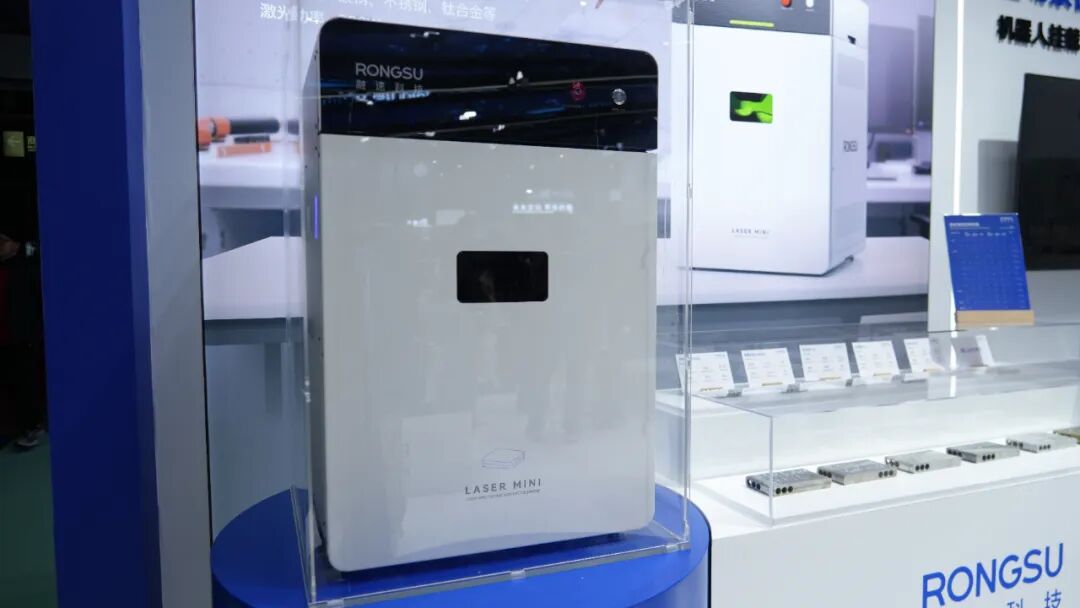
The desktop metal 3D printer Laser Mini of "Rongsu Technology"
I. Evolution of the technical route, a four - fold increase in production efficiency
The public is no longer unfamiliar with consumer - grade 3D printing technology. The principle of industrial - grade 3D printing technology is similar. Based on three - dimensional model data, it manufactures solid parts by stacking materials such as metal, plastic, and ceramic layer by layer. The industry calls it "additive manufacturing".
Compared with the "subtractive manufacturing" of traditional cutting and the "equal - material manufacturing" of forging and casting, additive manufacturing can streamline the pre - processing process, eliminate machining allowances, and reduce raw material costs with its manufacturing logic of "from nothing to something, layer by layer increase".
In the field of metal additive manufacturing, there are mainly two technical routes. Among them, the selective laser melting (SLM) technology occupies the mainstream position. Its advantage lies in the ability to form precision components with extremely high complexity and has been applied in fields such as rocket engine components in commercial aerospace. At the same time, the directed energy deposition (DED) technology shows potential in the manufacturing of large - scale structural parts and the repair of high - end components due to its advantages in deposition efficiency and forming size.
Xu Fangda, the founder of "Rongsu Technology", introduced that "Rongsu Technology" focuses on the DED route and promotes the evolution of its products from the first - generation wire arc additive manufacturing (WAAM) technology to the second - generation wire - laser additive manufacturing (WLAM). "As the first - generation technology, wire arc additive manufacturing has problems such as rough surface, slow printing speed, and high cost. The second - generation wire - laser additive manufacturing technology has solved these problems of surface roughness. Now, the surface of our products can be made very smooth, basically reaching the semi - finishing level of traditional manufacturing."
When the equipment is printing at high speed, the components in the equipment may be burned, which will affect the printing speed and stability. In response, "Rongsu Technology" has independently developed the multi - laser coaxial wire - feeding technology VEAM. The light pressure of multiple beams can refine grains and improve precision, solving the problem of stability during high - efficiency printing.
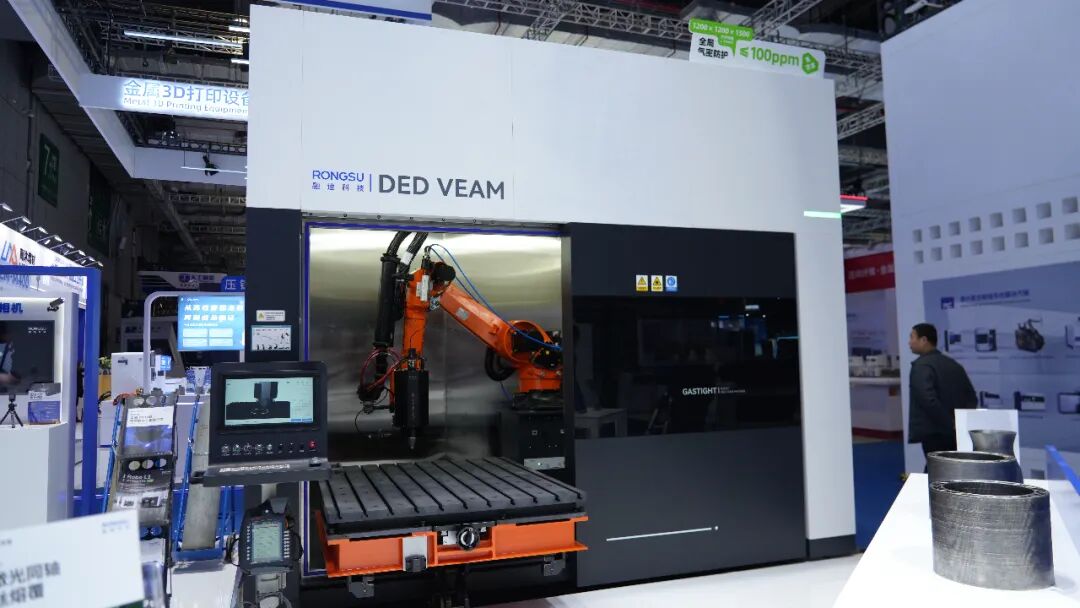
The super - coaxial laser additive manufacturing equipment Robo L1 of "Rongsu Technology"
On this basis, through technological iteration in the past year, "Rongsu Technology" has significantly improved the production efficiency and laser power of its equipment. Among them, the production speed has increased from 1 kg/hour to 4 kg/hour, and the laser power has increased from 1,500 watts to a maximum of 15,000 watts.
"An increase in speed means a reduction in cost." Xu Fangda introduced that the cost of additive manufacturing is mainly divided into material cost and labor - hour cost. The material cost basically does not change much, while the labor - hour cost is closely related to the printing speed and equipment preparation time. An increase in the printing speed means higher production efficiency, and the corresponding costs such as venue and personnel will be reduced, which is the core driving factor for reducing production costs. The equipment preparation time depends on the degree of process automation. "Rongsu Technology" will achieve greater improvements in equipment stability and turnover speed in the future.
The ultimate goal is to make the production cost competitive with traditional manufacturing. "Our cost goal is to be cheaper than traditional manufacturing. I think this goal will definitely be achieved within the next five years," Xu Fangda summarized.
II. Improving delivery capacity and accelerating market introduction
The improvement of technological capabilities and the reduction of costs will undoubtedly accelerate the market introduction of innovative technologies. However, for the traditional manufacturing industry, another major implicit cost of introducing new technologies is the transformation of production lines and the construction of acceptance systems.
In order to accelerate the market introduction process, "Rongsu Technology" plans to improve its own delivery capacity through production line construction, allowing customers to directly purchase products and reducing the cost pressure on customers for production line transformation and equipment purchase.
"For customers, the core evaluation criteria are quality, price, and delivery capacity." Xu Fangda introduced that in terms of quality, the products delivered by "Rongsu Technology" have met the standard requirements of customers after verification. Reducing costs and improving delivery capacity will be important directions in the future.
In November 2025, the headquarters project of the global additive manufacturing service base of "Rongsu Technology" was launched in Suzhou High - tech Zone. The project plans to invest more than 500 million yuan to carry out the design and manufacturing of 3D printing equipment and 3D printing contract manufacturing services. After reaching full production, the annual revenue is expected to exceed 300 million yuan. The construction of the service base will increase the production scale of "Rongsu Technology" and further radiate customers in Jiangsu and the Yangtze River Delta region.
In terms of specific customers, "Rongsu Technology" focuses on expanding the aerospace and heavy - industry fields. It has reached cooperation with major commercial aerospace customers and is also expanding customers in industrial fields such as steel metallurgy and petrochemicals. Xu Fangda analyzed that the aerospace industry has a relatively high acceptance of new technologies and is the priority industry direction for expansion. Based on the demand for cost reduction and efficiency improvement, traditional industries also have opportunities for cooperation and introduction on the premise that the technical indicators are verified.
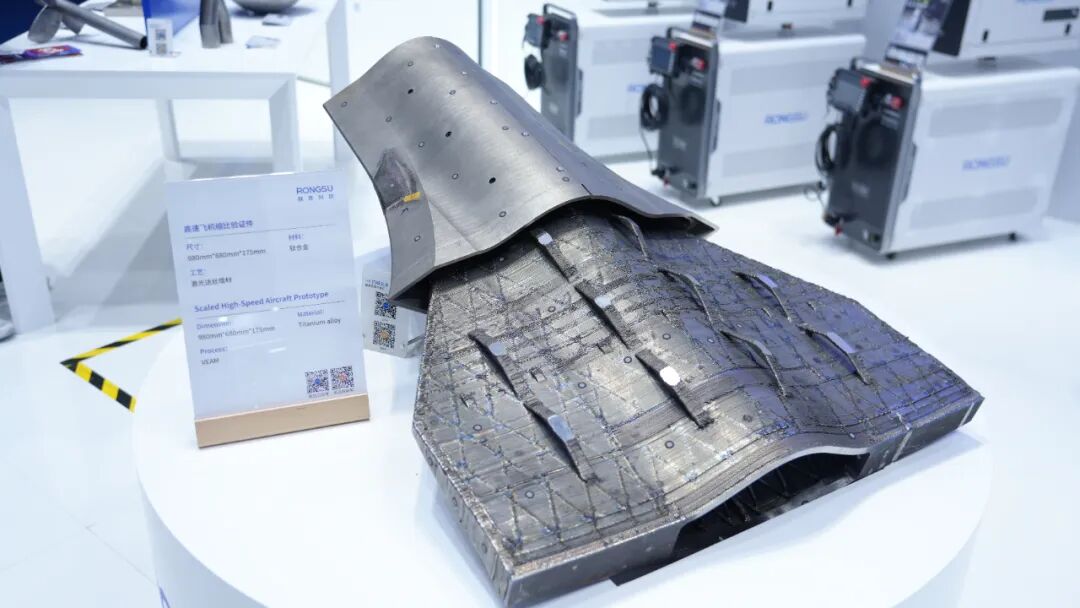
A scaled - down model of a high - speed aircraft made by metal 3D printing
At the same time, emerging fields such as the low - altitude economy have also become important directions for the market expansion of "Rongsu Technology". For unmanned aerial vehicle equipment, vehicles, and brackets and structural parts of airport support facilities, using additive manufacturing can achieve cost reduction, efficiency improvement, and improve development efficiency.
Currently, among the three types of services of "Rongsu Technology", namely printing, equipment, and device services, equipment revenue accounts for the largest proportion. Xu Fangda expects that with the improvement of delivery capacity, printing services will become the main driving force for revenue in the future, which will then drive the demand for upstream equipment.
In 2025, "Rongsu Technology" achieved a revenue scale of tens of millions of yuan, and the revenue is expected to triple in 2026.
36Kr Future Industries
"36Kr Future Industries" continuously focuses on urban development, industrial transformation, and the implementation of innovation and entrepreneurship projects. For media coverage, please contact wangfengzhi@36kr.com by email or scan the QR code.
In addition, 36Kr has officially launched the "36Kr Enterprise Investment Guide Internal Reference". Relying on its profound accumulation in the economic circle industrial cluster, regional key promotion plans, and investment promotion fields, 36Kr provides in - depth, detailed, timely, and exclusive comprehensive information services. It provides efficient and accurate industrial project internal references for government departments and helps project parties match industrial funds, connect with key contacts, and quickly integrate into the new industrial ecosystem.

This article is from the WeChat public account "36Kr Future Industries". Author: Zhang Bingbing, A Zhi. Republished by 36Kr with permission.