Xiaomi Auto has made huge profits. Its revenue has exceeded 100 billion yuan, with a gross profit margin of 24%, achieving the fastest profit-making milestone.
The fastest - ever new car - making force to achieve profitability has emerged.
Last night, Xiaomi Group officially released its Q4 performance report and the 2025 annual financial report. The annual total revenue reached 457.3 billion yuan, and the adjusted net profit was 39.2 billion yuan. Both figures reached the best performance in history.
The highlight is the automotive business. Its revenue exceeded 100 billion yuan for the first time, reaching 106.1 billion yuan, a year - on - year increase of 223.8%. More importantly, in 2025, Xiaomi's automotive business achieved an annual operating income of 900 million yuan for the first time, achieving the milestone of turning a profit for the year.
It has to be said that the growth of Xiaomi cars is really enviable to its competitors. Less than two years after the first car was launched, Xiaomi's automotive business achieved annual profitability, officially bidding farewell to the loss - making period.
However, behind the rapid development of the “wheels”, there lies a “bleeding” of the “core business”.
Revenue exceeds 100 billion yuan
Looking at the whole year, the annual performance Xiaomi just presented is indeed impressive.
The total revenue reached 457.287 billion yuan, a year - on - year increase of 25.0%. Although the growth rate declined compared with 35.04% in 2024, the absolute value reached a record high, and it was the first time to exceed 400 billion yuan. The adjusted annual net profit was 39.2 billion yuan, a year - on - year increase of 43.8%, definitely the best performance in history.
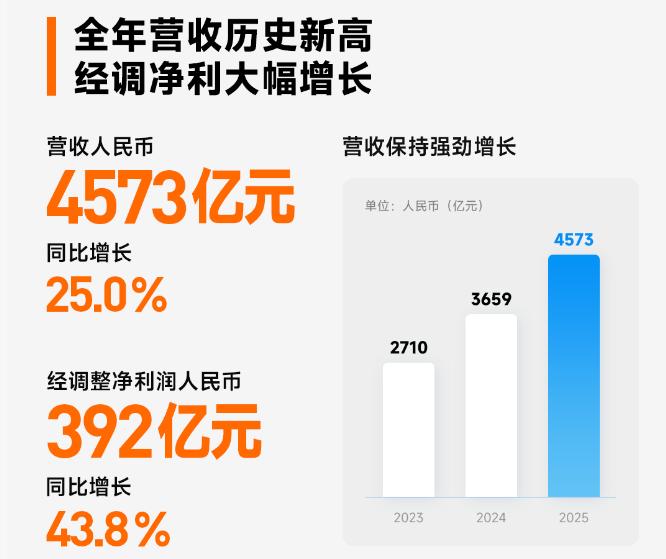
The 43.8% growth rate of profit far exceeds the 25% growth rate of revenue, which also means that while expanding its scale, Xiaomi has optimized its overall operating efficiency and product structure.
The key to Xiaomi's record - breaking performance in 2025 is, of course, its double - track sprint in the high - end smartphone market and the intelligent electric vehicle field.
In particular, the intelligent automotive business has achieved a milestone leap from the loss - making period to the profitable period. In 2025, the automotive business achieved a positive adjusted profit contribution for the first time throughout the year.
Specifically, in 2025, the revenue of Xiaomi's intelligent electric vehicles, AI and other innovative business segments was 106.1 billion yuan, a year - on - year increase of 223.8%. Among them, the revenue of intelligent electric vehicles was 103.3 billion yuan, an increase of 71.2 billion yuan compared with 32.1 billion yuan in 2024, a year - on - year increase of 221.8%. The revenue of other related businesses was only 2.8 billion yuan.
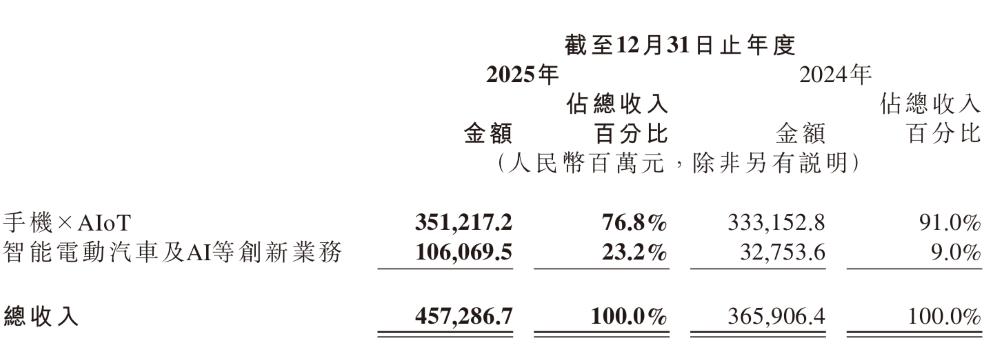
This also means that the intelligent automotive business has become the absolute second growth curve of Xiaomi Group. In 2025, the intelligent electric vehicles, AI and other innovative businesses accounted for 23.2% of Xiaomi Group's total revenue, an increase of 14.2 percentage points compared with 9.0% in 2024.
Xiaomi said that this was mainly due to the increase in vehicle delivery volume and the rise in ASP (average selling price). In 2025, Xiaomi Group delivered 411,082 vehicles throughout the year, an increase of about 274,200 vehicles compared with 136,900 vehicles in 2024, a year - on - year increase of 200.4%.
The financial report also specifically emphasized that the Xiaomi SU7 ranked first in the sales of sedans priced over 200,000 yuan in China in 2025, and the Xiaomi YU7 ranked first in the sales of mid - to large - sized SUVs in China for seven consecutive months.
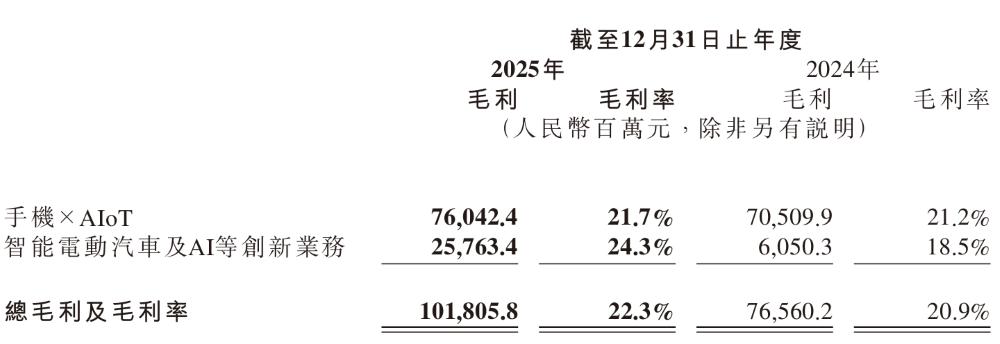
Moreover, the more it sells, the more it earns. In 2025, the gross profit margin of the business segment jumped from 18.5% in the whole year of 2024 to 24.3% in the whole year, and the operating income turned positive for the first time, recording an operating income of 900 million yuan for the whole year. In 2024, the adjusted net loss of Xiaomi Group's intelligent electric vehicle and other innovative business segments was still 6.2 billion yuan.
A gross profit margin of 24.3%, what does this mean?
For reference, Li Auto, which has achieved profitability for three consecutive years, had a comprehensive gross profit margin of 18.7% in 2025, XPeng Motors had 18.9%, Leapmotor had 14.5%, and NIO had 13.6%. It even exceeded that of large manufacturers such as BYD and Tesla. The former had a gross profit margin of 17.5%, and the latter had 17.8%.
In the entire Chinese automotive industry, currently only Seres can match Xiaomi in terms of gross profit margin. Seres' gross profit margin in the first three quarters of 2025 reached 29.38%, and its 2025 financial report data has not been released yet.
This also makes Xiaomi cars the fastest new car - making force to achieve profitability in history. Since the delivery of the Xiaomi SU7, it has only taken two years to complete the leap from the money - burning period to the profitable period.

This is because thanks to the delivery of the SU7 Ultra and YU7 series with a relatively high ASP, in 2025, the ASP of Xiaomi cars reached 251,200 yuan, a 7.1% increase compared with 234,500 yuan in 2024. Based on a simple estimate of the financial data, Xiaomi made a gross profit of about 61,100 yuan per vehicle in 2025, and the net profit per vehicle was 2,190 yuan.
In addition, in terms of R & D investment, Xiaomi Group's R & D investment in 2025 was 33.1 billion yuan, a year - on - year increase of 37.8%, mainly due to the increase in R & D expenses related to intelligent electric vehicles, AI and other innovative businesses.
It is worth mentioning that don't forget that Xiaomi's intelligent automotive business is bound with AI and other innovative businesses. Given that Xiaomi's AI progress is still in the money - burning stage, even Li Shiwei, the CFO of Xiaomi Group, said that the overall profit performance of this segment is the result of the game between “automotive scale - based revenue” and “R & D investment in AI and robots”.
In other words, the gross profit margin and profit of Xiaomi's intelligent automotive business alone may be higher than the apparent indicators show.
Decline of the smartphone business
If we look at Q4 alone, we will find that the single - quarter operating profit was only 6.229 billion yuan. Not only did it decline by 29% compared with 8.3 billion yuan in Q4 of 2024, but it was also directly halved compared with 15.1 billion yuan in Q3 of 2025.
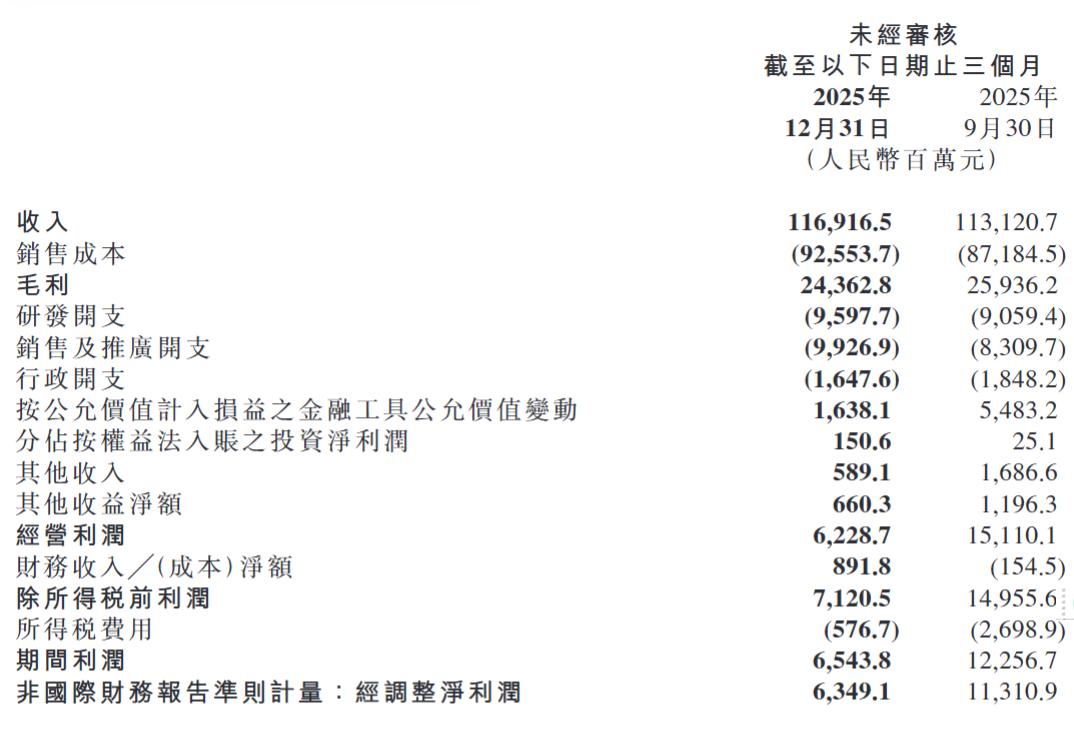
Q4 also broke the rhythm of hitting new highs for three consecutive quarters. Moreover, the net cash from operating activities of Xiaomi in Q4 also shrank significantly, only 614 million yuan.
It's not difficult to understand the decline in Q4 profit. An obvious fact is that Xiaomi's smartphone business has experienced a substantial contraction in the fourth quarter. The shipment volume of 37.7 million units decreased by about 11% year - on - year, the business revenue was 44.3 billion yuan, showing a decline both year - on - year and quarter - on - quarter, and the gross profit margin of smartphones also dropped to a record low of 8.3%.
The increase in the price of memory chips since November 2025 is the core culprit. Lu Weibing admitted in a conference call that the increase was much higher than the original prediction. The original prediction was already quite aggressive in the industry, but the actual situation was even more so.
Of course, this is also the common situation of the entire industry. In fact, since the first quarter of this year, the entire smartphone industry has witnessed a wave of collective price increases. This is the passive transmission from the sharp rise in the upstream memory prices to the downstream.
Precisely because of this, the performance of the automotive business in Q4 was exceptionally eye - catching. The revenue of Xiaomi Group's intelligent electric vehicles in the fourth quarter of 2025 was 36.3 billion yuan, an increase of 20 billion yuan compared with 16.3 billion yuan in the fourth quarter of 2024, a year - on - year increase of 122.0%.
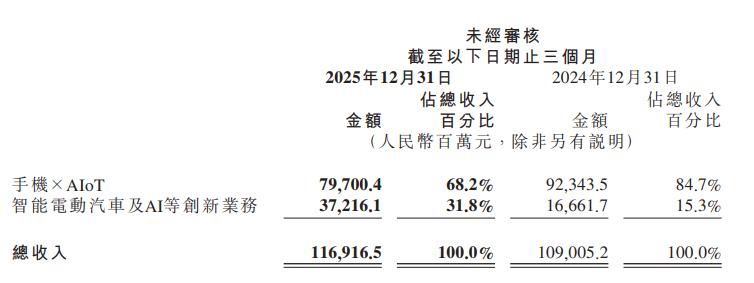
Moreover, it accounted for more than 30% of the group's total revenue in Q4, which is very close to the 37% share of the smartphone business.
The gross profit margin also increased to 22.7%, contributing an operating income of 1.1 billion yuan. Not only did it achieve quarterly profitability for the first time, but it also supported the group's profit performance in that quarter. In other words, the group's revenue growth in Q4 was basically driven by the automotive business.
Even from an annual perspective, the annual revenue of the smartphone × AIoT segment was 351.2 billion yuan, seemingly a 5.4% increase. However, the revenue of smartphones actually declined by 2.8% to 186.4 billion yuan, the shipment volume decreased from 168.5 million units to 165.2 million units, and the global market share also dropped from the peak of 14% to about 11%.
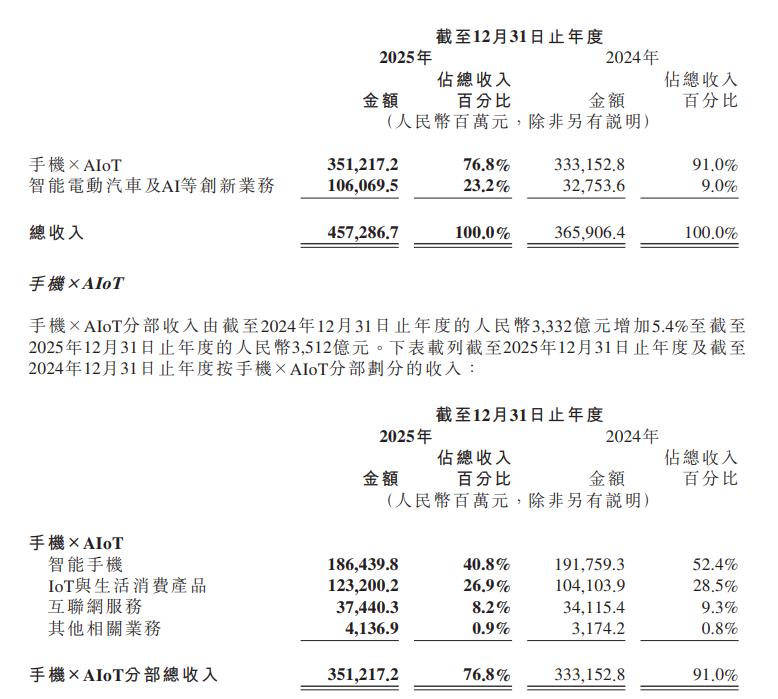
Although there has been a breakthrough in high - endization, the proportion of models priced over 3,000 yuan has increased to 27.1%. However, behind this is the sacrifice of the gross profit margin dropping from 12.6% to 10.9%. This also means that the profit contribution of Xiaomi's smartphone business is shrinking, from 24.254 billion yuan in 2024 to 20.266 billion yuan, a decrease of 16.4%.
Moreover, in terms of the gross profit margins of the two major internal businesses, the comprehensive gross profit margin of the smartphone × AIoT segment in 2025 was 21.7%, a year - on - year increase of 0.5 percentage points, which was 2.6 percentage points lower than the comprehensive gross profit margin of intelligent electric vehicles, AI and other innovative businesses.
This is sufficient to show that Xiaomi's automotive business is more profitable and has a faster growth rate than the smartphone business.
It also means that Xiaomi Group has shifted from relying solely on the smartphone business to a “automobile + smartphone” dual - engine driving pattern. In the future, the automotive business will even start to support the smartphone business.
Lu Weibing admitted in the financial report conference that “due to factors such as the increase in memory prices, the reduction of subsidies, and intensified competition, there will be some pressure on the performance in the short term”. Last year, Xiaomi predicted that the wave of memory price increases would last until 2027, which was already a relatively aggressive prediction, but currently, the price increase trend has exceeded expectations.
He also said that he fully understands the price - increase decisions of other smartphone manufacturers. Xiaomi is also under great cost pressure and hopes that consumers can understand that the price - increase trend is inevitable. “If we can't bear it anymore, we will definitely raise the price. Xiaomi has just held on a little longer than other manufacturers.”
In addition, he also said that although the memory usage of cars is relatively large, the increase in its proportion in the total material cost is not particularly obvious. Although the increase in memory prices has an impact on the gross profit margin of cars, it is far less severe than that on smartphones.
It is not difficult to see that the group has more confidence in Xiaomi's automotive business than the smartphone business. At the performance meeting, the goal of delivering 550,000 vehicles this year was re - emphasized.
With the ebb and flow of the two businesses, is the node of Xiaomi's “growth shift” far away?