While the industry is still competing in opening stores, Mixue Bingcheng is doing something else.
Text by | Chen Xi
In a challenging tea - beverage cycle, Mixue Bingcheng released a financial report that exceeded expectations:
In 2025, its revenue reached 33.56 billion yuan, and the net profit was 5.93 billion yuan, representing year - on - year increases of 35.2% and 33.1% respectively.
By the end of 2025, Mixue Bingcheng had 44,000 domestic stores, and Xingyunkafei (Lucky Coffee) had over 10,000 stores, making it one of the five coffee chains with over 10,000 stores. A total of 13,300 new stores were opened throughout the year.
This is a report card against the backdrop of increasing industry differentiation.
In 2025, the ready - to - drink tea industry entered an adjustment period. According to data from Zhaimen Canyanchuang, more than 25,000 milk tea shops closed in the past year. On the other hand, competition in the coffee market intensified, with a net increase of about 20,000 new stores in a year. Consumers' preferences have also changed. They are now more concerned about "value for money" rather than just "taste".
In such a market environment, Mixue not only withstood the changes, upgraded its products while maintaining low prices and continued to expand, but also seized the opportunity of the expanding coffee market, adjusted its sub - brand Xingyunkafei, and reached the scale of over 10,000 stores last year.
The number of stores and the number of new stores opened are the most intuitive data indicators in the tea and coffee market competition in the past few years. However, it can be seen that stores that open quickly also close quickly. Compared with the number of stores, another set of data in Mixue's financial report is more worthy of attention: "A net increase of 6,474 franchisees throughout the year."
According to people close to Mixue's management, in 2025, Mixue Bingcheng did not relax its franchise review standards. The pass rate remained below about 5%. The targets were still operators with physical business experience and the ability to invest long - term energy in management. For example, young entrepreneurs and operators of husband - and - wife stores are the key targets favored by Mixue.
This means that after the industry has gone through price wars, food - delivery wars, and store - closing tides, a group of more rational franchisees have started to make new choices. Each new franchisee is making a judgment with real money, which is a re - vote after verification.
Judging from the results, this choice is not blind. The financial report shows that in 2025, 2,527 global franchise stores of the Mixue Group closed. The main reason was that the company strengthened the active operation, adjustment, and optimization of overseas stores last year. In fact, this is the total number of closures of the group's three brands, accounting for only 4.2% of the total number of stores at the end of the year. The store - closing rate is still one of the lowest in the industry. When peers were under pressure in the price war, Mixue stabilized the profitability of its stores with its supply - chain advantages.
For front - line operators, the ability to make long - term profits is more important than the ability to expand rapidly. Therefore, this financial report cannot be simply summarized as "scale growth".
01 Mixue's New CEO Takes Office, Says Management Needs to "Repair the Roof in Sunny Weather"
At the performance briefing on March 24, Mixue's management mentioned that in 2026, the company will focus on improving the operating quality of stores, increasing investment in infrastructure and the operating system, and steadily and prudently expanding the store scale.
In other words, the expansion pace will slow down, but the investment will not decrease.
The speaker was Zhang Yuan, the new CEO of the Mixue Group. On the same day as the release of the financial report, Mixue announced a major management adjustment: Zhang Hongfu, the former CEO and founder of the group, was appointed co - chairman of the group; Zhang Yuan, the former CFO of the group, took over as CEO. Zhang Yuan joined Mixue Bingcheng as CFO in 2023 and has long - term experience in the consumer market. Zhang Hongfu will continue to participate in major group decisions and invest more time in the group's sustainable development strategy.
In 2020, when Mixue just exceeded the scale of 10,000 stores, the management realized that to maintain such a scale, heavy - asset investment in the supply chain was necessary to ensure a stable supply of raw materials and adhere to low prices. Therefore, in that year, Mixue introduced the only round of external investment, which was mainly used to invest in the supply chain.
To understand Mixue's competitiveness, the supply chain cannot be ignored. This started very early. In 2012, Mixue established a central factory and was one of the first companies in the tea - beverage industry to carry out standardized production.
Since 2012, Mixue has started to build multiple production bases, purchasing more than a dozen kinds of fruits in large quantities from their origins, processing them into frozen fruit cans in its own factories, and then distributing them to stores across the country through its self - built cold - chain logistics system. All these services are provided to franchisees free of charge. This is also the most distinctive feature of Mixue Bingcheng compared with its peers.
McDonald's has 45,000 stores globally. Its most important competitiveness is the cost advantage established through years of food industrialization. It is a representative of the cost - leadership strategy in the competitive theory of management guru Michael Porter. McDonald's saves money at every step. For example, to save the mixing time at the store end, it even spent tens of millions of dollars on researching and developing the spoon for McFlurry (although this spoon was later phased out due to environmental protection commitments).
Mixue Bingcheng is achieving the same thing in China. The management has a statement about its strategy: "Strengthen the supply chain, build the brand IP, and optimize store operations to achieve 'trinity total - cost leadership'." That is, use systematic capabilities to reduce overall costs, which requires long - term and forward - looking heavy - asset investment. In essence, it uses industrial capabilities to support efficiency and scale.
In the past few years, this system has continued to evolve, gradually upgrading from a room - temperature supply chain to a cold - chain system. The goal is to ultimately achieve consumer upgrading in products, enabling stores to use fresh fruits, freshly squeezed juices, and new milk for new products while still maintaining a single - product price of 6 - 8 yuan. This is undoubtedly a huge project, which Mixue's brand internally calls the "True Fresh and Pure" strategy.
Zhang Yuan mentioned at the meeting that in 2025, when the group was dealing with market changes, it realized the need for more forward - looking investment. "We need to look ahead and repair the roof in sunny weather."
This statement basically explains why Mixue is still increasing its investment at the current stage.
At the beginning of 2026, Mixue started to replace the room - temperature jam in its core product "Fresh Orange Smash" with frozen compound orange juice. The subsequent plan for this year is to promote the upgrading of raw materials for more products and fully introduce cold fresh milk. At the performance briefing, it was disclosed that in 2026, the group planned a strategic investment of about 1.8 - 2 billion yuan in total, of which 1.4 billion yuan was used for the in - depth transformation of the domestic supply chain. This is a typical long - term investment: it has a long cycle and slow results, but once established, it will be reflected in the cost structure and product strength.
At the same time, Mixue also plans to make up for a shortcoming: digital capabilities. As the proportion of food - delivery orders increases and orders shift online, the operating mode of stores is also changing, which puts forward new requirements for efficiency.
Zhang Yuan mentioned that the company will gradually retain users through the construction of a membership system and its own channels. At the same time, it will introduce more digital and intelligent tools at the store end, such as intelligent liquid - dispensing equipment and store management systems, to improve operating efficiency and reduce reliance on manual labor.
This is more like an extension of the existing system, allowing the capabilities established based on scale and the supply chain to continue to operate in the new consumption environment.
After price wars have become the norm and products have become more homogeneous, the focus of industry competition has actually changed. It has shifted from competing in expansion speed to competing in the ability to produce high - quality products at low prices and control costs. Against this background, the supply chain is no longer just a back - end capability but directly affects the operating results of stores. This is why Mixue chooses to continue investing at this stage instead of shrinking.
02 The Snow King IP: From Marketing Cost to Strategic Asset
If the supply chain solves the problems of cost and efficiency, then the brand needs to solve the problem of why consumers continuously choose you.
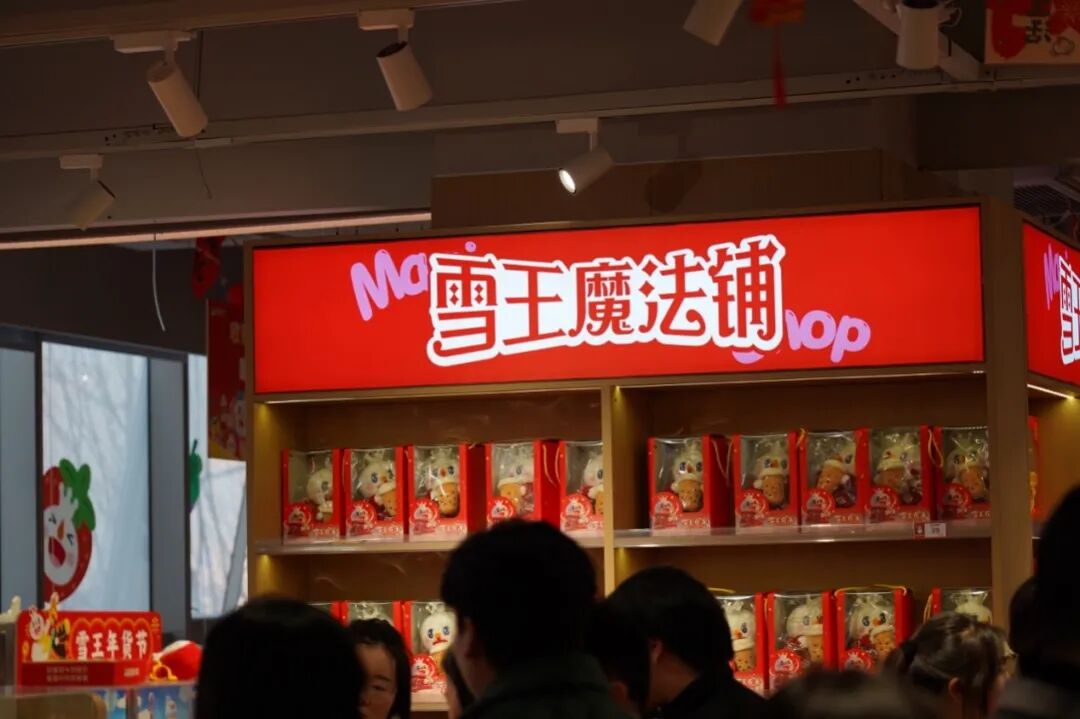
In January 2025, Mixue Bingcheng opened its "Global Headquarters Flagship Store" near Zhengzhou East Station. The location was clearly chosen - a transportation hub in the city with a huge daily passenger flow, targeting not only Zhengzhou consumers but also tourists. This store has the most diverse range of surrounding products of Mixue Bingcheng so far, offering a consumption experience of "buying a lot for 100 yuan".
After its opening, this flagship store quickly became a regional consumption landmark. During the three - day Tomb - Sweeping Festival holiday, the cumulative turnover exceeded 1 million yuan. In July of the same year, the highest single - day turnover exceeded 600,000 yuan. By the end of 2025, Mixue had opened such flagship stores in 23 cities, including Zibo, Baoding, Chongqing, and Hangzhou.
In the past year, the Snow King IP has made progress in both commercialization and content creation. In May, the animation "The Snow King Arrives" was launched in five languages, including English, French, and Portuguese. According to official data, the revenue from the Snow King cultural and creative products accounted for more than 80% of the total revenue at the Zhengzhou headquarters flagship store. This means that the Snow King IP is no longer just a marketing cost department but has started to have a clear growth and monetization path. The financial report shows that in 2025, Mixue Bingcheng's sales expenses accounted for only 6% of its revenue, far lower than the industry average.
The rich variety of derivatives has made the business model of the flagship store healthier. Previously, Mixue promoted the franchise of flagship - store models, but the store model that relied solely on beverage sales faced significant operating pressure. With the support of IP - related products, the profitability of single stores has improved.
In the entire catering industry, such a super IP is rare. The general public can obtain unique emotional value from the Snow King. Not everyone can afford Disney's surrounding products, but most people can afford Snow King fridge magnets and tumblers.
In today's context, such an IP image may be more valuable. Currently, homogeneous competition has become the norm in the tea and coffee industry. When product tastes and store models tend to be similar, emotional value will be a scarce differentiating factor.
Mixue clearly realizes this. The next step is the "City Theme Park". In February 2026, the "Snow King Park" was listed as a key - supported project in Zhengzhou and is planned to be located near the global headquarters of Mixue Bingcheng at Zhengzhou East Station. According to recruitment information, Mixue is recruiting performance coordinators with work experience at Disney or Universal Studios and coordinators for surrounding products familiar with the operating logic of Pop Mart. This is a small indoor park with multiple indoor theme experience areas, representing Mixue's initial exploration in the park scenario. At the same time, a Snow King movie is also in the planning stage. These actions are not carried out at a fast pace, but they have the same direction: to transform the IP from a series of marketing activities into a long - term asset that can be continuously accumulated.
03 The Second Growth Curve: Xingyunkafei Upgrades Comprehensively to Focus on Professional Coffee
Looking at the previous actions together, it can be found that they are actually interconnected. The supply chain solves efficiency problems, the Snow King IP solves demand problems, and the new business answers the same question - where else can this set of capabilities be applied?
2025 was a year of explosive growth in the coffee market. Xingyunkafei emerged, with its store count exceeding 10,000 and becoming one of the five domestic coffee chains with over 10,000 stores. In essence, it is still the collaborative reuse of the Mixue Group's supply - chain capabilities. The coffee roasting line at the Hainan factory was put into operation last year, providing a solid foundation for the development of Xingyunkafei.
The development pace of Xingyunkafei is a typical "Mixue pace" - slow and steady. From 2023 to 2024, Xingyunkafei focused more on internal matters, re - polishing its products, store models, and operating methods. In 2026, how Xingyunkafei and the main brand Mixue Bingcheng will collaborate has become the focus of industry attention.
Mixue's answer is "dual - brand, collaborative development". Mixue Bingcheng focuses on ready - to - drink tea, with coffee as a supplementary item on the menu; Xingyunkafei is positioned as a "professional brand focusing on freshly brewed coffee". The two share the supply chain but go in different directions, reusing the underlying capabilities without direct competition at the brand level.
The results of the adjustment are gradually becoming apparent, and the product - upgrading pace of Xingyunkafei has significantly accelerated recently.
First, in the Zhengzhou flagship store, hand - brewed coffee priced at 10 - 16 yuan was launched. The option of latte with Yuexianhuo milk was also added to the menu - the regular 350 - ml cup is priced at 12 yuan, and the large 700 - ml cup is priced at 16 yuan, a 2 - yuan increase compared to the original latte (10 yuan). In March this year, Xingyunkafei selected two cities, Jinan and Heze, for a pilot project, launching Yuexianhuo cold fresh milk with a 19 - day shelf life and fresh coffee beans with a 60 - day shelf life.
At the same time, special - blend products were launched in five cities, including Guangzhou, Xi'an, Jinan, Beijing, and Chongqing. For example, the 13 - yuan pineapple special blend uses single - origin beans from Ethiopia. The ability to sell high - quality beans at low prices is due to the coffee roasting line at the Hainan factory that was put into operation last year.
All these actions point to the same signal: Xingyunkafei is shifting from "high - quality at affordable prices" to "premium at affordable prices". In the second half of 2025, it announced its entry into first - and second - tier cities. Currently, most of Xingyunkafei's stores are still in third - tier and lower - tier cities, but the focus of future expansion is moving up.
At the performance meeting, Pan Guofei, the CEO of Xingyunkafei's China region, summarized the core strategy for 2026 in four words: "Improve quality and efficiency". In terms of product lines, a special - blend series will be launched for testing, and raw materials will be upgraded to fresh milk and fruits. In terms of store expansion, the layout in high - tier cities will be strengthened, and it will also enter Hong Kong and Macau. There are also investment plans of hundreds of millions of yuan for brand marketing, mini - programs, and space experience.