From going viral during the Spring Festival Gala to offline 4S stores: The robotics industry has finally emerged from the illusion of traffic.
As Unitree's application for IPO on the Science and Technology Innovation Board was officially accepted on March 20th, the "other shoe" of the listing journey of the "top student" in the embodied intelligence track, which has attracted the attention of the industry, is finally about to drop.
There are many interpretations of this event. However, the second sister also noticed that in this March, while the industry spotlight was drawn to the "technology + capital" feast, there were actually other relatively less eye - catching things happening in the track. But perhaps looking back a few years later, they will also be one of the historical footnotes of the development of this industry:
In March, so - called "robot 4S stores" were officially opened in different cities such as Beijing, Yangzhou, and Zhengzhou, providing a series of services including robot sales, rentals, and after - sales feedback;
The media revealed that the Coconut Palm Group issued a tender announcement for the procurement of humanoid robots for processing processes such as shelling. The announcement put forward clear and specific requirements in terms of technology, system control, and the lifespan of vulnerable parts.
On March 19th, the Ministry of Commerce disclosed that in the first two months of this year, the sales volume of embodied intelligent robots increased by 13%.
The Industrial Changes Reflected Behind the "4S Stores"
The steady growth of the sales volume of embodied intelligent robots in the first two months of the year is very likely due to the appearance of many types of robots from various brands on the stage of the Spring Festival Gala in the Year of the Horse.
However, after several years of development, the rapidly evolving industry has more or less reached a consensus: For robots to truly enter the public view, they cannot rely solely on national - level media events like the Spring Festival Gala, which have a good effect but are too infrequent.
The concept of 4S stores is not unfamiliar to everyone. As cars have become popular consumer goods for the Chinese people, this sales model, which has a physical offline space and can provide a series of services such as sales, spare part supply, after - sales service, and information feedback to buyers and experiencers, still occupies a core position in China's automobile sales system, despite facing some problems.
Data shows that in 2025, the 4S authorized distribution model accounted for 62% of China's new car sales volume. If we narrow it down to the pure - fuel vehicle field, the sales volume of 4S stores was nearly 95%.
You may wonder whether this model can be applied to embodied intelligent robots, which are quite different from cars, a well - established consumer product, in many aspects such as user attributes, concentration, and usage scenarios.
Don't worry. Let's slowly analyze the possible significance of this model at the current stage of embodied intelligence development.
Let's take a step back and look at the bigger picture.
While Unitree Technology, as the industry leader, is about to be the first to "cross the finish line" and go public, the robot track has also witnessed another round of financing boom in the past few months. According to statistics from media such as Caixin, the total financing in this field in 2026 has approached 20 billion yuan.
However, compared with the previous booms in the past few years, this wave of "funding rain" has not evenly benefited as many industry players as possible. Seven companies in the main body and component links have exceeded the 10 - billion - yuan valuation mark through this round of financing. And behind them, the "decoupling" between the leading and mid - tier companies is accelerating, and small and medium - sized players are starting to fall behind.
This is an inevitable result of the industry's development and competition.
If in the past few years, the narrative at the Spring Festival Gala level could more or less benefit most companies in the industry, then in the future, leading brands will increasingly not want consumers to confuse them with other small and medium - sized players and think that "they are all just robot manufacturers."
After all, the emergence and popularization of the automobile 4S store model are also inseparable from the trend that automobile companies are increasingly attaching importance to their brands and want to enhance consumers' trust in the brand through more professional and exclusive services.
Although robots have not yet achieved "consumer - level" user penetration, channels that can reach consumers on a large scale in real - world scenarios are useful when facing a broader user base. Moreover, the people who go to offline stores to see robots have a stronger sense of purpose than the audience watching the Spring Festival Gala on TV.
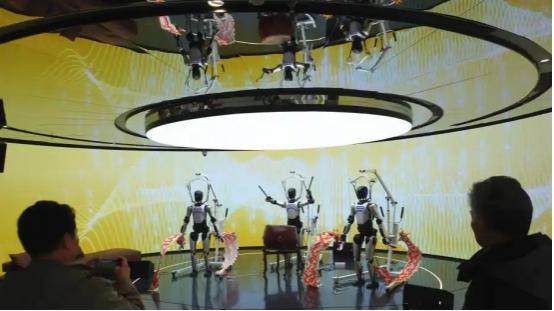
Take the "Humanoid Robot 4S" store that officially opened in Zhengzhou on March 15th as an example. It already has robot products from mainstream leading brands such as Unitree, Zhipu, and Leju. According to reports from media such as Yicai Global, Henan Embodied Intelligence Industry Development Co., Ltd., the creator of this 4S store, signed a strategic cooperation agreement with Unitree Technology on February 1st this year. Even earlier, leading brands such as Zhongqing, Ubtech, and Zhipu also chose to set up some manufacturing bases in Zhengzhou.
Through the in - store display, the public can get up - close to understand and experience the functions and usage scenarios of robots. With the comprehensive approach of industry - academia - research cooperation, embodied intelligence companies can convey their unique brand images and signals.
In addition to brand - related factors, the offline presence in the form of 4S stores can also help robot companies increase sales opportunities while saving costs.
Looking at the specific investment plan of Unitree's current IPO fundraising, the four major areas of model research and development, body research and development, new robot product development, and manufacturing base construction have divided the pre - raised funds of 4.2 billion yuan, and there is no mention of plans for sales channels.
Currently, China's robot industry, which mainly focuses on industrial and manufacturing customers, still aims at large - scale orders (and mass production) for development. In the future, as the product sales channels expand and customer needs become more diverse and fragmented, competition and demand for offline presence will gradually emerge.
Especially in a multi - opportunity market like Henan, which has a combination of industrial, agricultural, manufacturing, and rich cultural and tourism industries, early layout of a model like 4S stores through agreement cooperation can not only secure a position in advance but also ensure one's own interests in the game with channels. For leading brands aiming to gain an edge in future competition, it is undoubtedly an effective upgrade and supplement to the original sales model.
The third aspect is longer - term issues such as service quality and data, which are related to the current robot rental market.
With the outstanding performance of robots in a series of cyclical and non - normal scenarios such as cultural and entertainment and tourism, as well as the increasing demand from individual users for a trial experience, the robot rental market has gradually thrived.
The fact that "Qingtian Rent", a well - known robot rental platform in the industry, completed another round of over - 100 - million - yuan financing last week is proof that this track is favored. The investors include Lehua Entertainment, an idol brokerage company from a cross - industry.
Meanwhile, the large number of small and medium - sized robot rental platforms that have emerged in a short period has also led to a certain degree of chaos in the market. Media such as Jiefang Daily and Beijing Business Today have reported on this topic this year.

These non - standardized rental platforms take advantage of the urgent need of some robot companies to ship products and achieve sales volume. They not only push robot manufacturers into a certain degree of price war but also often "drop the ball" when providing services to institutional and individual consumers, affecting the reputation and image of robot products. Some platforms even choose to block the path of data transmission back to the robot manufacturers.
If relying on a service - integrated model like a 4S store with brand support, it can not only provide more timely and comprehensive maintenance services for users but also ensure that robots can pass the tests of stability and accuracy in some non - standard rental scenarios. The accumulated data assets can effectively flow back to the companies, which is helpful for future data training. In addition, for some scenarios with innovation requirements, which need customized cooperation with the technical capabilities of the robot manufacturers, the 4S store model, which has a closer connection with the manufacturers due to authorization, is also expected to perform better than ordinary rental platforms.
Inspiration from the "Pioneer" Coconut Palm Group
If leading robot companies show a trend of continuous and accelerated development, what new challenges have the industrial customers put forward? And what impact will it have on the industry?
On March 16th, the Coconut Palm Group issued a "Tender Announcement for the Procurement of Humanoid Robot Coconut Shelling and Peeling Equipment" with the goal of building an automated coconut processing production line and planned to purchase 50 humanoid robots.
The tender details are very clear, including work efficiency (each robot should process at least 360 coconuts per hour in line with the standards), the designed lifespan of core vulnerable parts (not less than 5,000 hours), etc., and also require suitability for its special humid environment.
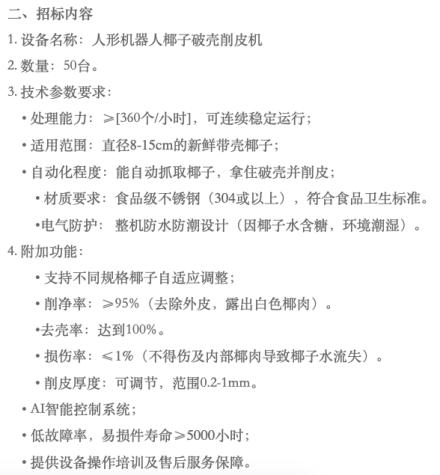
(The Coconut Palm Group mentioned detailed requirements for robot performance in the tender.)
As soon as the news came out, some people's first reaction was that the Coconut Palm Group, as a brand, has always had a "gene" for good marketing (presumably some people still remember the classic case of those fitness - model live - streamers in the live - stream room three years ago). Posting such a "recruitment - like" procurement announcement won't do any harm anyway.
However, more people can understand the high labor cost, safety risks, and high turnover rate associated with the traditional manual coconut - peeling process. As a well - known national brand, the Coconut Palm Group is as eager as the onlookers to know whether the current automation and intelligence level of robots is sufficient.
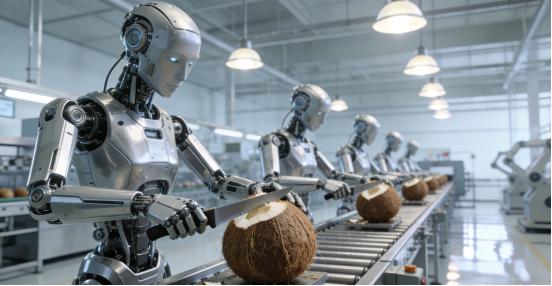
The example of the Coconut Palm Group at least shows that after industries with a higher degree of automation and structuring such as the automotive, electronics, and warehousing industries have started to accept robots on a large scale, in sub - scenarios such as sorting and processing, the process of challenging robots' capabilities from structured to unstructured is also accelerating.
More and more "atypical" customers like the Coconut Palm Group are willing to be the "pioneers," which is definitely a good thing.
Perhaps what might interest the Coconut Palm Group is the progress made by companies like Tashan Technology in the fields of tactile and finger sensors. Through the integration of vision and touch, as well as methods such as simulation and supervised learning, this company has previously been able to help crayfish processing plants achieve the separation of the head and tail in actual operations, and the meat - extraction rate of the crayfish tails and the accuracy of defective product classification are both at a relatively high level in the industry, thus expected to solve the automation problems of enterprises.
If a well - known consumer brand like the Coconut Palm Group can successfully use robots to "process" coconuts and conduct online live - streams from time to time, consumers will have a closer psychological connection with the robot industry.
Historically, the accelerated connection between market demand and technology is inseparable from evolving business models.
The series of performance indicator requirements put forward by the Coconut Palm Group seem a bit strict, but to some extent, they also inspire the robot industry to rethink the business model, including the sales link. Compared with the currently dominant "equipment purchase + maintenance" service (including the currently not - very - flexible rental market), is it possible that in the future, the selling price and method of robot labor can be split into payment by hour, by piece, or according to more detailed demand scenarios, just like human labor in some scenarios and seasons?
The characteristics such as the sharing of robot labor assets, pricing based on usage, and agility generated around this idea can, from the user's perspective, meet diverse needs and preferences and reduce usage costs, thereby further expanding the market demand for robots. From the perspective of robot manufacturers, it can accumulate a large number of usage scenarios and their data, promote the commercial return of products in hand, and continue to improve the capabilities of robots. On this basis, a more coordinated and prosperous business ecosystem will also thrive.
It is really worth looking forward to what changes will occur in different links during this process.
At the beginning of 2026, leading companies in the robot track started to accelerate their expansion in terms of brand, etc., based on the consideration of cost, risk, and efficiency. Meanwhile, the concepts of the industry and consumers are also being reshaped in this gradually unfolding elimination competition.
This article is from the WeChat official account "Caiguan Erjie", author: Erjie. Republished by 36Kr with authorization.