Li Xiang turns around, shifting from emulating Huawei to being himself.
In February this year, Li Auto's delivery volume increased slightly by 0.6% year-on-year.
This increase is almost negligible in the new energy vehicle industry. However, those familiar with the company know what this 0.6% means - it ended Li Auto's eight - month consecutive decline in deliveries.
Some optimists even predict that the second quarter of 2026 might be the starting point for Li Auto's all - out counterattack.
To understand the significance of this counterattack, we must first look back at the MEGA incident, regarded as a "watershed" in Li Auto's development history. Before this incident, Li Auto was a "blockbuster maker" and had been profitable for 11 consecutive quarters. After that, Li Auto suffered a 18.81% year - on - year decline in delivery volume and an 85.8% year - on - year decline in net profit in 2025.
This crisis not only became a turning point for Li Auto but also forced its founder, known for "extreme rationality", to complete a self - reconstruction.
Return
The MEGA incident was not Li Xiang's first darkest moment.
As early as 2005 during the startup period of Paopao.com, he experienced the embarrassing situation where 90% of his employees resigned collectively overnight. In the eyes of the employees at that time, he managed the company with an extreme goal - oriented approach, lacking humanistic care, and seemed "overly rational, only focusing on tasks and completely ignoring people."
More than a decade later, in 2019, before the mass production of Li ONE, the company only had enough cash on its books to last for another three months. Li Xiang met with more than 150 investors, but all of them rejected him. Due to the sharp decline in Tesla's stock price and NIO being abandoned by capital, no one dared to invest in projects in the entire new energy vehicle sector.
Out of desperation, he reluctantly approached Wang Xing, whom he had rejected during the Series B financing. He got 300 million US dollars, which solved the urgent problem. Many years later, when Li Xiang recalled this period in an interview with Luo Yonghao, he still choked with emotion:
"I almost ran the company out of business."
This is Li Xiang - surviving in the brutal business competition with extreme rationality and perseverance. Later, he also fully armed Li Auto with processes, KPIs, and a professional manager system, aiming for controllability, efficiency, and precise operation like a machine.
In March 2024, the MEGA was launched, and the term "coffin car" topped the hot search list. Facing the designer's request for a redesign, Li Xiang firmly refused to flatten the rear of the car, believing that:
"Changing it would mean admitting defeat."
This was not just a moment of anger. The bullet - shaped design reduced the drag coefficient to 0.215, and the actual range increased by 40 kilometers. Li Xiang was still the same Li Xiang, making decisions based on engineering logic and using rationality to confront the world.
But this time, it was different.
The failure of the MEGA was not due to a single reason - public opinion was the surface, the product was the middle layer, and the organization was the core. The superposition of these three crises ended Li Auto's era as a "blockbuster maker".
In terms of public opinion, the MEGA was involved in one of the "biggest smear campaigns in automotive history". This precise attack directly led many customers to cancel their orders and disrupted Li Auto's pure - electric vehicle strategy.
In order to completely get rid of the negative associations, Li Auto was forced to rename its originally planned pure - electric M series to the i series. Behind the change of just one letter was a huge cost of 2 billion yuan in invalidated molds and the need to open new molds.
In terms of the product, as Li Auto's first pure - electric vehicle model, the MEGA carried the mission of opening up a new battlefield. However, in the early stage of its launch, it encountered problems such as the "refrigerator and TV" being split into optional configurations, which led to a fragmented user experience and a lot of criticism.
Although Li Auto made an emergency adjustment one week after the launch: canceling the Pro and Ultra versions, only keeping the Max version as the standard configuration, and uniformly lowering the price, returning to the product logic of focusing on blockbusters, and shifting the sales focus from scenario creation to performance and cost - effectiveness competition, the market's first impression had already been formed. At its worst, the monthly sales volume of the MEGA once dropped below 500 units, and the factory responsible for this product was shut down for a month.
The deeper reason lies in the organizational level.
In the past three years, Li Auto has been learning the "Huawei - style matrix organization", trying to upgrade itself into a mature modern enterprise with processes and KPIs. However, this model had a rejection reaction in practice - the three product lines divided by price segments competed for resources in the limited niche markets, resulting in overlapping functions and fragmented decision - making.
A former employee once privately commented: "Li Auto's early success was due to the founder's talent in product definition and user insight. During the process of learning from Huawei, the company became more systematic, but the front - line combat effectiveness was also lost."
When Li Xiang later reviewed the situation, he also admitted that he had made a mistake in rhythm: "I wrongly treated the 'from 0 to 1' stage of Li Auto MEGA as the 'from 1 to 10' stage for operation. Li Auto, from top to bottom, paid too much attention to sales volume and competition, allowing desire to surpass value."
Affected by the "aftershocks" of the MEGA, Li Auto, which had once firmly held the top position among new - energy vehicle startups, once fell out of the top five in the monthly sales rankings of new - energy vehicle startups in 2025. At the end of October 2025, Li Auto recalled more than 11,000 units of the 2024 - model MEGA due to "insufficient anti - corrosion performance of the coolant", which significantly affected the profit, resulting in a net loss of 624 million yuan in the third quarter.
Li Xiang realized that an internal "surgery" was imperative. At the earnings conference call in November, he made a decision: to end the three - year - long professional manager governance system and return to the management model of a startup.
And an important sign of this return is stopping learning from Huawei.
Reconstruction
As early as 2022, Li Xiang began to introduce Huawei's IPD process. At that time, Li ONE had just gained a firm foothold, while AITO, empowered by Huawei, was rapidly encroaching on the market.
Before the MEGA crisis, half of Li Auto's core senior management had a Huawei background and introduced Huawei's management and models to Li Auto from different aspects:
Zou Liangjun, the former head of overseas sales and marketing at Huawei Honor, joined Li Auto as the senior vice - president of sales and service. He divided the national market of Li Auto into 26 battle zones and implemented high - intensity KPI management;
Li Wenzhi, who had 18 years of work experience at Huawei, joined Li Auto and led the optimization of the financial middle - platform, upgrading the original OKR mechanism to the PBC performance model.
The core of PBC is result - oriented and forced ranking: everyone has clear KPIs, and they need to be benchmarked, ranked, and evaluated every quarter. Its effect was once immediate - Li Auto's sales volume increased by 190% year - on - year in 2023.
After the MEGA crisis broke out, Li Xiang's first reaction was to solve the problem with a more effective process.
In April 2024, Li Auto issued an announcement to all employees, announcing the launch of the upgrade to the matrix - type organization 2.0: the CEO's office was officially renamed the "Product and Strategy Group", and a new GTM team was established, specifically responsible for the operation of new product launches.
The announcement clearly stated: "Li Auto should continue to deeply learn from Huawei in organizational capacity building, focus on user value, and improve decision - making quality and operational efficiency."
However, more than a year of rectification has instead led to a continuous expansion of Li Auto's losses. The "acclimatization" of the PBC model at Li Auto has also gradually emerged: there has been fierce competition in the sales system to meet the targets, with frequent problems such as cross - regional customer poaching and internal rebates; excessive focus on short - term sales volume targets has led to deviations in the judgment of the market trend of pure - electric vehicles.
At the Q3 2025 earnings conference call, Li Xiang deeply reflected: "Li Auto adopted the management model of a startup in the first seven years. As the scale expanded, we tried the professional manager governance system in 2022. After some efforts, the team has become worse and worse. We decided to return to the startup model."
After that, several Huawei - affiliated senior executives left the company one after another.
At the end of 2025, Li Wenzhi, the former head of HR business, Zou Liangjun, the former senior vice - president of sales and service, and Sun Baigong, the former head of GTM, left Li Auto one after another.
This is not a simple "purge" but a re - anchoring of the organizational genes. Li Xiang no longer tries to make Li Auto "the second Huawei" but wants to be Li Auto again.
In January 2026, Li Xiang took action again, making changes to the supply chain. He merged the "Parts Cluster" department into the "Manufacturing" division, which is now under the overall management of Vice - President Li Bin. The former head of the "Parts Cluster" department, Luo Ping, left the company. After the merger, the number of employees in the Manufacturing department swelled to more than 10,000, accounting for one - third of the company's total employees, becoming the "super - large department" in the intelligent vehicle group.
Demoting the original first - level department, which was benchmarked against NIO's Three - Electric Research Institute, to a subordinate unit of the Manufacturing department shows Li Xiang's determination to "improve efficiency and reduce costs". Under the logic of returning to the startup model, any redundant levels must be cut.
Organizational change is not only happening at the headquarters but also at the front line.
In February 2026, Li Auto issued a notice internally, officially launching the "Store Partner Program". This program is not a franchise model but an incentive mechanism for front - line store managers. Starting from some leading stores as a pilot, excellent store managers will be given the decision - making power for customer acquisition, operation, and team management, as well as the right to share profits. The assessment criteria will shift from single - dimensional sales volume to the overall operating results of the store.
An insider at Li Auto revealed the core concept of Li Xiang's reform this time: "Let those who understand users and the market take the core positions and manage the stores as if they were running their own businesses."
This time, Li Xiang no longer only focuses on tasks but also starts to pay attention to "people". Li Xiang, who once believed in processes, begins to delegate power and learns to trust those who, like him, want to build and sell good cars.
With the organizational change, Li Auto's product lines have also been re - configured, and the adjustment of the product strategy is another way for Li Xiang to "let desire return to ability".
Reorganization
In January this year, Zhang Xiao, the former head of Li Auto's second product line, left the company to start his own business. The company then merged the three product lines previously divided by price ranges into two, completing the "streamlining" of the product lines: the first product line is now led by Tang Jing, covering the MEGA, L9, L8, and L7; the second product line is led by Li Xin, covering the i series and L6.
In the past three years, the most thorough aspect of Li Auto's learning from Huawei was the way of dividing product lines. Divided by price segments of over 400,000 yuan, 300,000 - 400,000 yuan, and below 300,000 yuan, the three product lines were supposed to cover each niche market precisely in theory.
However, in actual operation, in the limited niche markets, the three lines competed for resources, with overlapping functions and fragmented decision - making, which seriously reduced the sales efficiency. An internal employee once privately complained:
"Three product lines all wanted to compete for the same customer, but in the end, none of them succeeded."
Behind this is that Li Auto's once - proud "blockbuster logic" has been diluted by the "desire for expansion". When reviewing the situation, Li Xiang also admitted this strategic mistake: "We were too eager to cover every price range, but in the end, we failed to achieve absolute dominance in any range."
Simultaneous with the reduction of product lines is the streamlining of SKUs.
At the beginning of 2026, Li Auto announced that the L series would return to the "single - product blockbuster" logic: the core configurations would be standard across the entire series, completely eliminating the pain point of "a discounted experience for the entry - level version". This means that Li Auto has embraced again the success code of the ONE and L9 eras - focusing on a single top - level configuration and penetrating the market with extreme product strength, rather than catering to users with different budget ranges through configuration gradients.
Actually, as early as after the failure of the MEGA, Li Auto had already started to return to the blockbuster product logic of focusing on single products. Soon after the complexity of SKUs caused customer complaints, the MEGA underwent version reduction, focusing on the MAX version and continuously iterating the product.
In April 2025, Li Auto launched the MEGA Home special family version, making multiple upgrades according to the needs of Chinese family users: second - row rotating zero - gravity seats, a larger rear - row screen, and electric doors for the whole vehicle - these iterations were adjustments made after the team carefully listened to the suggestions of more than 1,000 early users.
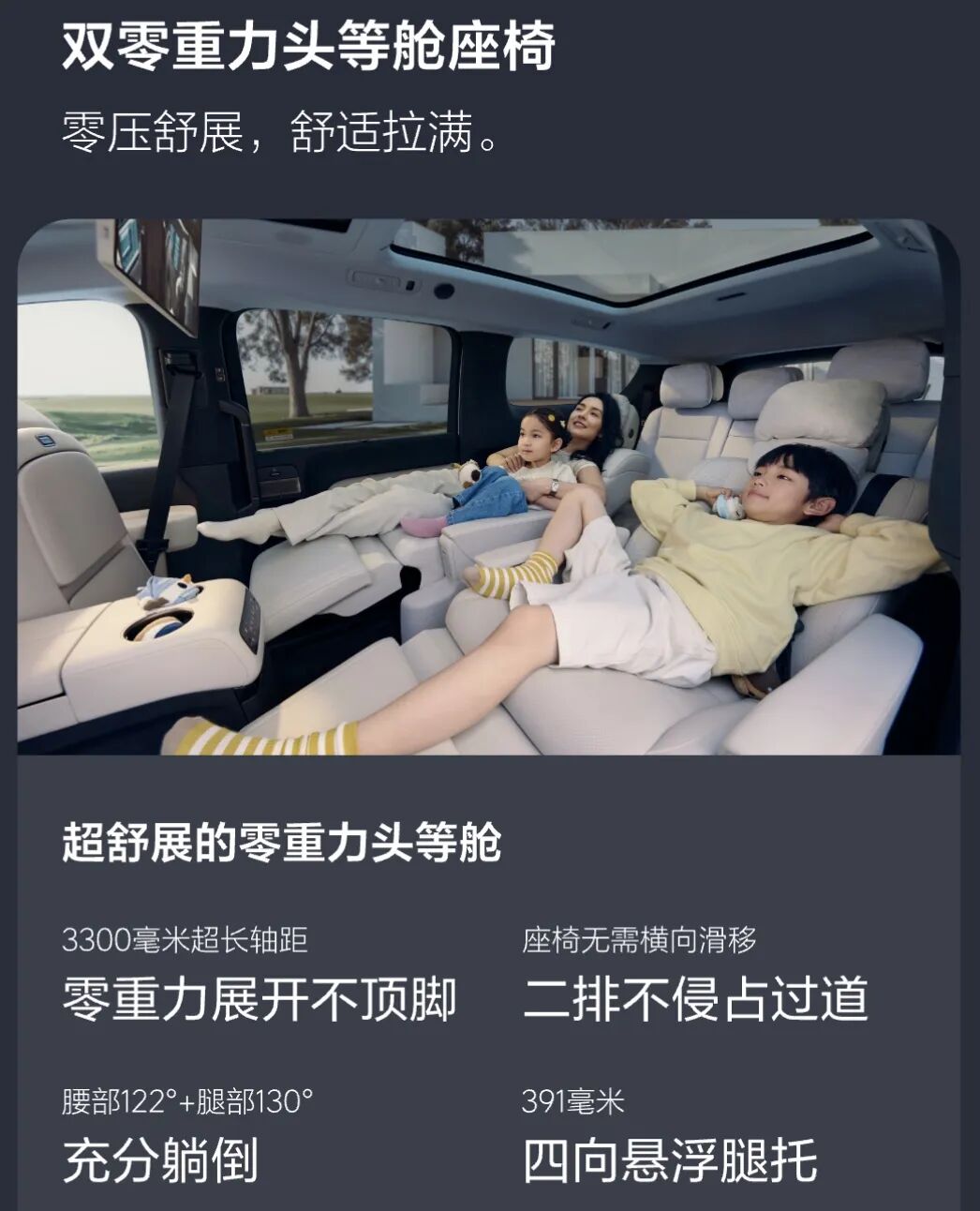
Some configurations of the Li Auto MEGA Home, Source: Li Auto
Soon, this change showed results:
In August 2025, the delivery volume of the MEGA exceeded 3,100 units, ranking first among pure - electric vehicles priced over 500,000 yuan; in October, the MEGA had firmly occupied the benchmark position in the MPV market priced over 500,000 yuan and became the product with the highest preservation rate among pure - electric MPVs.
"Completing is 100 times more important than being perfect. First, create a bunch of mediocre products and then quickly iterate them to a high - quality level is far more important than painstakingly creating a perfect product."
Li Xiang's words in an interview program are the best interpretation of the MEGA crisis.
The MEGA is not perfect, but it allowed Li Auto to enter the pure - electric vehicle market. Through continuous iteration, it achieved a "turnaround" and at the same time enabled Li Xiang to complete a self - reconstruction.
Whether it is organizational change or product line reorganization, the ultimate goal is to get Li Auto back on the growth track. Currently, Li Xiang's "healing" efforts have shown initial results: in February 2026, the delivery volume was 26,421 units, a slight increase of 0.6% year - on - year.
While the sales volume is improving, he has also taken new actions: deploying embodied intelligence.
New Bet
As early as February 2025, Li Auto internally approved the "Strategic Closed - Loop Management Plan