72 hours after the launch of Xiaomi's new SU7: Customer flow is diluted, and it's time to compete with strong product capabilities.
Two years ago, 36Kr reported on the grand occasion at the stores after the launch of the first - generation Xiaomi SU7.
It was a Friday. At a store in a large shopping mall in Beijing, a Gulf Blue Xiaomi SU7 received test - drives from nearly 60 potential car owners within 9 hours during the day.
The test - drive car's full - charge range that day was originally 800 kilometers. At the end, the displayed range on the meter was only 40 kilometers, and the system had already shown a red warning.
On March 19, 2026, Xiaomi launched the new - generation SU7, and 36Kr visited this store again.
We observed that until Saturday evening, a new - color Cabri Blue SU7 in the store still had a displayed range of more than 250 kilometers.
“There were almost no customers on Friday, and one of the test - drive cars stayed in the basement all day,” a salesperson told 36Kr. “It wasn't until the weekend that the new SU7 saw a peak. ‘We're a large store in the Beijing area. This weekend, the total number of test - drive orders from more than a dozen of our salespeople was about 60 - 80 per day.’”
According to official data from Xiaomi Auto, currently, a total of 50,000 test - drives of the new SU7 model have been completed at 477 stores across the country, which means that on average, each store received 105 test - drive orders in the first three days after the launch.
For the first - generation SU7, which caused a sensation in the market two years ago, on the first working day after its launch, the number of test - drives at a single store reached about 200.
Since 2024, the number of Xiaomi stores across the country has increased by more than 400. With the sharp increase in the number of stores, the “popularity” of the new SU7 seems to have been diluted.
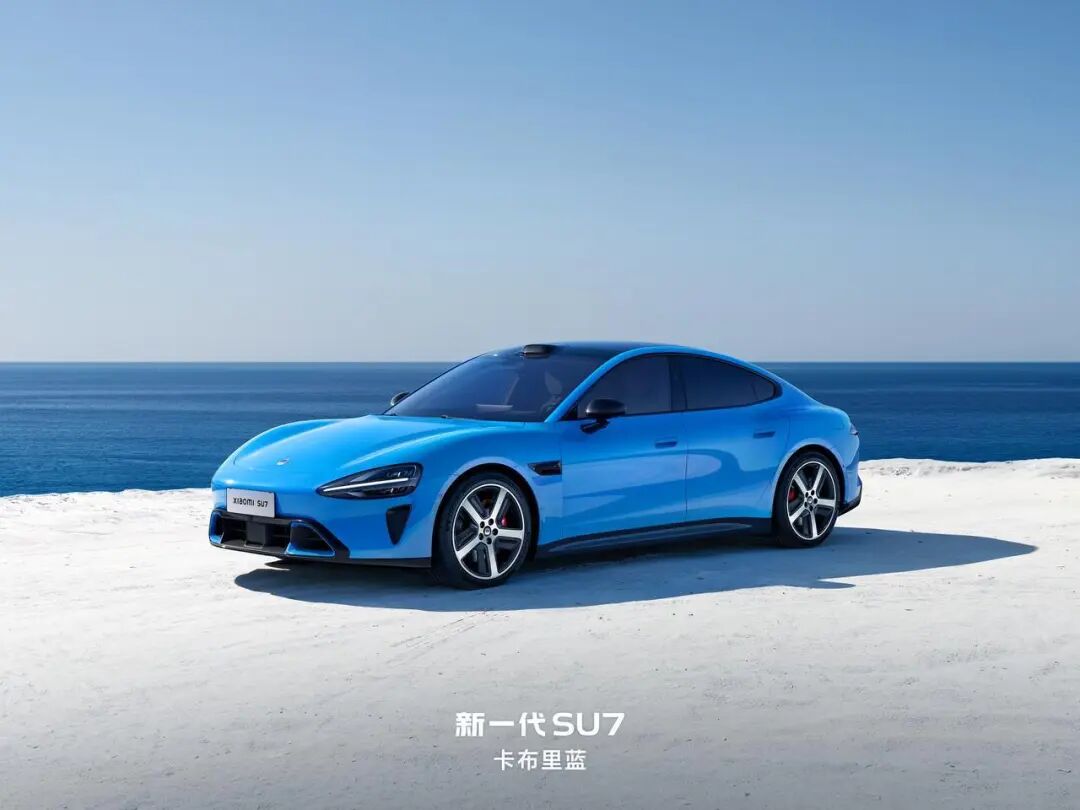
New exterior color of the new - generation Xiaomi SU7
On the night of the new SU7's launch, Xiaomi announced the order situation: it received 15,000 non - refundable deposit orders in 34 minutes.
Although this figure is not as sensational as the “88,000 firm orders in 24 hours” of the first - generation SU7 and the “200,000 firm orders in 3 minutes” of the YU7, winning 15,000 firm orders within half an hour still proves Xiaomi's appeal in the pure - electric vehicle market.
On March 23, Lei Jun revealed in a live - stream that the number of locked orders for the new SU7 has exceeded 30,000. 36Kr also learned from the supply chain that the latest sales target of the new - generation Xiaomi SU7 for 2026 is 120,000 units.
In the mobile phone and 3C industry, consumers can replace their devices every year, continuously injecting popularity into new products. However, the usage cycle of a car usually lasts 3 - 5 years or even longer.
Users who bought the Xiaomi S4 smartwatch two years ago may choose to replace it with the S5 as soon as it was launched. But even the most loyal owners of the first - generation SU7 are unlikely to consider replacing their cars with the new model just two years later.
This is the difference between the “impulsive upgrade” in the consumer electronics field and the “deliberate” large - scale consumption.
As Lei Jun said, Xiaomi's expectation for the new SU7 is to “let more people understand and like Xiaomi's products.” Therefore, the core focus of the market has also shifted: after the first - generation product “broke through the circle” with its phenomenal popularity, can the new - generation SU7 effectively expand the user circle again and reach a wider and more mainstream consumer group?
The new - generation Xiaomi SU7: same appearance, more features with a slight price increase
The new SU7 still has three versions, with prices of 219,900 yuan, 249,900 yuan, and 303,900 yuan respectively, a price increase of 4,000 yuan compared with the old model.
“There are more than 100 upgrades in the new car, and the material cost alone is nearly 20,000 yuan. But after the adjustment of the purchase tax policy, we don't want new car owners to feel that buying a new - generation SU7 exceeds their budget, so in the end, we only increased the price by 4,000 yuan,” Lei Jun told media such as 36Kr after the new Xiaomi SU7 press conference.
In addition to controlling the price increase, Xiaomi's sincerity is also reflected in its response to consumers' real needs.
Xiaomi knows that the exterior design is the core factor for the SU7 to attract the market. Therefore, the new SU7 generally continues the styling language of the old model, with only a slight adjustment to the front grille. In addition, two new body colors, Cabri Blue and Cabernet Red, and a new double - layer plum blossom wheel style have been added, further enhancing the uniqueness of the vehicle's appearance.
The changes inside the car are more significant. “Comfort” has become a more prominent label for the new - generation SU7.
The new SU7 comes standard with an 18 - way adjustable sports seat for the driver's seat, the front passenger seat is upgraded to a zero - gravity seat, and a sleep headrest is added to the rear seats. At the same time, the audio system is upgraded to a 14/25 - speaker system, the sunroof is upgraded to a partitioned intelligent dimming glass, the four doors are upgraded to double - layer laminated glass, and an extra ultra - quiet cabin option is also provided.
“For the front passenger and rear seats, we aim to make them as comfortable as possible within the general direction of a sports car,” Lei Jun told media such as 36Kr frankly.
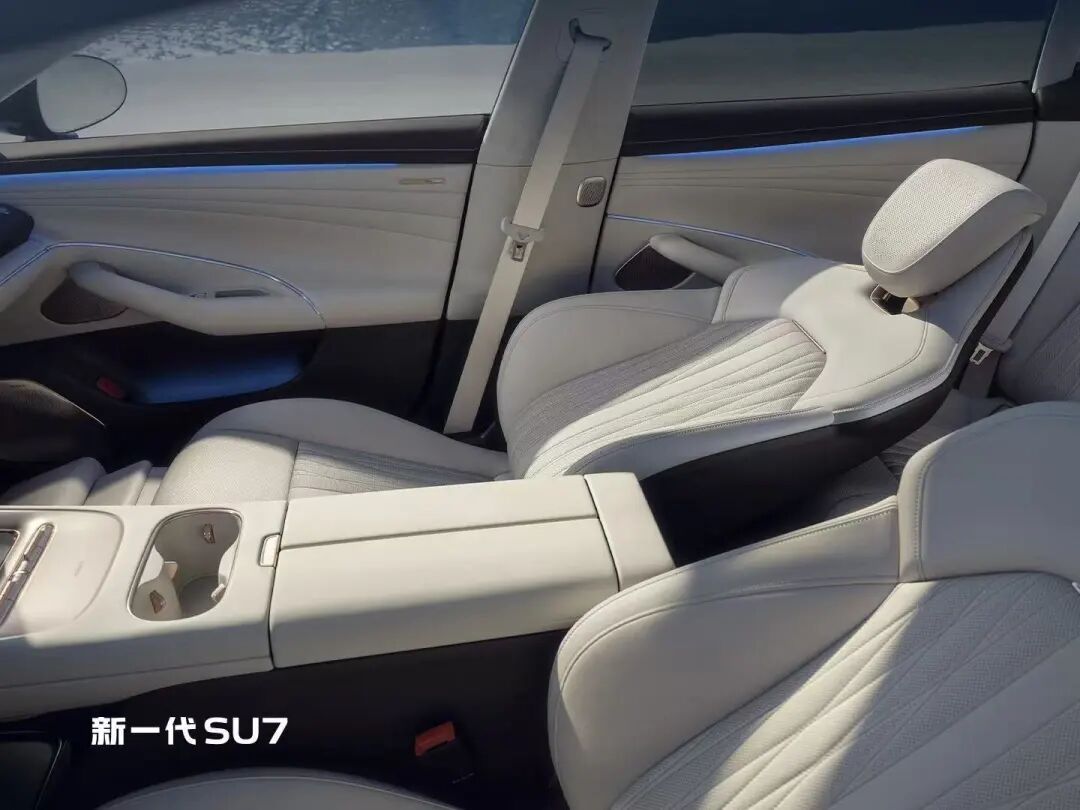
Zero - gravity front passenger seat of the new - generation Xiaomi SU7
In terms of range, through the upgrade of the whole - vehicle architecture, the new SU7 Pro version achieves a CLTC range of 902 km, and its power consumption level has also reached 11.7 kWh per 100 kilometers, close to that of the Tesla Model 3.
The improvement in safety is reflected in the application of ultra - high - strength steel materials in the body structure, the increase in the number of airbags, and the upgrade of the battery protection layer. In terms of intelligence, the new SU7 is the same as the YU7, with a full - configuration hardware system including an NVIDIA Thor chip and a lidar as standard across all models.
In terms of power and chassis, the Xiaomi SU7 is equipped with an upgraded V6s Plus motor. The power and 0 - 100 km/h acceleration time of all models have been improved. The Pro and Max versions are upgraded to closed - type air springs and CDC variable - damping shock absorbers, and all models are upgraded to be standard with fixed calipers and 265 - mm rear wide tires.
After communicating with several old car owners who have test - driven the new SU7, 36Kr heard the following feedback: “The parameters are faster, but the driving feel has become duller,” and “The road feel is not as clear as before, and the chassis tuning is obviously more focused on comfort.”
Behind these feelings, there is a common judgment: the new SU7 is trying to balance sportiness and comfort to meet a wider range of user preferences.
The product strategy of the new SU7 is Xiaomi's most direct response to its situation. Facing increasingly fierce competition and more rational consumers, the new - generation SU7 must use its real product strength to face this more practical test.
The first weekend after the launch: the peak popularity has passed, and there are many onlookers
During the first weekend after the launch of the new SU7, 36Kr visited 6 stores in Beijing.
Many front - line salespeople frankly told 36Kr: “The Xiaomi SU7 is no longer a phenomenal hit like the first - generation model.” An obvious phenomenon is that most of the customers who come to the store are “Mi fans” who come out of a “curiosity” mindset, and many of them are already owners of the SU7 or YU7.
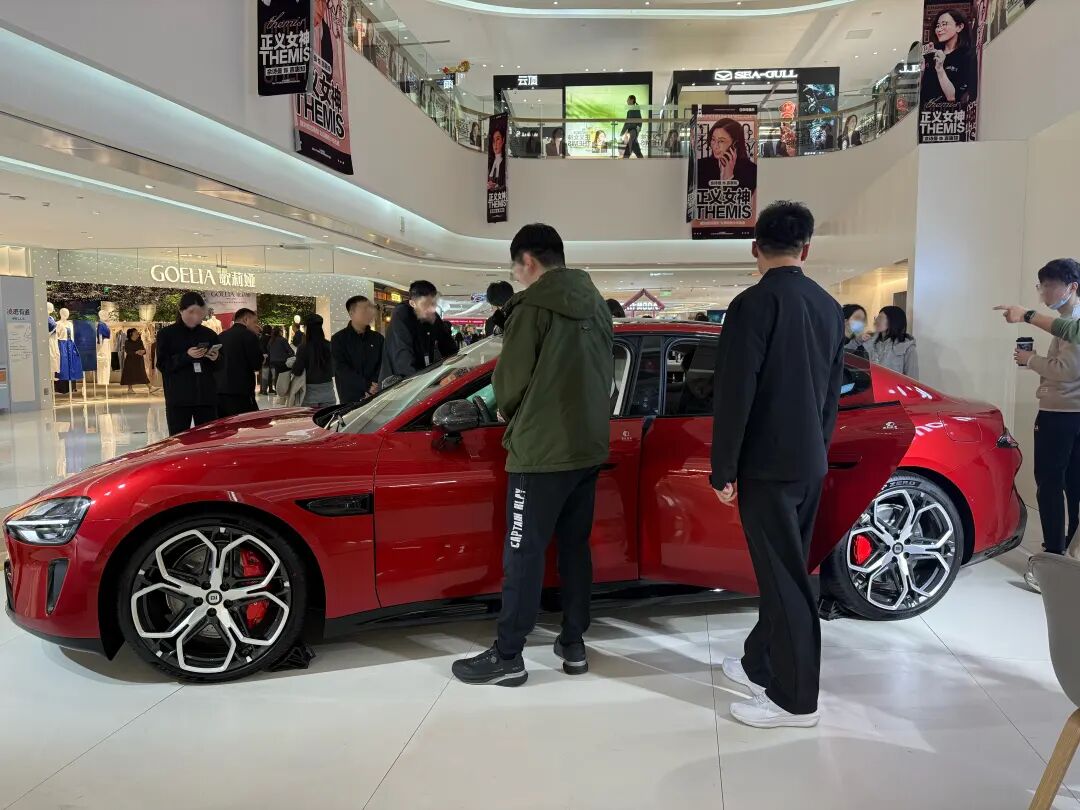
A real - shot of a Xiaomi SU7 showroom in the Beijing area
“Two years ago, when the old SU7 was launched, people passing by would take a look, and there were even old people and children queuing up to come in and look at the car,” a front - line salesperson who has worked at Xiaomi Auto for two years told 36Kr. “The appearance hasn't changed. People passing by take a look and assume that the new model is the same as the old one, so they don't want to get in the car and take a look.”
In terms of orders and sales, the general feeling of front - line salespeople is that the decision - making cycle of customers has been significantly lengthened, and most of them hope to make a comparison before making a decision. “The first batch of 16,000 cars across the country were almost all sold out by Friday night, and almost all the orders on the weekend were for customized cars to be delivered in May - July.”
A salesperson showed 36Kr the detailed breakdown of the on - the - road price of the new - generation SU7. On this basis, Xiaomi offers two financial plans: one is a regular installment plan with an annual interest rate of 2.5%, and the other is a seven - year low - interest plan with a longer term and an annual interest rate of 1.9%.
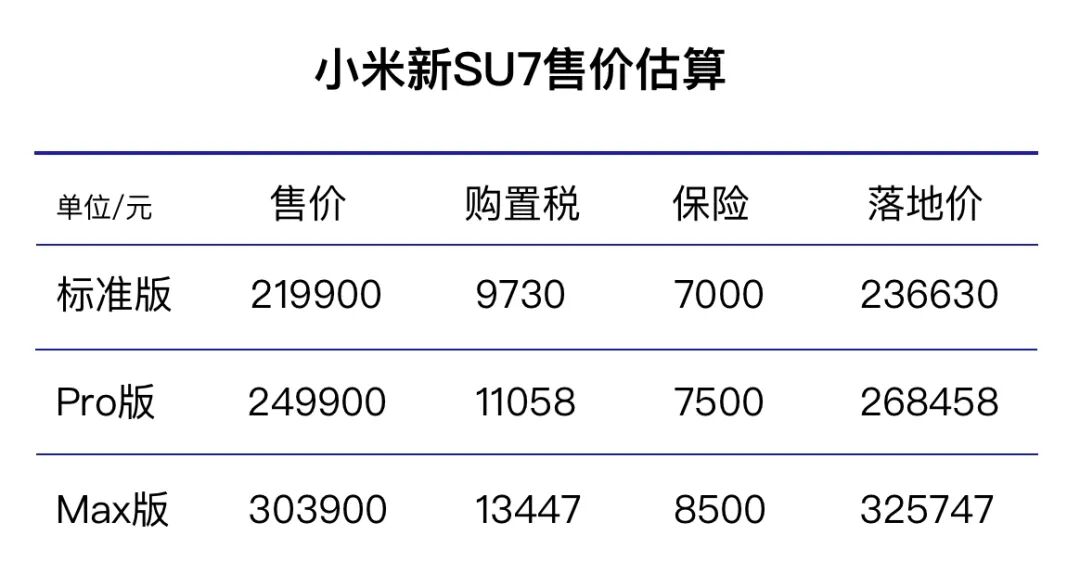
Estimated price of the new Xiaomi SU7, charted by 36Kr
In the communication with several potential car owners, 36Kr learned that they are quite sensitive to the price and financial policies. “The total interest of the Xiaomi installment plan is about 10,000 - 20,000 yuan, and Tesla's five - year interest - free policy is very attractive to us,” a potential customer said.
Therefore, the salesperson suggested that they choose a customized order because the payment method for customized cars is based on the policy at the time of pick - up. Currently, the delivery cycle for customized cars is about May - June. “The salesperson said that there may be an interest - free policy by then, but I still want to wait and see.”
The customer group of the Xiaomi SU7 is changing. From the “Mi fans” who initially paid for the brand sentiment and love, it is gradually extending to rational consumers who value specific configurations, vehicle - using costs, and product value. This practical group of people is the solid foundation in the automobile consumption market.
Externally, there is direct competition from market veterans like the Model 3 and new stars like the Shangjie Z7. Internally, there is the more practical YU7 and the upcoming extended - range series competing for users' budgets. The Xiaomi SU7 has now truly entered a survival battle relying on product strength.
Two years ago, when the first - generation SU7 broke through the circle with its phenomenal popularity, Xiaomi Auto enjoyed the huge traffic dividend gathered by brand potential. It was a funnel driven by curiosity, sentiment, and market gaps, which allowed Xiaomi to quickly gain a foothold in the automobile field.
However, the traffic came in a rush and ebbed quickly.
The automobile industry is a capital - intensive, long - cycle, and zero - tolerance industry. Cool designs and intelligent experiences can indeed attract market attention, but the long - term success of an automobile company actually depends on a series of complex and boring internal capabilities such as supply - chain management, quality control, cost control, channel service, and even second - hand car residual value management.
The market response to the new - generation SU7 is the most direct projection of this state.
Now, the Xiaomi stores have returned to normal from the bustling crowds, the customer decision - making cycle has lengthened, and the comparison criteria have shifted from “love” to specific configurations, costs, and values. This marks that Xiaomi Auto's business logic is shifting from an “explosive model” relying on marketing and publicity to an “endurance race” relying on product strength, systematic operation, and long - term user word - of - mouth.