After reaching the summit, Dreame's robotic vacuum cleaners are still "obsessively" pursuing innovation.
In March in Shanghai, the global home appliance and consumer electronics industries set their sights on AWE. Thousands of global enterprises participated in the exhibition. From the in - depth integration of AI technology to the virtual - real collision of embodied intelligence, the industry is in an intertwined game of rapid technological iteration and rational market regression.
There was a constant stream of people in Dreame's 10,000 - square - meter exhibition hall, and the estimated number of daily visitors exceeded 100,000. The floor - sweeping robot area became the focus. A robot nimbly maneuvered between table and chair legs, and its mop plate completed a column - surrounding cleaning with an extremely large angle.
The on - site demonstration showcased two core technologies of Dreame's new floor - sweeping robot: on one hand, there was a structural evolution with a secondary joint, enabling in - depth coverage of complex spaces; on the other hand, there was a breakthrough in physical capabilities, achieving in - depth cleaning effects with 160°C high - temperature steam.
These two technological paths have broken away from the "parameter competition" in the industry in the past few years, which focused on suction power, navigation, and hot - water temperature, and pointed to a more fundamental question: In what other ways can floor - sweeping robots better serve users?
Dreame has provided the right answers multiple times, and the market response has been more direct. On March 12, Euromonitor International, a globally renowned market research institution, issued an authoritative certification stating that Dreame's floor - sweeping robots ranked first in global high - end floor - sweeping robot sales. By 2025, it will have the highest market share in 30 countries globally, and its market share will exceed 40% in 18 countries and regions, including Sweden, Denmark, and Germany.

(Image source/Enterprise)
Being continuously chosen by high - end consumers from different cultural backgrounds, this global - number - one certification not only firmly records Dreame's past achievements in floor - sweeping robots but also serves as a key entry point for understanding its current layout.
The leader doesn't chase after trends but creates them. Behind Dreame's floor - sweeping robot's ability to nimbly go around columns and perform high - temperature disinfection is an innovative foundation built by complex mechanical structures and intelligent algorithms, which has been transformed into a system - level capability that can be replicated in the long term and continuously iterated, supporting every step of Dreame's floor - sweeping robot in a longer - term race.
System Reconstruction of "Real Cleaning"
Users' essential needs for floor - sweeping robots have always focused on two propositions: where to clean and how clean the cleaning can be. The former refers to the completeness of space coverage, and the latter concerns the thoroughness of the cleaning effect.
In the past three years, the suction power has soared from 3000Pa to 30,000Pa, the hot - water temperature for mopping cloth cleaning has risen from 60°C to 100°C, and mechanical arms have emerged and expanded from single - arm to double - arm designs. However, an embarrassing reality persists: the dead corners around table and chair legs, which are frequently seen in daily use, are still unreachable for the equipment, and heavy - oil scenarios like kitchens cannot be thoroughly cleaned in one go.
Most manufacturers are not unaware of the limitations of existing solutions. Many have made linear extensions on the existing paths, but few have dared to break the structural framework and start from scratch.
In the face of cleaning dead corners such as table and chair legs, flower - pot bases, and the bottoms of hanging cabinets, the common approach in the industry is to rely on algorithms to repeatedly twist and stick to the edges or increase the size of the side brushes to extend the cleaning range. Both methods are attempts to forcibly extend the working radius when the equipment cannot enter the area.
The drawbacks of these methods are obvious. Twisting reduces cleaning efficiency, doubling the time required to clean the same area; increasing the side brushes only provides a linear extension, and when encountering obstacles like table legs that require surrounding cleaning, a circle of dead corners still remains.
Dreame's floor - sweeping robot offers a solution of a secondary swing arm, which adds a joint to the original single - stage swing arm. The first - stage swing arm is responsible for basic outward expansion, and the secondary swing arm can swing around the first - stage arm like a human forearm. The included angle between the two has expanded from 50° to 140°, and the extension distance of the mop plate has jumped to 16cm.
However, the real value of these numbers can only be understood in real - life household scenarios.
"If we only had a single - stage swing arm, the flexibility would be far from enough," Meng Jia, the president of Dreame Technology's floor - sweeping robot division, told Yingke. "In scenarios with dense table and chair legs and complex furniture shapes, relying on extension in only one direction has limited length, and it's easier to reach the area but not clean it thoroughly. It's like a human arm; without an elbow joint, increasing the length only allows for linear movement and no bending."
The secondary swing arm brings not only length but also freedom. When the included angle between the two swing arms can be dynamically adjusted between 50° and 140°, the robot can finally achieve true "column - surrounding cleaning" when facing obstacles like table legs. When it needs to enter low - lying spaces such as under the sofa, the swing arms can also actively swing outward and fold inward, allowing the mop plate to reach those previously unreachable dead corners.
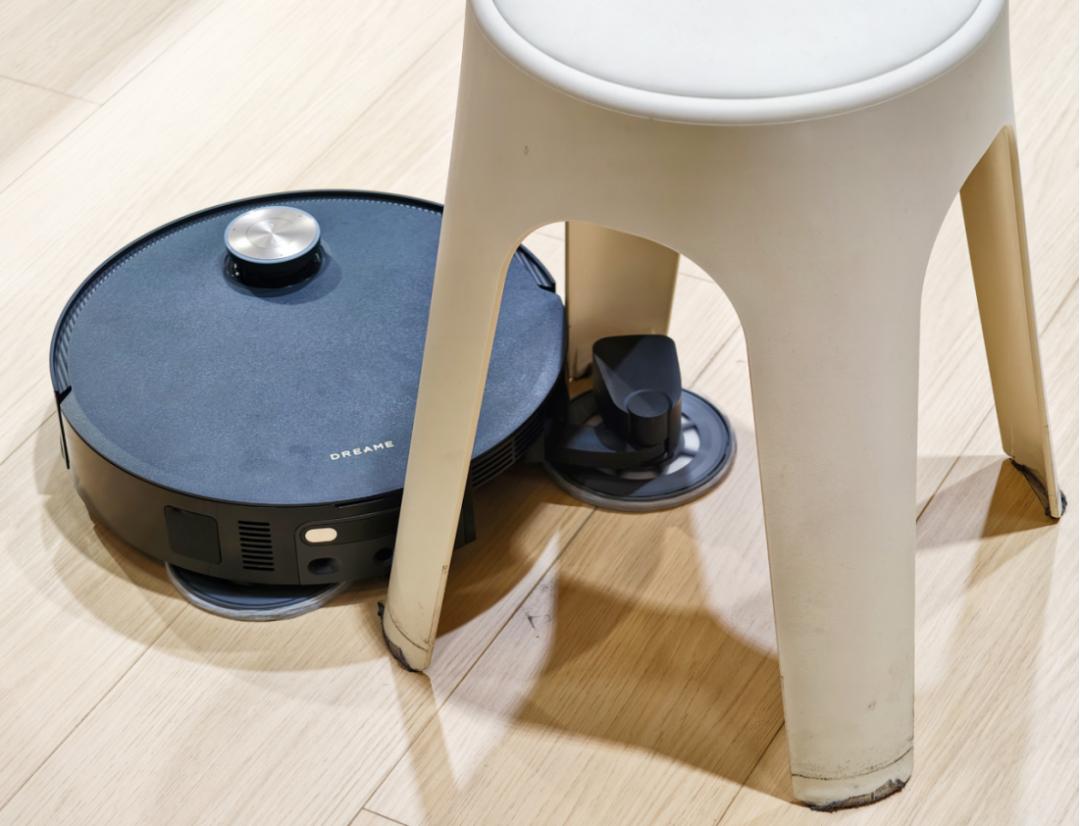
(Image source/Enterprise)
It can be said that the evolution from a straight arm to a curved arm has enabled Dreame's floor - sweeping robot to actively enter narrow and complex spaces.
After solving the problem of "being able to enter," the robot also needs to provide a "thoroughly clean" experience.
Users are not satisfied with just "looking clean." High - frequency cleaning scenarios such as the sticky oil stains on kitchen floors over the years, the bacterial hazards in pet - activity areas, and the concerns of families with infants and young children about bare - foot walking face more hidden and fundamental pain points than just "visible dust."
Previously, the competition among manufacturers in high - temperature cleaning has always focused on the temperature of hot - water cleaning for the mop. The temperature has risen from 60°C to 100°C, but the hot water only cleans the mop, not the floor. The temperature of the mop drops significantly after leaving the base station. When facing dried - up oil stains, the robot often has to repeatedly mop the floor five or six times but still fails to clean it thoroughly, and ultimately, users have to intervene manually.
The cost of this path - dependence is that users' needs are left unmet, and the industry is moving further and further away from the ultimate goal of "truly clean floors."
Dreame's floor - sweeping robot found in market research that more than 80% of users hoped to have stronger stain - removal capabilities in the kitchen and dining areas, and families with infants and pets had higher requirements for floor disinfection.
These needs point in one direction: the cleaning medium, rather than the cleaning tool, must reach an effective temperature.
Dreame's floor - sweeping robot offers a new solution in its new product, shifting from hot - mopping disinfection to a steam - cleaning route. The floor - sweeping robot can generate 160°C high - temperature steam in 8 seconds, directly flushing stubborn stains on the floor through four - way spraying. Coupled with a 99.99% disinfection rate of the steam, it truly allows users to walk bare - foot freely.
On the surface, it seems to be an update of two technological functions. In fact, the structure of each component and the refinement of each node experience represent Dreame's systematic reconstruction of the existing floor - sweeping robot form. While the industry is still deeply involved in parameter - based involution on the existing path, Dreame's floor - sweeping robot chooses to break away from homogeneous competition and directly address users' most basic and essential cleaning needs.
Collaborating with Users on Overall Capabilities
From the first - ever bionic mechanical arm to solve corner - cleaning problems, to the secondary swing arm achieving an ultimate 16cm outward expansion, and the first introduction of high - temperature steam into a floor - sweeping robot, Dreame's floor - sweeping robot doesn't stop at the explosive effect of single - product innovation. Instead, it transforms each product iteration into a long - term victory in user insight and systematic capabilities.
The visible innovation is stunningly captured in the moment when Dreame's floor - sweeping robot's mechanical arm "extends." However, to support this function to operate stably countless times, there are also many invisible investments from users.
Although the secondary swing arm only seems to add one more motor, it has triggered a chain reaction. The module space has doubled, directly squeezing the original air - duct position, which has led to a complete overhaul of the wiring, piping, and structural stacking inside the main unit.
What's even more challenging is the lifespan issue. The secondary swing arm needs to rotate about 90 degrees to fully expand. Under this working condition, it cannot meet the service - life requirement of 300,000 to 500,000 rotations for the core torsion spring. The R & D team reduced the rotation angle of the torsion spring to about 30 degrees by adding a set of reduction gears, effectively tripling its service life. This gear set, invisible to users, has become the core guarantee for the stable extension and retraction of the swing arm.
Similar details also emerged in the R & D of steam technology. High - temperature steam is common in floor - washing machines, but introducing it into a floor - sweeping robot is far from just a "transplant."
To fit the steam module into the compact main unit of a floor - sweeping robot, the conventional steam modules on the market are too large to be embedded. The steam module is only about 1 millimeter away from the mainboard and the battery. The continuous high - temperature heat radiation impacts the core components, easily leading to a decrease in the mainboard's stability and a reduction in the battery's service life. In the early stage of R & D, several prototype machines were burned out just because of the heat - dissipation problem.
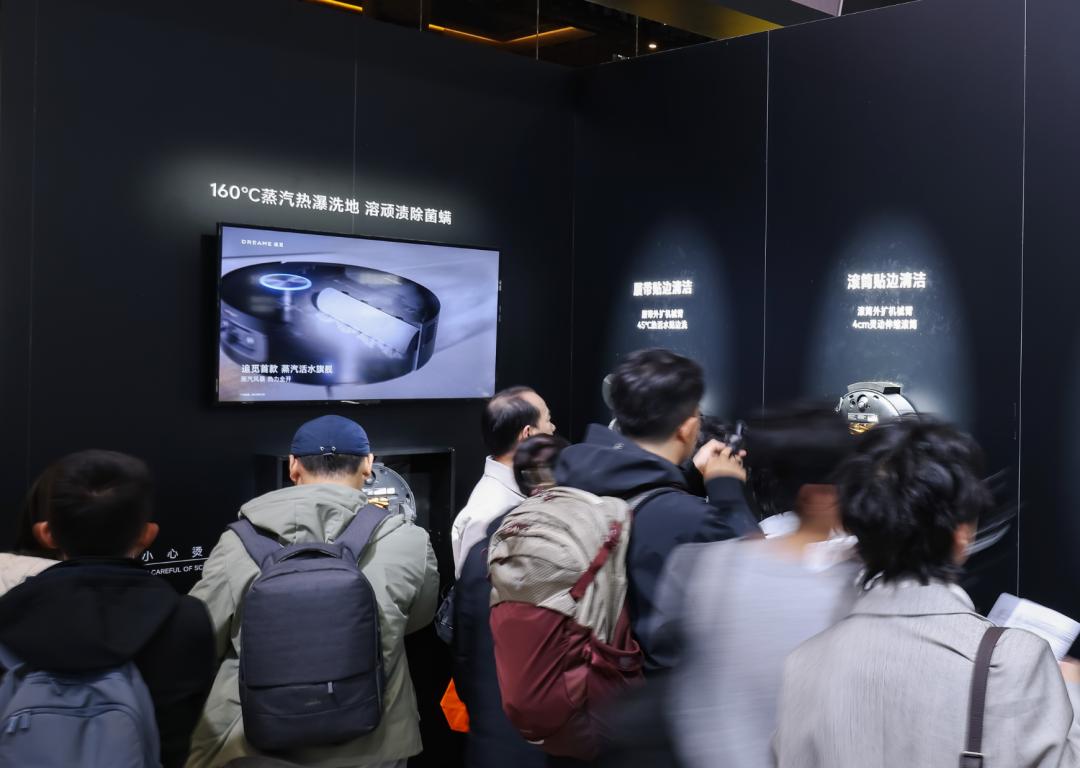
(Image source/Enterprise)
The R & D team repeatedly discarded the original plans and went through 7 structural revisions. They finally managed to reduce the volume of the steam module to one - third of that of market products, creating space for the main unit and ensuring the performance of the components.
But this is only the first step. For cleaning products directly serving households, safety is the bottom line. They spent several more months on heat - insulation verification, using heat - insulating materials to ensure that the parts touchable by hands do not exceed 50 degrees, and adding an intelligent detection unit to monitor the heating status in real - time. After months of functional testing, the steam technology was finally launched in Dreame's floor - sweeping robot.
This obsession with details in Dreame's floor - sweeping robot R & D points to a method: in - depth user participation.
From user reviews, questionnaire surveys to pre - launch internal testing, Dreame's floor - sweeping robot has an exclusive "ten - step insight method" that allows users' voices to penetrate the entire process from product R & D to launch, with over 1 million user tests per year.
"Users' pain points are actually clear, but they just can't clearly describe what kind of product they want," Meng Jia said. "Just like before the invention of cars, users would only ask for a faster horse because they had never seen a car. Once users express their pain points clearly, it's our responsibility to develop and launch the product."
Based on this product principle, what Dreame's floor - sweeping robot does is far more than just solving the pain points clearly complained about by users. It is also committed to hitting the unspoken "pleasure points" of users, aiming to be a brand that truly understands users.
This persistence in users' real needs often means taking a more difficult path: not chasing trends, not piling up parameters, and not rushing to launch products. Instead, it is willing to invest more time and cost to develop a good - enough product.
In Europe and the United States, where the entry threshold is extremely high and users are picky about mechanical craftsmanship, Dreame's floor - sweeping robot has a market share of over 40% in 18 countries and regions, including Germany, Sweden, Denmark, and France, and ranks first in 30 countries globally.
Its success is not a coincidence in a single market but the result of being chosen by users with different cultures and consumption habits. This global recognition, in turn, has become the greatest confidence for Dreame's floor - sweeping robot to continue investing in innovation.
True innovation is often hidden in places invisible to users. However, a good - enough product will ultimately gain users' trust and cross the trust gap between the brand and the market.
Behind Dreame's floor - sweeping robot's rise to the top is the collaboration between these invisible efforts and the visible users' needs.
Gateway to the Future: The Entrance of Embodied Intelligence
While the industry is still repeatedly discussing how embodied intelligence can truly enter household scenarios, at the AWE site, Dreame's floor - sweeping robot presented a concrete answer: an all - around household butler robot.
With a four - legged wheel - leg structure, this robot has all - scenario mobility. It can freely move between the living room, bedroom, balcony, and outdoors, smoothly go up and down stairs, etc., combining stability and walking efficiency. The design of human - like double arms enables it to complete basic household chores such as table - wiping and clothes - folding, and it also has the potential to operate tools and link with household appliances. In the future, it can cover scenarios such as cleaning and disinfection, pet care, and elderly care, gradually moving towards true human - like household - chore - handling capabilities.
From a floor - sweeping robot to a household butler, it may seem like a huge leap, but in Dreame's floor - sweeping robot layout, it is a clear evolutionary path.
The underlying logic of this judgment lies in the early accumulation of real - life scenarios. Through daily real - life use, it continuously accumulates an understanding of the household environment, user habits, and floor interaction. This scenario - based accumulation close to real life also provides an important foundation for Dreame to further explore embodied intelligence.
Meng Jia told Yingke: "As an intelligent terminal that entered households on a large scale earlier, the floor - sweeping robot can achieve rapid iteration based on a large number of real - life scenarios, and then accumulate a deeper understanding of the complex and dynamic household scenario. This is an innate advantage that other intelligent forms can hardly match." Users don't need to deliberately initiate any operations. They just need to let the floor - sweeping robot run according to daily habits, and it will automatically complete environmental mapping, obstacle recognition, and behavior - pattern learning.
Meanwhile, the technologies such as environmental perception, dynamic obstacle avoidance, object recognition, and voice interaction accumulated by Dreame in its floor - sweeping robot products are not exclusive to a single product but are the technological core that can be reused across different forms. These mature and market - verified capabilities are being rapidly transferred to the all - around household butler robot.
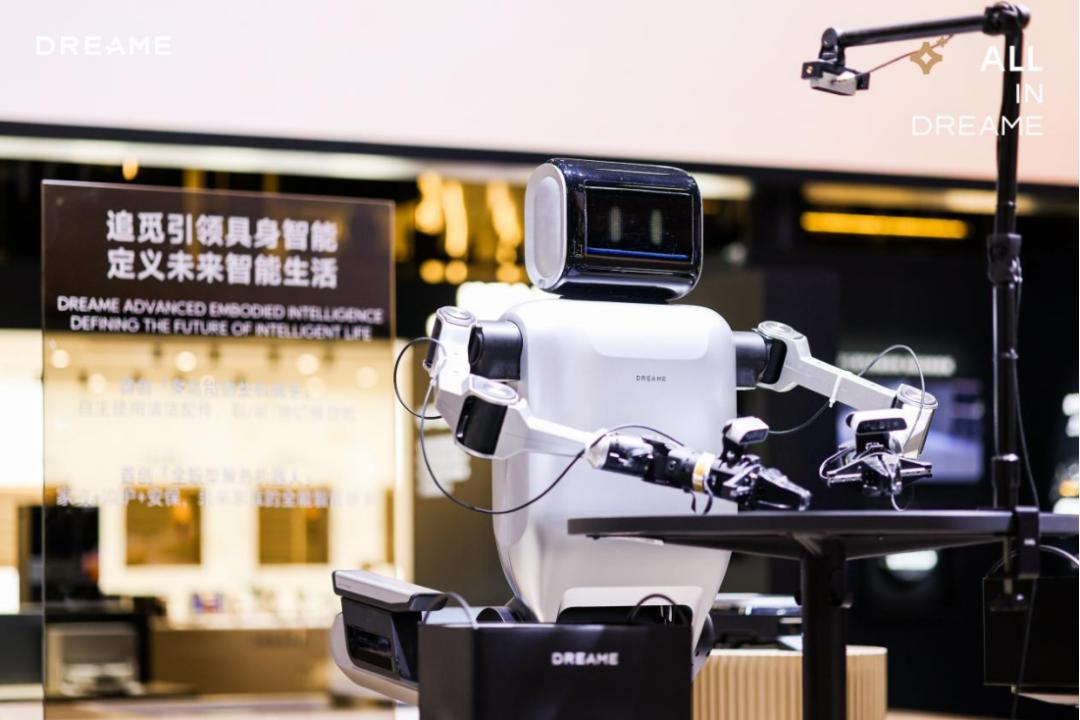
(Image source/Enterprise)
Laboratory simulations and restricted scenarios can hardly reproduce the complexity of the real household environment. The truly valuable environmental understanding and behavior - interaction capabilities