The bad times for Li Auto are far from over.
The tough times for Li Auto are still not over.
If the return to quarterly losses in the third quarter of 2025 was still affected by the one - time recall of the MEGA model, then the poor performance in the fourth quarter of 2025 indicates that this auto company, which has returned to its startup state, has not yet emerged from the pain.
On March 12th, Li Auto released its financial report for the fourth quarter and the whole year of 2025. After recording a net loss of 624 million yuan in the previous quarter, the net profit in the current quarter finally turned positive to 20 million yuan, and the adjusted net profit reached 274 million yuan. The vehicle gross profit margin also rebounded from 15.5% in the previous quarter to 16.8% on a sequential basis.
However, these signs of recovery are just superficial. After excluding the stable investment income of over 400 million yuan that Li Auto earns from financial management every quarter, Li Auto was still in a loss - making state in the current quarter, with an operating loss of 443 million yuan and an adjusted operating loss of 188 million yuan.
The vehicle gross profit margin in the current quarter was also declining. Excluding the impact of the MEGA recall in the previous quarter, the real vehicle gross profit margin of Li Auto in the third quarter of last year should have been 19.8%. In the fourth quarter, it actually declined by 3 percentage points on a sequential basis. The popularity of the low - priced model i6 last year didn't change much and even dragged down Li Auto's profit performance.
The decline of other indicators is even more straightforward. In the current quarter, Li Auto's total delivery volume decreased by 31.2% year - on - year, vehicle sales revenue decreased by 36.1% year - on - year, total revenue decreased by 35% year - on - year, and gross profit decreased by 42.8% year - on - year. It's so bad that there's no need to say more.
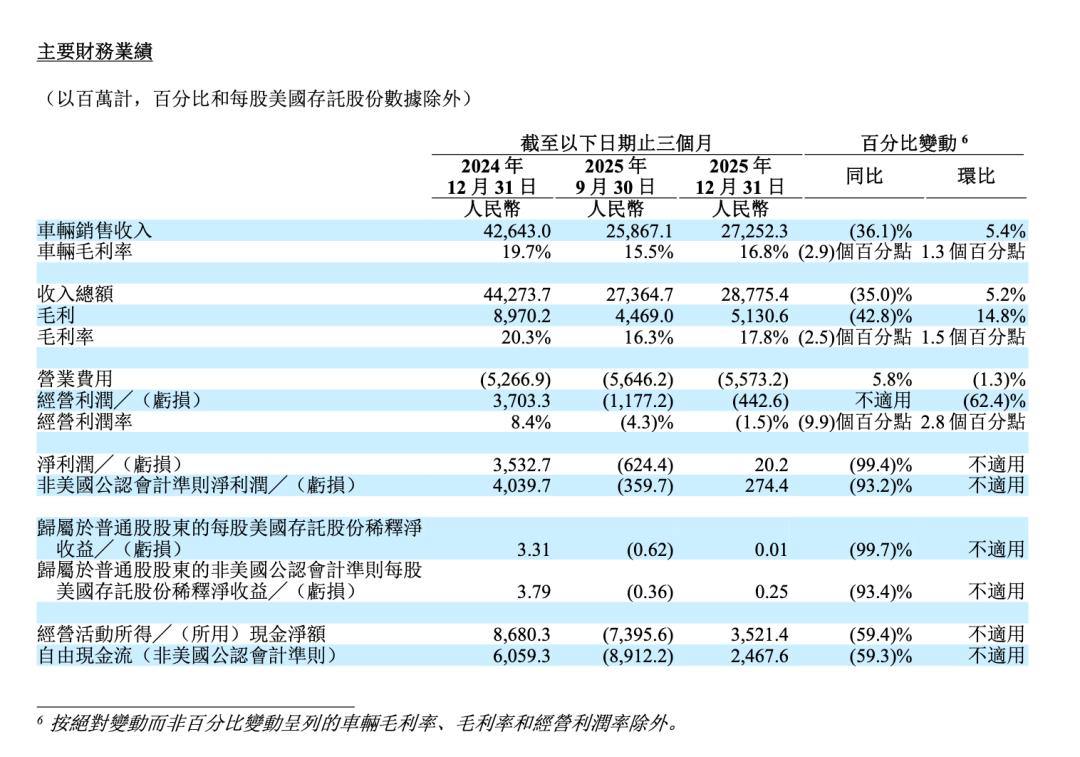
Li Auto's financial report for the fourth quarter of 2025
Looking at the whole year, Li Auto was almost in a state of decline. In 2025, Li Auto's total revenue decreased by 22.3% year - on - year, gross profit decreased by 29.2% year - on - year, net profit decreased by 85.8% year - on - year, operating profit turned from positive to negative, dropping from 7 billion yuan in 2024 to an operating loss of 521 million yuan, and free cash flow dropped from 8.2 billion yuan in 2024 to negative 12.8 billion yuan in 2025.
Last year was the tenth year since Li Auto was founded, and it might also be the year when the company faced the most challenges. The range - extender route that they were once proud of is being challenged by more and more latecomers. The pure - electric products still failed to take the lead after a one - year delay, and they even encountered a large - scale battery safety incident.
"In the past three years, I and the startup team have been trying to learn the management system of professional managers and forcing ourselves to accept various changes. However, we have become worse versions of ourselves," Li Xiang reflected during the earnings conference call in the third quarter of last year. This was one of the rare moments when he publicly admitted his mistakes after the failure of the MEGA.
Since the second half of last year, Li Auto has carried out a wide - range organizational structure adjustment and personnel changes, abandoned the professional manager system, and returned to the startup state. They lost at least 10 senior executives and core leaders in a year, and almost all the Huawei - affiliated management team withdrew. Li Xiang began to take on more responsibilities.
Li Xiang set a goal for 2026 of a 20% year - on - year increase in sales volume, corresponding to an annual sales volume of less than 500,000 vehicles. This goal is not very impressive, falling back to the sales level of Li Auto in 2024. In contrast, Leapmotor set a goal of 1 million vehicles for this year.
After being beaten by reality, Li Xiang, who has always been high - profile, has finally become more pragmatic.
An even worse fourth quarter
Just looking at the surface, the third quarter of 2025 might be one of the worst quarters for Li Auto in the past few years. In that quarter, Li Auto's 11 - quarter consecutive profit streak ended, and all indicators showed a decline. Li Xiang also rarely criticized and reflected on himself during the earnings conference call, admitting the mistakes of the management team in the past.
However, in fact, the indicators of Li Auto in the third quarter of last year were much better than expected. Excluding the impact of the MEGA recall, Li Auto was still in a profitable state in that quarter, the vehicle gross profit margin remained at a stable level, and the revenue per vehicle increased on a sequential basis. Except for the significant year - on - year decline in the delivery volume in that quarter, it was far from being the darkest moment.
However, in the fourth quarter, which is the peak season for the auto market, Li Auto's performance further declined. After the delivery volume in the third quarter of last year decreased by 39% year - on - year to 93,211 vehicles, the delivery volume in the fourth quarter only increased by 17% on a sequential basis to 109,194 vehicles, and continued to decrease by 31.2% year - on - year. The sales volume was even lower than that in the second quarter of last year.
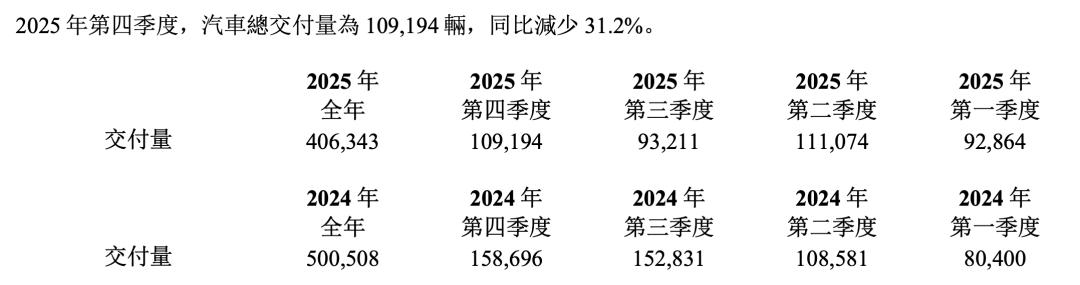
Quarterly delivery volumes of Li Auto in 2025 and 2024
While the delivery volume was declining, the decline in Li Auto's vehicle sales revenue in the current quarter was even greater, decreasing by 36.1% year - on - year to 27.3 billion yuan. The vehicle gross profit margin dropped to 16.8%, which was the first time in the past four years that Li Auto's quarterly vehicle gross profit margin fell below 17% (excluding the impact of events such as the MEGA recall).
At the same time, the revenue per vehicle of Li Auto in the current quarter further declined to 250,000 yuan, which was still 277,900 yuan in the previous quarter and 268,400 yuan in the same period last year.
Part of the reason is the drag of the low - priced model Li i6. Although the Li i6, which was launched in September last year, is the most popular model among Li Auto's pure - electric products, it is also the model with the lowest price.
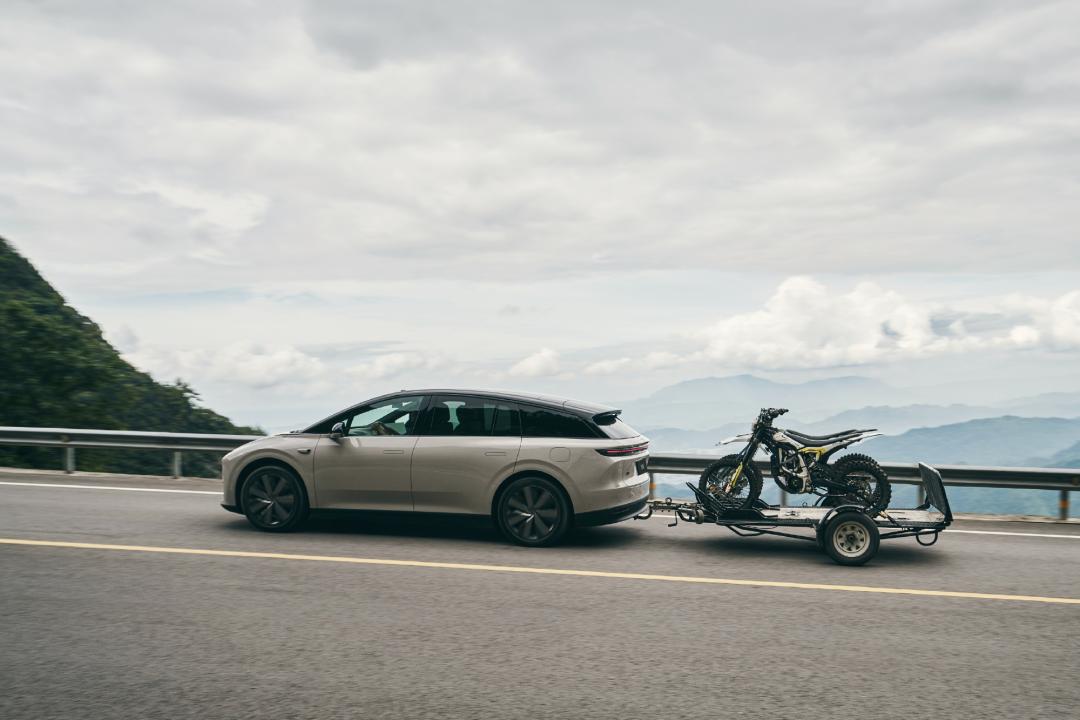
Li i6
The Li i6 learned from the lessons of the first model i8 in the i - series. There is only one configuration for the whole series, with a unified retail price of 249,800 yuan, which is the same as that of the Li L6 in the same class. After the discount during the initial sales period, the price is even lower.
The i6 is the first blockbuster model for Li Auto since it entered the pure - electric market. It received over 20,000 large orders on the day of its launch. In the past three months, the monthly sales volume has been stable at around 16,000 units. In February this year, it even accounted for about 60% of Li Auto's monthly sales volume.
However, the increase in the sales volume proportion of the Li i6 indirectly indicates the weak sales of Li Auto's original high - priced models and the MEGA series, which in turn led to the decline of Li Auto's vehicle gross profit margin.
What's frustrating is that the only model that can take the lead, the i6, encountered insufficient production capacity in the early stage of its launch. The vehicle pick - up cycle for some users was once extended to 17 weeks. Ma Donghui, the president of Li Auto, revealed during the earnings conference call that the production capacity bottleneck of the i6 has now been resolved, and the monthly delivery capacity of the i6 will reach 20,000 units in the future.
Restricted by various problems, Li Auto's revenue in the current quarter decreased by 35% year - on - year to 28.8 billion yuan, and the gross profit decreased by 42.8% year - on - year to 5.1 billion yuan. The operating loss in the current quarter was 443 million yuan, while it was 3.7 billion yuan in the same period last year. The operating profit margin also dropped from 8.4% in the same period last year to negative 1.5%.
Li Auto's net profit in the current quarter was only 20 million yuan, and the adjusted net profit was 274 million yuan. If we deduct the 430 million yuan of investment income generated by the 101.2 billion yuan in cash on Li Auto's books, the company's main business was actually in a loss - making state in the current quarter.
More importantly, the sales volume and revenue guidance given by Li Auto for the next quarter is still not optimistic, and the revenue decline is greater than the delivery volume decline. Li Auto expects the delivery volume in the first quarter of 2026 to be between 85,000 and 90,000 vehicles, a year - on - year decrease of 8.5% to 3.1%; the revenue is expected to be between 20.4 billion yuan and 21.6 billion yuan, a year - on - year decrease of 21.3% to 16.7%.
Calculated simply, the revenue per vehicle of Li Auto in the first quarter of this year may continue to decline. Considering that Li Auto's flagship model, the new L9, will not be officially launched until the second quarter of this year, the vehicle gross profit margin of Li Auto in the first quarter may continue to decline.
After the release of the financial report yesterday, Li Auto's stock price in the US stock market fell by 2.52%, with a closing price of $17.83 and a market value of $18.831 billion. In the past six months, Li Auto's stock price has been on a downward trend, falling from a high of $31.8, with a decline of over 40% so far.
The yet - to - come embodied intelligence
At the beginning of 2021, Li Xiang issued an internal letter to all employees, elaborating on Li Auto's strategic goals for 2025. Li Xiang said in the letter that in 2025, the sales volume of electric intelligent vehicles in China would exceed 8 million, and Li Auto would occupy 20% of the market share, becoming the number one intelligent electric vehicle enterprise in China.
Looking back now, Li Xiang's prediction of the market may be a bit conservative. According to the data released by the China Association of Automobile Manufacturers, in 2025, the production and sales volume of new energy vehicles in China both exceeded 16 million, and the proportion of new energy vehicles in domestic new car sales exceeded 50%.
However, Li Xiang's prediction of his own company was a bit off. After lowering the sales target twice in a row, Li Auto's annual sales volume last year still did not meet the expectations, finally reaching only 406,300 vehicles, a year - on - year decline of 18.81%.
Li Auto did not become the number one intelligent electric vehicle enterprise in China. Leapmotor, known as the "half - price Li Auto", won the first place in the sales volume among new - force car companies with nearly 600,000 vehicles sold. Li Auto's annual sales volume only ranked fifth among new - force car companies, behind Xiaomi and XPeng.
Now, Li Xiang's positioning of the company has changed. Even though Li Auto's own sales volume has been declining in the past year, Li Xiang still set embodied intelligence as the core goal of the company's development and firmly regarded robots as the future of the company's development in the next 10 years.
He said during the earnings conference call in the third quarter of last year that if products only stay at the level of electric vehicles, the competition logic will turn into a parameter war. In the future, cars should become embodied intelligent products in the physical world, not only having the ability of a top - level driver but also being able to play the roles of a parent's assistant and a flight attendant. "Just like how our mothers took care of and cared for us when we were kids."
Li Xiang believes that cars are the core form of robots. "The cartoons and movies of 'Transformers' clearly tell us that the two main forms of robots are human - like and car - like. 'Knight Rider' and 'Cars' also clearly tell us that cars are one of the core forms of robots."
According to LatePost, Li Auto established two new second - level departments, "Space Robots" and "Wearable Robots", last year to explore embodied intelligence. At the end of last year, Li Auto released its first smart glasses, Livis. At the beginning of this year, Li Auto started recruiting employees for positions related to humanoid robots.
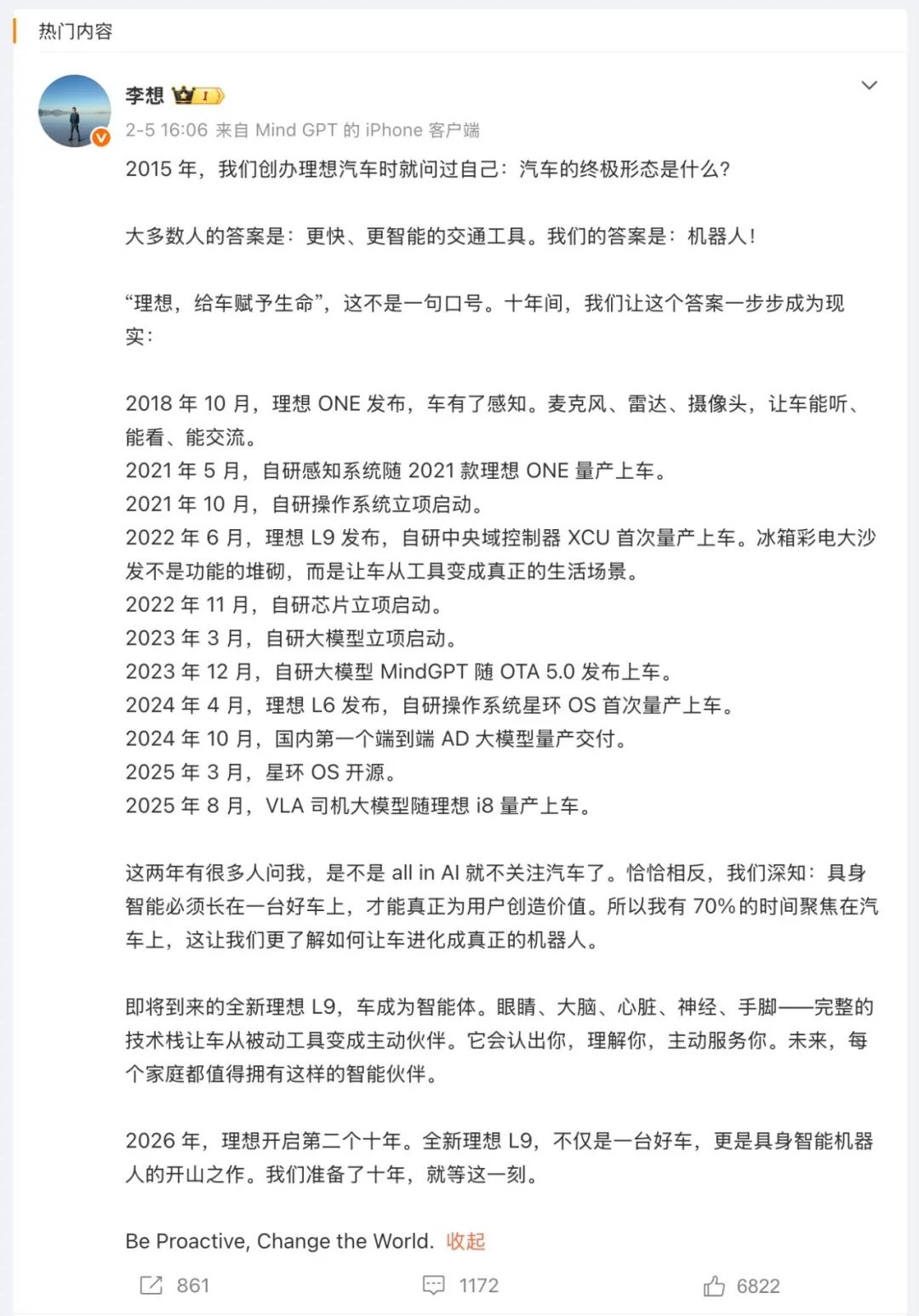
Li Xiang posted on Weibo in February this year, saying that the ultimate form of a car is a robot
Many car companies in the industry are betting on the robot direction. The most well - known one is Tesla, and XPeng also showed its first humanoid robot, IRON, to the public last year. However, few domestic car companies are betting on the embodied intelligence direction as comprehensively as Li Auto.
Amid the pressure on the company's external sales and the internal organizational adjustments, the market seems to have some complaints about Li Xiang's emphasis on the future of AI, especially considering that Li Auto will face greater competitive pressure this year.
Since last year, more and more domestic new energy vehicle companies have entered the range - extender SUV market. In addition to Huawei's AITO, Great Wall's WEY, BYD's Denza, Geely's Zeekr, and even SAIC IM have all launched range - extender SUVs, seizing the market share of Li Auto's L series.
During the earnings conference call, analysts also paid extra attention to the investment scale of Li Auto in the field of AI/embodied intelligence.
Li Tie, the CFO of Li Auto, said that the company's R & D expenses in 2026 are expected to remain at around 12 billion yuan, of which the investment related to AI accounts for 50%. Li Tie emphasized that they do not regard the auto business and the AI business as independent sectors but integrate the R & D of AI capabilities into the company's overall business model, and all R & D investments will serve the upgrade of the existing business system.
Li Xiang said during the earnings conference call that they will be cautious and continue to explore in terms of business and product implementation. When expanding into fields outside of the auto industry, they will incubate projects such as AI glasses and robots in the mode of a startup company, abandoning the "extravagant" R