The joy of stockpiling is completely ruined by an underperforming refrigerator.
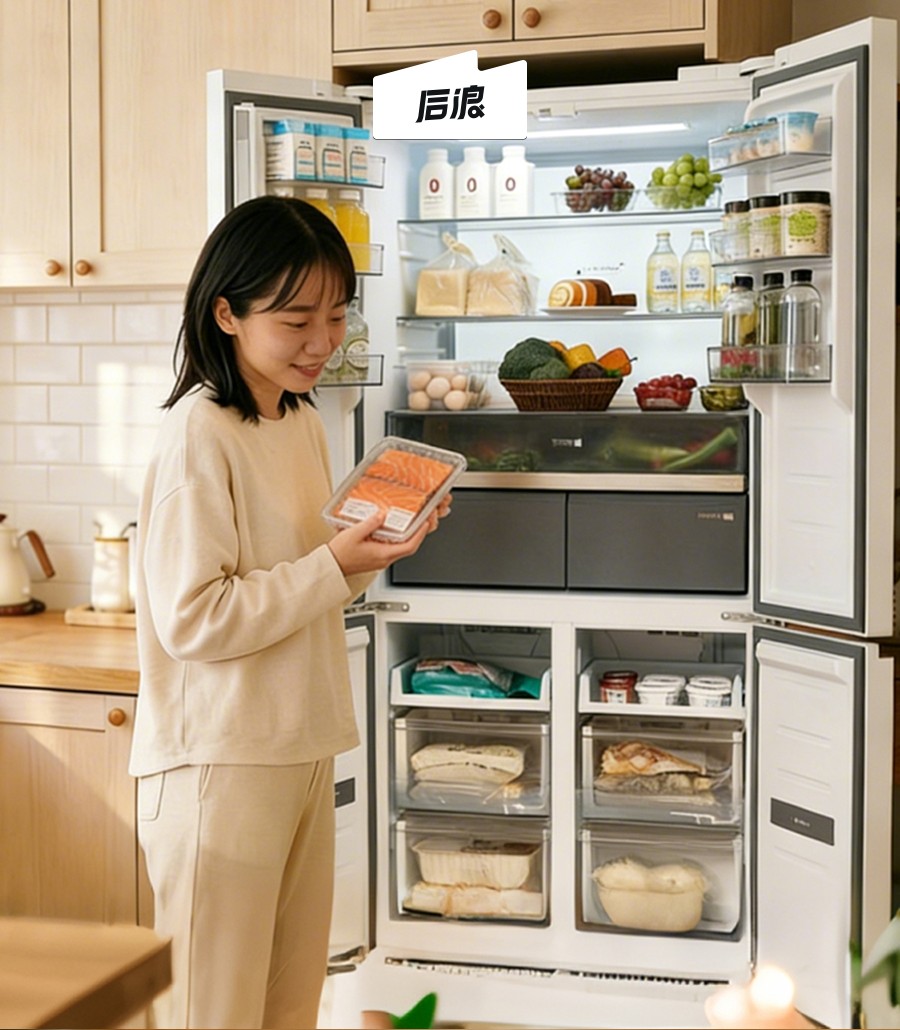
Many people have a habit - after working overtime and getting home, the first thing they do is to casually open the refrigerator door.
When you see the groceries stocked over the weekend in the fridge: cherry tomatoes, steaks, a box of Kyoho grapes, Sam's Club Swiss rolls... Even if you don't eat them, just taking a look makes you suddenly feel relaxed. During the day, you're a fragile office worker, relying on iced Americanos and basic vital signs to get through your meals. But when you get home at night and open the fridge, looking at the fridge stuffed with food, you finally feel that there's at least one thing going right in your day. Because what's in the fridge is the only certainty of the day.
Before you know it, the refrigerator has become a stage to showcase the quality of life. Different from the cold storage of our parents' generation that was filled with "old leftovers", our refrigerators nowadays are more like a delicate "ingredient museum": the freezer compartment doesn't just hold frozen dumplings, but also features prime steaks and deep - sea prawns; the refrigerator compartment doesn't store leftovers, but neatly - packed organic fruits and vegetables, premium coffee beans, cold - brewed tea...
The role of the refrigerator is changing from a "leftover disposal base" to a "guardian of high - quality life". It's your own little world that lights up and waits for you no matter how late it is. However, it seems that the capabilities of the refrigerator can no longer keep up with our needs. The ideal is great, but the reality often disappoints.
For this reason, the "Post - 90s Research Institute" launched a "Small Survey on Refrigerator Usage Habits" and received 732 valid questionnaires. Take a look at the following 5 insights. Does your fridge match any of them?


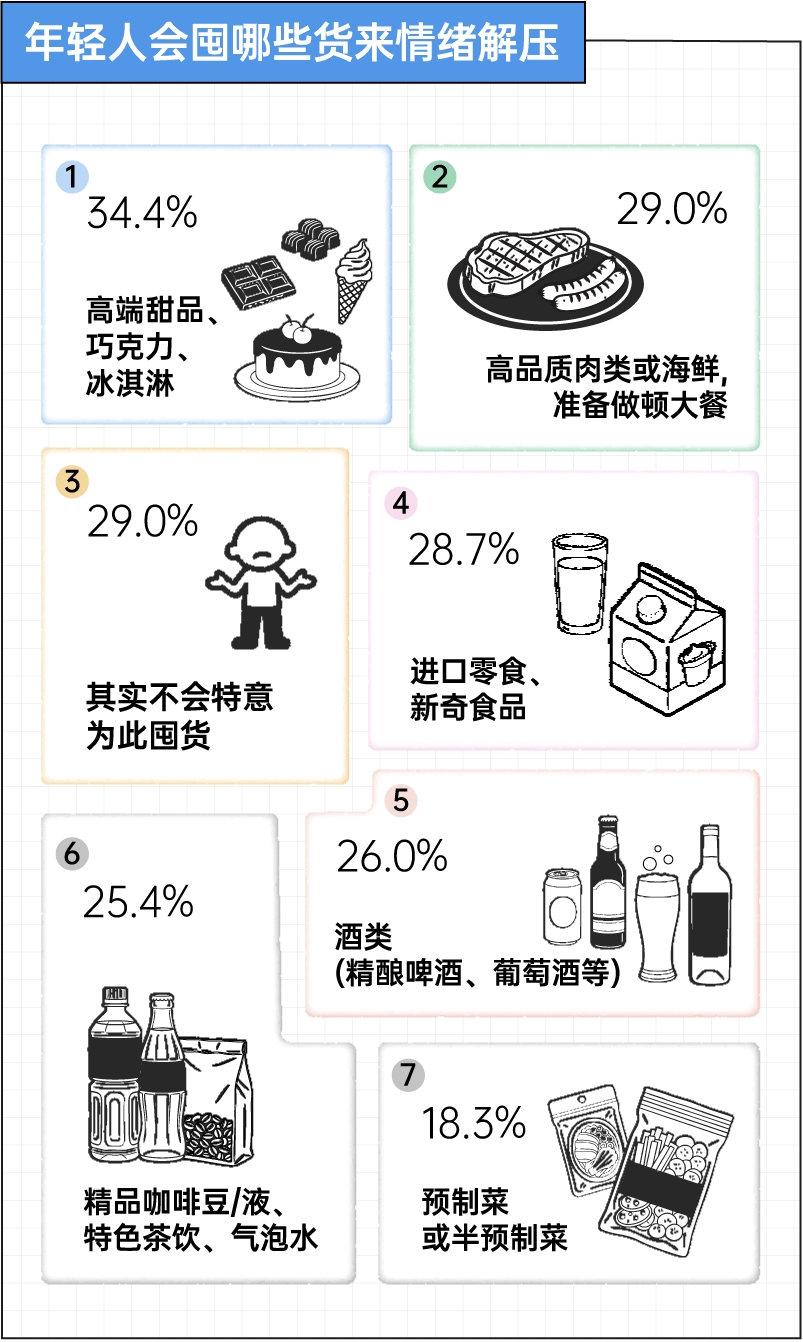
For many people, stocking up the fridge has become an activity to regulate emotions. During those late - night emo moments or on idle weekend afternoons, who can resist placing a large order just for the sake of pleasing themselves and filling the fridge with their favorite foods? The survey shows that nearly half of the people will silently restock the fridge when they are over - stressed.
Stockpiling specific delicacies is a small ritual to make peace with oneself. The survey shows that about 30% of people will stock up on high - end desserts, ice - creams, chocolates, high - quality meats or seafood, and more than a quarter of people will choose premium coffee beans/liquids, craft beers or imported snacks. These are not necessities for survival, but they are essential for a good life.
As the personalized menu becomes increasingly rich, the fridge no longer just stores ordinary ingredients. Those prime steaks, deep - sea prawns, and premium coffee beans are all expensive. However, the reality is that after being stored for a long time, the ingredients lose their original taste - the steaks become dry and tough; the coffee beans absorb other odors and lose their aroma. All the hard - stocked sources of dopamine end up being wasted because of an unreliable fridge.

After the upgrade of food and beverage quality, the freezer is the first to be overwhelmed. The survey shows that only 30.3% of people think the fridge space is "completely sufficient". 70% of people are wavering between "basically sufficient" and "insufficient". And for the freezer, 64.2% of people directly say that it's almost full.
The reason is that besides frozen dumplings, buns and other instant noodles, there are also new "guests" such as basic meats, seafood, high - quality prime beef and mutton, and even popular ready - to - cook dishes.
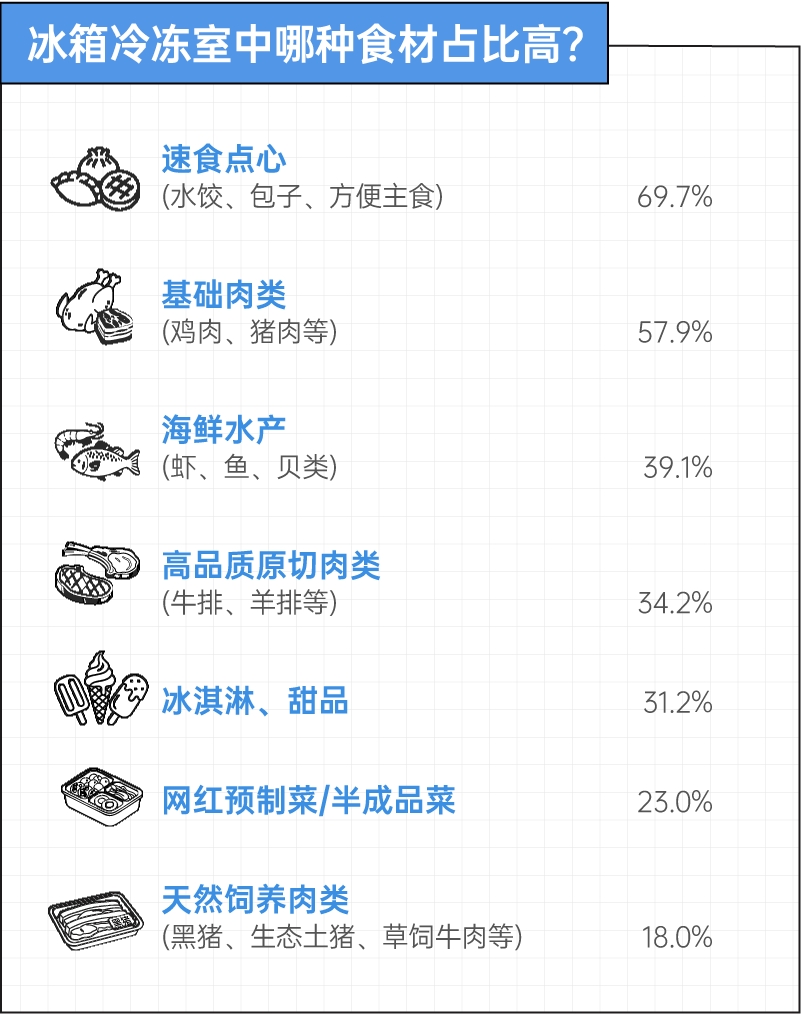
The freezer has evolved from a grain storage to a family "high - end ingredient reserve center". This "ingredient upgrade" stems from a simple desire: to eat more nutritiously and with higher quality in limited time.
But the problem also arises: we are willing to spend money on quality, but the fridge may not be able to preserve it. In the survey, more than half of the people dare not stock up too much because they are worried that "the taste will get worse after being frozen for a long time". It's not that they don't want to stock up, but they're afraid to take the risk, worried that the steak will be full of blood and the seafood will lose its flavor after thawing.

You may also have this feeling - fewer and fewer people go to the vegetable market. This is an irresistible trend. Under the fast - paced life and work pressure, going to the supermarket or vegetable market has become a rare activity. For many people, the offline shopping scenario is more like a regular stress - relief ritual. When it comes to the daily need for fresh food procurement, the "one - time purchase, multi - day preservation" centralized meal - preparation mode has taken its place.
The survey shows that 40.9% of people "mainly rely on online platforms and place high - frequency orders as needed" (TOP1), 22.7% of people choose to "make a large purchase once a week to stock up for a week" (TOP2), and 20.2% of people are used to "stocking up in large quantities irregularly and enjoying the sense of satisfaction of a warehouse - style storage" (TOP3). It can be seen that compared with going to the supermarket frequently to buy absolutely fresh ingredients, more people are adapting to the way of "stocking up fresh ingredients as needed" to save time.
In other words, this also poses a higher challenge to the long - term preservation ability of the refrigerator compartment. Unfortunately, only a small proportion of people are satisfied with the refrigerator compartment.
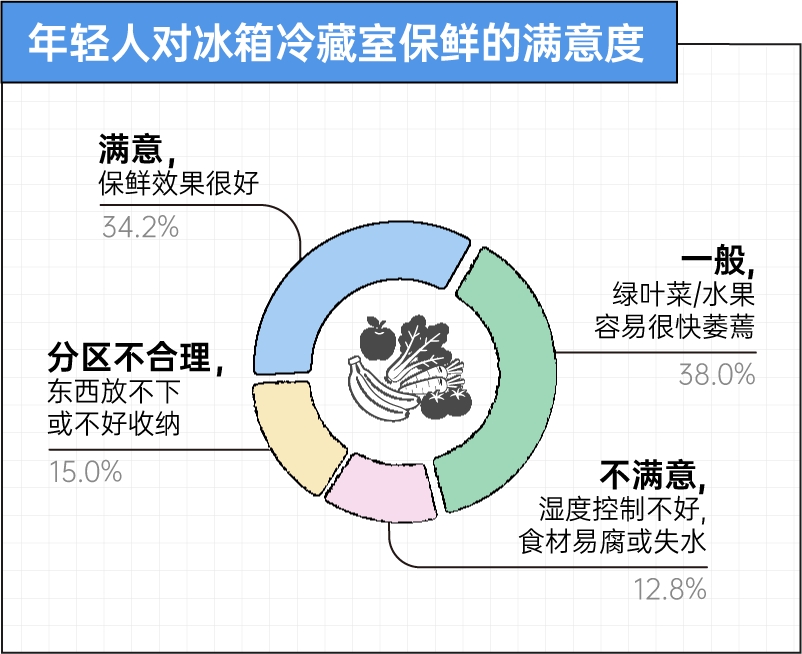
The ideal scenario of "fresh food freedom for a whole week" usually falls apart around Wednesday: the green leafy vegetables stuffed into the bag start to turn yellow, the fruits wrinkle, and you have to throw away half a bag of wilted vegetables in the middle of the week. Not only is it a waste of money, but there's also a sense of frustration - it seems that you can't even handle the simple task of having a good meal.
To keep the groceries stocked over the weekend fresh for a longer time, you have to take them out of the bags, divide them into portions and put them in fresh - keeping boxes. This is really difficult for busy office workers with limited time. The survey shows that 39.3% of people admit that they "sometimes carefully divide the food into portions and sometimes just put them in the fridge with the original packaging". Most of the time, people just put the groceries into the fridge directly in the supermarket plastic bags.
Taking the food out of the bags and dividing them into portions is more tiring than cooking. But if you don't do it, the vegetables won't last until Wednesday. As a result, people don't even dare to buy too much: if you buy too little, it's not enough; if you buy too much, you're afraid of wasting. You have to hesitate for a long time before placing an order for groceries.

As the refrigerator has become a carrier of the delicate life scene, the items stored in it have become more diverse than ever. Nowadays, the dining table is no longer dominated by Chinese cuisine. The survey shows that more than one - third of people will try Western cuisine, baking, and making special drinks at home.
A steak that needs to be carefully pan - fried, a self - made cold - brewed tea, or even a "white people's meal" that can be prepared in 10 minutes... The proportion of people involved in these diverse cooking scenarios in the survey all exceeds 20%. But as flavors blend, the nightmare of odor mixing is approaching: Half of the people are constantly troubled by the inexplicable "fridge odor", and 31.4% of people don't dare to put durians, instant noodles with snails or overnight seafood in the fridge because of this.
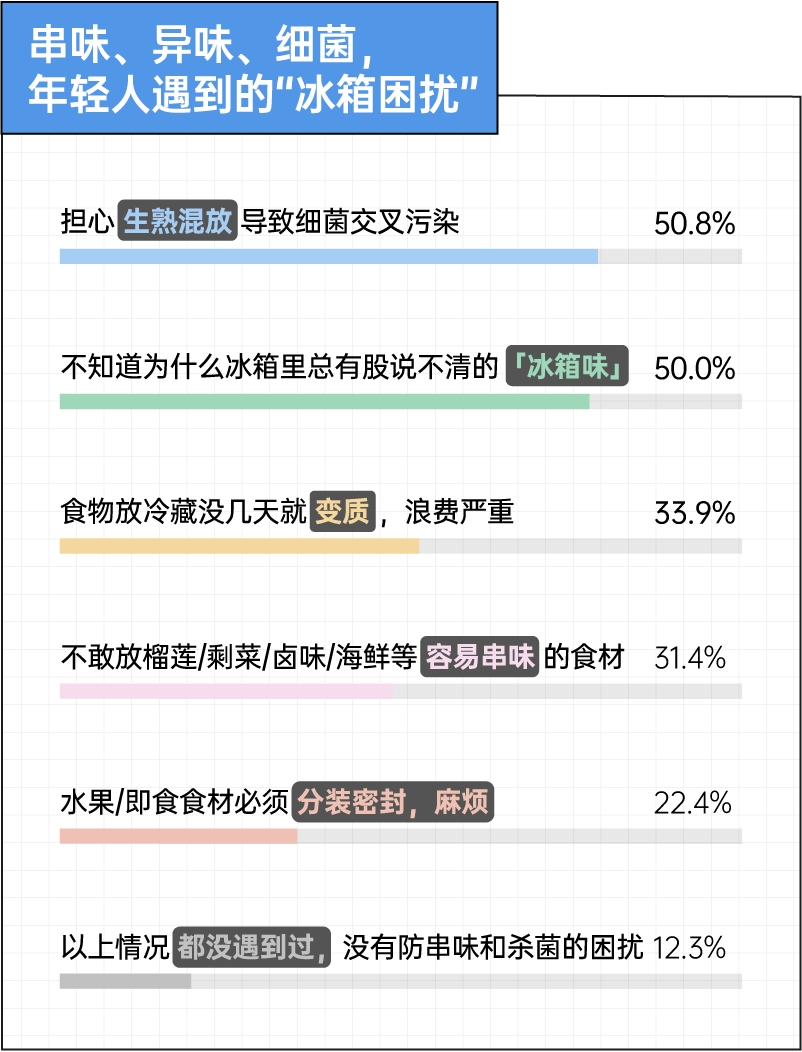
What's even more worrying is health - 50.8% of people are afraid of cross - contamination of bacteria caused by mixing raw and cooked food. Ice - cream is next to salmon, and high - end yogurt is beside overnight marinated food. Every time you open the fridge, you can't help but wonder: Is it really okay for these things to be in a closed space?
You can tolerate the odor mixing, but the bacteria are invisible and intangible, and the more you think about it, the more uncomfortable you feel. Some people wipe with alcohol, some buy sterilizing lamps, and some arrange the food in specific areas. After all these efforts, the odor still mixes, and the worries still remain. In the end, you can only pretend it doesn't exist and just make do with it.

As the saying goes, to see how well a person is living, just go into their home. A refrigerator with an aging panel and a protruding position is an outlier in the house. As the largest and most prominent appliance, the refrigerator has now changed from a flat, functional electrical appliance to a symbol of the quality of the home.
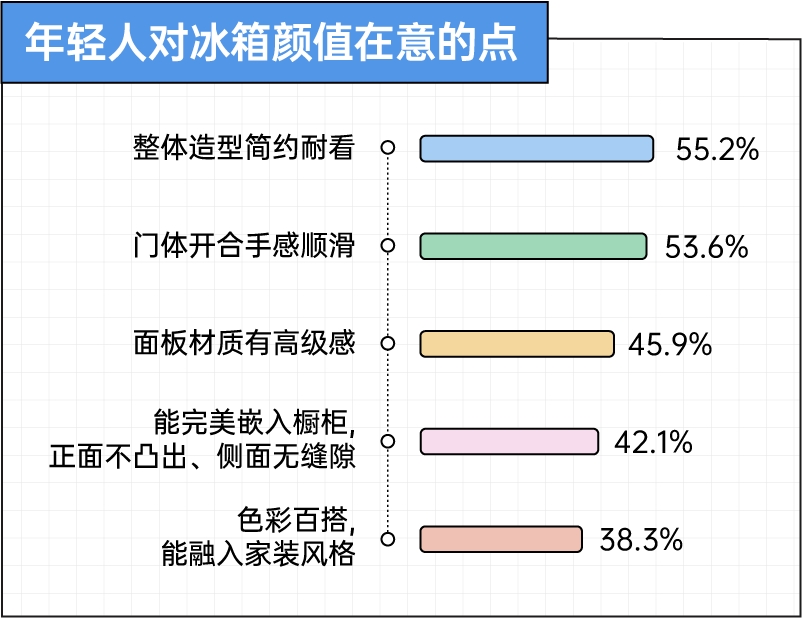
The survey shows that people have very specific requirements for the appearance of the refrigerator: More than half of the people regard "a simple and timeless overall design" as the primary standard. The second and third most - concerned points are "smooth door - opening and closing feel" and "a high - end panel material". 42.1% of people hope that the refrigerator "can be perfectly embedded in the cabinet, with no protrusion on the front and no gap on the side" - this is really a moment of extreme comfort for those with an organized personality.
For those who pursue a sense of order, the refrigerator should ideally be something that coexists with the overall design style - unassuming, but showing the owner's aesthetic everywhere. A refrigerator that can be ultra - thin and embedded, with high - end texture and color, is not just good - looking. It can visually expand the sense of space, making the small - sized kitchen appear more transparent and tidy. When you close the fridge door, the whole space is unified and clean, without any obtrusiveness or compromise.
This is probably what we want: something that is both useful and good - looking. It doesn't have to be expensive, but it has to be appropriate.

By now, you may have noticed: Our lifestyle has long been upgraded, but the refrigerator seems to have fallen behind. Each of the above problems is a small annoyance - not being able to keep things fresh, not being able to preserve for a long time, strong odor mixing, sticking out - but when put together, they become reasons to make do with things every