Detroit Echo: OPPO, vivo, Honor, and Xiaomi, Driven Crazy by OpenClaw, Flock to the High-End Market
Brands like Rongmi, OPPO, and VIVO may never have expected that one day their biggest competitor wouldn't be Apple, but a domineering "lobster."
In just a few months, OpenClaw has transformed from a geek toy into a phenomenon-level hot topic. In front of Tencent's headquarters, engineers even offered free installation services to passers-by. Shenzhen Nanshan Square was once crowded with developers and ordinary people queuing up with their laptops. Tech giants like Tencent, Alibaba, and ByteDance quickly followed suit, with one-click deployment templates and cloud images emerging one after another. Derivative tools like QClaw/WorkBuddy have turned WeChat/QQ into direct remote control entrances.
Beyond the "National Lobster-Raising" event, OpenClaw's impact on Mac mini sales and the quiet entry of AI glasses are vying to define the best computing terminal in the AI era. Meanwhile, the most popular hardware in the mobile internet era - smartphones - has surprisingly fallen silent.
Moreover, at the beginning of 2026, the long-standing market rules for smartphones were completely rewritten. This time, price hikes had no brand boundaries and no price range exemptions. The flagship models of Samsung's S26 series saw an average price increase of 1,000 yuan, and the starting price of Honor Power 2 was raised by a whopping 700 yuan (a 35% increase). Even the Realme Neo series, known for its "affordability," was 300 yuan more expensive than its previous generation.
Mainstream brands all initiated large-scale price increases in the same quarter. According to the latest news, OPPO and OnePlus announced price adjustment notices today. Earlier reports indicated that almost all brands, including VIVO, Xiaomi, and Honor, have clearly planned a new round of price adjustments in March, with a second or even third round possible in the second half of the year.
The direct trigger for this price hike is the sharp increase in the prices of memory and flash storage. According to data from TrendForce, the spot price of mobile phone storage chips has increased by more than 300% in the past three months. The cost of 12GB LPDDR5X memory has soared from 200 yuan to nearly 600 yuan, and the price of 1TB flash chips has also risen from over 200 yuan to around 600 yuan. The price of 256GB UFS4.0 has increased by 80% to 90%.
In the past two years, the construction of AI infrastructure centered around large models has entered a money-burning race. The demand for computing power from tech giants has increased exponentially, with the scale of model parameters advancing from billions and tens of billions to hundreds of billions and trillions. Multimodal applications such as text-to-image and video generation have further raised the ceiling of computing power. Storage manufacturers like Samsung and SK Hynix have quickly shifted their production capacity to higher-margin HBM (High Bandwidth Memory), resulting in a significant reduction in the supply of consumer-grade DRAM and NAND Flash needed for smartphones. Once the supply-demand balance is disrupted, price hikes become an inevitable outcome.
As a result, a comprehensive price increase spreading from high-end flagships to mid-range and entry-level models has become the most severe price shock in the smartphone industry in the past five years. The most affected are the mid- and low-end smartphone brands that are caught between costs and the market and have extremely thin profit margins.
The OpenClaw Effect: Will Smartphones Be Abandoned by AI?
To understand the current predicament of the smartphone industry, we need to first look back at its most glorious days. In the past fifteen years, the mobile internet has built an extremely efficient value closed-loop: Smartphones are the most private and portable personal terminals, and apps are the most precise service distribution carriers.
Whether it's hailing a taxi, making a payment, socializing, or shopping, every need has been precisely packaged into an icon by engineers, accessible with just a touch of the screen. This logic has not only created huge commercial value but also shaped the habit of a generation of consumers to "replace their phones every two years." Each new generation of products improves in these aspects, and users are happy to upgrade every two or three years to enjoy the enhanced experience brought by technological progress.
However, AI is fundamentally shaking the most proud features of smartphones - portability, ease of use, and always being online. In the face of the requirements of AI agents, these features have instead become bottlenecks.
From the end of 2025 to the beginning of 2026, an unexpected phenomenon quietly occurred in the tech circle: With the explosive popularity of OpenClaw (a powerful AI agent framework), the sales of Mac mini saw a rare and significant increase. Developers and geeks around the world rushed to buy it, just to deploy their own AI agents on this small desktop computer. Even if the functions were not yet perfect, they wanted to experience the future interaction of "AI automated task execution" as soon as possible.
In an era where everyone is looking for the "next AI hardware," the first to become the best carrier for AI is not the flagship smartphones stuffed with AI features, but a simple desktop computer.
This result is not accidental. Computers have existed as production tools since their inception. Before the appearance of the graphical interface, computers only had a command line, with a black background, white text, and a blinking cursor. Only those who could speak "machine language" could operate them.
Although the graphical interface has lowered the usage threshold, the underlying genes of computers have never changed: a complete file storage system, an operable command-line interface, and a highly customizable operating environment. These features make computers naturally capable of being "invoked by machines." The emergence of AI has even enabled ordinary people to issue commands in natural language and let machines execute them - and the computer's architecture is naturally prepared for this "human commands, machine executes" model.
Smartphones have taken a completely different evolutionary path. They only emerged in the 21st century, and their entire interaction logic skipped directly to the graphical interface. The design goal was to make operations as simple, intuitive, and zero-threshold as possible. For the sake of ease of use, apps on smartphones are designed as closed, ready-to-use islands. The permissions of each app are strictly controlled, and the core system interfaces are basically closed to third parties. Inter-app communication is strictly restricted.
This architecture was an advantage in the mobile internet era, but in the AI era, it has become a fatal constraint. It's hard to imagine that an app downloaded from the App Store can automatically answer your takeaway calls, check your schedule, and complete your shopping, because the permissions and capabilities of smartphone apps are almost locked within the app sandbox.
That's why the iPad has never been able to replace the Mac, and the "smartphone assistant" style of AI smartphone solutions is ultimately a roundabout way. The answers all point to the same thing: Computers naturally retain the soil for "machine interaction," while smartphones were designed from the beginning for "human interaction."
Meanwhile, the quiet rise of AI + AR glasses is also posing a deeper challenge to smartphones at the "form factor" level. As an AI carrier, glasses don't require users to take out a device, unlock the screen, or find an app - they are right in the field of vision, constantly sensing the environment and responding to needs at any time. This "app-free" interaction paradigm is naturally compatible with the way AI agents "continuously run in the background and actively serve people."
The actions of capital and tech giants best illustrate the certainty of this direction. Meta's Ray-Ban AI glasses have quickly penetrated the global market. Among the top three Chinese internet companies by market value in 2025, two have clearly entered this field: ByteDance's Pico is about to release AR glasses, and Alibaba's Qianwen AI glasses sold out in just three hours.
As previously mentioned in an article in "New Position," when AI becomes powerful enough, the interaction paradigm of "I open an app" will be replaced by "AI completes tasks for me." This change will have a gradual but irreversible impact on the current business model of smartphones.
Facing the deep-seated anxiety brought about by the changes in hardware form factors, smartphone manufacturers have come up with the most direct response strategy: acceleration. Almost the entire month of March was filled with new product launches - VIVO X300 Ultra, OPPO Find N6, Honor Magic V6 (Chinese version), and OnePlus 15T. There were three or four flagship models debuting in the middle of the month alone, and the OPPO Find X9 Ultra will follow in April.
The strategy of smartphone manufacturers to accelerate feature stacking and release products more frequently is essentially an "external expression of internal anxiety." Before finding a product definition that is truly suitable for the AI era, they use a higher release frequency and more aggressive configurations to maintain consumers' attention and desire to replace their phones.
However, the problem is that this method is facing a double contraction of users' aesthetic fatigue and willingness to replace their phones. In an environment where storage prices are rising rapidly, launching new products as soon as possible and locking in the current cost window is a more rational choice than waiting and seeing. But this also creates a paradox: The more new products there are, the smaller the differentiation space for each product; the faster the pace, the harder it is to meet users' expectations of "a truly worthwhile upgrade."
Data released by the China Academy of Information and Communications Technology shows that the average time between phone upgrades has increased from 24 months in 2020 to 33 months in 2025. Under the dual pressure of the price hike and the uncertainty of form factors, this number is still increasing.
A Misfortunate Disaster: Who Killed the Budget Smartphone?
Today, we know that the cost of a smartphone is highly concentrated in three core components: the processor, which accounts for a large part of the BOM (Bill of Materials), memory and storage, and the screen. Together, these three components account for more than half of the cost. This means that the price fluctuations of memory and storage directly determine the profit line of smartphones.
In 2025, the supply-demand balance in the memory market was completely disrupted. Memory price adjustments were not only significant in amplitude but also chaotic in rhythm.
The previous price adjustment cycle of once every six months or a year has been compressed to twice a month. For the same smartphone with 12GB + 256GB storage, the overall material cost can fluctuate by more than a thousand yuan within a few months.
This has led to significant fluctuations in the mid- and low-end markets. UBS predicts that in 2026, the memory cost of low-end smartphones will account for 40% to 45% of the BOM, far higher than the 20% to 30% in 2025. In other words, for a budget smartphone priced at 1,500 yuan, nearly half of the cost structure will be memory and storage.
From an economic perspective, the shrinkage of this market is a reversal of the "technological deflation" logic in the AI era. In the past fifteen years, the continuous decline in hardware costs under the influence of Moore's Law has made it possible to have "affordable high-performance devices." However, when the construction needs of AI infrastructure fundamentally change the global supply-demand structure of storage chips, this logic is disrupted.
Facing this fundamental change in the cost structure, "New Position" believes that mid- and low-end smartphone brands, once known for their "cost-effectiveness," actually have only three options.
The first option is to directly raise prices. However, budget smartphones are targeted at the most price-sensitive consumer group, and these users are extremely sensitive to price changes. A direct price increase will cause a large number of users to turn to the second-hand market, previous-generation flagships, or simply delay upgrading their phones. The public's doubts after Honor Power 2 was priced at 2,499 yuan confirm this market reaction.
The second option is to maintain the original price and absorb the cost increase on their own. This means that the brand's financial statements will bear the industry-wide cost shock. For mid- and low-end brands that rely on large-scale sales, the more they sell, the more they lose. This situation of losing money with each sale will quickly deplete the brand's cash flow.
Therefore, for rational manufacturers, discontinuing production is the most practical choice. Instead of being trapped on both sides, it's better to actively cut unprofitable SKUs and concentrate limited resources on more profitable product lines. IDC predicts that in 2026, the market share of the low-end market below $200 will shrink by 4.3 percentage points to 20%. This shrinkage is not due to consumers' willingness but rather the active withdrawal of the supply side.
The market has presented a strange scene: Flagship smartphone launches are bustling, while the budget smartphone market is quiet. According to media reports, in January 2026, Xiaomi and OPPO reduced their annual smartphone orders by more than 20%, VIVO by nearly 15%, and Transsion to less than 70 million units. The main models cut were mid- and low-end phones and overseas products.
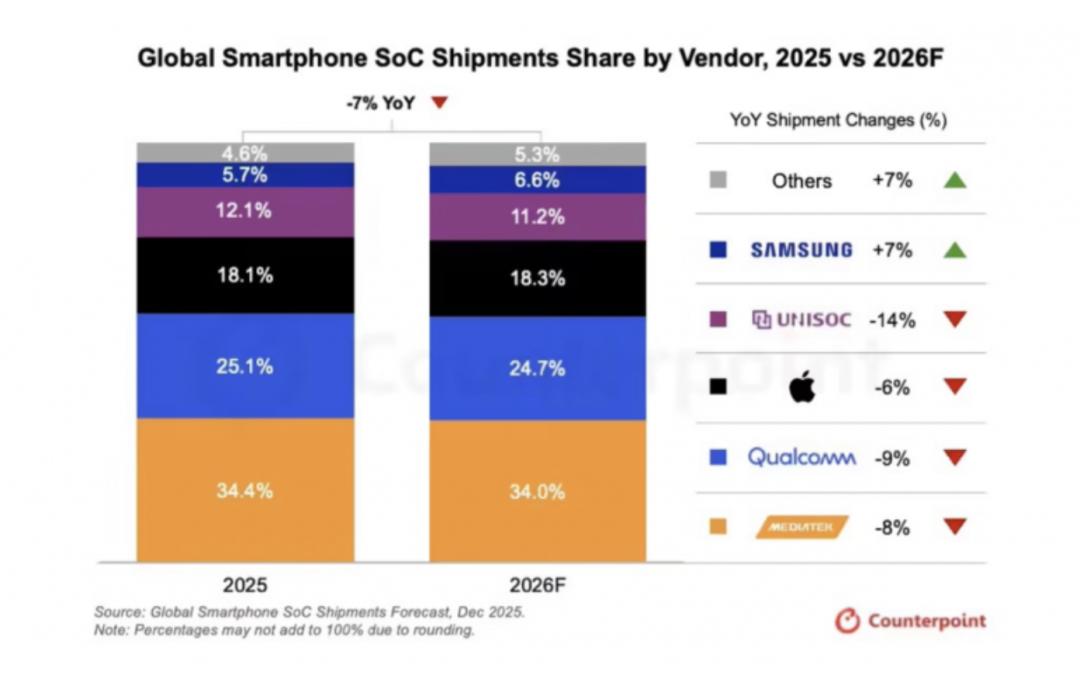
The upstream chip market has also sent a signal: Counterpoint predicts that MediaTek's shipments will decline by 8% year-on-year in 2026, Qualcomm's by 9%, and Spreadtrum, which mainly serves the low-end market, by 14%.
As budget smartphones become a thing of the past, consumers are voting with their feet. In the county-level smartphone market, there is a unique "reverse replacement" phenomenon. With the same budget, instead of chasing the latest models, consumers are turning to the second-hand market for previous-generation flagships. They can get a better hardware experience at a lower cost. This behavior is the most rational and helpless response of ordinary consumers to the price hike.
In this industry-wide retreat from the mid- and low-end markets, no one can stay out of it. All brands targeting the sinking market are experiencing severe pain. The first to bear the brunt may be VIVO, the absolute king of the "sinking/mid-range smartphone market" in the past few years.
In the early stage of the industry's development when specifications were king, VIVO, adhering to its internal "down-to-earth" culture, showed unreserved expansion determination in the mid- and low-end price segments. It not only launched a dense product lineup such as the Y series, S series, and iQOO to meet different consumer levels but also built an extremely powerful offline moat. By 2024, VIVO had more than 250,000 offline stores in towns and cities (including direct-sale, agent, and franchise stores). This extensive offline network greatly enhanced the channel's carrying capacity and continuously pushed VIVO's mid- and low-end smartphones into millions of households with astonishing throughput.
According to the latest data from RD Observation, VIVO is the absolute leader in the 0 - 2,000 yuan price range, with an overall market share of up to 22.0% (VIVO accounts for 16.8%, and iQOO accounts for 5.2%). The iQOO 15, which focuses on performance, sold more units in the first 30 minutes of its launch than the previous generation did on its first - day sales. On the first - sale day, offline sales increased by 280%. Behind this amazing explosive power is still the victory of its large offline channel network and its core customer base.
In the past four years, thanks to the continuous support of the sinking market, VIVO has often ranked first in China's smartphone market in terms of shipments. However, this also proves that its huge total sales volume largely depends on the mid- and low-end markets. When the memory inflation brought by AI mercilessly erodes the profits of low-end smartphones, VIVO's once - intimidating scale barrier has instantly become a heavy structural burden.
No one feels this pressure more acutely than Hu Baishan. This veteran, who was promoted to VIVO's president less than a month ago, didn't have time to enjoy the joy of his new position before running into the first big problem after taking the helm.
He has taken over a large - scale channel matrix deeply rooted in the sinking market, which was once proven to be invincible. However, at this moment, the low - margin business logic that supports the high - speed operation of this system is facing severe challenges from the external environment. How to lead these 250,000 offline stores, which are used to the traditional large - scale sales model, to break out of their comfort zones and adapt to the "cyclical ebb of budget smartphones" caused by the supply chain will be the first major obstacle this new president must overcome after taking the