Flash charging reigns supreme. What does battery swapping have to do with it?
Last week, a press conference once again made BYD the focus of the entire industry. As for the absolute foundation, it must be the second-generation Blade Battery, which took six years to develop.
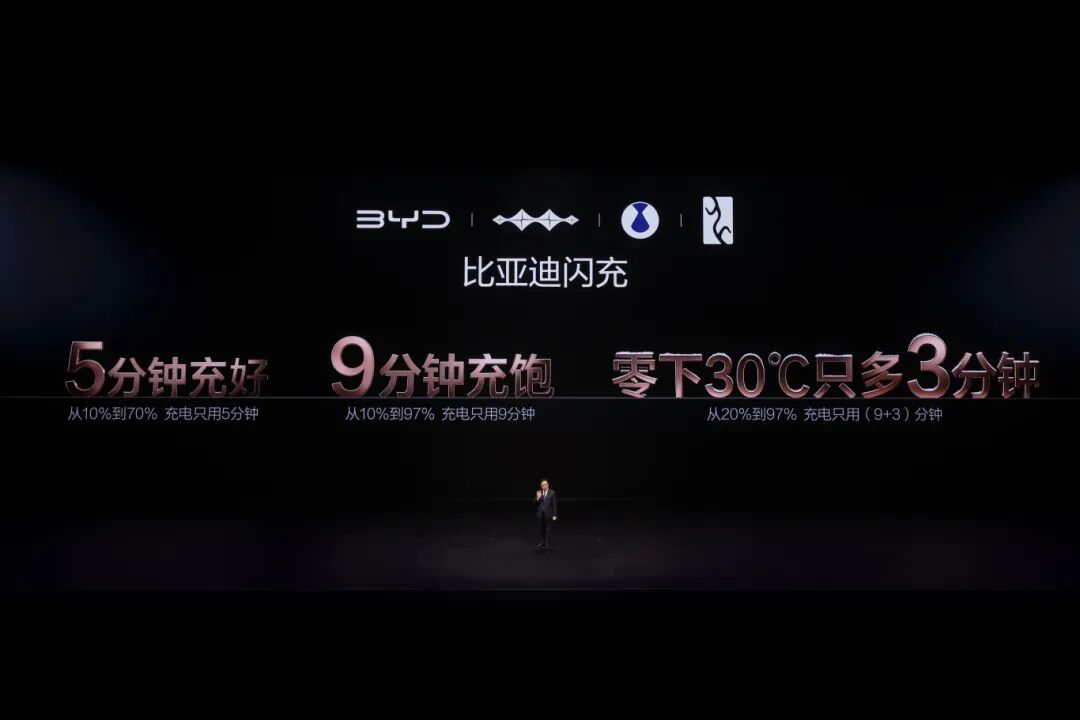
Wang Chuanfu, the keynote speaker, didn't introduce the specific parameters in a rather dry way like a typical tech-savvy person. Instead, he demonstrated how "amazing" it is from the perspective of charging speed, which is most relevant to users.
At room temperature, many BYD models equipped with the second-generation Blade Battery can charge from 10% to 70% in just 5 minutes. In contrast, what really made the audience exclaim was that the second-generation Blade Battery can charge from 10% to 97% in only 9 minutes.
Yes, you read it right. The speed is comparable to refueling.
The line on the PPT behind Wang Chuanfu, "Fully charged in 5 minutes, completely full in 9 minutes," became the most impressive highlight of the entire press conference.
Of course, the subversive progress of the second-generation Blade Battery is not only about being "powerful," but also about being "stable."
It has completely solved the problem of charging performance decline of electric vehicles in low-temperature or even extremely cold environments. A test vehicle, after being left in an environment of minus 30 degrees Celsius for 24 hours, can charge from 20% to 97% in less than 12 minutes.
More importantly, vehicles equipped with the second-generation Blade Battery are "not picky about charging piles." They are compatible with all 4.8 million public charging piles in the country, and the charging speed is 30% - 50% faster than similar models.
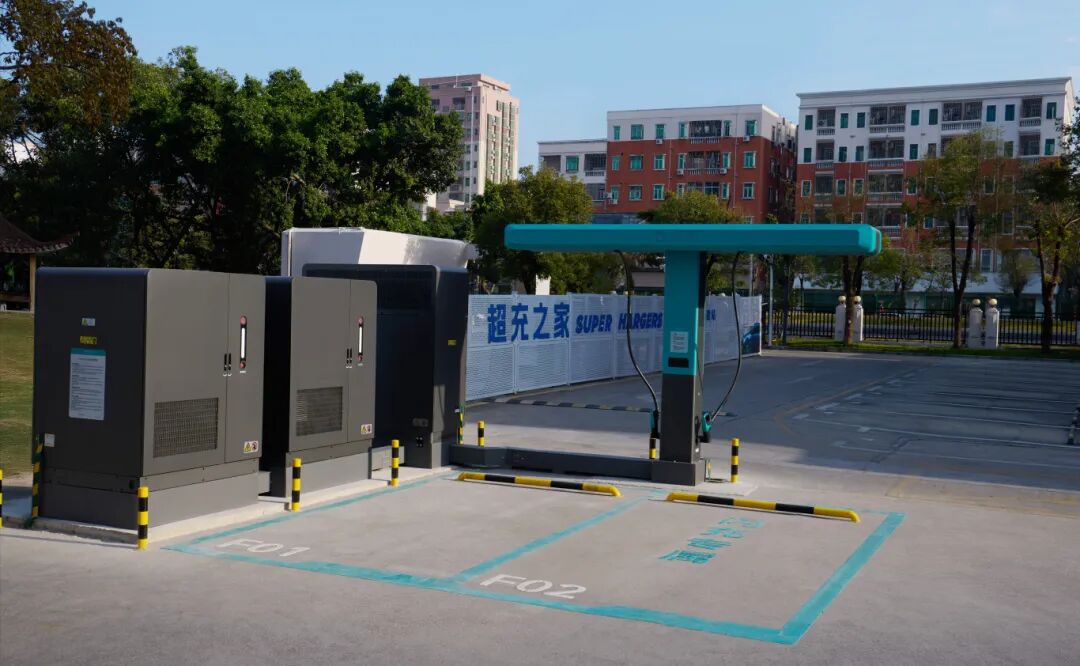
At the same time, in order to give full play to the maximum power of the second-generation Blade Battery, BYD has also launched the second-generation Flash Charging Pile. The single-gun charging power reaches 1500kW, making it the world's most powerful mass-produced single-gun charging pile. When combined with the energy storage system, it will not put too much burden on the power grid.
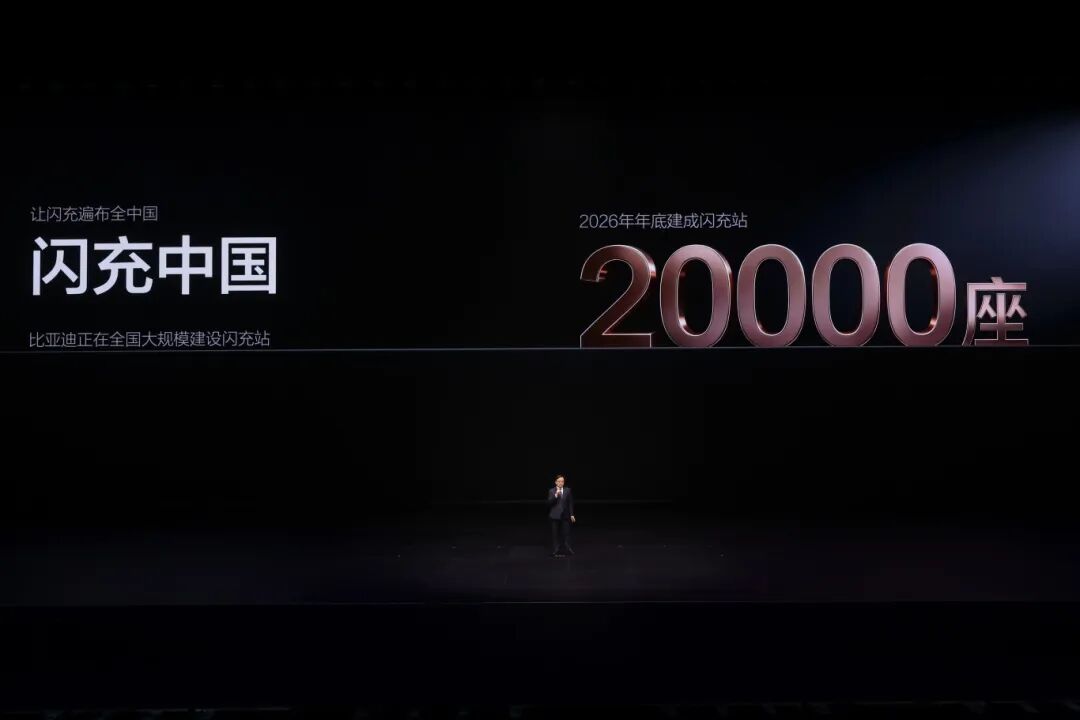
Moreover, Wang Chuanfu officially announced the simultaneous launch of the "Flash Charging in China" strategy. That is to say, a large number of flash charging stations will be built across the country. It is expected that 20,000 stations will be completed by the end of this year.
In addition, all owners of vehicles equipped with the second-generation Blade Battery can enjoy the right to free charging at national flash charging stations for one year from the date of vehicle delivery. Subsequently, the charging fees will be the same as the industry standard.
Anyway, in just over two hours, BYD dispelled most of its recent gloom and downturn with a press conference that precisely addressed users' pain points.
In the past few days, videos related to the second-generation Blade Battery and flash charging technology have continued to gain popularity on major social platforms, showing no sign of fading.
When looking through the comments of netizens, I accidentally found a subtle opinion: NIO is "doomed" again.
More precisely, as BYD's sweeping charging plan is rapidly rolled out, the battery swapping system that this new energy vehicle manufacturer has been proud of and deeply involved in for many years will seem vulnerable.
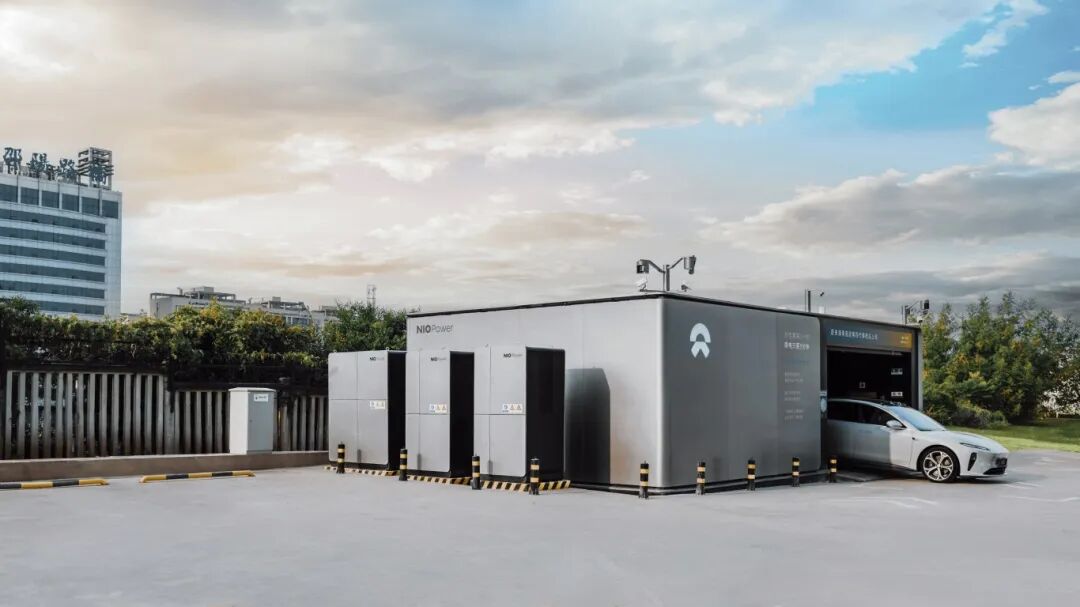
Because, in terms of both speed and density, it no longer has any advantages. Some extremely radical doubters even think that "from the very beginning, battery swapping was a wrong choice."
All of a sudden, the two protagonists of today's article are forced to stand on opposite sides. In the eyes of onlookers, the two technological routes must fight to the death.
Regarding this, both BYD and NIO seem very helpless.
From BYD's perspective, after the press conference, the focus that it originally wanted everyone to pay attention to should be the revolutionary progress of the second-generation Blade Battery, rather than simply getting stuck in the argument of "which is stronger, flash charging or battery swapping."
From NIO's perspective, every time a new ultra-fast charging technology is released in the industry, there will be a deluge of negative opinions saying that "battery swapping is doomed." This cycle is really exhausting.
In the past two days, when opening the WeChat Moments, the executives and employees of the two car companies have also been speaking out alternately.
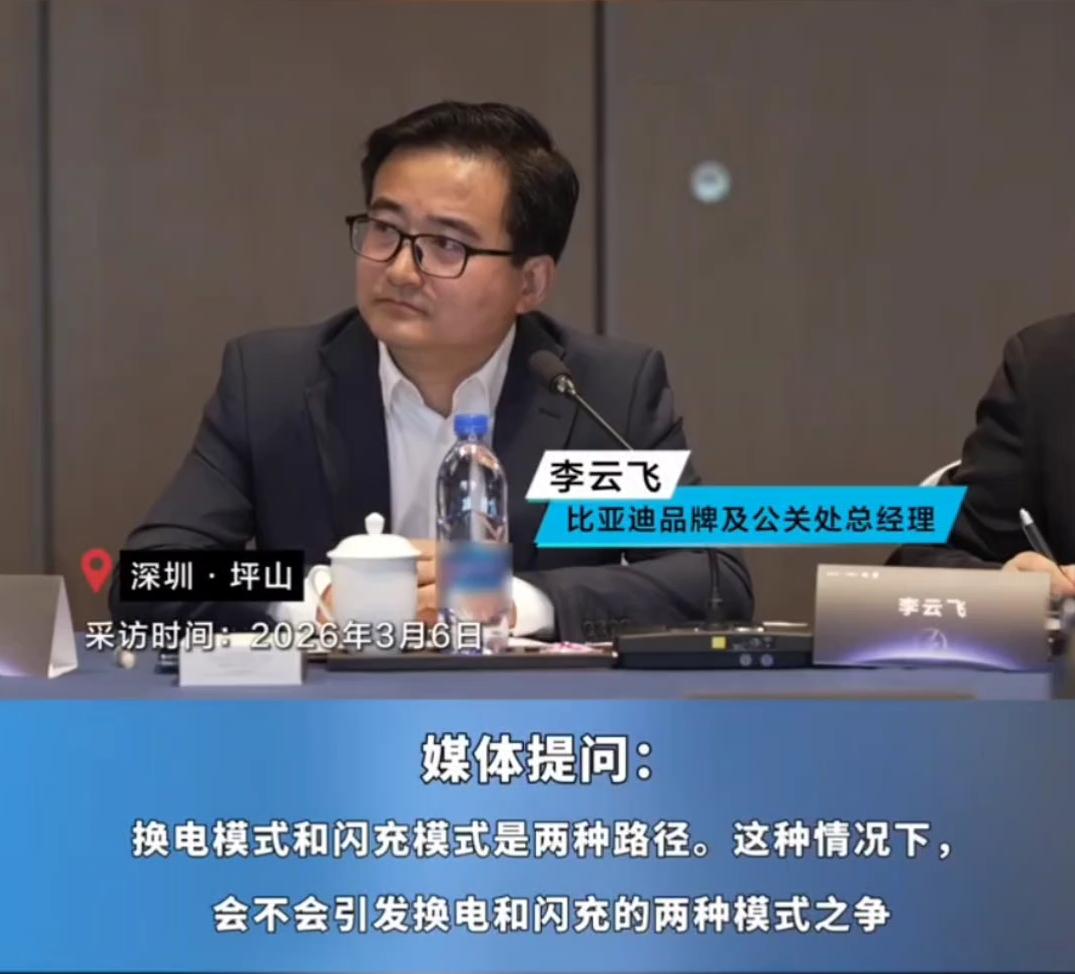
Among them, what impressed me most was definitely a statement from Li Yunfei, the general manager of BYD's brand and public relations department: "In terms of technological routes in the industry, there should be a hundred flowers blooming and different paths leading to the same goal. Although flash charging and battery swapping seem to be different routes, their common goal is to promote the transition from gasoline-powered vehicles to electric vehicles."
What a broad vision!
In contrast, Li Bin, the founder, chairman, and CEO of NIO, even appeared on CCTV and held a live broadcast to justify the battery swapping model. "Ultra-fast charging and battery swapping are not contradictory. It's like being good at both Chinese and math. The two technological routes solve problems in different scenarios and for different purposes."
Immediately afterwards, he also specifically added: "No matter how fast ultra-fast charging is, it can never be as fast as battery swapping. Solving the problem of battery life is the biggest systematic advantage of battery swapping. Using ultra-fast charging too often will definitely cause some damage to the battery's life, health, and long-term safety. This is actually something that many people don't often consider."
There's no doubt that Li Bin has his own point.
In my opinion, I'd like to put forward two viewpoints to participate in this heated discussion. One is the title of today's article, "Flash charging is invincible, what does it have to do with battery swapping?"

What it implies is that the two technological routes don't interfere with each other. So why talk about one killing the other?
Actually, I suggest that all readers take a good look at an article published last year on the personal WeChat official account "Fei Chang Shuo" by Shen Fei, the president of NIO's LeDao. It directly points out that ultra-fast charging and battery swapping are not in a "life-or-death" competitive relationship, but are solutions for different dimensions.
The former focuses on pursuing the ultimate single-vehicle single-time charging speed. This extreme pursuit of "speed" may sometimes require trade-offs in terms of battery life, battery safety, and even grid stability.
The latter aims to build a multi-dimensional energy ecosystem. It not only needs to achieve the quick "3-minute battery swapping," as fast as refueling, but also needs to simultaneously solve the safety management, life management, and hierarchical utilization of the battery throughout its life cycle. It aims not only to maximize the value of each battery but also to let the scattered battery swapping stations, as distributed energy storage units, aggregate into a flexible adjustment resource for the power grid (virtual power plant).
Therefore, ultra-fast charging is constantly approaching the physical limit in the dimension of "charging speed," while battery swapping is reconstructing the energy network from a systematic level, achieving efficient collaboration among "vehicles - stations - batteries - power grids - users" and building a smart energy interconnection network based on electric vehicles.
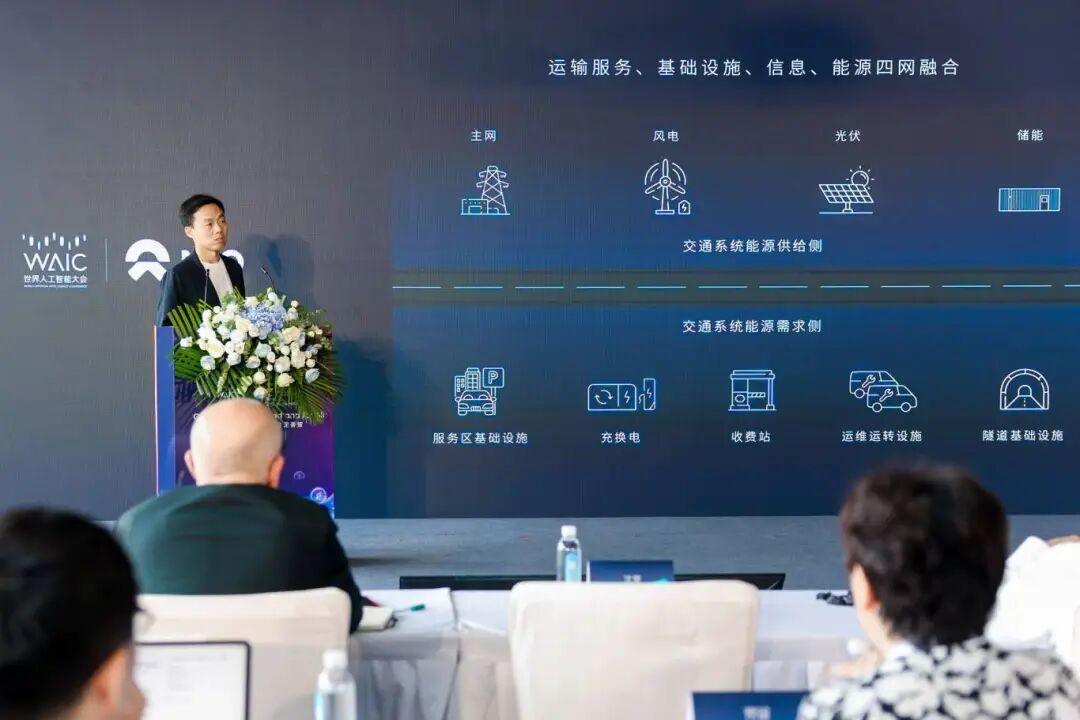
In Shen Fei's view, this is essentially a competition between "single-dimensional optimization" and "systematic reconstruction," and the two are not on the same dimension at all.
As a dedicated new energy vehicle user, I firmly believe that the two technological routes will coexist forever, rather than one killing the other.
Moreover, even if we assume the worst, are all NIO models only capable of battery swapping and not ultra-fast charging? Take the ET9 as an example. The officially advertised peak charging power has reached 600kW.
As of now, in addition to NIO, CATL, also known as the "King of Batteries," is also vigorously deploying the chocolate battery swapping business. Does that mean it's being stubborn?
Last year, the national standards related to battery swapping were officially released. And in terms of subsidy policies, the state has always taken care of and encouraged battery swapping models.
Anyway, all of the above is enough to refute many baseless doubts.
Personally, I'd like to call on everyone to view the rapid development of the Chinese new energy market more rationally and objectively. Whether it's BYD's flash charging or NIO's battery swapping, they are both sharp swords forged patiently by excellent domestic brands.
They shouldn't fight among themselves but should direct their efforts against gasoline-powered vehicles.
Just as Li Yunfei said earlier, promoting the transition from gasoline-powered vehicles to electric vehicles is the common goal of the two technological routes. Especially in 2026, with the phasing out of policies and the increasing wait-and-see attitude of end consumers, the new energy vehicle market seems to be stagnating.
At this moment, it's even more necessary for leading players to step forward and lead the way out of the dilemma. Fortunately, through a press conference, BYD, with its second-generation Blade Battery, has set a good example for other automakers. On the other hand, NIO is also steadily expanding its charging and battery swapping network, patiently waiting for a huge qualitative change triggered by quantitative accumulation.
They are all respectable players.
Precisely based on this background, it doesn't make much sense to continue arguing about which of the two technological routes is better. Existence is reasonable. The continuous progress and iteration of ultra-fast charging and battery swapping are all aimed at providing new energy vehicle users with a better charging experience.
As the saying goes, "Those who blindly create confrontation are either stupid or malicious."
I even think that every time such negative opinions emerge, it seems like a third party is causing trouble. For those automakers without relevant technological reserves, those who choose to take shortcuts, and those who are hesitant about transformation, every major change in the industry is a devastating blow.
In short, ultra-fast charging can't kill battery swapping. Instead, they will jointly eliminate those who are not enterprising.
This article is from the WeChat official account "C Dimension". Author: Cui Liwen. Editor in charge: Shi Jie. Republished by 36Kr with permission.