Bull stocks frequently emerge in the track. Will it be the next 100-billion leader?
Author | Freddy
Data Support | Gogudata (www.gogudata.com)
The wealth - creating myth of AI in the A - share market continues.
Since the advent of ChatGPT, the "shovels" have become increasingly valuable. Stocks of major companies in various AI infrastructure sectors, such as Foxconn Industrial Internet, Zhongji Innolight, Shenghong Technology, and Cambricon, have seen their market values soar.
As the computing power logic extends to the upstream energy supply, power grid equipment, as one of the few core sectors most favored by funds in the market recently, has also witnessed an explosion, with numerous stocks doubling in price in the past year.
Last year, Siyuan Electric, which we talked about, successfully crossed the 100 - billion - yuan market value threshold.
Before we knew it, another leader in the UHV field has accumulated a 112% increase this year.
It is only one step away from a 100 - billion - yuan market value.
01 The Big Cycle of Power Grid Investment
As large models move towards the real - time inference stage dominated by billions of users, tech leaders are gradually realizing a key reality:
The most core physical bottleneck restricting the development and commercial implementation of AI technology has become the stable and low - cost power supply.
This week, representatives of seven companies, including Microsoft, Google, OpenAI, Amazon, Meta, xAI, and Oracle, signed relevant documents at the White House in the United States, promising to supply or purchase the electricity required for AI data centers on their own.
That is to say, these tech giants have to pay for their own power sources when building data centers, which has led to a surge in orders for gas turbines abroad. Benefiting from the US gas turbine orders, the stock prices of Weichai Power, Dongfang Electric, Harbin Electric, and Shanghai Electric, which have the ability to undertake overflowing orders, have risen rapidly.
However, even if they manage to get the electricity, whether it can be connected to the power grid ultimately depends on the grid's carrying capacity.
This technological competition for AI hegemony is evolving into an escalating energy competition, which has also activated the power grid equipment sector and provided support for its rise in the past year.
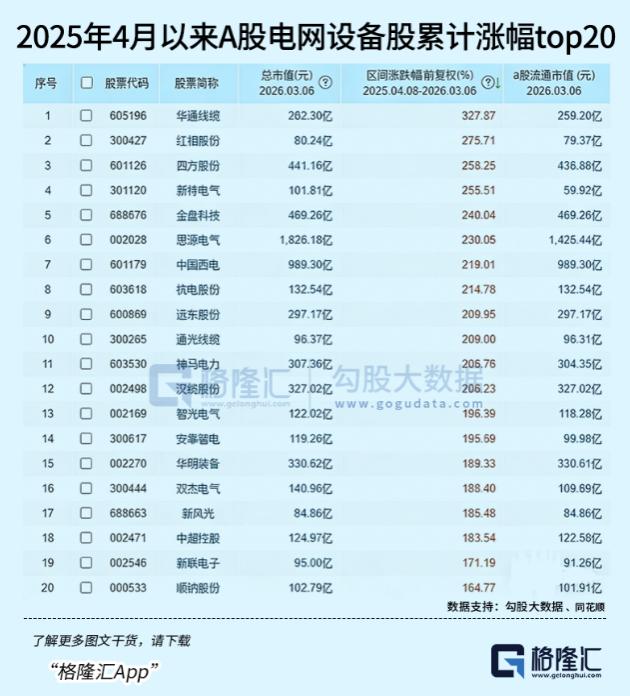
Top 20 cumulative increases of A - share power grid equipment stocks since April 2025
Looking at the domestic market first, the total investment of the two major power grids in the "15th Five - Year Plan" will exceed 5 trillion yuan. This unprecedented investment scale provides certain demand support for sub - sectors such as UHV, smart grids, and distribution network automation.
Abroad, recently, power grid operators in some parts of the United States have successively promoted a transmission expansion plan worth up to $75 billion. The core is to build a batch of 765kV ultra - high - voltage AC lines, which are expected to be extended to 10,000 miles.
In addition, the European Union also released the "European Power Grid Package" on December 10, 2025, planning to invest 1.2 trillion euros to fully modernize the power grid by 2040.
By now, we should understand that this is a new large - scale cycle of power grid investment.
Previously, foreign companies in the electrical equipment field had more orders than they could handle, and the demand may spill over to high - voltage/ultra - high - voltage companies in Japan, South Korea, and China.
The contradiction between the rapid growth of AI computing power and power supply is, on the surface, the pain of infrastructure construction, but in essence, it is a re - distribution of global technological dominance.
02 Token Going Global
As ordinary individuals, we may not be able to appreciate how much the rapid construction of infrastructure such as the large - scale laying of UHV lines and the installation of wind and solar power generation facilities every year can help the development of downstream industries.
So, let's first look at a set of data.
Data from OpenRouter shows that in February 2026, the number of calls to Chinese AI models increased by 127% in three weeks, surpassing the United States for the first time. Four out of the top five global models are Chinese, accounting for a total of 85.7%. A year ago, the share was less than 2%.
Moreover, the users of this platform are mainly overseas developers, with US users accounting for as high as 47.17%, while Chinese developers only account for 6.01%.
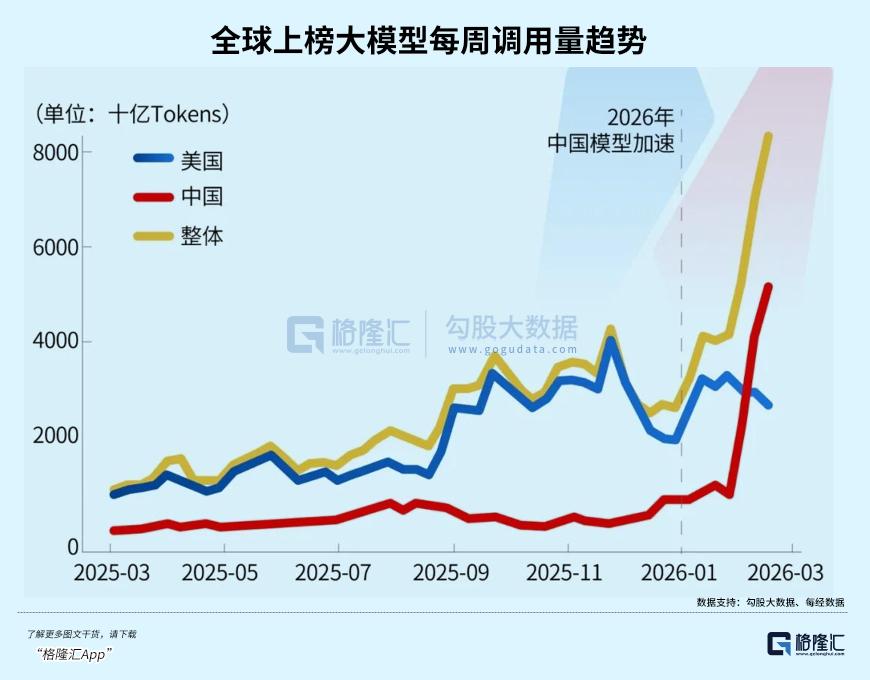
Trend of weekly call volume of global listed large models
This is not just a simple victory in model competitiveness. Behind it, there must be a large - scale and low - cost national energy infrastructure to provide value output to the global AI community.
To understand this, we need to re - deconstruct Token.
As the smallest semantic unit for large models to process and generate information, in the business model, Token is the core anchor point for service billing. In the cost structure, power and depreciation of computing hardware account for more than 70% of the production cost of a single Token.
As predicted by the "Jevons Paradox", the improvement of computing power efficiency has instead triggered an exponential demand for the total amount of computing power, completely breaking the original energy balance.
After entering the inference stage, what really determines the commercial feasibility of AI is not the larger the model, the better, but the inference power efficiency - how many inference results can be produced per watt - hour of electricity.
Currently, in the inference cost of a top - tier chip, the proportion of electricity bills may only be 6% - 8%. However, with the rapid iteration of domestic inference chips and the extreme optimization of model architectures, the hardware cost per Token will continue to decline, while the electricity cost in daily operation will increase with the explosion of inference scenarios.
Comparing the Token output prices of mainstream AI large models in China and the United States, the Token output prices of mainstream artificial intelligence models in the United States generally remain at a high level of about $10 per million Tokens (equivalent to about 72 yuan). In contrast, the output prices of mainstream large models in China have been significantly compressed to the range of 10 - 20 yuan per million Tokens.
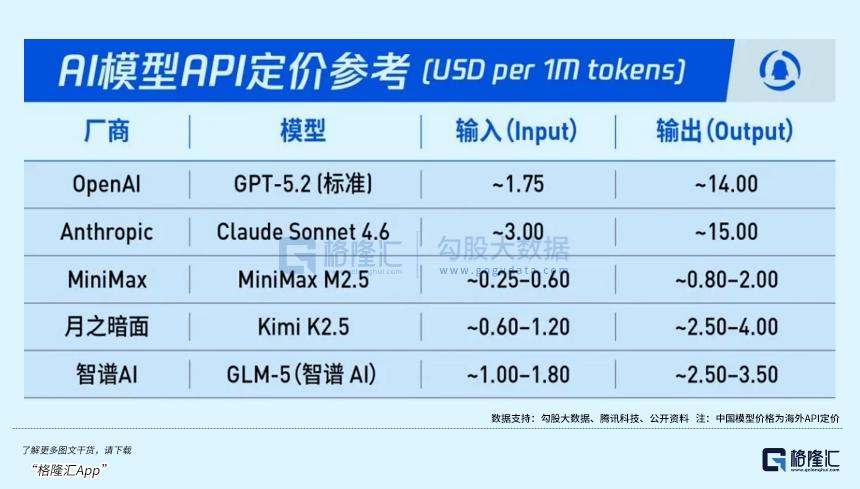
Pricing reference for AI model APIs
This is a nearly seven - fold price advantage.
Those who have used Claude Code may have noticed that through the API interface, we can replace the underlying large models with domestic models such as Zhipu, Minimax, and Kimi. The usage effect will not be significantly different, but the Token price is much cheaper than that of foreign models.
With this nearly seven - fold price advantage, Chinese large models have been able to quickly capture the global developer market at a very low commercialization cost while matching the performance of international first - tier models. We call this "Token Going Global".
The establishment of the "Token Going Global" model cannot be separated from a major background: There is a divergence in the power supply capabilities between China and the United States.
It is predicted that the power demand of data centers in the United States will soar from 176 terawatt - hours in 2023 to 325 - 580 terawatt - hours in 2028. By 2028, the annual electricity consumption of artificial intelligence alone will be equivalent to 22% of the total electricity consumption of all households in the United States.
Power demand of US data centers
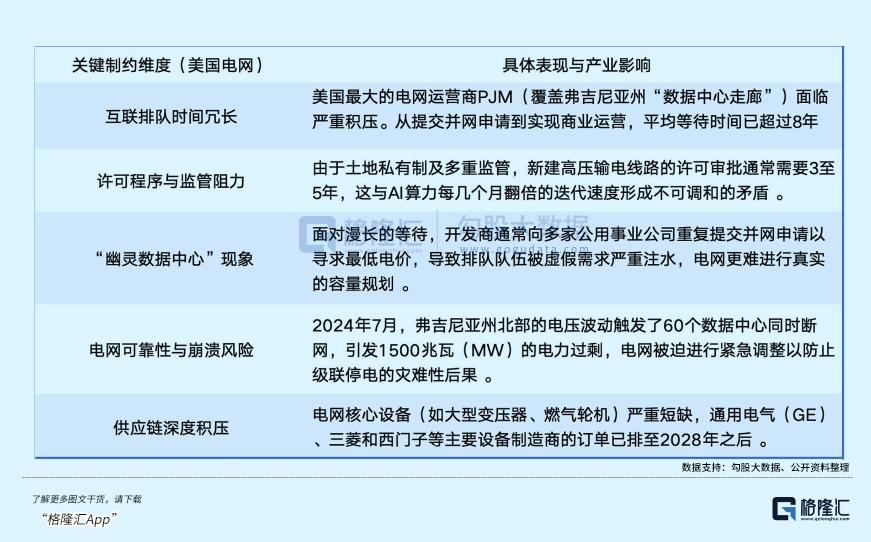
Facing such a rapid increase in demand, the aging power grid infrastructure in the United States and the lengthy administrative approval procedures have put its power supply in a structural dilemma.
Specifically, PJM, the largest power grid operator in the United States, is facing a serious backlog. The average waiting time for a new project from submitting a grid - connection application to commercial operation has exceeded 8 years. At the same time, restricted by land private ownership and multiple regulations, the permit approval for new high - voltage transmission lines usually takes 3 - 5 years. In addition, there is a serious shortage of core equipment such as large transformers, and the orders of major manufacturers have been scheduled until after 2028.
This extremely slow grid - connection efficiency forces tech giants to seek direct contracts with private power generation companies and even choose to physically "disconnect" from the grid to save time.
In contrast, the advantages of China's power industry system are beginning to stand out. The relatively loose and stable power supply and demand environment has become a solid foundation for the overseas expansion of AI computing power.
On the one hand, China has been leading other regions in the world in the deployment of clean energy capacity in recent years; on the other hand, China has maintained the production capacity of fossil energy to ensure the absolute stability and base - load supply of the current power grid. In the field of nuclear power, China also shows a large - scale construction in progress and absolute production capacity dominance.
In addition, the "East - to - West Computing" project has given full play to its cost - saving advantages in spatial layout.
This project has broken the traditional logic that computing power must be concentrated in eastern coastal cities. By deploying national - level computing hubs in energy - rich western regions and relying on UHV power grid technology, China has achieved a deep integration of the "computing power network" and the "energy network".
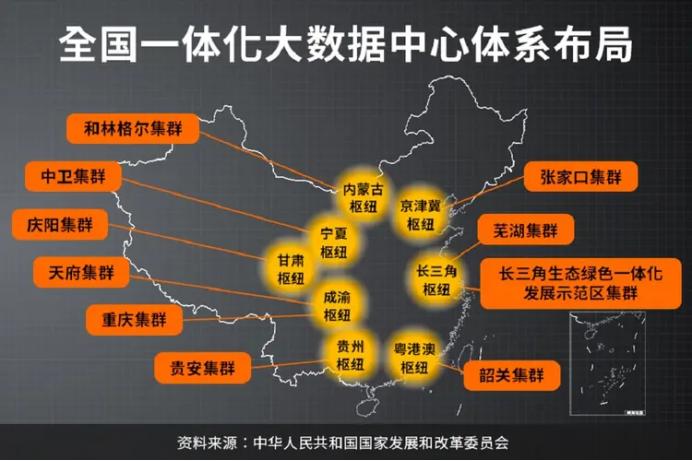
(NetEase)
This not only solves the problem of new energy consumption but also provides rock - solid physical support for large - scale computing power operations. Ultimately, it will surely be reflected in the commercial aspect, forming a highly competitive price advantage.
In the western nodes of the "East - to - West Computing" project, thanks to rich wind and solar resources and policy guidance, the settlement prices of green electricity in Xinjiang, Gansu, Ningxia, Qinghai and other places in the first half of 2025 were as low as 0.202 - 0.276 yuan per kilowatt - hour.
This extremely low electricity price advantage at the global level has directly reshaped the commercialization cost curve of large models. It can be said that China's electricity price can be directly transformed into global AI pricing power, and the most competitive weapon for China's computing power services to be "sold globally" is its competitive energy price.
The process of producing Tokens is essentially a process of converting abundant domestic electricity into cross - border intelligent services through high - end computing clusters.
Going deeper, this "power - computing power - Token" business closed - loop has established a new form of digital energy trade, and China's digital services are upgrading to high - value - added "value exports".
03 Overwhelmed with Orders
In this historical window period with a huge power gap and urgent power grid transformation, Chinese power equipment enterprises are taking advantage of their complete industrial chain to transform from product followers to technology and rule - makers.
Take the latest performance report for 2025 as an example.
Siyuan Electric has benefited from both the domestic expansion of intelligent computing power and the shortage of overseas power equipment due to AI demand. The delivery of its high - voltage switches, transformers and other products at home and abroad has accelerated.
Its revenue last year reached 21.205 billion yuan (+37.18%), and its net profit attributable to shareholders soared by 54.35% to 3.163 billion yuan.
Jinpan Technology also confirms this logic. It achieved a net profit of 659 million yuan for the whole year (+14.89%). Relying on its advantages in the field of high - efficiency dry - type transformers, its sales revenue in the field of AI data centers is increasing significantly, becoming the core engine for driving profits.
These are the direct providers of services for computing power centers.
Secondly, to meet the requirement that the proportion of green electricity in new computing power centers should exceed 80%, data centers will need to introduce large - scale distributed new energy and micro - grid technologies in the future. Equipment suppliers are no longer just providing single hardware but need to have the ability to provide integrated solutions including liquid cooling, energy storage, and grid - forming converters.
In China, NR Electric's coordinated control technology of power sources, grids, loads, and energy storage and virtual power plant solutions are the core for ensuring the stable use of green electricity in computing power centers. Sifang Co., Ltd. also adopts a route that combines secondary equipment with high - end control. In addition to traditional substation automation products, it is trying to increase the proportion of new high - end complete sets of equipment in its product structure, such as solid - state transformers (SST).
Moreover, in the future, the underlying main physical power grid (UHV) needs to continue to expand at a high intensity to solve the problem of cross - regional energy allocation.
XD Electric and TBEA, as the main suppliers of primary equipment such as UHV converter transformers and GIS, will have their business fundamentals supported by the upward shift of the central level of social electricity consumption and the rigid demand for new energy consumption.
Among them, UHV converter transformers represent the limit of voltage level and manufacturing process, with high technical barriers. According to LeadLeo, in the domestic market, TBEA, XD Electric, and Baobian Electric form an oligopoly, and the three companies together account for about 85% of the market share.
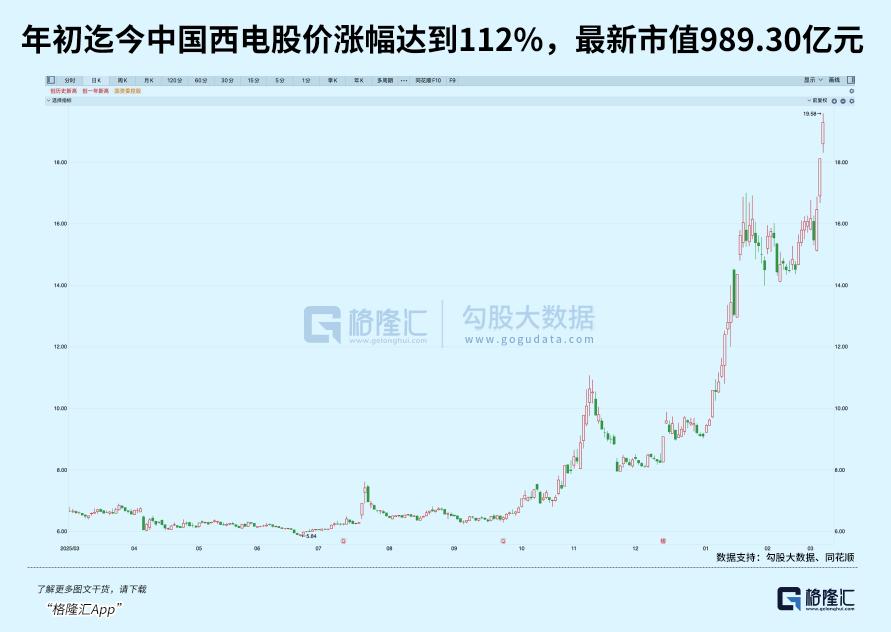
Stock price trend of XD Electric
However, compared with TBEA, which has a more diversified business structure, XD Electric's business is highly focused on primary equipment (high - voltage switches, transformers). It is the only domestic enterprise that can provide a full range of UHV AC and DC power transmission and distribution equipment and has mastered the R & D and production capabilities of a full set of UHV AC