The cooking robot has become a hot topic on social media. Is the catering industry about to undergo a major change?
Recently, a community canteen in Hangzhou has become a hot topic on social media. The reason is not something else, but that the canteen has introduced two "new employees" - stir - frying robots, each costing 60,000 yuan.
The stir - frying robots have greatly reduced the workload of the canteen chefs. "Previously, a chef had to cook more than 40 dishes and was extremely busy. Now, 80% of the dishes are handed over to the robots!" Moreover, the "cooking skills" of the robots are by no means inferior. According to the canteen staff, the two "new employees" can be called "standardized cooking masters". Their core advantage lies in the precise control of oil and salt ratios down to the gram. The dishes they cook have a fresh color and a proper saltiness, which fits the modern concept of healthy eating. Some customers have directly said that "it's really delicious".
The stir - frying robot is still a new thing in the entire catering industry. However, it's obvious to everyone that it has great potential, and the catering industry is about to undergo a major change. Then there are the following points that we need to figure out: First, what is the current market size of stir - frying robots? Second, why has it become popular? Third, what impact will it bring to the catering industry? Fourth, which catering categories are more suitable for using stir - frying robots? Finally, what will happen to chefs?
1 The Market Size of Stir - Frying Robots: Expected to Exceed 12 Billion Yuan by 2030
The news at the beginning of the article was pushed onto the hot search on the second day of this year's "Two Sessions", which can illustrate some problems. In the "Government Work Report" released the day before, "artificial intelligence" was mentioned 7 times, and "embodied intelligence" (the combination of artificial intelligence and physical entities such as robots) was clearly listed as a future industry. And the stir - frying robot is an excellent manifestation of "artificial intelligence +" and "embodied intelligence" in the catering service field.
As early as two years ago, during the 2024 National "Two Sessions", Jia Nan, a member of the Standing Committee of the National Committee of the Chinese People's Political Consultative Conference and the former deputy director of the National Bureau of Statistics, proposed that the application potential of artificial - intelligence stir - frying robots in China's catering industry is huge, and artificial - intelligence robots can be used to achieve fresh cooking on a larger scale. At the Beijing "Two Sessions" in early 2026, the district head of Pinggu cooked dishes on - site for reporters and netizens with a robot in the inquiry room for representatives and committee members. He believes that this represents a "kitchen revolution". Empowering the kitchen with artificial intelligence can precisely control oil and salt and greatly liberate people's hands.
The popularity of stir - frying robots is increasing day by day, and the market shows an obvious growth trend. The latest data from NCBD (Catering Baodian) shows that the market size of China's stir - frying robot industry exceeded 3.5 billion yuan in 2025 and is expected to exceed 12 billion yuan by 2030.
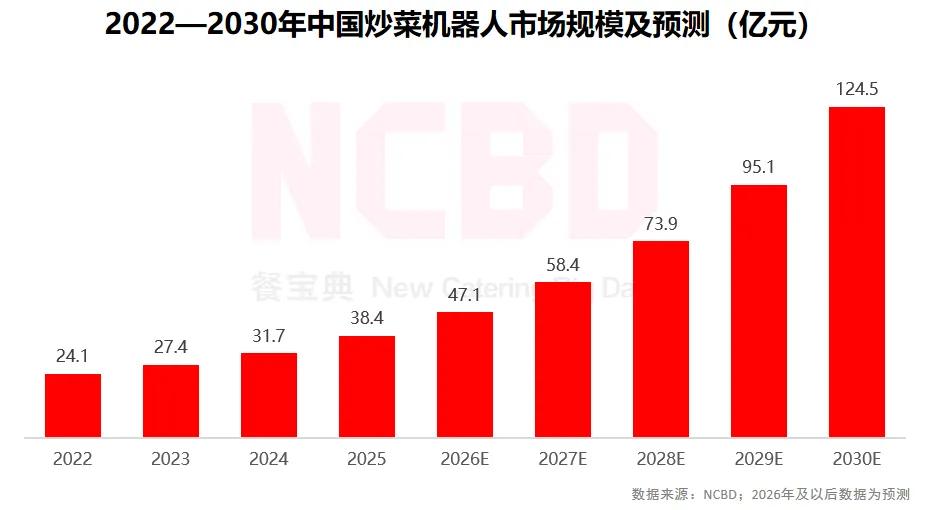
Currently, stir - frying robots are mainly used commercially, showing the characteristics of "commercial use first, household exploration". They have been applied in some catering enterprises and achieved good results. For example, some stores of Xiaocaiyuan have been using stir - frying robots since 2023; Dami Xiansheng, a fast - food brand under the Xiangcunji Group, has used stir - frying robots in multiple stores to assist in restaurant operations; in addition, many restaurants of Laoxiangji have also adopted intelligent stir - frying robots and other equipment.
2 Why Stir - Frying Robots Have Become Popular
The "Research Report on the Development Prospect of China's Stir - Frying Robots" by NCBD (Catering Baodian) points out that the popularity of stir - frying robots is an inevitable result of the superposition of multiple factors.
First, the catering industry is facing real difficulties. On the one hand, the labor cost continues to rise, seriously squeezing the profit space of enterprises; on the other hand, the shortage of chef talents is becoming increasingly prominent, and young people are not willing to choose cooking as their profession. This not only increases the recruitment difficulty of catering enterprises but also makes it difficult for enterprises to innovate in dishes and maintain stable quality. Stir - frying robots, on the other hand, have the advantages of improving cooking efficiency, reducing labor costs, and ensuring stable dish quality, which can help catering enterprises solve their problems.
Second, the technology is becoming increasingly mature. The development of artificial - intelligence technology allows robots to deeply learn the stir - frying skills of chefs and achieve precise control of heat and oil temperature. The Internet of Things technology enables robots to connect to the cloud database, and users can remotely operate through mobile phones and access a large number of recipes. The maturity of technology has enabled stir - frying robots to move from "concept" to "practical use".
The promotion at the national strategic level is another key factor. Relevant policies have been continuously strengthened in 2025 and 2026. In the "Guiding Opinions on Promoting the High - Quality Development of the Catering Industry" issued by 9 departments including the Ministry of Commerce, the R & D and application of artificial intelligence and intelligent equipment in the catering field are clearly encouraged. At this year's "Two Sessions" at all levels, stir - frying robots have received further attention. From the national to the local level, policy dividends have paved the way for the popularization of stir - frying robots.
Of course, it also cannot be separated from consumers' needs. Consumers complain that pre - made dishes "lack the wok flavor" and also hope for fast food delivery and stable quality. Stir - frying robots exactly address this pain point: they can achieve "fresh cooking on - site", retaining the "wok flavor" and achieving standardization. They can satisfy consumers and relieve the burden on catering enterprises at the same time.
3 The Impact of Stir - Frying Robots on the Catering Industry
The emergence of stir - frying robots is called a "kitchen revolution", and its impact on the catering industry is positive and far - reaching. It can be mainly viewed from three aspects:
First, the impact on catering enterprises. It mainly includes:
(1) Reducing labor costs. Taking a certain catering brand as an example, before introducing stir - frying robots, a standard store needed to be equipped with 3 - 4 professional chefs, and the monthly labor cost was as high as 20,000 - 30,000 yuan. After using the robots, the monthly labor cost can be reduced by about 10,000 yuan. For group - meal and fast - food enterprises with a large labor force, the cost savings are even more considerable. After introducing stir - frying robots, the cost structure of catering enterprises will shift from "high labor cost" to "equipment depreciation + maintenance cost".
(2) Improving cooking efficiency. During peak dining hours, manual cooking often becomes a bottleneck. The food - delivery speed of stir - frying robots is significantly faster than that of manual cooking. In scenarios where a large number of dishes need to be served in a short time, the efficiency advantage is extremely prominent.
(3) Ensuring dish consistency. Traditional Chinese cuisine has "different flavors for different people". Even the same chef may cook dishes with differences in different states. Stir - frying robots are not affected by "emotions". Through precise control of oil and salt down to the gram and standardized cooking procedures, they ensure that the taste and quality of each dish are highly consistent. This is crucial for the large - scale expansion of chain catering enterprises.
(4) Assisting in the standardization and large - scale development of the catering industry. The biggest challenge for catering enterprises in chain expansion is to ensure the consistency of dishes in each store. Stir - frying robots reduce the dependence on individual chef skills through standardized operations, laying a solid foundation for chain expansion.
In addition, after catering enterprises introduce stir - frying robots, the layout of the kitchen space needs to be redesigned to adapt to the robots' work processes. At the same time, the demand for chefs in enterprises decreases, but the demand for compound talents who understand equipment maintenance and data management increases.
Second, the impact on catering ingredients (supply chain). According to the "2026 China Catering Ingredients Development White Paper" jointly released by NCBD (Catering Baodian) and the Shanghai International Fine Food Exhibition (Expo Finefood), this impact mainly includes four aspects:
(1) Standardization and pre - preparation of ingredient forms. Robots cannot handle raw ingredients with irregular shapes as flexibly as human chefs. This will accelerate the development of central kitchens and third - party supply chains. Ingredient suppliers need to provide standardized clean vegetables that have been washed, cut, and portioned. The application of pre - made ingredients will be more widespread.
(2) Changes in the selection of ingredient categories and varieties. Varieties suitable for mechanical processing are more popular. Suppliers will cultivate and promote agricultural product varieties that are more suitable for mechanical cutting. The demand for basic ingredients will be more concentrated, promoting large - scale and intensive planting and breeding in the upstream.
(3) High requirements for ingredient quality and specifications. For robots, "standard" is more important than "senior". They require the size and maturity of each batch of ingredients to be highly consistent, which puts forward higher requirements for the grading and screening of ingredients. The proportion of frozen ingredients may increase.
(4) Other indirect impacts. The procurement focus of catering enterprises may shift from scattered farmers' markets to large - scale central kitchens or standardized ingredient suppliers; the supply chain will become shorter, more concentrated, and more efficient, and the loss rate will be significantly reduced; "robot ingredient solution suppliers" may emerge.
Third, the impact on consumers. The popularization of stir - frying robots will enable consumers to enjoy freshly cooked dishes with stable quality at a lower price. The precise control of oil and salt also fits the concept of healthy eating. In scenarios such as elderly care and schools, the elderly and students can also eat meals that are "freshly cooked, nutritious, and affordable".
4 Which Catering Categories Are Suitable for Using Stir - Frying Robots
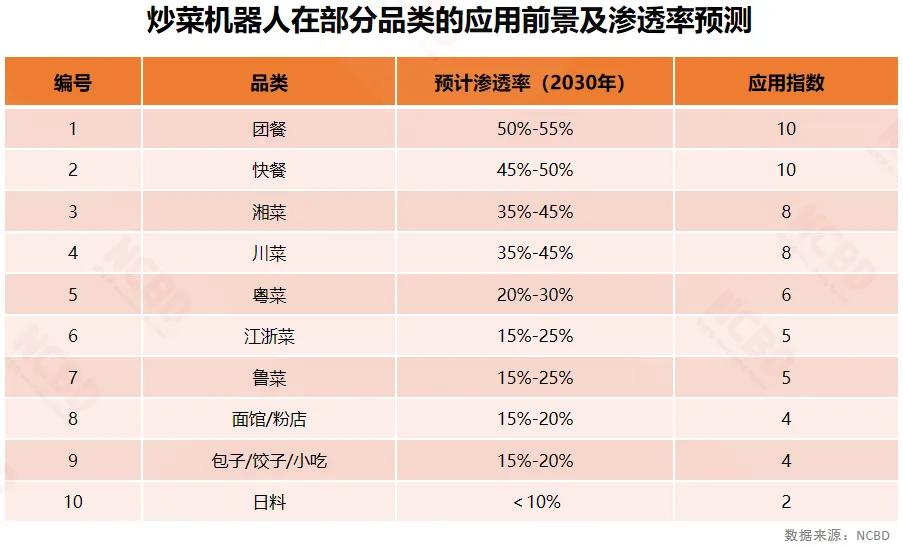
According to the research of NCBD (Catering Baodian), from the perspective of future application scenarios, stir - frying robots have greater potential in group meals, fast food, Hunan cuisine, and Sichuan cuisine; while in Japanese cuisine, high - end full - service restaurants, etc., the potential of stir - frying robots is relatively limited.
(1) Group meals. Group meals are characterized by a fixed number of diners and relatively standardized dishes, which are highly consistent with the advantages of stir - frying robots. In scenarios such as school, enterprise, and government canteens, the requirements for efficiency, cost, and food safety are extremely high. Robots can not only ensure large - scale food delivery but also control nutrition and health through precise ingredient input.
(2) Fast food. The market size of Chinese fast food is nearly one trillion yuan, but the pursuit of efficiency is extremely strict. Brands such as Dami Xiansheng and Laoxiangji have taken the lead in introducing stir - frying robots. Fast - food dishes are relatively fixed, and the cooking process is standardized, which is very suitable for robot operation.
(3) Hunan cuisine, Sichuan cuisine, and other categories that require high - heat stir - frying. Hunan and Sichuan cuisines emphasize the "wok flavor" and require high - temperature stir - frying. Stir - frying robots are exactly good at precisely controlling the heat and can achieve the effect of high - heat stir - frying. Some stores of Xiaocaiyuan (Anhui cuisine) have been using stir - frying robots since 2023, and the effect is remarkable.
Categories such as Japanese cuisine, which have extremely high requirements for delicate knife skills and the presentation of the original flavor of ingredients, and dishes in high - end full - service restaurants that require the creative play of the head chef are still not suitable to be replaced by robots at present.
5 What Will Happen to Chefs
Will stir - frying robots replace chefs? The answer is obviously no. However, the chef industry will definitely be affected and even impacted. The demand for chefs in basic positions will be greatly reduced, and those chefs who mainly engage in repetitive work and lack core skills will face the pressure of transformation.
Analysts from Catering Baodian believe that chefs have four "evolution" directions in the future:
First, dish R & D chefs. The recipes executed by robots need to be developed, debugged, and optimized by professional chefs. The experience and taste of chefs are transformed into the program parameters of robots. Chefs achieve "from 0 to 1", and robots achieve "from 1 to N". This requires chefs to have stronger data thinking and standardization capabilities.
Second, robot administrators. "Technical chefs" who understand how to operate, maintain, and debug robots will become a necessity. They no longer need to stir - fry with a wok but need to monitor the operation of the machines and handle abnormal situations.
Third, high - end custom chefs. In fields such as high - end full - service restaurants and private - dining cuisine that require creativity, artistry, and personalized services, machines are difficult to replace. Real "culinary masters" will become even rarer and more valuable.
Fourth, catering entrepreneurs. Stir - frying robots have lowered the threshold for catering entrepreneurship. One person and one machine can open a small "front - store, back - factory" shop. Chefs can start a business with lighter assets based on their understanding of dishes and the market.
As the district head of Pinggu in Beijing said, "Empowering the kitchen with artificial intelligence has greatly liberated people's hands." Chefs' hands are liberated, and they can invest more in creative work such as dish innovation, quality control, and cultural exploration. Stir - frying robots are not the enemies of chefs but their assistants.
6 Conclusion
In the future, the penetration rate of stir - frying robots in key categories will further increase. By combining stir - frying robots with on - site manual cooking, catering enterprises can create a more cost - effective store model and enhance the market competitiveness of their brands. For chefs, instead of worrying about being replaced, they should actively embrace the change and become the leaders of this "kitchen revolution".
In China, the stir - frying robot industry is about to experience explosive growth. As a representative of new - quality productivity, stir - frying robots will make great contributions to solving the structural pain points of the traditional catering industry and promoting the standardized inheritance and innovative development of Chinese food culture. In the new era of "human - robot co - cooking", the Chinese catering industry will have a more wonderful future.
This article is from the WeChat official account "Catering Baodian", written by the editorial department of Catering Baodian, and is published by 36Kr with authorization.