Make money from both traffic and sales. Chinese tech products dominate MWC.
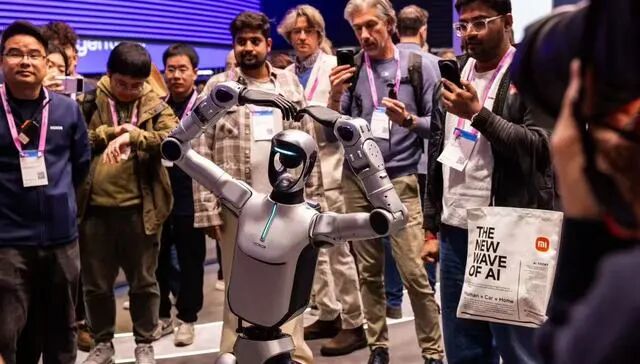
The Honor robot interacts with the audience (Image source: Honor)
From late February to early March every year is the liveliest time in Barcelona. More than 100,000 technology practitioners flock to the city from all over the world for the Mobile World Congress (MWC). This exhibition, known as the global communication industry's weather vane, has always been an excellent opportunity to compete for overseas orders.
Over the past 20 years, MWC has been dominated by mobile phone and communication equipment manufacturers. They always book all the airport and street advertisements in advance. However, more and more manufacturers have stepped into the spotlight this year. Besides mobile phones, robots, low-altitude aircraft, AI glasses, and various intelligent terminals have also joined the competition to seize the opportunity to expand overseas.
Interestingly, the vast majority of these eye-catching products are from China.
At this year's MWC, the booths of Chinese manufacturers represented by Huawei, Xiaomi, Honor, Lenovo, etc., are almost the "traffic magnets" on-site. Xiaomi's concept supercar Vision Gran Turismo, Honor's ROBOT PHONE, Unitree's boxing robot, and Alibaba's Qianwen glasses are among the most eye-catching products at this year's exhibition.
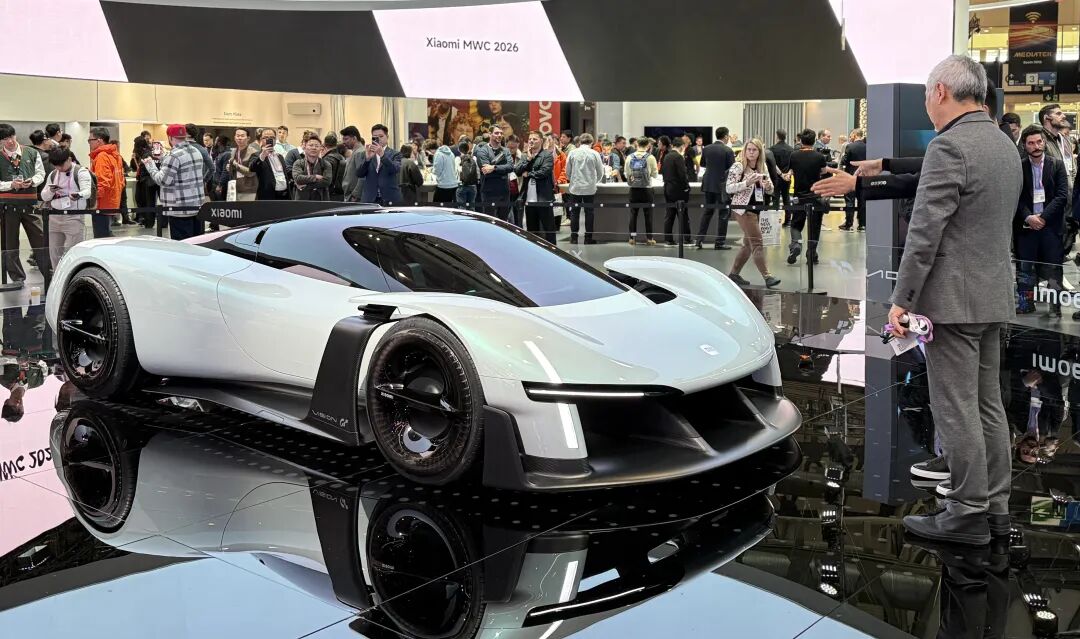
The Xiaomi GT Vision concept supercar is surrounded by onlookers (Image source: Jiemian News)
Different from Chinese companies that entered the European market in the past, today's Chinese companies no longer rely on specifications or cost - effectiveness to win. Instead, they use more creative ideas to conquer overseas customers, and AI provides them with great opportunities. "There are a lot of positive reviews from foreign users. We are now receiving countless cooperation requests from overseas manufacturers every day. We are simply swamped with work," a staff member at Alibaba's Qianwen booth told Jiemian News.
From price advantages to technological advantages, Chinese hardware manufacturers are trying to prove that an era of high - end overseas expansion for them is coming.
"We can't be the supporting roles of Apple and Samsung"
Every visitor entering the MWC venue will be impressed by the two huge posters at the entrance: one is for Huawei's Mate X7, and the other is for Xiaomi's 17 Ultra, representing the current high - end models promoted by these two top Chinese mobile phone manufacturers.
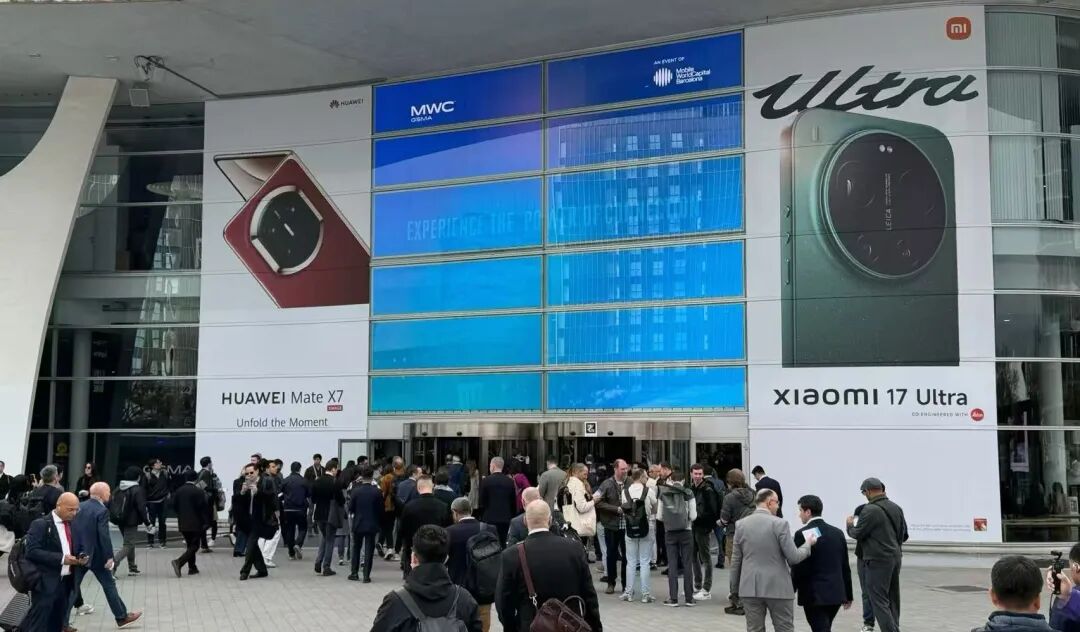
Posters of Huawei and Xiaomi outside the main exhibition hall (Image source: Jiemian News)
The stories these two companies want to tell are different.
As the world's largest communication equipment manufacturer, Huawei's highlights at this year's exhibition are the competition for 6G standards and the overseas debut of its super - node computing power products. In the terminal business, affected by sanctions, Huawei's mobile phones once faded out of the overseas market. The products with relatively high sales are wearables such as headphones and smartwatches, which have a lower dependence on the operating system.
However, the signal of Huawei's mobile phones returning to the overseas market is getting stronger. On the eve of this year's MWC, Huawei launched the Mate 80 Pro in Madrid, Spain, with a starting price of 1,299 euros (equivalent to about 10,510 yuan). This is also the first time in three years that Huawei's straight - flagship Mate series has returned to the overseas market.
According to Jiemian News, the overseas version of the Mate 80 Pro is equipped with a Kirin chip and EMUI 15 based on Android, and the HarmonyOS has not been installed yet. A Huawei booth staff member told Jiemian News: "We have made full preparations for the daily usage habits of overseas users. In addition, the HarmonyOS ecosystem is gradually maturing, and going overseas is an inevitable step for it in the future."
Xiaomi's strategy focuses more on using mobile phones as the core to drive other product categories and bringing its new retail strategy to Europe to establish its own position. Lu Weibing, the president of Xiaomi Group, said in an interview with Jiemian News that in the future product strategy, they need to adapt to the usage habits of local users and optimize the efficiency of product services (such as assembly).
Another urgent task for Xiaomi is to promote the overseas expansion of its cars according to the schedule starting in 2027. Considering the high - end brand effect brought by the car business in the domestic market, this will be a crucial battle in Xiaomi's brand overseas expansion.
Omdia data shows that in the European smartphone market in 2025, the top three were Samsung, Apple, and Xiaomi, with market shares of 35%, 27%, and 16% respectively. Honor entered the top five for the first time with its X series. In the global high - end market, the biggest winners are still Apple and Samsung. A Counterpoint report shows that in 2025, Apple's share in the global market for phones priced over $600 reached 62%, Samsung took 20%, and the shares of other manufacturers were all in single - digits.
A Honor channel source told Jiemian News that the high market shares of Apple and Samsung in the high - end market give them strong bargaining power in negotiations with operators and channel partners, and the profit margins they offer are quite tight. The entry of Chinese high - end mobile phones into the European market can, to some extent, increase the bargaining power of channel partners. On the other hand, Chinese manufacturers are more active in innovation in mobile phone form factors and AI functions, which also helps stimulate the replacement wave. This is why European partners are keen to cooperate with Chinese manufacturers.
At this year's MWC, there were many eye - catching innovations from Chinese mobile phone manufacturers: Honor's ROBOT PHONE combines a mobile phone, a gimbal camera, and an interactive robot; Transsion's magnetic interconnection concept phone allows users to replace device components at any time; vivo brought the "v - single" X300 Ultra equipped with a 400mm teleconverter; ZTE also exhibited the Doubao phone deeply integrated with the overseas application ecosystem.
The consensus among manufacturers is that mobile phones are the most important AI interaction entry point at present, and end - side models, Agent capabilities, and multi - modal interaction will also be important areas for future investment. Lu Weibing mentioned in the interview that Xiaomi's core strategy is to combine model capabilities with specific application scenarios. Its 1 billion - scale terminal volume, self - developed MiMo series of large models, and the ecosystem of vehicles, homes, and mobile devices are currently its most important assets.
"If we only try to enter the European market by giving more profit to the channels, we will definitely not be able to compete with others. We must have something new. We can't be the supporting roles of Apple and Samsung. Now every time we come to Europe, we are fully booked with dinners with channel partners. At least we can bring them some new possibilities," said the aforementioned Honor channel source.
All for orders
This year's MWC is not only about mobile phones. The Chinese robot legion composed of manufacturers such as Unitree, Zhipu Robotics, and Magic Atom has also become a new and eye - catching force.
In January this year, these three companies had just returned from the CES (Consumer Electronics Show) in Las Vegas, USA. Similar to CES, the interactive Chinese robots also attracted a large number of onlookers in Europe, standing in sharp contrast to the surrounding booths.
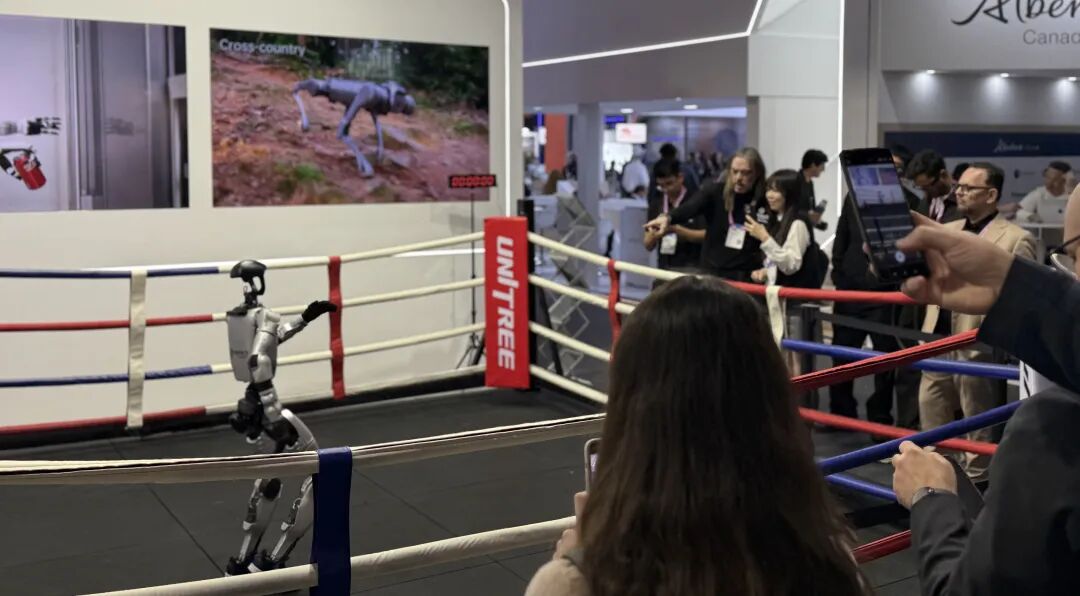
Unitree's robot performs Chinese martial arts (Image source: Jiemian News)
Unitree's robot boxing and martial arts performances still caused cheers throughout the venue; Zhipu Robotics exhibited a complete product series from dexterous hands to humanoid robots; Magic Atom brought full - size humanoid robots and quadruped robots for consumer and industrial scenarios. The common point of these manufacturers is that they emphasize that their products can not only perform but also adapt to different scenarios and achieve large - scale implementation quickly.
Zhipu Robotics has also opened an official independent website overseas, integrating product display, direct purchase, and leasing services. The starting price for leasing has dropped to 899 euros. Leasing is one of the services Zhipu is currently promoting vigorously, and its leasing service network covers 17 countries and regions around the world. After the rise of the embodied intelligent robot industry, Chinese manufacturers are particularly competitive in the global market, thanks to their manufacturing advantages and performance at the model level that can compete with the Western leading camp.
A on - site salesperson told Jiemian News that considering products, scenarios, and regions comprehensively, the company's general sales logic is that humanoid robots target the North American market, especially scientific research scenarios represented by university laboratories such as Stanford and Berkeley; the European market focuses on home services and elderly care; and the Southeast Asian market focuses on scenarios such as inspection and handling that can replace human labor.
The aforementioned salesperson said that after the company appeared on the Spring Festival Gala this year, the number of leads in the domestic business, whether from the government, cultural and tourism sectors, or the leasing sector, has skyrocketed. This has made the manufacturer more willing to invest in cooperation costs with various IPs.
The same goes for the revenue conversion of overseas exhibitions. Another employee of an embodied intelligent enterprise told Jiemian News that the team has a clear KPI for exhibitions like MWC. That is, the leads collected at the exhibition site need to go through the funnel from MQL (Marketing Qualified Leads) to SQL (Sales Qualified Leads) and finally be converted into actual orders.
"For example, how much was spent on this MWC, how many leads were obtained, and how many were converted. Finally, there will be a rough ROI (Return on Investment). It must be effective. The ROI of CES before was greater than 1," the employee said. The cost of participating in MWC is similar to that of CES. Excluding the material cost of the booth, the booth itself costs about 10,000 yuan per square meter.
Similar to the process of other global exhibitions, participating in MWC requires booking booths one year in advance. The aforementioned interviewee predicted that more Chinese robot manufacturers may participate in 2027.
"The domestic market is extremely competitive. Our top priority in 2026 is to compete for the overseas market," a robot exhibitor told Jiemian News.
The same logic also applies to AI glasses. The Qianwen glasses, which were just officially announced in China, made their global debut during this year's MWC. It is worth mentioning that the Qianwen booth is set up next to Meta, the current global leader in smart glasses, and there are even more people queuing up to experience Qianwen's products than Meta's. A on - site staff member told Jiemian News that Qianwen is preparing to build an overseas sales channel, and the overseas version will be launched within this year.
If Meta Ray - Ban focuses on content recording and social sharing, Qianwen emphasizes more on AI assistants and life services, which is its differentiating advantage. In terms of the overseas ecosystem, Qianwen AI glasses will be connected to services such as Spotify and Google Maps in the future, and functions such as music playback and map navigation will be integrated into the glasses.
MWC is a mirror
Chinese exhibitors have left too many "WOW Moments" for overseas audiences. However, after the amazement, the real and long - term test lies outside the exhibition hall.
The person - in - charge of a domestic AI glasses manufacturer told Jiemian News that his company has participated in several large - scale exhibitions such as CES, MWC, and IFA. At each exhibition, he has received many cooperation offers from overseas partners. In his view, Chinese AI glasses are backed by the world's best supply chain and are more innovative in concept, which is a "dimensionality reduction strike" against many products at the exhibition.
However, he soon discovered another reality. "Just because foreigners are amazed doesn't necessarily mean they will buy. The Chinese and overseas glasses markets are completely different. This may be the first lesson every manufacturer has to learn."
The most obvious difference is that foreigners wear glasses far less frequently than Chinese people. They prefer sunglasses. "Many of our framed glasses do not meet their daily usage habits. Even if we can make them into sunglasses, some functions designed for business scenarios, such as real - time translation, will be awkward to use while wearing sunglasses. The best solution is to design products that meet their needs for the overseas market, but with the current resources and energy of our startup, it is definitely not enough."
The market still needs to be educated. The aforementioned person - in - charge mentioned that many overseas manufacturers seeking cooperation do not understand AI glasses, and many of their requests cannot be met, such as using them for the blind. In addition, due to issues such as unresolved channel distribution and difficult - to - implement after - sales services, there are not many successful channel agency cooperation agreements.
This kind of experience is not an isolated case. The founder of a companion robot startup told Jiemian News that the company participated in MWC with large domestic enterprises last year. They received many on - site inquiries, but few actual orders were finalized. The core reason is that the companion robot products are quite homogeneous, and small companies lack bargaining chips in cooperation negotiations.
However, his attitude remains optimistic: "There is a saying that you need to participate in overseas exhibitions for three years to see results. We have only participated for one year. The market is still very broad, and going overseas is definitely a major trend. We have the ability to make the world's best hardware products, so why not sell them?"
Compared with mobile phones, the markets for humanoid robots, companion robots, and AI glasses are still niche markets in their infancy. The service process and after - sales experience are still being explored. "It's still difficult to say what a stable and effective overseas expansion path is because this industry is changing so fast. Basically, it changes every week or month. Maybe the strategy from last month will be ineffective this month."
A robot exhibitor also mentioned that the company is well aware that it is difficult to achieve large - scale sales in the overseas market quickly. However, at this stage, it will closely follow up on the after - sales service to ensure the initial service quality and reputation and is still willing to give sufficient time for growth. "From product standard certification and transportation regulations at the start to cultural differences and scenario penetration, the investment cycle in the robot industry is very long. It can't be as fast as the mobile Internet. We need to have this expectation."
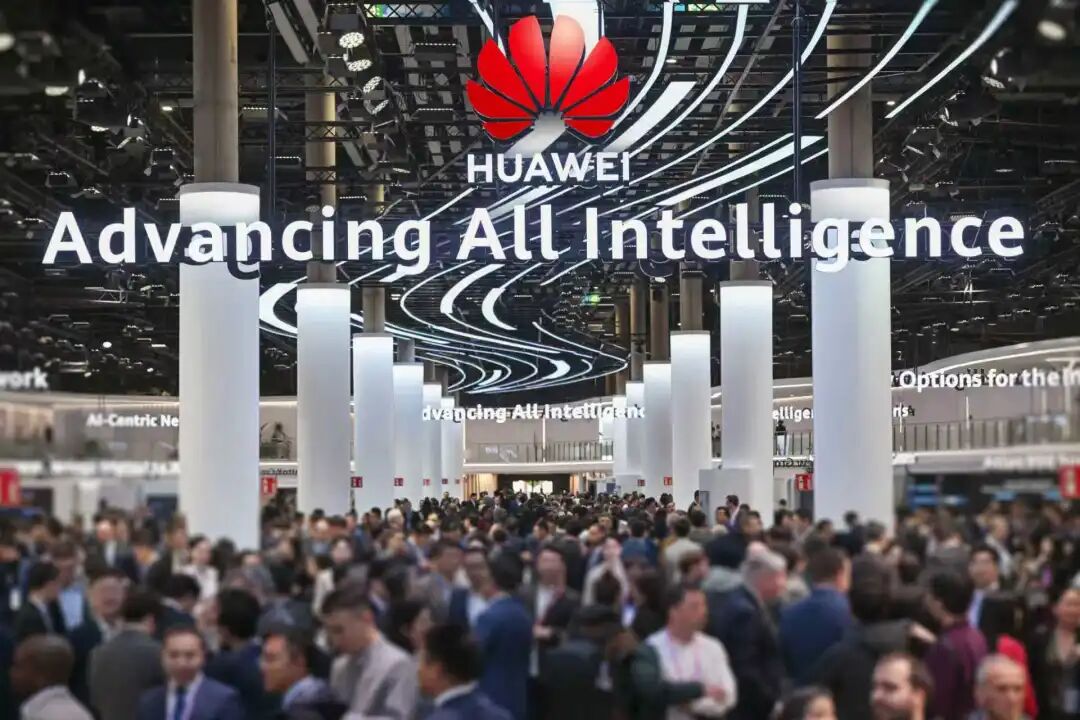
The Huawei booth is crowded with people (Image source: Huawei)
In the new narrative of globalization, Chinese hardware manufacturers have obtained the ticket to the future. However, to truly take root in unfamiliar lands, they need not only imagination but also the patience to resonate with the local market.
MWC is more like a mirror, reflecting the opportunities and gaps in the global market. Chinese manufacturers are undergoing the most stringent market tests here, and they are becoming more determined to expand overseas. They believe that the global journey of Chinese technology will not end in this spring in Barcelona.