Counting down 10 days! The call for submissions for the 2026 Best AI Scenario Penetration Cases is in full swing.
At the beginning of 2026, the AI field in China is extremely popular, and almost every few days there are blockbuster news flooding the screens.
Domestically, on the stage of the Spring Festival Gala in the Year of the Horse, four humanoid robot brands, Unitree Technology, Galaxy General, Magic Atom, and Songyan Power, made a collective appearance, covering multiple programs such as martial arts, songs, sketches, and micro - movies. With high - difficulty actions and immersive interactions, they demonstrated the accelerating process of China's AI moving from the laboratory to the public eye, becoming a landmark highlight of the "most AI - filled Spring Festival Gala in history".
Abroad, the CES exhibition has become a platform to showcase the strength of Chinese AI enterprises. Among the 38 booths in the humanoid robot exhibition area, Chinese enterprises occupy 21, accounting for more than half. More importantly, the robots exhibited this time are no longer just concepts but are aimed at actual application scenarios. Many products have achieved the continuous operation ability from autonomous route planning, item recognition to multi - step operations. The practicality of technology implementation has become the core competitiveness.
From the Spring Festival Gala stage to the international arena, China's AI is gradually moving towards in - depth industrial development. "Scenario application" has become the key criterion for testing the value of AI.
In January this year, 36Kr launched the selection of the 2026 AI Best Scenario Penetration Cases, aiming to discover those AI application benchmark cases that truly solve industry pain points, generate actual commercial value, and are replicable. Since the launch of the case collection, it has attracted many enterprises and institutions to apply, covering dozens of tracks such as intelligent manufacturing, content production, local life, finance and healthcare, and public services. High - quality cases continue to emerge.
This selection adopts a two - way application system. We not only welcome technology - enabling parties such as large models, AI Agents, and embodied intelligence to apply, but also encourage technology - practicing parties such as enterprises in various industries and public sectors to participate. Through the cross - verification of the perspectives of both supply and demand sides, the real effects and industrial value of AI technology in scenario implementation can be seen more clearly and objectively by the industry.

Super - strong jury lineup to assist the review from multiple dimensions
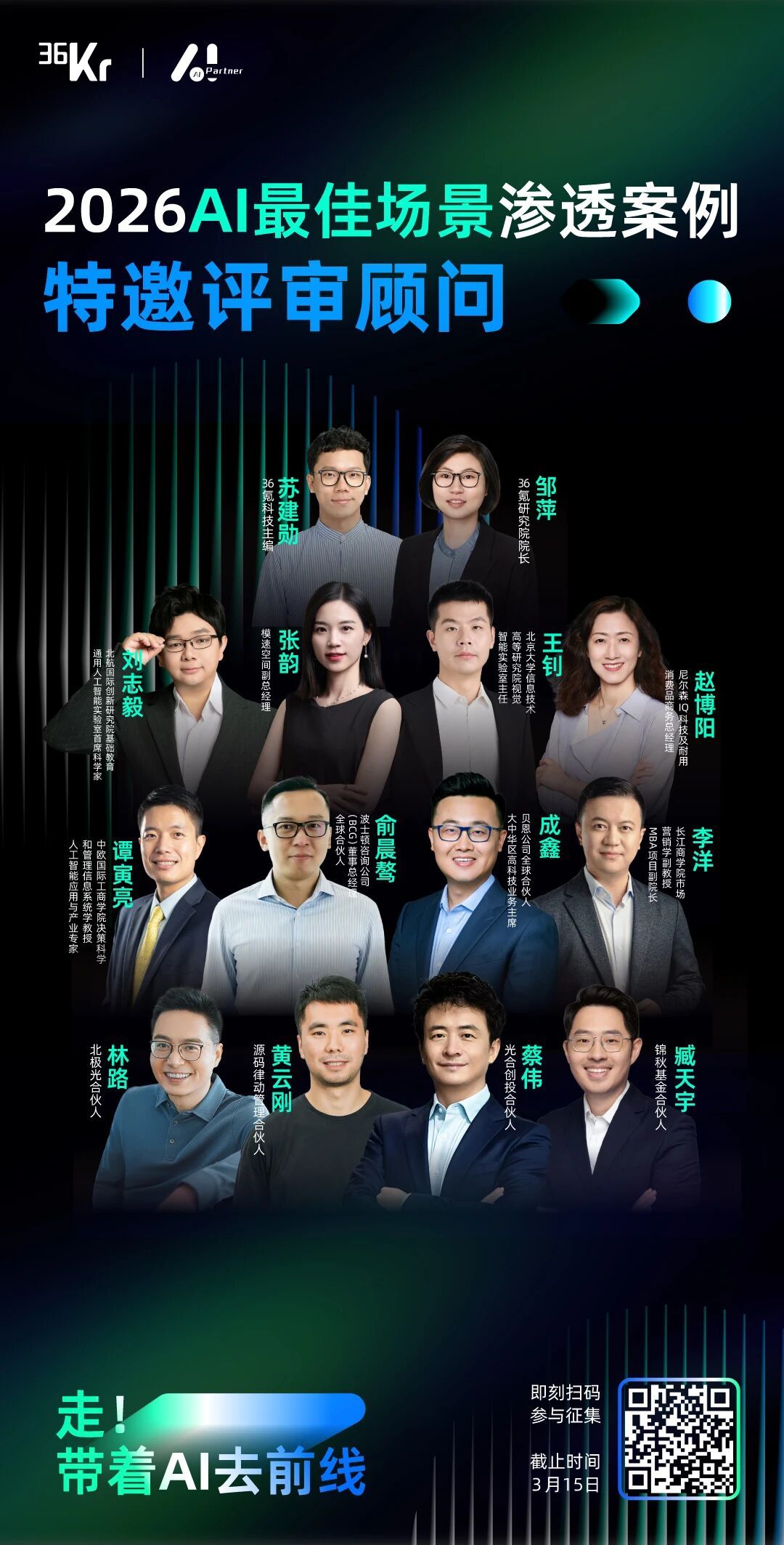
To ensure the professionalism and authority of the selection, we invited 14 senior industry experts, well - known investors, and professional analysts to form a super - strong jury. They will conduct a comprehensive evaluation from multiple dimensions such as scenario penetration, commercial value, technological innovation, and replicability to select the 2026 AI Best Scenario Penetration Cases.
The members of this jury include Huang Yungang, Managing Partner of Source Code Rhythm; Cai Wei, Partner of Photosynthetic Venture Capital; Lin Lu, Partner of Northern Light Venture Capital; Zang Tianyu, Partner of Jinqiu Fund; Cheng Xin, Global Partner of Bain & Company and Chairman of the High - tech Business in Greater China; Yu Chen'ao, Managing Director and Global Partner of Boston Consulting Group (BCG); Tan Yinliang, Professor of Decision Science and Management Information Systems at China Europe International Business School and Expert in AI Application and Industry; Li Yang, Associate Professor of Marketing at Cheung Kong Graduate School of Business and Deputy Dean of the MBA Program; Zhang Yun, Deputy General Manager of Modu Space; Wang Zhao, Director of the Visual Intelligence Laboratory at the Institute of Advanced Information Technology, Peking University; Liu Zhiyi, Chief Scientist of the General AI Laboratory for Basic Education at the International Innovation Institute of Beihang University; Zhao Boyang, General Manager of Technology and Durable Consumer Goods Business at Nielsen IQ; Su Jianxun, Science and Technology Editor of 36Kr; and Zou Ping, Dean of the 36Kr Research Institute.
Centering around the theme and evaluation dimensions of this selection, the judges shared valuable insights based on their own research and industry observations. Combining their views, 36Kr has also roughly outlined the key trends for the future implementation of AI scenarios, providing direction for the industry.
Insight 1: The difficulty of AI implementation lies not in technology but in the reconstruction of organizational and production relations
The biggest obstacle to the implementation of AI in enterprises no longer lies in the technology itself, but in the adaptation of processes, organizations, and decision - making mechanisms.
Liu Zhiyi, Chief Scientist of the General AI Laboratory for Basic Education at the International Innovation Institute of Beihang University pointed out that current enterprises face challenges in four aspects: technology, business, organization, and data. Large institutions are prone to fall into the "innovator's dilemma", while small and medium - sized institutions have "ability gaps". They need to break through the situation differently through methods such as shadow system testing and lightweight function slicing.
Zhang Yun, Deputy General Manager of Modu Space straightforwardly said that a large number of AI projects are stuck in the pilot stage and are difficult to scale up and replicate. The core reason is not that the model technology is not good, but that the business processes and organizational structures have not been adjusted synchronously. "AI implementation has never been a simple technological upgrade. It is more like a readjustment of production relations."
Insight 2: AI needs to enter the decision - making closed - loop rather than just being an auxiliary
To judge whether AI has truly achieved in - depth scenario penetration, there needs to be a clear and quantifiable core criterion. "Capable of execution, attributable, forming a closed - loop, and integrated into the system" has become the key standard for measuring the depth of AI implementation.
Professor Tan Yinliang of Decision Science and Management Information Systems at China Europe International Business School and Expert in AI Application and Industry believes that the sign of in - depth AI embedding is not "usability" but entering key decision - making and triggering actions, forming a closed - loop of data - decision - execution - feedback. He proposed four core indicators: entering key decision - making and triggering actions, forming a complete data - decision closed - loop, being able to attribute business indicators to units, and integrating into the system layer rather than being a surface - level tool. The "Agent content" in excellent cases will become the gold standard for measuring the depth of integration.
Zou Ping, Dean of the 36Kr Research Institute gave three judgment signals: First, whether the R & D and verification cycle can be shortened by an order of magnitude; second, whether the depth of human - machine collaboration and the overall efficiency are significantly improved; third, whether the quality of the final product or service has achieved a substantial leap. She said that the common feature of excellent cases is to deeply integrate the general capabilities of large models with profound industrial knowledge (Know - How) and complete vertical transformation for specific scenarios.
Insight 3: Agent and hardware - software collaboration will become the core engine in the next stage
The competition in large models is becoming more concentrated, and future value will shift to "system - level solutions and implementation in the physical world".
Wang Zhao, Director of the Visual Intelligence Laboratory at the Institute of Advanced Information Technology, Peking University judged that current model fine - tuning has become the basic ability of AI enterprises, and AI Agents are the core of commercial implementation. Multimodal technology will continue to expand the boundaries of human - machine interaction, and hardware - software collaboration will open up the implementation space of AI in the physical world. For new players in the industry, focusing on the fields of intelligent agents and hardware - software collaboration in the next 1 - 3 years will be the key direction for achieving differentiated competition.
Cheng Xin, Global Partner of Bain & Company and Chairman of the High - tech Business in Greater China believes that the core driving forces for AI scenario penetration will be concentrated in three aspects: Agent orchestration, multimodal data perception and execution, and standardization of hardware - software interface protocols. "The real technological breakthrough is not writing content but performing tasks." Extracting data quickly at the device end and making real - time decisions are of great significance to manufacturing, healthcare, and intelligent terminals.
Insight 4: The AI competition pattern is changing from marginal empowerment to core business takeover, and the gap between fast and slow is widening
AI is moving from solving marginal problems to "defining efficiency, rewriting costs, and reconstructing moats".
Li Yang, Associate Professor of Marketing at Cheung Kong Graduate School of Business and Deputy Dean of the MBA Program believes that in the next 1 - 2 years, the industry competition pattern will be reshaped at three levels: core product reconstruction, decision - making process transformation, and business model innovation. AI will be upgraded from an auxiliary tool to a decision - making subject, promoting the transfer of decision - making power to the AI operating system. It will also change from a process assistant to a creator of new value, giving birth to new business models. Currently, the general scenarios have become a red ocean, and the real blue ocean lies in fields with complex professional knowledge, data silos, and high costs. Among them, the prospects of R & D - type intelligent agents and the large - health field are particularly broad. Enterprises need to list AI implementation as a "top - leader project" and simultaneously improve their data, organizational, and ecological capabilities.
Zhao Boyang, General Manager of Technology and Durable Consumer Goods Business at Nielsen IQ summarized three industry changes driven by AI: First, the industry concentration is increasing. Leading enterprises with core AI capabilities will use AI to optimize the supply chain and improve innovation efficiency, further expanding their market share; second, the competition dimension is expanding, shifting from product and price competition to full - link competition driven by data + AI. The retail industry has shifted from competing in the number of stores to competing in AI - driven consumer insights and omnichannel operation efficiency; third, opportunities for new entrants are emerging. AI lowers the entry barriers for some industries, and start - up brands can use AI tools to accurately understand the market and locate niche demands, achieving overtaking on curves.
The following is the lineup of this jury:

10 - day countdown, sincerely invite your participation
In addition to the case selection, we have also set up three highlights:
Highlight 1: Special Tribute Award
We will establish a special award to pay tribute to those "lighthouse keepers" and "barrier breakers" who were brave enough to explore and invest in the early stage of AI application implementation, paving the way for the industry, and focus on the "people" and "spirit" behind the technology.
Highlight 2: Big Survey on Buyer Pain Points
We will conduct a survey on the users (buyers) of AI products participating in the application, sort out the real decision - making logic, implementation pain points, and value evaluation system of each industry in the process of introducing AI, and form an "AI demand market map" to help technology providers accurately empower the industry.
Highlight 3: Conjecture on Future AI Scenario Penetration
We will publicly collect from the public "the AI - deeply - transformed scenarios you most expect". Based on a large amount of feedback, we will outline the key industries and future scenarios that AI technology is about to transform, providing a reference for the industry's forward - looking layout.
Let valuable AI scenario applications be seen, let high - quality implementation practices become industry benchmarks, and let the value of technological innovation be fully released in real scenarios.
10 - day countdown! The registration channel will officially close on March 15. We sincerely invite you to actively participate!
Guide for applying for the "2026 AI Best Scenario Penetration Cases":

This article is from the WeChat official account "36Kr", and 36Kr is authorized to publish it.