Saying goodbye to price wars, car companies are playing the "financial card" with ultra-long 7-year loans.
In the domestic automobile market at the beginning of 2026, a new competitive situation is emerging. The direct price war that once dominated the market is gradually fading away. Low - interest car purchase plans with a term of 7 years or more, centered around "low down payment, low monthly payment, and long - term", have become the common choice of over 20 car manufacturers. From new energy upstarts like Tesla, Xiaomi, and Li Auto, to traditional domestic brands like BYD and Great Wall, and then to joint - venture brands like Dongfeng Nissan and GAC Honda, they have all joined the fray. Some brands have even extended the loan term to 8 years and reduced the down payment to 0 yuan, continuously lowering the threshold for car purchases.
This wave of ultra - long - term low - interest loans is not only a marketing adjustment by car manufacturers in response to the current market environment but also a signal that the automobile market is shifting from price competition to financial competition. For consumers with limited budgets and real - demand for cars, the low - threshold car purchase method does bring tangible convenience. However, consumers also need to comprehensively consider the differences in the plans, cost composition, and property rights rules behind this model based on their own situations. Against the backdrop of the regulatory authorities continuously standardizing the behavior of automobile financial services, how car manufacturers can ensure the compliance and transparency of their financial promotions and how consumers can understand the core logic of different plans have become the core issues worthy of attention in this wave of car - buying frenzy.
Car manufacturers' diversified layouts, with different focuses on low - interest plans
The industry trend of 7 - year low - interest car purchase was first initiated by Tesla in January 2026, and then quickly followed by the industry. As of late February, over 20 car brands have launched relevant plans. Car manufacturers from different camps have designed significantly different plan rules based on their brand positioning and market strategies. They have different focuses on aspects such as down - payment ratio, annualized interest rate, loan model, and additional conditions, which also requires consumers to carefully distinguish the differences when faced with a plethora of promotional information.
In the camp of new energy upstarts, the plan design shows obvious differentiation characteristics. Some brands focus on transparency and low interest rates, while others attract consumers with a low - threshold approach.
Tesla's 7 - year low - interest plan adopts the bank mortgage loan model, with a down payment starting from 15% and an annualized interest rate as low as 0.5%, equivalent to an annualized interest rate of about 0.98%. The most core feature is that the vehicle property rights belong to the consumer from the moment of vehicle pick - up, which also makes its plan relatively more transparent; NIO has launched an even lower annualized interest rate of 0.49% in the industry, and at the same time, it clearly promises not to charge financial service fees. Consumers do not need to pay a penalty if they need to prepay the loan, further reducing the additional costs of car purchase.
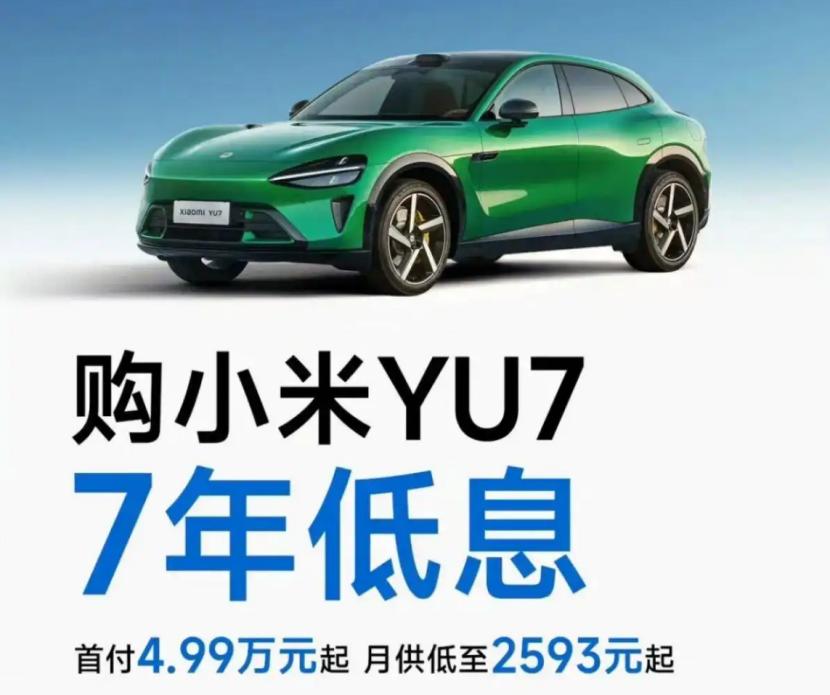
New upstart brands such as Xiaomi, XPeng, and Li Auto focus on lowering the car - purchase threshold. The down payment also starts from a minimum of 15%, and the annualized interest rate is between 1% - 2.5%. However, these plans generally have additional conditions such as qualification review and vehicle model restrictions.
Traditional domestic brands have followed the trend and intensified their efforts with flexible plan designs to meet the needs of different consumer groups. BYD operates its 7 - year low - interest plan through its own financial leasing company. The vehicle property rights rules are similar to those of leading new upstarts like Tesla, allowing consumers to clearly determine the property rights at the beginning of car purchase and reducing potential disputes in the future; IM Motors has launched a relatively radical plan in the industry. The combination of "7 - year 0 down payment + 0 interest in the first 3 years" almost eliminates the upfront financial pressure of car purchase. However, this plan also has more additional constraints. It not only has more detailed requirements for consumers' creditworthiness but also makes relevant regulations on vehicle use and maintenance. Consumers need to meet all the conditions to enjoy the corresponding financial benefits.

Joint - venture brands choose to promote with an ultra - long loan term as the selling point. Dongfeng Nissan was the first to extend the loan term from 7 years to 8 years, supporting 0 down - payment car purchase, and also highlighting the slogan of "low daily payment". Dongfeng Nissan proposed that all vehicle models in the series can enjoy 96 - installment payment, with a daily payment as low as 27 yuan. Such a statement allows consumers to intuitively feel the reduction of the repayment pressure. However, the annualized interest rate of such plans is relatively high, up to 4.88%. Behind the seemingly affordable low daily payment is the increase in the total interest cost brought by the longer term.
This time - limited promotion method can indeed help car manufacturers quickly boost orders and relieve the current high inventory pressure, but it also makes some consumers make car - buying decisions without fully understanding the information. However, it is also worth noting that Cheshi Ruijian conducted actual calculations using two hot - selling models in the market, and the differences are significant.
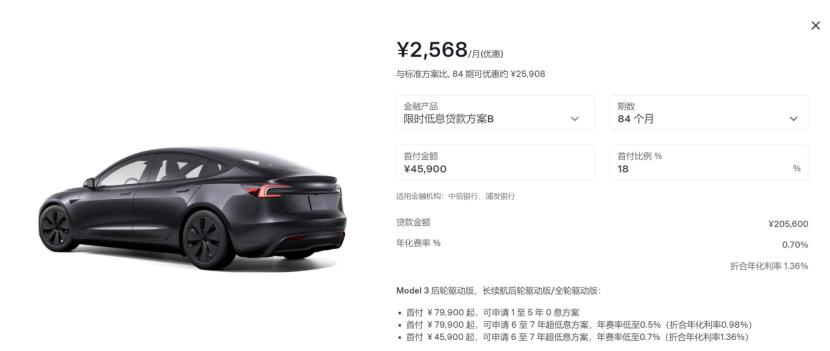
Taking the Tesla Model 3 Rear - Wheel Drive version as an example, its official guide price is 259,500 yuan. According to Tesla's 7 - year low - interest plan, with a 18% down payment, the loan amount is 205,600 yuan, the annualized interest rate is 0.7%, and using the equal - principal - and - interest repayment method, the monthly payment for 84 installments over 7 years is about 2,568 yuan, and the total interest expenditure is about 10,032 yuan.
The official guide price of the Dongfeng Nissan Teana Harmony Cockpit Comfort version is 129,900 yuan. According to its 8 - year 0 down - payment low - interest plan, the loan amount is 129,900 yuan, the annualized interest rate is 4.88%, and with equal - principal - and - interest repayment over 96 installments, the monthly payment is about 1,650 yuan, and the total interest expenditure is about 27,386 yuan. From the calculation results, it can be clearly seen that the ultra - long term and 0 down payment of joint - venture brands bring a much higher total interest cost than new energy brands, and the actual car - buying expenses of consumers vary significantly.
The core logic of 7 - year low - interest plans: model and cost
The core differences in 7 - year low - interest car purchase plans are not only reflected in the down payment and interest rate but also hidden in the loan model and the composition of the actual cost, which is also the part that ordinary consumers tend to ignore. Currently, the ultra - long - term loan plans in the market are mainly divided into two categories: bank mortgage loans and financial leasing. More than 90% of car manufacturers have chosen the financial leasing model, and only a few brands like Tesla use the bank mortgage loan. There are essential differences in property rights ownership, usage rights, and subsequent disposal between the two models, which directly affect consumers' car - buying experience and asset rights.
The rules of the bank mortgage loan model are relatively simple. After consumers pay the down payment, they apply for a loan from the bank to buy a car. The vehicle is registered in the consumer's name, and only the vehicle is mortgaged to the bank as repayment guarantee. The property rights belong to the individual from the moment of vehicle pick - up. In this model, consumers have full use rights of the vehicle. They only need to repay the monthly payment on time during the repayment period and go through the vehicle release procedure after repaying the loan. Even if there is a repayment overdue in the future, the bank needs to go through legal procedures to dispose of the vehicle, and consumers' relevant rights are clearly protected by law.
The financial leasing model is commonly understood as "rent - to - own". During the lease period, the ownership of the vehicle belongs to the leasing company, and consumers only have the right to use the vehicle. Although they also make monthly payments, simply put, users sign a long - term lease contract instead of a loan contract. During the 7 - year repayment period, consumers are just renting the car, not the owners. In this model, consumers' vehicle use is subject to certain restrictions. Some plans also require the vehicle to be maintained at a designated store, and the resale value of vehicles under the financial leasing model is 5% - 10% lower than that of vehicles purchased with a regular loan. If consumers need to change cars in the future, the disposal income of the vehicle will be affected.
In addition to the differences in the loan model, the actual cost of the 7 - year low - interest plan is not just the apparent interest expenditure. The additional fees and prepayment rules in some plans will also change the actual car - buying cost. Although some brands have clearly canceled the financial service fee, under the financial leasing model, many car manufacturers require consumers to compulsorily bind in - store insurance, and the insurance types and premium standards are all set by the store. Consumers cannot independently choose a more cost - effective insurance plan. At the same time, some plans will charge a prepayment penalty, and this additional expenditure will become a hidden car - buying cost.
Taking new energy vehicles as an example, according to the current iteration speed of intelligent electric vehicles, 7 years is enough for technological generational changes. Once technologies such as solid - state batteries and high - level intelligent driving are widely implemented, the residual value of existing models may drop sharply. After three or four years, when the market price of the vehicle is already lower than the loan balance, it will be very embarrassing to change cars.
The reason why car manufacturers are flocking to launch 7 - year low - interest car purchase plans is essentially an inevitable choice to cope with the current market environment. Previously, the regulatory authorities stopped the disorderly price war in the automobile industry. Direct price cuts not only cause dissatisfaction among old car owners but also lead to a decline in vehicle residual value and put great operating pressure on dealers. The ultra - long - term low - interest loan method has become an effective means for car manufacturers to boost orders in a compliant manner. Some experts say that the interest - subsidy cost of car manufacturers will most likely be passed on to consumers through hidden fees, compressed configurations, or service quality, which is also the reason why some plans seem to have low interest rates but the actual total expenditure is not low.
However, this new model of financial competition is not in a regulatory blind spot. In December 2025, the State Administration for Market Regulation issued the "Compliance Guidelines for Price Behaviors in the Automobile Industry (Draft for Comment)", emphasizing the need to standardize price behaviors in automobile sales, financial services, and other links, clarifying the relevant rules for marked - price pricing, and requiring car manufacturers to clearly publicize all information related to car - buying costs, such as loan interest rates, repayment methods, and additional conditions, without deliberately obscuring or vaguely expressing them.
Cui Dongshu, the secretary - general of the Passenger Car Association, also said previously that the shift from "price competition" to "financial competition" in the automobile market is an inevitable trend in the industry's development. However, this competition must be based on compliance and transparency. If car manufacturers have problems such as unclear statements, obscured additional conditions, and cost transfer, they will also cross the compliance red line and be punished by relevant departments. Currently, some regulatory measures have been implemented to urge car manufacturers to standardize their financial promotion behaviors, enabling consumers to have a clearer understanding of the real situation of different plans.
Image sources: Tesla, Xiaomi Auto, BYD
This article is from the WeChat official account "Cheshi Ruijian", author: Yang Shuo. Republished by 36Kr with permission.