AI in defense: An underestimated new trend
Recently, the controversy surrounding "AI's involvement in beheading operations" has been making a lot of noise.
However, from an investment perspective, what's more worthy of attention is not the political conflict itself, but a trend it reveals - AI in defense is becoming a core track for AI applications.
In the past, the core players in the US military - industrial system were traditional giants like Lockheed, Boeing, and Raytheon. Their business model is very clear: adding a markup to the cost and selling hardware.
The more complex the project, the longer the cycle, and the higher the budget, the more stable the profit margin. In essence, this is an industrial system centered around heavy - asset manufacturing and based on long - term contracts.
But AI in the military industry is changing this logic.
The new - generation companies represented by Anduril Industries propose the idea of defining weapon systems with software. The core is no longer the platform itself, but algorithms, system integration, and continuous upgrading capabilities.
If the profit of traditional military industry comes from "project scale", then the profit of AI military industry comes from "system efficiency" and "continuous iteration".
This implies two changes:
First, the revenue structure is more technology - oriented. The revenue model is shifting from one - time delivery to a long - term contract structure of "platform subscription + integration and operation and maintenance + continuous upgrading", with a stronger technological attribute.
Second, the valuation logic may shift. As the core assets shift from platform hardware to "software platform + system integration", the pricing framework of the market for some leading companies is moving from the contract manufacturing logic of traditional military industry to the platform and growth logic of technology companies.
A representative company is Palantir. In fiscal year 2025, its operating income was approximately $4.475 billion, a year - on - year increase of 56%; the net profit was approximately $1.625 billion, a year - on - year increase of more than 250%, and the dynamic price - earnings ratio even exceeded 200 times.
Today, starting from the investment logic, let's talk about this opportunity that is rarely discussed but worthy of continuous tracking in the AI era - AI in defense.
AI Pushes Information - based Warfare to the Extreme
Before Anthropic, Palantir was the one that pushed AI to the frontline of war.
Palantir's business is quite simple. It is a consulting company similar to McKinsey and Accenture, providing IT consulting and AI solutions to companies in various industries. However, what's special is that half of its revenue comes from the government and the military.
Palantir's main role in the military is data analysis and decision - making.
One of the representative products of data analysis is Palantir Gotham.
The function of Gotham is to integrate satellite images, surveillance footage, bank statements, and call records, and piece together seemingly unrelated information into a relationship network. Through Gotham, the decision - making efficiency of commanders will be greatly improved.
Before the killing of Osama bin Laden, intelligence officers screened out the key "messenger" by constructing a relationship network and then locked in the abnormal compound in Abbottabad. In essence, that set of capabilities is data mapping and anomaly recognition.
Today, on the battlefield in Ukraine, Gotham is also used for battlefield target positioning and strike support.
The general process is that the commander inputs the target coordinates on the computer, then the algorithm automatically calculates the firing direction and the distance to the target, and assigns the task to the weapon with the optimal cost - performance ratio. After the operation, Gotham will also feed back the results to the algorithm for iteration.
Don't underestimate this.
After the Gulf War, the US military put forward the concept of "information - based warfare". In essence, it is to shift the core variable of war from "firepower scale" to "information processing speed".
Since then, war is no longer just a physical confrontation, but a competition in cognitive and decision - making efficiency.
In addition to data processing, AI is also deeply involved in the ever - changing battlefield decision - making. A typical representative product is Palantir's artificial intelligence decision - making platform AIP.
Two years ago, Palantir publicly demonstrated the application of AIP in military scenarios. In this case, a military operator responsible for monitoring the situation in Eastern Europe received a vague alarm - there was a suspected enemy assembly 30 kilometers away.
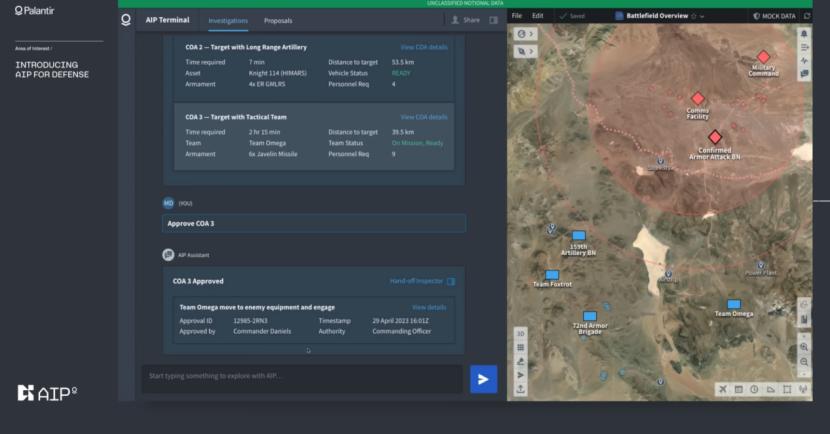
To better understand the real situation, AIP automatically pulled out information on all military units in the area and dispatched an MQ - 9 drone to obtain 1 - meter resolution images. Finally, the drone footage showed an enemy T - 80 main battle tank.
Subsequently, the AI system integrated variables such as the distance between the enemy and us, the scale of troops, the supply status, and potential collateral damage, generated three action plans, and highlighted key decision - making information for each plan, such as the required time and supply status, to assist in decision - making.
When the human commander approved the third plan, the system automatically planned the marching route, checked the ammunition reserve, allocated electronic jamming resources, and generated a complete combat plan. The whole process only took a few minutes.
From an investment perspective, AI's deep involvement in war decision - making brings two structural changes.
First, efficiency becomes a quantifiable competitive advantage.
From intelligence screening to resource allocation, the decision - making process is compressed, standardized, and modeled. The improvement in efficiency is directly translated into a tactical advantage.
When efficiency can be optimized by software, the system capabilities have long - term iteration space.
Second, technology companies are starting to become participants in the rules.
As more and more decisions are generated by algorithms, the designers and maintainers of algorithms are actually involved in defining the decision - making structure. This is why the conflict between Trump and Anthropic is not only a political game, but also a game about algorithm boundaries and discourse power.
The Logic Behind the Doubling of Financing
After talking about the implementation of AI, let's take a look at the attitude of investors towards AI in defense.
A fact that is rarely discussed directly is that defense is becoming one of the core tracks for AI applications.
Capital is the most sensitive. According to PitchBook data, the venture capital transaction volume in the defense technology field soared to a record $49.1 billion last year, up from $27.2 billion in the previous year, almost doubling.
According to CB Insights data, the equity financing of defense technology startups more than doubled last year, increasing from $7.3 billion in 2024 to $17.9 billion, mainly due to the increase in the financing of artificial intelligence startups.
What's more thought - provoking is the change in investors' attitudes.
In 2025, the number of institutions actively participating in defense technology investment increased by 41%.
Some mainstream VCs that previously avoided military industry investment for "ethical reasons" have begun to re - define it as a necessary investment to "support democratic values".
We all know that money doesn't flow into a track for no reason. The reason for so much money pouring in is simple: someone is paying for AI in defense.
And the payer is the Pentagon.
In fiscal year 2026, the Pentagon for the first time set up an independent budget line of $13.4 billion for AI and autonomous systems. This is the largest single - year AI investment in US defense history. Among them, $9.4 billion is for aerial drones, accounting for 70%.
That is to say, the air superiority in future wars is shifting to algorithm - driven unmanned systems.
In the primary market, some representative companies have emerged.
One of the more well - known ones is Shield AI. Shield AI is a defense AI autonomous system company founded in 2015 by a former Navy SEAL member, with a latest valuation of $5.3 billion.
Its core product, Hivemind, enables drones to fly autonomously in a combat environment without GPS and communication links. In June 2025, the X - 62A equipped with Hivemind participated in an air combat exercise as an AI - controlled entity and completed offensive and defensive maneuvers against a manned F - 16.
Its business model mainly consists of defense contracts, hardware sales, and software licensing. It charges for system delivery and software licensing from the US Department of Defense, allied forces, and aviation OEMs. In 2025, it won a large - scale contract from the US military. The V - BAT was deployed in the Indo - Pacific and Europe, and Hivemind was licensed to manufacturers such as Airbus and Kratos.
In 2025, its revenue was $267 million, a year - on - year increase of 64%, and the target for 2026 is $400 million.
Another AI defense company, Anduril Industries, is said to have a valuation of over $60 billion.
This company was founded by Palmer Luckey, the founder of Oculus.
Its core product, Lattice OS, is an AI - driven battlefield operating system that integrates data from drones, sensors, and radars, automatically identifies threats, and recommends response plans.
It is reported that Anduril generated approximately $1 billion in sales in 2024, and it is expected to double to approximately $2 billion last year.
Not only in the air, but also the development of autonomous maritime systems is accelerating.
Saronic, an unmanned surface vessel company in Texas, completed a $600 million Series C financing last year, with a valuation of $4 billion. In December 2025, it won a $392 million production contract for the Corsair autonomous vessel from the US Navy.
It is said that Saronic is now seeking a new round of $1.5 billion financing at a valuation of $7.5 billion.
Europe is also replicating this path.
Helsing, known as the "European version of Palantir", was founded in 2021. Its core product is battlefield AI software, focusing on the digitalization of defense for NATO allies in Europe.
The boom in AI in defense has also spread to the secondary market.
The stock price of AeroVironment (AVAV), the leading US small - scale unmanned aerial system company, has risen by approximately 90% in the past 12 months. In 2025, the company acquired BlueHalo for approximately $4.1 billion to strengthen its layout in the field of AI - driven anti - drone and autonomous systems.
The investor market is betting on a trend: the production function of war is changing.
If the war in the industrial era was a competition of steel and population, then the war in the digital era is a competition of model quality, data integration ability, and the speed of deduction and response.
The significance of the "Epic Fury" operation is not just a political event. It is more like a real - combat verification in a high - intensity scenario.
When algorithms truly enter the kill chain, investors see not the conflict itself, but the proven value of the system. It is no coincidence that Palantir's stock price rose by more than 5% on a single day after the operation.
War is being software - enabled, and software can be priced.
This article is from the WeChat official account "Silicon - based Observation Pro", author: Lin Bai. Republished by 36Kr with permission.