Once the king of floor-cleaning robots, why has it been hit hard by new players?
In the era of large models and amidst fierce stock competition, established players in the floor-cleaning robot industry may no longer be able to rest easy.
By the end of 2025, iRobot, the pioneer of the household floor-cleaning robot category and once holding over 80% of the global market share at its peak, officially filed for bankruptcy protection. This giant, which had dominated the industry for over three decades, finally fell under the impact of new forces.
A similar story is unfolding in the domestic market.
Ecovacs expects its net profit attributable to shareholders in 2025 to double year-on-year, and Roborock's annual revenue increased by over 50%. Behind the seemingly prosperous performance, there are hidden competitions and power struggles within the industry.
According to "Yidu Pro", the cross - border attacks of new forces and the technological equalization brought by large AI models are rapidly eroding the once - insurmountable industry barriers. The battle for the throne in the floor - cleaning robot industry has entered a new stage.
Ultimately, the real competition among all major forces will be the integration of household data and the capabilities of robots.
Positive Performance Fails to Conceal the Anxiety of Traditional Players
The seemingly impressive performance data has not brought enough security to traditional leading players. The reconstruction of product definitions and the changing market landscape are constantly eroding their first - mover advantages accumulated over the years.
Ecovacs' 2025 performance forecast shows that its annual net profit attributable to shareholders is expected to reach 1.7 billion to 1.8 billion yuan, a year - on - year increase of 110.90% to 123.30%.
Roborock's performance report for the same period shows that its annual total operating revenue was 18.616 billion yuan, a year - on - year increase of 55.85%. The performance growth rates of these two industry leaders far exceed the 18.7% increase in the overall industry's shipment volume.
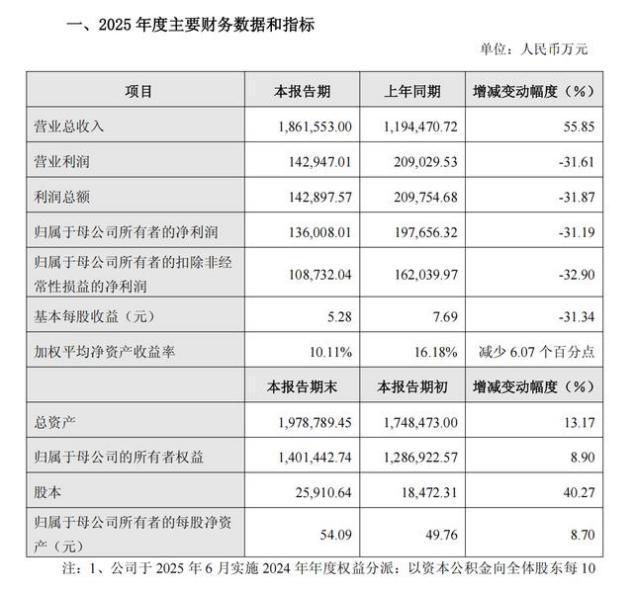
However, beneath the prosperity, "Yidu Pro" has observed that some concerns are beginning to surface.
On the one hand, Ecovacs' performance has been "recovering" for two consecutive years, but its profit growth rate lags behind its peers. On the other hand, while Roborock's revenue has shown significant growth, its net profit attributable to shareholders has declined by 31.19% year - on - year. Behind the increase in revenue but not in profit, in addition to the product iteration and supply - chain factors claimed by the company, the intensifying industry competition cannot be ruled out as an influencing factor.
The most prominent features are the changes in the product competition logic brought by new technologies and the rapid evolution of the new market landscape.
Mr. Zhu, who has years of experience in the hardware industry, said, "In the past decade, the core of competition in the floor - cleaning robot industry was relatively straightforward. Companies competed around hardware parameters such as battery life, navigation accuracy, and cleaning coverage. Lidar, SLAM algorithms, and motor performance were the core moats built by leading enterprises. However, with the rapid popularization of large AI models, this competition logic has been gradually changing."
He further pointed out that large models have endowed robots with the ability to understand natural language and make autonomous decisions in different scenarios. What users need is no longer just a tool that can clean the floor along a set route, but a household assistant that can understand instructions, perceive the environment, and actively solve problems.
Therefore, consumer electronics manufacturers and supply - chain enterprises have started to use AI to reinvent their products, which is commonly referred to as "+AI" in the industry. Meanwhile, the mature supply - chain system in the Pearl River Delta has significantly lowered the procurement threshold for core hardware such as motors and sensors. New players can quickly launch products that meet mainstream demands without having to accumulate technology from scratch. The technological barriers that used to take years to build can now be caught up within a few months with the support of large models and a mature supply chain.
This forces traditional players to focus on new technologies and products to achieve rapid market breakthroughs. As the key revenue - generating cleaning business can directly affect their financial reports, when the manufacturers' performance shows some bright spots, there will be varying degrees of pressure on either the revenue or profit side.
Subsequently, the market landscape has also changed significantly in recent years, with new - force players catching up rapidly.
In the domestic market, according to data from Lotu Technology, Ecovacs' online sales volume share was 30.4% in 2025. Although it still ranked first, the second - tier players caught up much faster than expected. According to data from Aowei Cloud Network in the first half of 2025, Xiaomi's online market share reached 16.83%, and Dreame's reached 11.72%. The combined share of the two is already close to Roborock's 23.69%.
The changes in the global market are even more obvious. According to IDC data, in the first three quarters of 2025, Roborock ranked first globally with a 21.7% share, and Ecovacs ranked second with 14.1%. However, Dreame and Xiaomi, which entered the market later, followed closely with shares of 12.4% and 10% respectively.
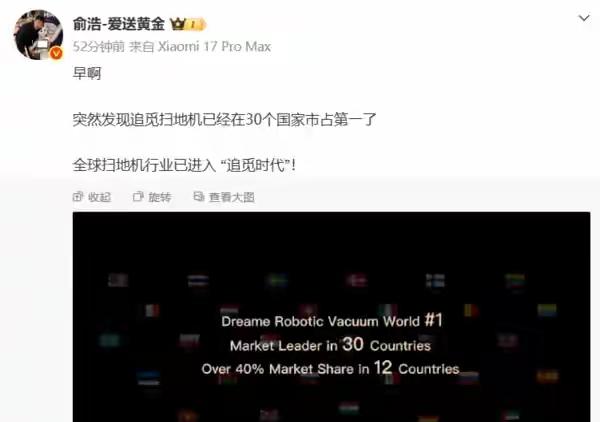
In particular, Dreame's market share increased by nearly 5 percentage points compared with the same period last year, while Ecovacs' share increase was less than 1%.
Notably, Dreame ranked first in the European market, with a 26.8% market share in Western Europe, breaking the monopoly of traditional leading brands in the overseas high - end market.

Further analysis reveals that the performance growth is more of a dividend from the overall expansion of industry demand rather than the strengthening of the traditional players' moats. Considering that the core of competition has shifted from hardware parameters to intelligent interaction and from single products to scenario - based ecosystems, the first - mover advantages of traditional players are being rapidly diluted.
Even players with decades of experience in the floor - cleaning robot industry cannot rely on past achievements to rest easy.
New Forces Disrupt the Market, and Home Cleaning Enters an Era of Comprehensive Competition
Some new forces in the smart home appliance market seem not only to be vying for a share of the floor - cleaning robot market but also to be trying to reshape the rules of the entire home cleaning industry. With their ecological advantages and rapid technology iteration, they have pushed the industry competition to a new level.
The core competitiveness of new forces first comes from the cross - industry reuse of underlying technologies. For example, Dreame started with high - speed digital motors. This core technology can be applied not only to floor - cleaning robots but also to various product categories such as floor scrubbers, hair dryers, and vacuum cleaners, forming a cost advantage through technology reuse.
In terms of product definition, Dreame has fully integrated the entire technology chain into its products. The dual - robotic - arm floor - cleaning robot it launched can not only clean the floor but also pick up debris and organize furniture, expanding the product's capabilities from two - dimensional floor cleaning to three - dimensional space.
Xiaomi, relying on its mature ecosystem, has incorporated floor - cleaning robots into the smart home scenario. Users can achieve device linkage through the Mi Home APP. For example, the cleaning device can be automatically started when the door opens, and the whole - house cleaning can be automatically initiated when no one is detected at home. This advantage of ecological linkage is difficult for traditional single - category players to match.
In terms of product strategy, traditional players' product layouts were more focused on floor - cleaning robots in the past, and new product iterations mainly involved upgrades in parameters such as suction power and obstacle avoidance.
In contrast, new forces have targeted the entire home - cleaning scenario from the start. Some of their product portfolios cover multiple categories such as floor - cleaning robots, floor scrubbers, and kitchen small appliances, achieving full - price - range and full - scenario coverage.
The benefits of a full - category layout are twofold. Firstly, it can spread out R & D and supply - chain costs. Secondly, it can easily build user loyalty. For example, a user who has purchased a Xiaomi TV and refrigerator is more likely to choose a Xiaomi floor - cleaning robot.
The characteristics of new players in the cleaning market are very distinct. Like new car - making forces, they have excellent product innovation capabilities, are good at expanding in the product and market, and are also good at telling stories to capital and users.
Considering that brands like Xiaomi also have strong R & D resources, a large user base, and a large number of physical stores, they have surpassed traditional giants in the air - conditioner category. In the future, the same situation may occur in the floor - cleaning robot category.
Looking back, the competition in home cleaning has shifted from a functional competition of "whether the floor can be cleaned" to an ecological competition of "whether the full - scenario household chores can be solved." The underlying competition has also become a PK of the comprehensive strength of different manufacturers.
The entry of new forces has accelerated the technological equalization in the industry, putting brand competition and R & D ability comparison on the table. According to "Yidu Pro", although the current leading players in the floor - cleaning robot industry are still dominated by established manufacturers, the rankings are likely to change significantly in a few years. Some old manufacturers may become more and more passive in the new competition.
Home - service Robots Reach a New Turning Point, and Scenario Data Becomes the Key
Looking at the industry as a whole, the competition among manufacturers in recent years around floor - cleaning robots indicates that floor - cleaning robots are actually just the starting point for home - service robots. The entire industry has now reached a crucial turning point in the transformation from "cleaning tools" to "home butlers." Both traditional players and new forces are standing on a new starting line.
In other words, simply betting on floor - cleaning robots in the robot market can no longer support the long - term growth of enterprises, and it is also out of step with the explosive development of technology.
Users need a complete home - service solution rather than multiple scattered home appliances. Nowadays, leading players are rapidly expanding their product boundaries. Ecovacs has extended from floor - cleaning robots to floor scrubbers, air purifiers, and industrial robots, gradually moving towards embodied intelligence.
Roborock has launched washing machines and lawn - mowing robots, expanding its cleaning capabilities from indoor home environments to outdoor courtyard scenarios.
Dreame has even built a full - category product matrix covering cleaning, personal care, and large home appliances. It has also introduced an AI dual - scraping and washing robotic arm for the first time, which consists of a "flexible forearm" and a "rigid upper arm." The forearm scrapes off water stains and dirt in corners along the edges, while the upper arm removes stubborn stains by applying pressure. Combined with the embodied - intelligence algorithm, the machine can "see" dirt on the floor like a human and make action choices, thereby achieving full - scenario penetration in home services.
Looking back, the transformation from single products to full - category ecosystems has become an industry consensus. Future competition will definitely be between ecosystems rather than single products. The comprehensive upgrade of technological directions has made embodied intelligence the new battlefield in the industry.
After all, the development of embodied - intelligence technology has enabled robots to act autonomously, make independent decisions, and complete complex tasks in home environments.
However, there is no absolute leader in the field of home humanoid robots yet. According to "Yidu Pro", the core bottleneck lies in the integration of robot - specific large models and home - scenario data.
This is similar to the fact that L3 and L4 in intelligent driving require a large amount of data for training. The complexity of home environments far exceeds that of industrial scenarios. Each home has different layouts, items, and user habits, requiring robots to have strong adaptive and common - sense reasoning abilities.
In this regard, both traditional players and new forces are still in the exploratory stage. Traditional players like Ecovacs and Roborock have years of accumulated home - scenario data and user usage habits, which is their greatest advantage. New forces like Dreame and Xiaomi have faster technology iteration speeds and stronger ecosystem integration capabilities, also having the opportunity to overtake their competitors.
There are also manufacturers such as Unitree Robotics, which specialize in humanoid robots and are also strong competitors in the future home - service robot market.
The future competition in the floor - cleaning robot industry will not be about cleaning itself. As the industry enters the intelligent era from the tool era, all enterprises need to redefine their positions.
Therefore, today's market share is only temporary. Whoever can first complete the technological closed - loop of embodied intelligence and truly build a complete home - service ecosystem will win the ticket to the next era.
The turning point in the home - service robot industry has arrived, and the new competition has just begun.
Images are from the Internet. If there are any copyright issues, please contact us for removal.
This article is from the WeChat official account "Yidu Pro", written by Fengcheche. It is published by 36Kr with authorization.