Behind the $110 billion, OpenAI's "Three Faces of AGI"
Perhaps the largest single financing in the history of technology has emerged.
On February 27, 2026, OpenAI announced the completion of a $110 billion financing round, with a valuation of $730 billion.
Behind this round of financing, Amazon invested $50 billion, while Nvidia and SoftBank each invested $30 billion.
Everyone is discussing how large this sum of money is, how high this valuation is, and how crazy this arms race is. But after reading the contract terms several times, we discovered something even more peculiar than the numbers themselves:
In this deal, AGI - Artificial General Intelligence, the most core and philosophically significant concept in the AI field - has been completely transformed into a financial tool.
Moreover, it is given completely different functions in different contracts.
Behind the astonishing financing and grand ideals, there are "three faces" of AGI.
The First Face of AGI: The Switch for Interest Distribution
The story dates back to 2019.
That year, Microsoft made an initial investment of $1 billion in OpenAI (and has since cumulatively invested over $13 billion). The two companies signed a contract that was unprecedented in the history of technology. There was a clause in the contract, later known as the "AGI Clause" - Once OpenAI announces the achievement of AGI, Microsoft will lose access to future models.
At that time, this clause seemed like a pure "safety valve."
OpenAI's original intention was to ensure that AGI benefits all of humanity, rather than being monopolized by any single company. So, they designed this safeguard: If AGI is truly achieved, the business cooperation will end, and the technology will return to "all of humanity."
It's quite romantic, isn't it?
But by the end of 2024, things took a different turn.
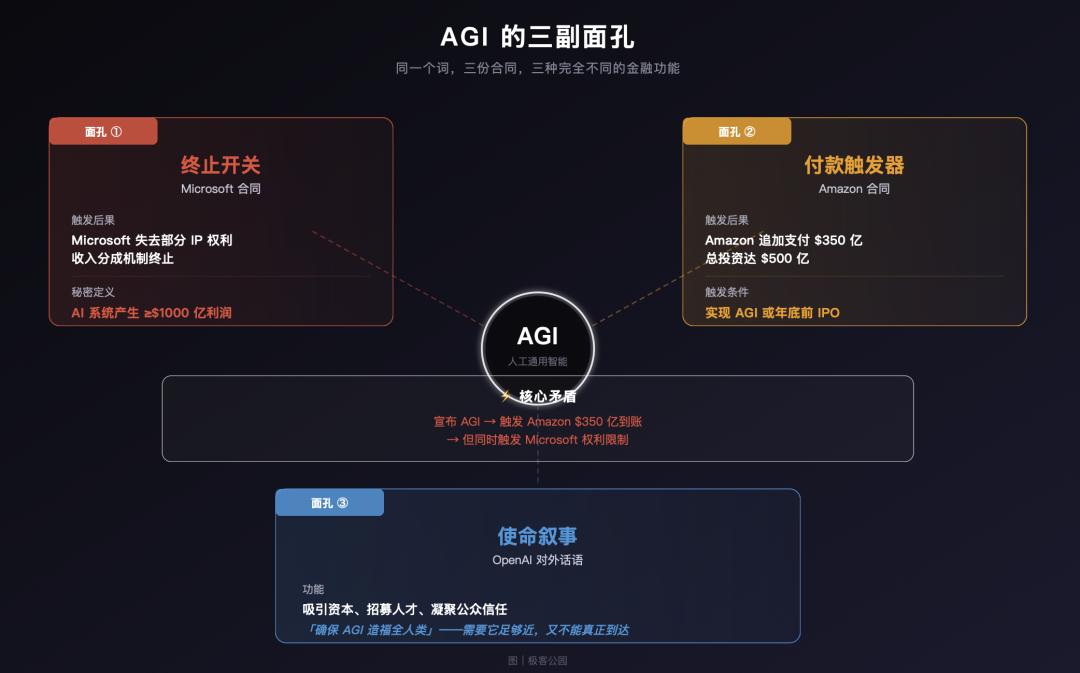
The Three Faces of OpenAI's AGI | Image Source: GeekPark
Leaked documents obtained by The Information show that there is actually a secret definition between OpenAI and Microsoft: The trigger condition for AGI is - OpenAI develops an AI system that can generate at least $10 billion in profit.
It's not "passing the Turing test," not "surpassing humans in all cognitive tasks," and not any of the standards that the scientific community has debated for decades. It's $10 billion in profit.
A concept that should have been defined by scientists has been quietly incorporated into a financial formula by two companies. (It should be noted that this definition comes from the 2023 agreement. The new agreement in October 2025 added an independent expert verification mechanism. Whether the two sets of standards coexist is not entirely clear from public information.)
In October 2025, the two parties signed a new agreement and made several key changes: The announcement of AGI needs to be verified by an independent expert panel; Microsoft's IP rights are extended until 2032, but there are restrictions after AGI; the revenue sharing remains valid until AGI is verified.
In other words, in Microsoft's contract world, AGI is a "termination switch" - its function is to change the distribution of rights and interests between the two companies once triggered.
When to press this switch, who will press it, and according to what standards are themselves a game worth hundreds of billions of dollars.
The Second Face of AGI: The Payment Trigger
Now, let's turn our attention to the protagonist of this $110 billion financing round: Amazon.
Amazon's $50 billion investment is not a one - time purchase. The structure is: Pay $15 billion first, and the remaining $35 billion will only be transferred after "specific conditions are met."
A report by The Information points out that these conditions include: OpenAI achieves an IPO by the end of the year, or reaches a certain AGI milestone.
See? The same word - AGI - appears in the second contract, but its function is completely reversed.
For Microsoft, AGI is a sword hanging over its head: once announced, Microsoft's rights are restricted. But for Amazon, AGI is a $35 billion check: once announced, the money will be transferred.
Putting these two mechanisms together creates a structural absurdity:
Announcing AGI → Triggering the transfer of $35 billion from Amazon → But at the same time triggering restrictions on Microsoft's rights
Not announcing AGI → Microsoft's revenue sharing continues → But Amazon won't get the $35 billion
OpenAI is caught between two contracts. The same word, is a reward in one contract and a punishment in the other. Sam Altman has to walk a tightrope between two completely opposite incentives.
Of course, there is a third way:
IPO.
If OpenAI goes public by the end of the year, it can also trigger the $35 billion from Amazon without touching the "AGI bomb."
But an IPO means that the public market will set its own price on the question of "whether you have achieved AGI." By then, this question will no longer be just a private game between two companies.
What's even more subtle is the other side of the deal.
Amazon invested $50 billion in OpenAI, but OpenAI also promised to spend $100 billion on AWS over the next 8 years, using 2GW of Trainium chip computing power; in addition, it will deploy 3GW of inference computing power and 2GW of training computing power on Nvidia's Vera Rubin system.
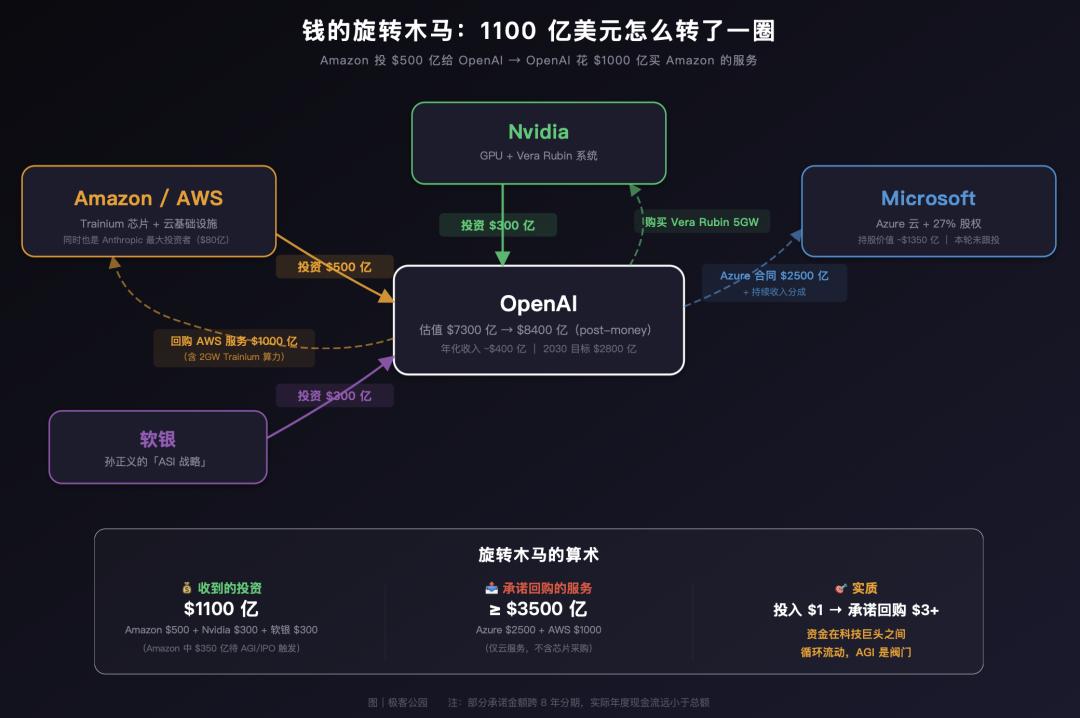
The Carousel of OpenAI's Sky - high Financing | Image Source: GeekPark
Amazon gives OpenAI $50 billion first, and then OpenAI spends $100 billion to buy Amazon's services. The funds go around between the two companies and come back, except that there are a few more contracts and a trigger called "AGI" in the middle.
Some on Wall Street are already calling it a "circular financing." A Reuters analysis directly warns that this model of mutual corporate investment and signing supply deals may artificially inflate demand and revenue.
But in my opinion, "circular financing" is just the surface. The real question is: When a $35 billion cash flow is tied to a concept without scientific consensus, can this concept still retain its scientific meaning?
The Third Face of AGI: The Mission Narrative
OpenAI's official website still bears the words: "Our mission is to ensure that artificial general intelligence benefits all of humanity." (Our mission is to ensure that artificial general intelligence benefits all of humanity).
This is the third face of AGI - It's not a contract clause, but a "mission," a flag, a narrative tool that makes investors write huge checks, top researchers join, and the whole world pay attention.
When Sam Altman announced this round of financing, he said: "AI will be everywhere. It's changing the entire economy, and the world needs a large amount of collective computing power to meet the demand." And OpenAI's external narrative is: We are entering a new stage, and cutting - edge AI is moving from research to daily use on a global scale.
Pay attention to the subtle change in wording.
Two years ago, Altman was still saying that super - intelligence might arrive in 2025. Now he downplays AGI as "a milestone on the way," saying, "We've given ourselves some flexibility because we don't know what will happen."
This adjustment in stance is not because the technical judgment has changed - it's because the function of AGI in the contract has changed.
When AGI was just an academic vision, you could shout "We're about to achieve AGI" to motivate the team and attract capital. But when AGI becomes a contract keyword that triggers a $35 billion payment, changes Microsoft's rights boundary, and may trigger antitrust reviews, every public statement about this word may have financial consequences worth hundreds of billions of dollars.
So, Altman has to be very careful. He needs the concept of AGI to be close enough to make investors believe that this big bet is worth it; at the same time, he needs it to be far enough away so as not to accidentally trigger the mines in the contract.
In OpenAI's external narrative, AGI is both the end - goal and the horizon - you're always moving towards it, but you can never really reach it. At least not until the contract terms are properly arranged.
This makes us think of a deeper question.
After this round of financing, the value of the non - profit foundation's shares in OpenAI exceeds $180 billion, making it "one of the most well - resourced non - profit organizations in history."
But the core mission of this non - profit organization is precisely built on a concept that has been completely financialized.
When the mission of "benefiting all of humanity" and the clause of "triggering $35 billion" are tied to the same word, does this word belong to science, capital, or law ?
Looking back at this $110 billion financing, the numbers themselves are not actually the most important. OpenAI's valuation has risen from $500 billion to $730 billion, a 46% increase in 4 months - these numbers will be refreshed by the next larger financing round.
What's really important is that this deal shows us a profound transformation that the AI industry is going through: the most core technological concepts are being contract - based, financialized, and tooled.
AGI is a termination switch in Microsoft's contract, a payment trigger in Amazon's contract, and a mission statement on OpenAI's official website.
Three faces, three functions, all pointing to the same word.
Perhaps this is the metaphor of this era:
A technology that may change the fate of humanity has been divided, priced, and written into the terms before it truly arrives.
The technology media Newcomer had a sharp comment on this round of financing:
"Convince enough CEOs and rich people that you'll change the world, and get them to write huge checks."
The question is - when all the checks are written, how much of its original meaning does the word "AGI" still retain?
*Image source: CNN
This article is an original article by GeekPark. Please contact Geek Jun on WeChat (geekparkGO) for reprinting.
Geek's Question
Do you think AGI should be defined by scientists or by contract terms?
This article is from the WeChat official account "GeekPark" (ID: geekpark), written by Hua Lin Wu Wang, and published by 36Kr with authorization.