The other side of the "Robot Spring Festival Gala": Amidst laughter, we have embraced a new type of human-robot relationship.
In 1996, a huge orange - peel - shaped box was brought onto the Spring Festival Gala stage.
It was the sketch "Funny Stories about Robots" written by Feng Xiaogang and co - starred by Cai Ming and Guo Da. In that work, Guo Da, a middle - aged bachelor, bought a humanoid robot named "Caihua" to relieve his loneliness. He used the remote control to switch the robot between being "understanding" and "passionate". The rigid interactions between humans and the robot made the whole audience burst into laughter.
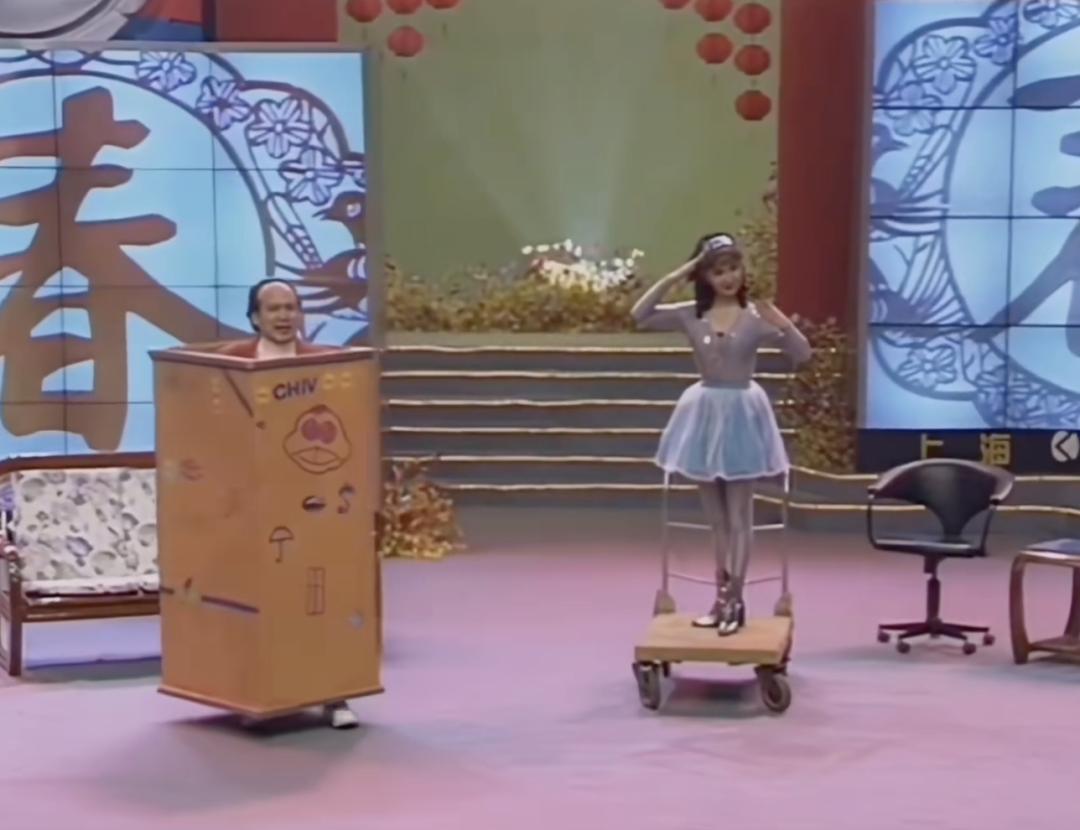
The sketch "Funny Stories about Robots" in 1996 | Image source: Spring Festival Gala
However, in the following thirty years, there was no more phenomenon - level work on the Spring Festival Gala with robots as the absolute protagonists.
It wasn't until last year that the program "Yangge Bots" where robots performed yangge brought robots into the public view, and embodied intelligence became the hottest topic and the keyword of the past year.
Last year's program was a technical debut, while this year's is more like a systematic display.
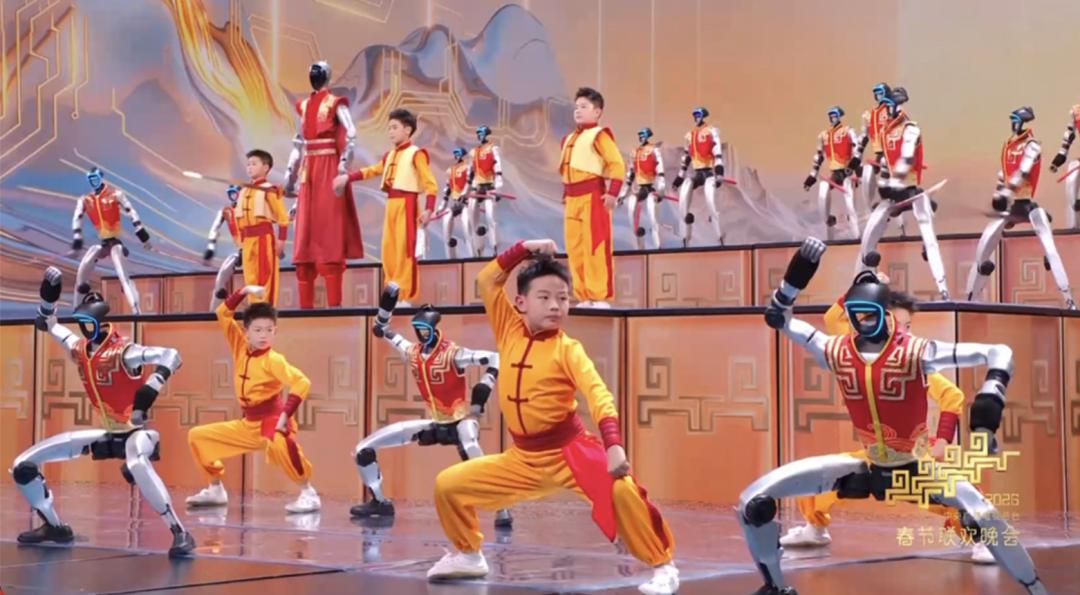
On the 2026 Spring Festival Gala, from sketches to dance accompaniments, from martial arts performances to advertising insertions, robots are almost becoming the stars of the gala, permeating multiple segments of the whole show. Their presence has never been so prominent.
01 From "Humans Playing Robots" to "Robots Playing Humans"
If thirty years ago in "Funny Stories about Robots" we were watching "humans playing robots", then this year, in "Grandma's Favorite", we saw "robots playing humans".
The plot of the sketch is not complicated. Teacher Cai Ming, who is thirty years ahead of her time, has entered old age. Since her grandson seldom comes home, she simply bought a row of robots for cyber - aged care.
When the real grandson came home, he found that the robots could not only serve tea and water for grandma but also provided a lot of emotional value. Facing the grandma who said "raising a son can't prevent old - age, but raising robots can", in order to compete for her favor, the real grandson tried to prove that he was more valuable than those cold lumps of iron.
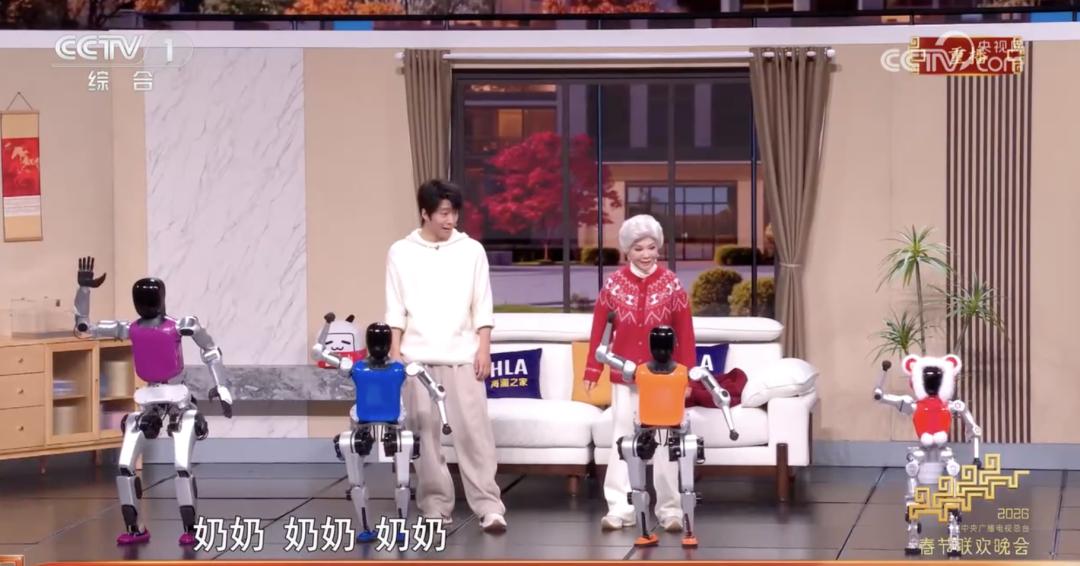
It's still a family with four children | Image source: Spring Festival Gala
However, it turned out to be a complete fiasco for the grandson.
In terms of serving tea and water, the robots were fast, stable, and accurate; in terms of talent shows, the robots easily did backflips on the spot, while the grandson could only spin in place; in terms of providing emotional value, the jokes told by the grandson were embarrassing and fell flat, while the robots were connected to the cloud - based large - model, and every joke hit grandma's funny bone precisely.
This series of dense gags also showed the public the combination of the robot's control ability, semantic understanding ability, and emotion recognition ability.
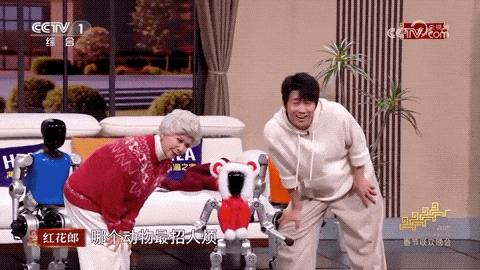
The robots in this sketch are responsible for providing "emotional value" | Image source: Spring Festival Gala
Most parents might sigh about the young people's neglect of filial piety, while young audiences could turn the tables and think "it's not bad to be taken care of by robots when getting old".
But the plot twist in the sketch came more suddenly than making dumplings: the grandson was actually facing a fake grandma, a high - imitation humanoid robot made by the real grandma in a 1:1 ratio of herself.
When the "fake grandma" with Cai Ming's face but a hint of mechanical stiffness in her micro - expressions was pushed to the center of the stage, perhaps all the viewers across the country fell into the same uncanny valley at that moment.
The truly terrifying thing is that the grandson was the only human on the stage. He argued with the large - model and competed with the motors. After all his efforts, he was actually seeking the recognition of another robot.
Although the sketch finally focused on the unbreakable family bond between grandma and grandson, the other side of the sketch "Grandma's Favorite" is:
When a person chooses to replace a family member with a robot, it is an active ideological choice. When a family member can't distinguish between a robot and a real family member, it is the result of the technical completion. The former is an ethical choice, and the latter is a technical ability.
The performance was of course choreographed, but the stage presented a familiar technological trend. The robot's ability to understand jokes, respond, and coordinate actions is exactly what this year's hottest "embodied intelligence" is about.
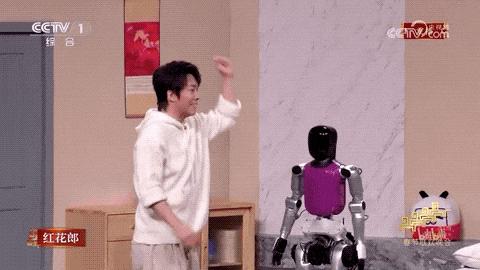
Humans are completely defeated in front of robots | Image source: Spring Festival Gala
From a technical perspective, the "real and fake grandma" scenario reflects the ultimate direction of the combination of digital human modeling and embodied intelligence. In the past, digital humans were confined to the screen and could only talk to you. This year's stage assumes that they have stepped off the screen, have a physical body, and have the ability to execute actions.
For that tens - of - seconds shot, Songyan Dynamics stuffed 32 micro - motors inside the bionic face and paired it with platinum silicone skin to achieve pixel - level replication of facial micro - expressions. But beyond the technical power, the speculative power of this sketch is even more thought - provoking.
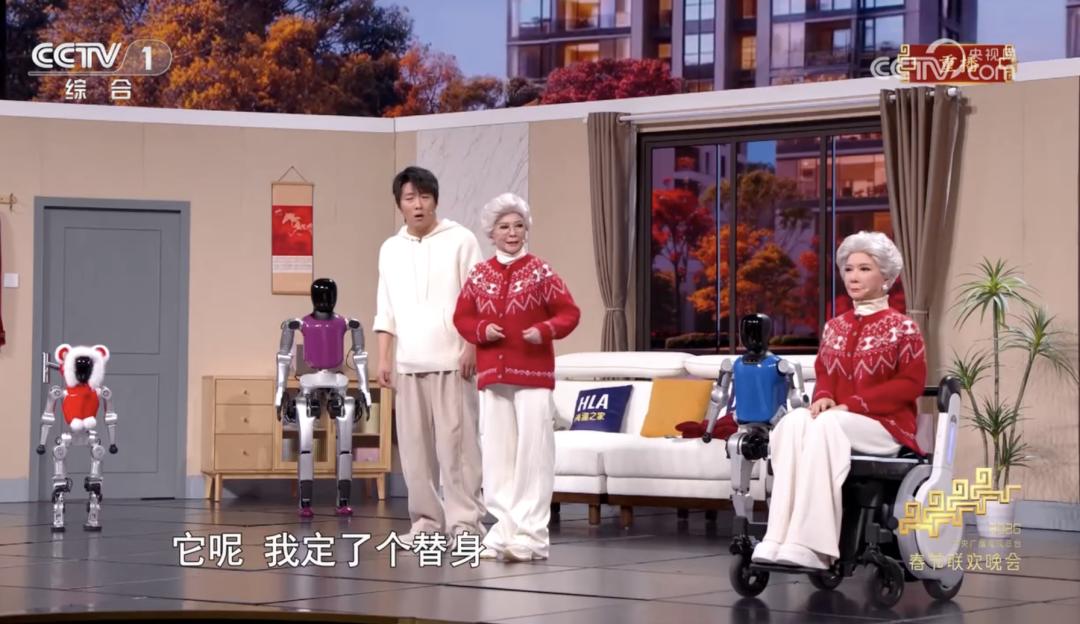
The scariest thing is that the "real grandson can't recognize the fake grandma" | Image source: Spring Festival Gala
Thirty years ago in "Funny Stories about Robots", people were imagining how robots could serve life, and finally Guo Da sighed that "robots are still not as good as humans".
And this year, Cai Ming sighed that "robots can never replace my dear grandson".
It sounds warm - hearted, but if you think about it carefully, humans' confidence in the face of robots is diminishing. It seems that the only thing we can rely on is feelings and relationships, rather than abilities.
In the face of extreme computing power and simulation technology, is there still an irreplaceable authenticity in human emotional connections? This is probably the most hardcore question left to us by the first sketch at the beginning of this year's Spring Festival Gala.
If "Grandma's Grandson" is a speculative exploration of concepts, then the next program "Wu Bots" is a demonstration of technical power.
02 From Yangge to Martial Arts
This year, Unitree's robots have evolved from dancing yangge directly to performing martial arts. The difficulty has multiplied exponentially.
Yangge emphasizes consistent rhythm, stable steps, and neat formations. It is the aesthetics of industrial automation, and essentially tests the precision of repeated actions and synchronous control.
But martial arts are different. Martial arts require transient stability at high speeds. We saw the humanoid robots complete a series of high - dynamic actions: somersaults, wielding sticks, Thomas spins, downward kicks, drunken boxing...
The contact surface of bipedal robots is extremely small. Usually, only the dozens of square centimeters of the soles of their feet support the body. They have to complete drastic changes in posture in a very short time, catch their own center of gravity, interact with humans, and keep the rhythm consistent.
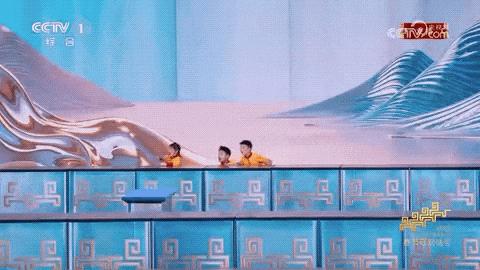
The robots are performing acrobatics this year | Image source: Spring Festival Gala
In the performance of the robot martial arts team, it was not as uniform as expected. During some difficult actions, one or two robots in the group seemed to lose their balance. But every time they landed, they consciously adjusted their center of gravity, making the whole performance end perfectly without any mistakes.
These moments that made the audience hold their breath were actually the most "show - off" technical demonstrations of the whole show.
Two years ago, the yangge performance was "rigid". Every step of the robots was written in the code. Even if there was a small pit on the ground, it might still step on it and fall.
But this year's martial arts performance is "alive". Those "feints" are because the robots' brains sense the slippage of their feet or the deviation of the landing posture in milliseconds, and then instantly calculate a torque compensation of hundreds of Newtons to force the body back to a balanced state.
Notably, the swaying feeling of the "drunken boxing" was deliberately designed to introduce instability and then show off the robots' stability ability.
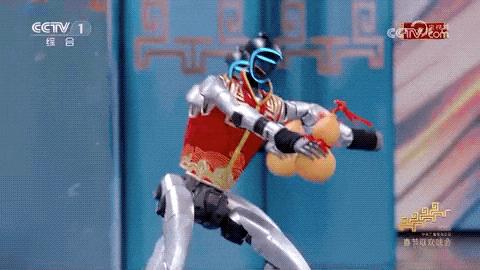
This set of drunken boxing precisely grasped the audience's psychology of "expectation violation" | Image source: Spring Festival Gala
This is the visualization of reinforcement learning on the stage.
The core of reinforcement learning is to let the system make repeated trials and errors in a large number of simulated environments. In the past year, these robots have experienced hundreds of millions of "cyber falls" in the virtual simulation world. They made repeated trials and errors in the simulated environment and learned to keep stable under various extreme disturbances such as on ice, gravel, and slopes.
In other words, last year's robots were "rehearsed". Now these robots are "trained".
Now the robots can tolerate deviations because they have the robustness to correct themselves within milliseconds. This is why "Wu Bots" at this year's Spring Festival Gala looks more "breathable" than "Yangge Bots".
As Wang Xingxing, the founder of Unitree Technology, said in an interview: "This year, the robots completed interspersed formations and martial arts actions while running fast. This high - dynamic and high - coordinated swarm control technology is making its global debut."
The approximately two - meter - tall Unitree H2 that appeared at the end of the program was more like an open "show of strength".
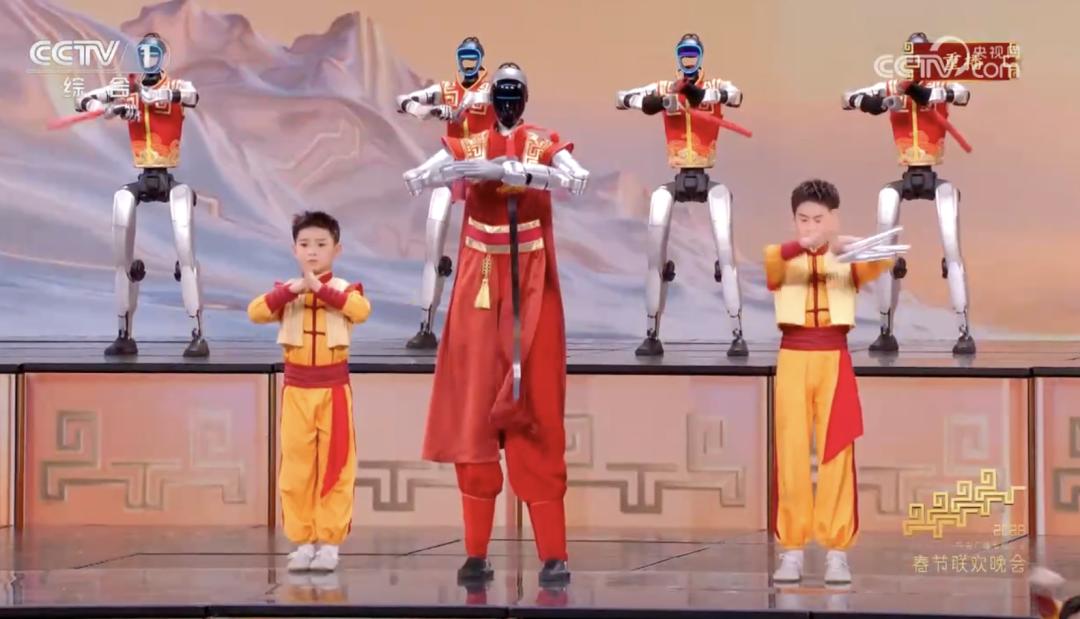
When the big robot appeared, it was both exciting and terrifying | Image source: Spring Festival Gala
The challenges brought by the larger size are far greater than the visual impact. A height close to two meters means a higher center of mass. The higher the center of mass, the exponentially more difficult it is to maintain balance. Any slight deviation in posture will be magnified into a greater risk of toppling.
But that big guy completed high - amplitude arm swings and quick turns in the center of the stage. Its joints were flexible, and its movements were crisp and smooth, even more so than the previous "Wu Bots", giving a feeling of upgrading from 60Hz to 120Hz high - refresh rate.
This shows that the large - sized joint drive unit has reached a new industrial critical point in terms of heat dissipation design and torque density while maintaining high explosive power.
It proves that Chinese robots can not only be small and delicate but also large and powerful. They can handle difficult tasks with ease and have a solid foundation.
03 From the Laboratory to the Spring Festival Gala
After the two programs starring robots ended, the "robot presence" in the whole Spring Festival Gala did not decrease. Instead, they became supporting roles and started to be the backdrop for many programs, which is like a metaphor for robots moving from the laboratory to people's daily lives.
In the micro - movie starring Shen Teng and Ma Li, Shen Teng, who was worried about not making it to the Spring Festival Gala, finally rehearsed an opera with a robot. Then the robot replaced Shen Teng and fully demonstrated its abilities, from playing with Chinese walnuts to roasting sausages, from folding clothes to picking up express deliveries. Finally, a group of stars surrounded it and sang "Robots enter thousands of families, and technology benefits you and me".
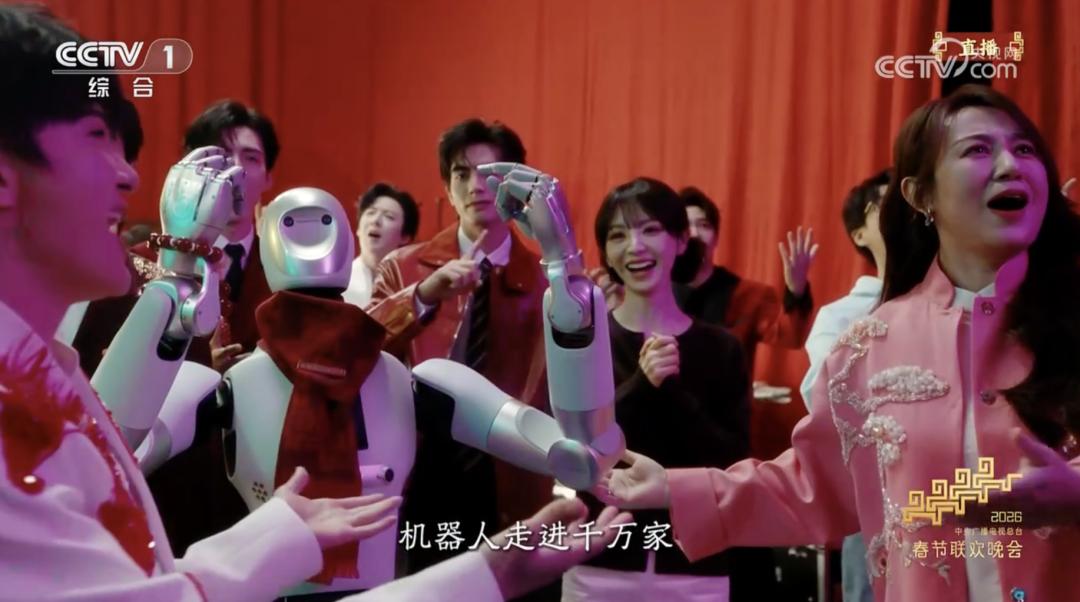
The plot twist in this program is even more abrupt than making dumplings! | Image source: Spring Festival Gala
Unitree Technology, Magic Atom, Galaxy Universal, Songyan Dynamics... These four robot companies appeared on the CCTV Spring Festival Gala of the Year of the Horse, forming a "sea of robots". In the Yibin, Sichuan branch venue, we saw robots and humans sitting at the same table, eating hot pot and singing. During the boring advertising voice - overs, the host also mentioned robots of different brands at different times.
They began to seep into the capillaries of this national - level gala like air.
If we just watched the fun during the Year of the Dragon, then during the Year of the Horse, we saw real - life applications. The 2026 Spring Festival Gala strongly promoted the application of robots in family and entertainment scenarios. This also marks the industry's official expansion from the B - end to the C - end.
So, what exactly happened to the Chinese robot industry this year?
First, there was a "commoditization" miracle in the supply chain.
We have to admit the domestic industry chain integration ability. In the past year, countless factories in Shenzhen, Hangzhou, and Shanghai have turned these precision components into standard parts. Now, a