Medical Outlook for 2026: Hundreds of Companies Queuing for HK Stock Listings. Can the Medical Sector Create Another "Myth"?
Text | Hu Xiangyun, Hai Ruojing
Editor | Hai Ruojing
At the beginning of 2026, the medical track was quite lively, with "booming" and "cooling down" scenarios playing out in the market simultaneously.
Medical device stocks such as Jingfeng Medical and Beixin Life went public one after another, showing a good upward trend; the brain-computer interface triggered a collective frenzy in both the primary and secondary markets. Borui Kang and Qiangnao Technology are sprinting for IPOs, and the valuation of another invasive brain-computer startup in Shanghai has also exceeded 4.5 billion yuan.
Currently, over a hundred medical companies are queuing up for listing in the Hong Kong stock market, and there are widespread rumors that the IPO policy is about to be tightened. Some industry insiders even believe that "a 30% break - even rate for new stocks will become the norm." So, what are the windows and opportunities for medical companies to go public in 2026? How are companies planning to go public smartly coping with market risks?
Last year, the innovative drug sector created many wealth myths: the "subscription king" with a 6000 - fold new - share subscription, and the stock prices of more than a hundred companies doubling within the year. In 2026, more cornerstone and early - stage investors will have their shares unlocked one after another. After the emotions and glitz fade away, it still depends on hard strength to support the long - term market value. The scale and structure of BD transactions remain the key for the market to judge the quality of pharmaceutical companies and new drug molecules.
After a year of baptism, the capital market has become more rational in its response to the License - out (external authorization) of innovative drugs, and it is not uncommon for "BD not to boost the stock price." In 2026, MNCs' enthusiasm for Chinese new drug assets remains undiminished. Besides the already crowded oncology track, which new directions are becoming hotspots for big pharmaceutical companies to compete for?
Among the players in new drug BD authorization, AI - native biopharmaceutical companies can no longer be underestimated. In the past month or so, Insilico Medicine, Deepwise AI, etc. have frequently obtained BD transactions, and the valuation of a well - known domestic AI pharmaceutical startup has reached $3 billion. How do veteran new drug players view the potential of "AI scientists" in drug development?
On the consumer side, "AI intelligent doctors" are rapidly changing the way the public seeks medical consultations and manages their health. Internet giants are eager to seize the health super - entrance. At the same time, consumer - grade medical devices, digital therapeutics and other directions, with the massive amount of data accumulated in the past, have become the most precious "fuel" in the AI era and are ushering in new opportunities.
Compared with the promising innovative drug track, the pace of the medical device track emerging from the shadow is relatively slower. Affected by the difficulties of going global and geopolitics, Chinese innovative medical devices have not yet entered the global asset pricing system like new drugs. Can the situation of Chinese innovative medical devices going global improve in 2026? Can the primary market investment hit the bottom and rebound...
To address the above issues, at the beginning of 2026, 36Kr interviewed nine investors and entrepreneurs in the medical and health track. Thanks to:
Xie Xin, Executive Director/Senior Vice - President of China Biopharmaceutical (01177.HK); Chen Bing, Vice - President of International Business Development, Cooperation and Strategic Investment of AstraZeneca; Liu Dan, Managing Partner of Pivotal bioVenture China (Biwo Investment); Li Junhong, Partner of Longpan Capital; Yu Jianlin, Deputy General Manager of GTJA Investment Group; Sun Xiaolu, Founder/Managing Partner of Bixinxing Venture Capital; Yan Yi, Partner of Shuimu Venture Capital; Zhang Xiao, Founder of Syneron Bio; Qian Kun, Co - founder of SenseTime Medical.
36Kr has summarized these insights into the top ten trends in 2026. Here are their detailed views:
1. The performance of new pharmaceutical IPOs in 2026 will be significantly differentiated. Many companies are launching Pre - IPO round financing to hedge against regulatory tightening and market risks
Xie Xin of China Biopharmaceutical: After the bubbles and reshuffles of the previous two years, investors have become more mature and have higher requirements for IPO projects. Currently, there are more than 400 companies queuing up for listing in the Hong Kong stock market. The performance of IPOs in 2026 may be differentiated. Funds will flow to companies that have successful cases/potential of going global through BD, are technologically leading in niche tracks, and have clear product listing time and sales expectations (such as peak revenue and profit of new drugs). On the contrary, companies without competitive advantages will face great pressure in IPO.
Liu Dan of Biwo Investment: We have always been actively involved in the international placement of new drug companies in the Hong Kong stock market. At the end of 2025, we observed that several companies in the Hong Kong stock market had their stock prices break even, and the market was briefly cold. However, the performance of Insilico Medicine, Ribobio Co., Ltd., etc. later made us believe that it was just a regular low - trading period at the end of the year, rather than a systematic correction of the Hong Kong stock market.
We are quite optimistic about the IPO issuance in the Hong Kong stock market in 2026. The market will continue to rise with slow twists and turns. Of course, the stock market is uncertain. Therefore, many companies will consider conducting Crossover round financing to hedge against the issuance window and market adjustments. There are also signs of policy tightening and the orientation of supporting high - quality companies to go public. For example, for companies seeking A + H listing, if their market value in the A - share market is not high, there is a high probability that they will encounter obstacles in subsequent Hong Kong stock market listings.
Yan Yi of Shuimu Venture Capital: In 2026, there is a possibility that the IPO policy in the Hong Kong stock market will be tightened. Many companies hedged against risks through Pre - IPO round financing last year, and many friends also consulted us about such projects. The valuation range of these companies is mostly between $300 million and $500 million, and the expected financing is about $50 million. It is recommended that for such projects, the focus should still be on analyzing the value of the company's pipeline, rather than chasing short - term listing expectations.
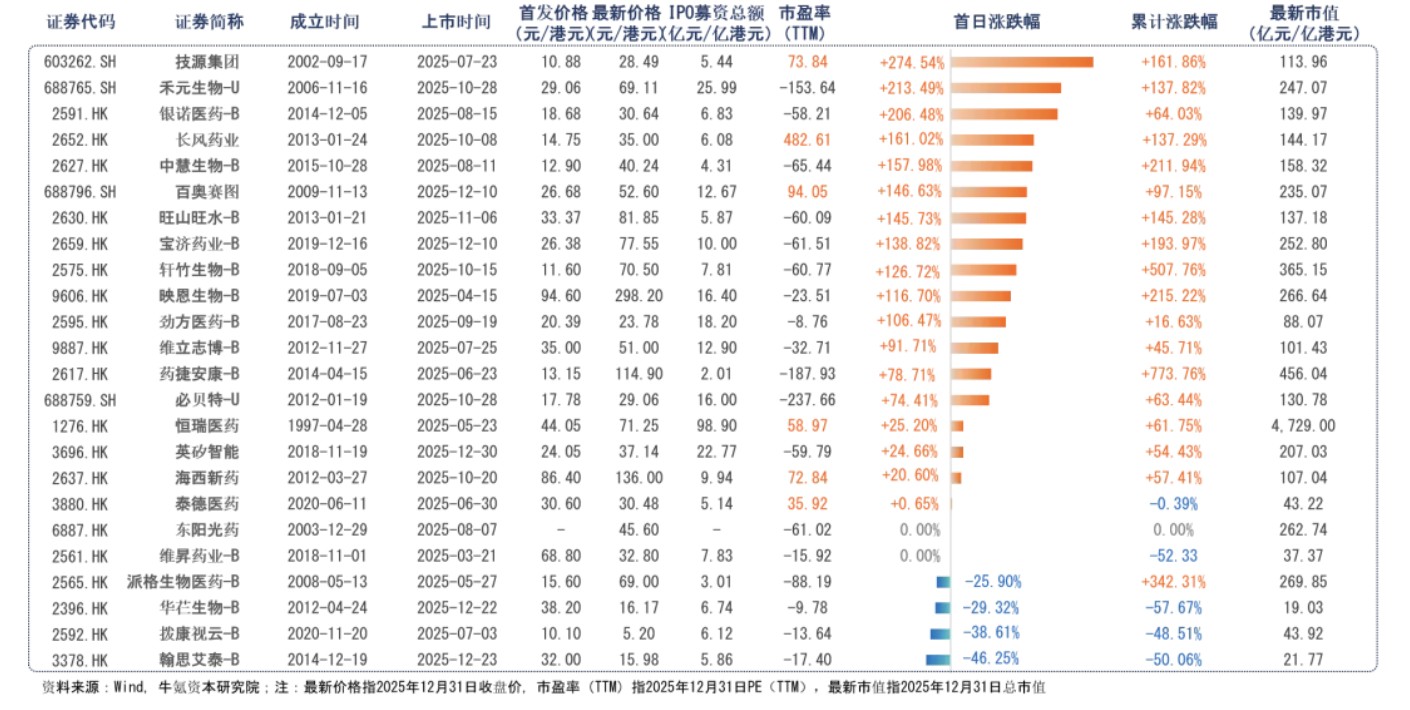
The IPO situation of Chinese biopharmaceutical companies in 2025 (Data source: Wind, Niukr Capital Research Institute)
2. The global share of China's new drug BD transaction volume will continue to increase. MNCs' enthusiasm for purchasing remains undiminished, but there is a trend of "good quality but not cheap price"
Chen Bing of AstraZeneca: Currently, both MNCs and domestic pharmaceutical companies are still actively promoting cooperation, and large - scale BD transactions will still occur in the future. The scale of BD transactions is mainly determined by the product life cycle, and there is a relatively unified standard in the global market. For example, the scale of tens of billions of US dollars is applicable to mature global products; the scale of one billion US dollars (down payment) is applicable to products about to enter Phase III clinical trials; the scale of 100 million US dollars is applicable to products in Phase I clinical trials; the scale of tens of millions of US dollars is applicable to pre - clinical products.
The effect of BD on the stock price should be analyzed on a case - by - case basis. If a company is considered by investors to have only one leading product, a BD transaction can bring cash flow and stabilize the company's development, but it will also reduce the company's future imagination space. If a company has a strong platform or multiple pipelines and only conducts a BD transaction for one of its products, investors will be optimistic about the platform's potential to continuously produce new pipelines, and there will still be a large investment space in the future.
Liu Dan of Biwo Investment: Multinational pharmaceutical companies' enthusiasm for purchasing Chinese innovative drugs remains high. Last year, the total BD transaction volume of Chinese innovative drugs accounted for 50% of the global total. I believe this proportion will continue to rise, but the year - on - year growth rate will slow down. One reason is the influence of geopolitics; the other is that the label of "good quality and low price" for Chinese new drugs has been somewhat weakened.
At the JPM in 2026, some multinational pharmaceutical companies and US dollar funds mentioned that some Chinese pharmaceutical companies are relatively aggressive in "asking for high prices." In the past year, the valuation of Chinese new drug assets as a whole has been in a reasonable range of "good value for money." If they deliberately pursue "sky - high prices," it may damage the reputation of Chinese Biotech globally and is not conducive to forming a benign ecological cycle between the Chinese and American pharmaceutical industries.
3. A new paradigm for tumor treatment has taken shape, and the track is crowded; new drugs related to autoimmune diseases, metabolism, and the central nervous system have attracted much attention
Chen Bing of AstraZeneca: In the past few years, multinational pharmaceutical companies have been most eager to supplement their oncology pipelines and the resulting Modality innovations such as ADCs and bispecific antibodies, which are precisely the areas where Chinese pharmaceutical companies have invested more in the past few years. Currently, the oncology field is quite crowded, and the data requirements will become higher and higher, such as more advanced clinical stages or more detailed and later - line data.
In the future, BD may extend from oncology to treatment fields such as autoimmune diseases and cardiovascular diseases. Complementary pipelines are expected to reach transactions at an earlier stage.
Xie Xin of China Biopharmaceutical: China Biopharmaceutical focuses on four major fields: tumor immunology, liver disease metabolism, respiratory antiviral, and external medicine. In 2026, while deeply cultivating these four fields, it will accelerate the development of chronic disease products such as those for cardiovascular and cerebrovascular diseases and the central nervous system. From the perspective of technological paths, we are concerned about small nucleic acids, ADCs, bispecific antibodies, and technologies related to the central nervous system. We will also pay attention to immature technological paths such as in - vivo CAR - T, but we need to see more drug - forming data before taking action to balance risks.
Li Junhong of Longpan Capital: In the future, the treatment of advanced tumors may form a "triangle" combination: cytotoxic drugs (chemotherapy/ADCs) + immunosuppression (PD - 1 monoclonal antibodies/bispecific antibodies, etc.) + immune stimulation (cytokines, etc.).
Tumor treatment aims to achieve OS (overall survival) benefits, enabling patients to survive long - term or even be cured. Relying solely on immunosuppression to "release the brake" is not enough, as the number of beneficiaries is limited. Immune stimulation is also needed to "step on the accelerator" to mobilize the body's own immune function. Therefore, the development of tumor immune stimulants (such as PD - 1/IL - 2 fusion proteins, cytokines such as IL - 12/IL - 15/IL - 18, and the 4 - 1BB target) is one of the important future directions. The key lies in targeted delivery, controlled release, and balancing efficacy and toxicity.
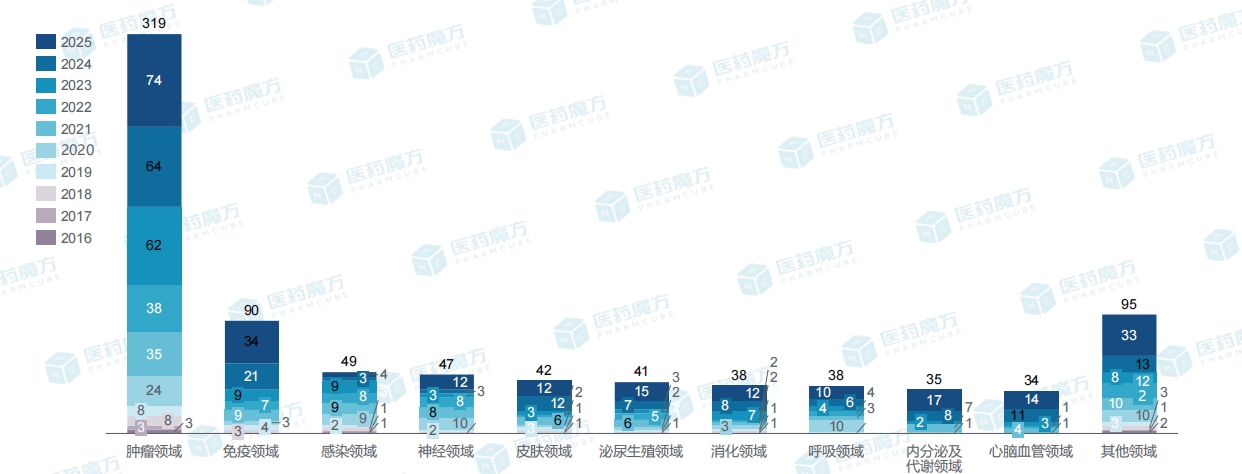
Distribution of disease fields involved in China's innovative drug BD from 2016 to 2025 (Data source: Pharmcube)
4. GLP - 1 "miracle drugs" for diabetes and weight loss still have high value in terms of reducing side effects and developing new indications
Chen Bing of AstraZeneca: Only a few companies will stand out in the GLP - 1 track in the end, and the core lies in clinical efficacy. Unlisted products need to find differentiated advantages: First, optimize the administration form. Many people care about the pain and inconvenience caused by injections, so there is still room for oral formulations. Second, efficacy, especially weight - loss effects and cardiovascular benefits. Third, the frequency of administration. Patients need products with a longer half - life and lower administration frequency. Fourth, long - term safety, reducing adverse reactions and rebound after drug withdrawal.
Liu Dan of Biwo Investment: In the metabolic field, the value of the GLP - 1 target is far more than just weight loss. Future R & D iterations will focus on two dimensions. One is dual - or multi - target drugs to overcome the limitations of existing single - target drugs such as side effects. The other is to explore its potential for expanded treatment in indications related to metabolic liver diseases, kidney diseases, etc.
5. AI - driven drug discovery has not yet disrupted human efforts, and the concentration at the top is obvious. In 2026, it will receive more financing and BD. "Those who have data will win the world" in drug - making
Zhang Xiao of Syneron Bio: At the JPM Conference in 2026, "AI" and "China" were the most important keywords, and Chinese AI pharmaceutical companies were the core focus of MNCs. This year, there will be more good news about BD for Chinese AI pharmaceutical companies. Currently, the overall enthusiasm for financing of AI pharmaceutical companies is relatively high, but the concentration effect at the top is obvious. Only two or three companies are highly sought after, and many other companies may still face relatively big challenges in financing.
Technologically, with the enrichment of data and the breakthrough of basic model capabilities, AI's capabilities in molecular design, target evaluation, etc. are continuously evolving and improving. However, it will take some time to achieve very disruptive results or results far beyond human capabilities. On the regulatory side, the US FDA is very actively embracing AI and reforming the drug review methods and processes, which will bring benefits.
Chen Bing of AstraZeneca: The success of "AI - driven drug discovery" ultimately needs to be proven by druggability and clinical value, rather than just how much optimization is achieved in a certain link. From the perspective of drug - making, I think AI has a greater chance of developing new indications for already - listed drugs. Because there is enough past data for AI to learn from and analyze, but drug patent terms and regulatory requirements need to be considered.
Xie Xin of China Biopharmaceutical: Last year, funds began to flow back into the domestic AI - driven drug discovery field, and we have also established an AI team of more than a hundred people. I believe that it is an inevitable trend for molecules independently designed by AI to be approved for marketing, but the core is that "those who have data will win the world." Data reserves determine the effectiveness of clinical advancement and product implementation.
6. The AI dividend will be first released in the consumer medical device field. AI consultations, digital therapeutics, etc. will face great opportunities
Sun Xiaolu of Bixinxing Venture Capital: AI has already penetrated deeply into areas such as new drug R & D, medical devices, and digital therapeutics. Many innovative medical device products have applied intelligent and automated solutions to varying degrees. Digital therapeutics also has new opportunities. The technology is becoming more mature, and its value in clinical treatment is truly being demonstrated. Recently, the regulatory side has issued registration certificates, and doctors are also willing to try.
Yan Yi of Shuimu Venture Capital: We judge that the AI dividend will be first released in the consumer medical field, such as ventilators and sleep monitors. Because the improvement of product effects brought about by AI makes C - end consumers willing to pay for more accurate home - use medical devices. Many consumer medical devices are equipped with built - in sensors that can collect physiological data in real - time. Now, various multi - modal models can activate the massive amount of health data and make them truly valuable.
In terms of medical consultations and health information retrieval, the changes brought about by AI will far exceed imagination. AI consultations can respond to health problems more professionally and accurately. The biggest benefit is that it equalizes access to high - quality medical information and will also help individual users develop better health habits.
In terms of competition, AI currently has two key aspects: basic model capabilities and product application capabilities. For To C - end products, AI should become more and more "human -