Overcoming challenges in "core" materials, Envision Semiconductor offers new options for the post-Moore era
Recently, Suzhou Xijing Semiconductor Technology Co., Ltd. (hereinafter referred to as "Xijing Semiconductor") announced the completion of a new round of financing. Founded in April 2022, the company is a high - tech enterprise in China that focuses on the R & D, engineering, and industrialization of carbon nanotube wafers. Its aim is to provide disruptive solutions for the post - Moore era. Currently, the company has received nearly 100 million yuan in investment from several well - known institutions.
Currently, silicon - based chip technology is facing dual challenges of the "physical limit" and the "economic dead end". Process miniaturization has led to a sharp increase in technological complexity and cost. Against this backdrop, carbon nanotubes, with their advantages such as ultra - high carrier mobility, advanced structure adaptability, and ideal CMOS characteristics, have become the key material to break through the bottleneck. They are expected to achieve the performance of advanced nodes with mature processes and open up new industrial paths.
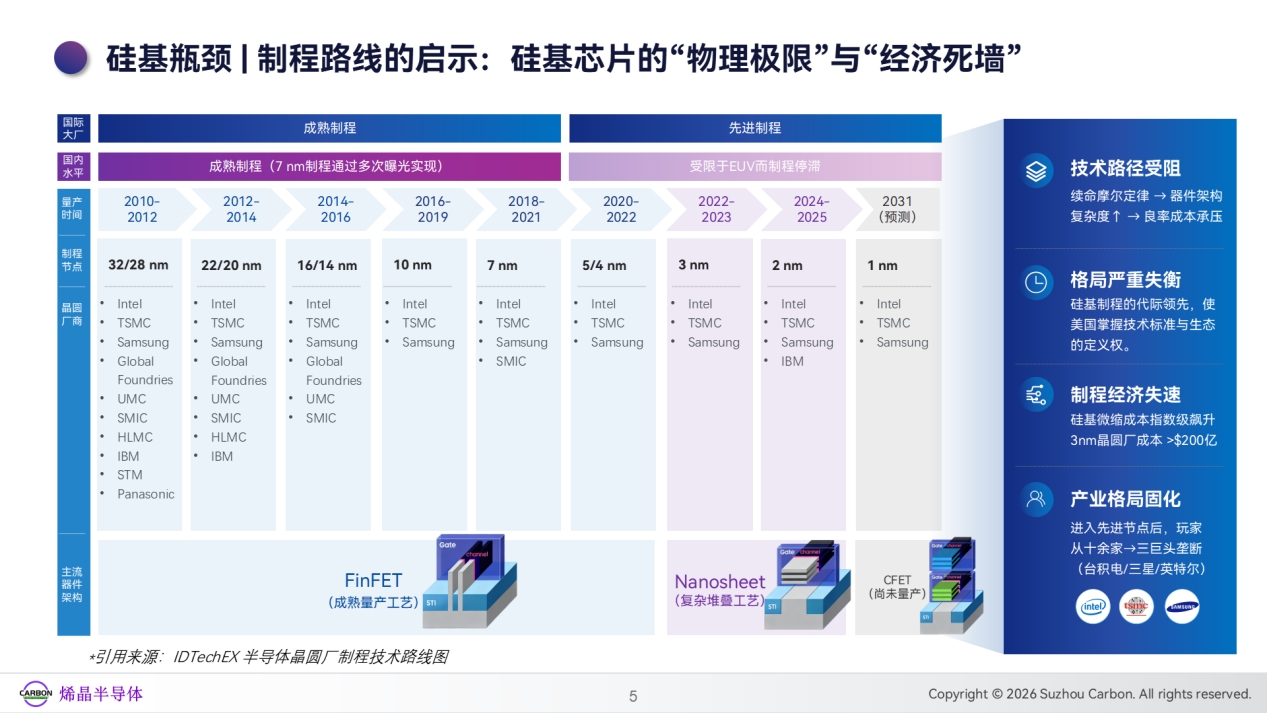
Image source: "Industrialization White Paper on Carbon Nanotube Wafers" released by Xijing Semiconductor
The industry consensus points out that the core of carbon nanotube industrialization lies in systematically solving two major problems: achieving "stable supply of high - quality wafer - scale materials" and "development of carbon nanotube CMOS processes compatible with semiconductor production lines (Fab)". As a pioneer in this field, Xijing Semiconductor can provide a full - stack solution for carbon nanotube wafers. Currently, the company has completed the mass - production verification of 8 - inch carbon nanotube wafers, achieving a leap from the laboratory to engineering. It has also made progress in process development and tape - out verification with several industry leading customers. Developing 12 - inch wafers compatible with mainstream production lines is its next - stage milestone, which is regarded as the "passport" to access the global manufacturing system and an inevitable path for industrialization.
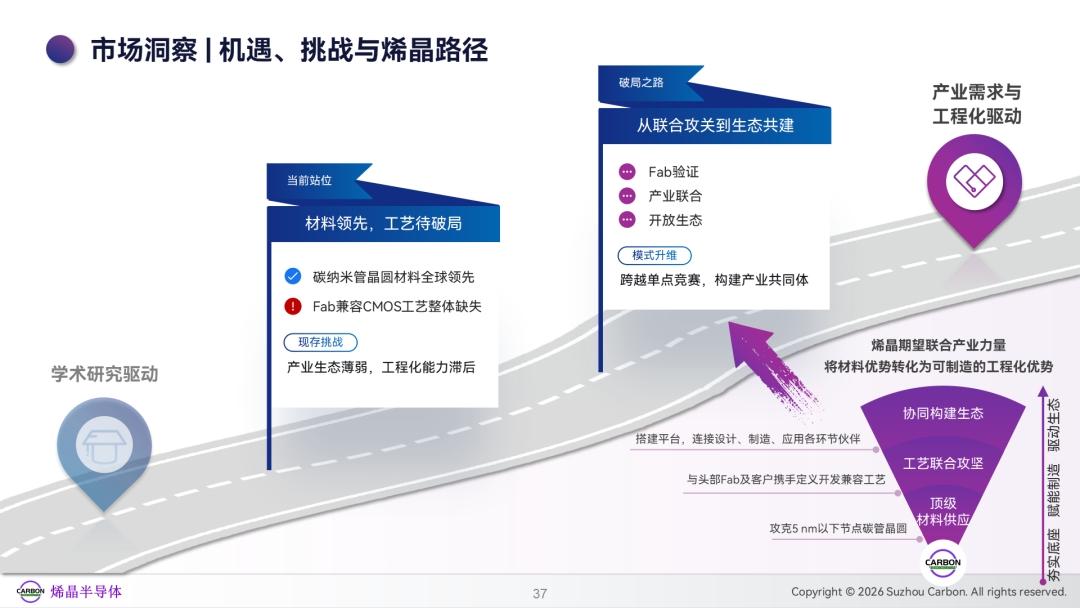
Image source: "Industrialization White Paper on Carbon Nanotube Wafers" released by Xijing Semiconductor
Currently, the global industrialization competition situation is very clear: the United States has completed tape - out verification in system architectures such as CNT - CMOS 3D integration; European carbon - based capacitor products have passed reliability certification and are accelerating commercialization; Japan and South Korea have announced specific release plans for high - end device manufacturing and core components (such as high - performance infrared sensors). These developments all point to the upcoming booming market directions such as advanced computing power chips, special discrete devices, and photoelectric sensors.
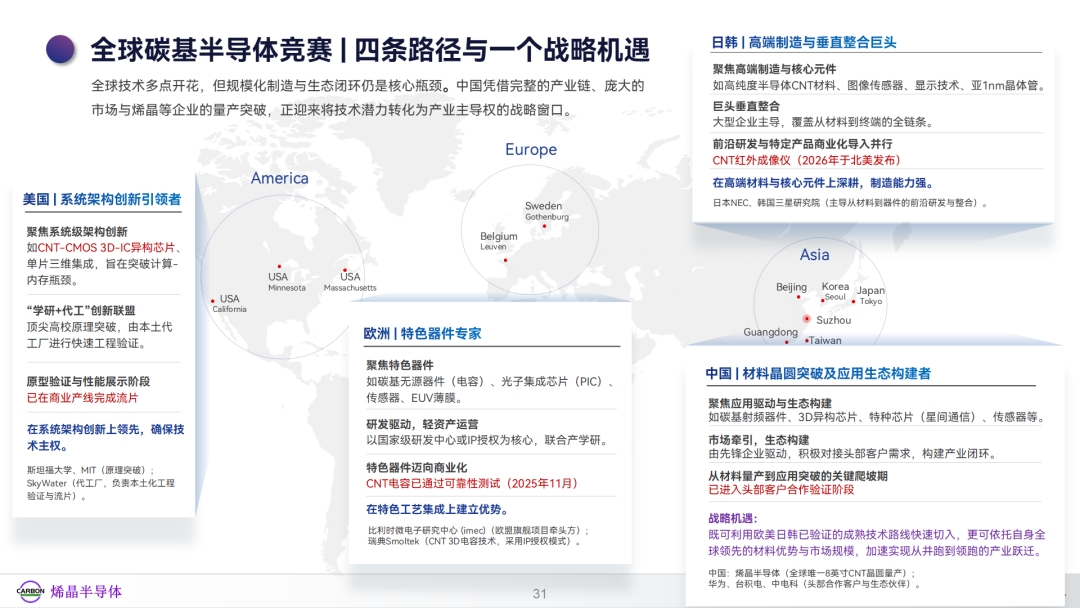
Image source: "Industrialization White Paper on Carbon Nanotube Wafers" released by Xijing Semiconductor
To transform market potential into industrial momentum, Xijing Semiconductor will focus on three major directions based on this round of financing: optimizing the 8 - inch wafer process to improve production capacity and yield; tackling the R & D and production line verification of 12 - inch wafers; and carrying out joint development with ecological partners for frontier scenarios such as low - orbit communication and 3D computing power chips to accelerate the transformation of material advantages into product competitiveness.
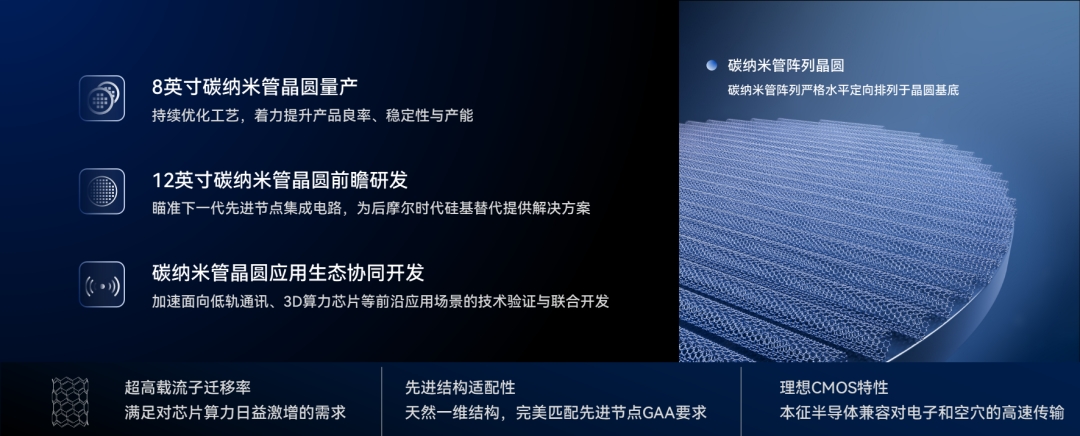
It is worth noting that while announcing the financing, Xijing Semiconductor also released the "Industrialization White Paper on Carbon Nanotube Wafers". Based on the company's industrialization practice, the report systematically sorts out the technical context, industrial challenges, and business prospects, providing the industry with an in - depth reference for moving from the technical blueprint to industrial reality.