In the first month after the phased-out purchase tax incentives, the sales of several automakers have plummeted.
January just passed was the first natural month after the purchase tax on new energy vehicles changed from "exemption" to "half - exemption".
Over the past decade or so, China has consistently adhered to exempting vehicle purchase tax, with the exemption amount for each passenger car not exceeding 30,000 yuan. As new energy vehicles continue to develop, the subsidy for the purchase tax on new energy vehicles is also declining: starting last month, the purchase tax for each passenger car has changed from exemption to half - exemption, and the tax reduction amount does not exceed 15,000 yuan.
As the "policy subsidies" gradually fade away, automakers are facing a real "market" test.
01
According to the prediction of the Passenger Car Association, the retail sales volume of narrow - sense passenger cars in China reached about 1.8 million in January 2026, a month - on - month decrease of 20.4% and a year - on - year slight increase of 0.3%. Among them, the retail sales volume of new energy vehicles is expected to be about 800,000, with a penetration rate of about 44.4%. Based on the data previously released by the Passenger Car Association, it can be calculated that the retail sales volume of new energy vehicles in January this year decreased by 40.2% month - on - month and increased by 7.5% year - on - year.
On the one hand, the passenger car market in January maintained the general rule of "month - on - month decline" as in the past. This is because December of each year is the season for automakers to boost sales at the end of the year, so car - buying welfare policies are frequently introduced. Coupled with the Chinese consumption tradition of "buying a car to go home for the Spring Festival after a busy year", people tend to buy cars at the end of the year. Therefore, the sales volume in January naturally declined compared with that in December last year.
On the other hand, although the predicted sales volume in January this year showed a slight increase compared with the same period last year, this was mainly due to the time advantage brought by the Spring Festival falling in mid - February this year. However, although the year - on - year increase was "slight", compared with the sales volume of 2.034 million vehicles in January 2024, there was a significant decline. Behind this, there is a great relationship with the decline of purchase tax subsidies and consumers' strong wait - and - see attitude.
In addition, the 44.4% penetration rate of new energy vehicles in January this year showed a significant decline compared with the nearly 60% penetration rate last month. It can be seen that with the weakening of the "policy subsidies" for new energy vehicles, consumers' enthusiasm for new energy vehicles has decreased.
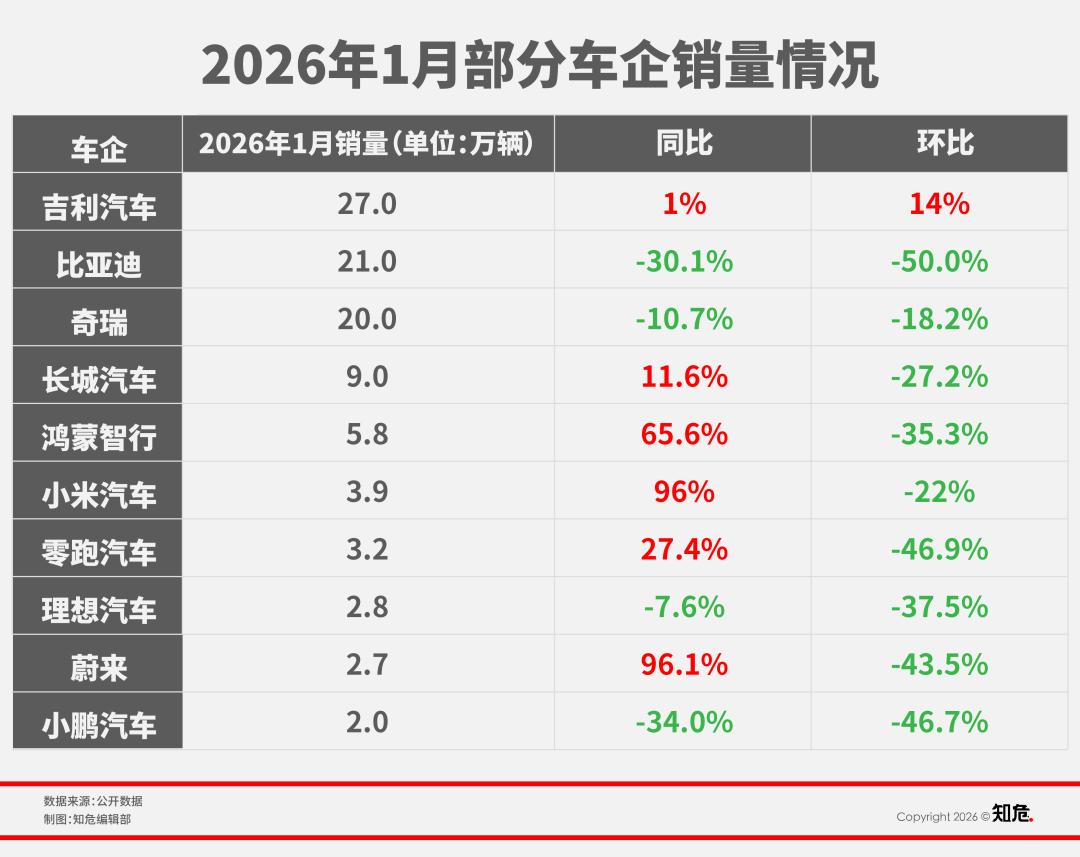
Looking at specific automakers, several sets of data are also worthy of attention. As can be seen from the figure below, several automakers have a large year - on - year decline, and it can even be said that "they are in a mess".
Their characteristic is that they mainly focus on new energy products, and the prices of their main models are not high.
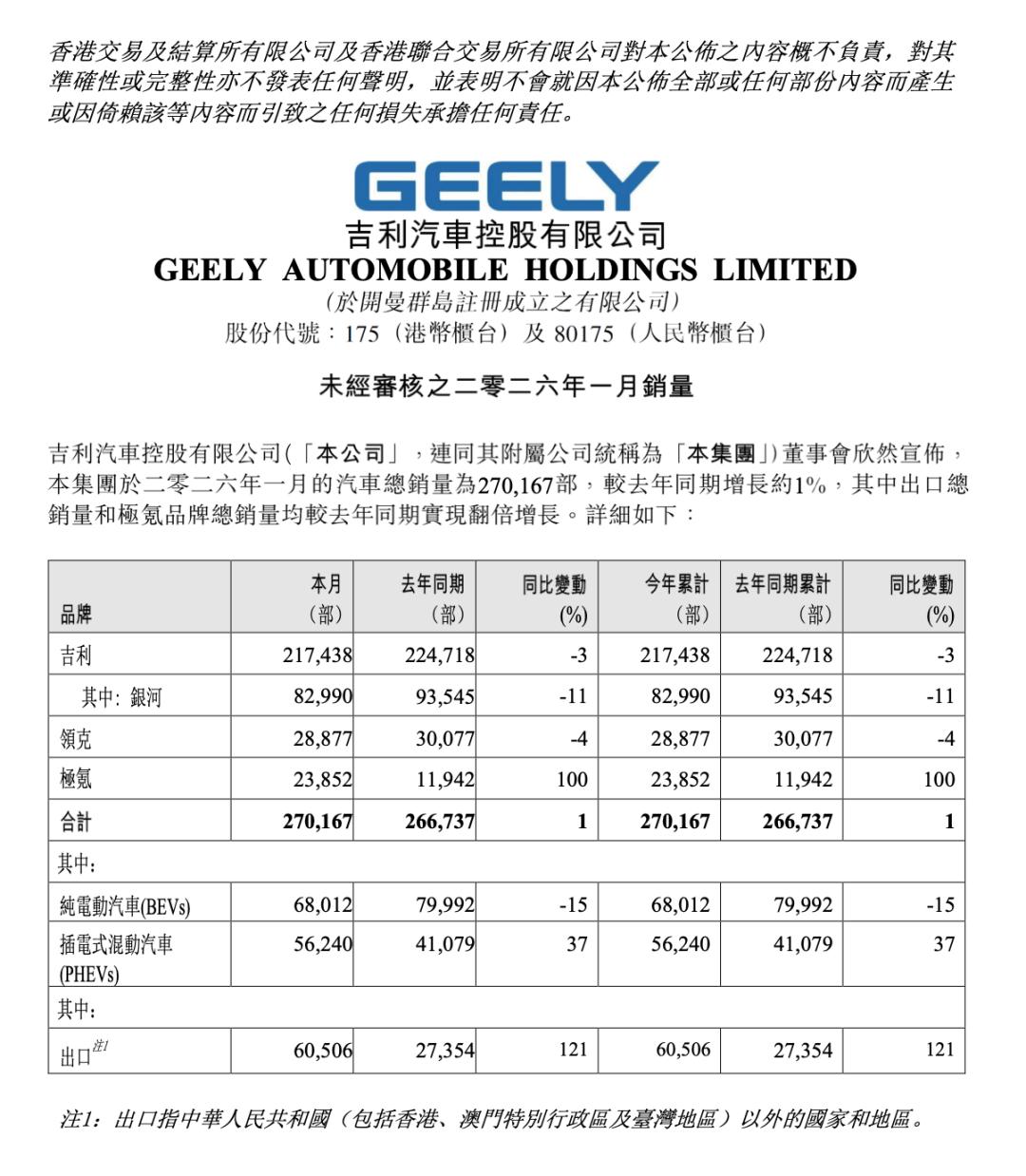
Specifically, the passenger car sales volume of Geely Automobile Group reached 270,000 in January, a year - on - year increase of 1% and a month - on - month increase of 14%. It became the number one among Chinese independent brands in terms of sales volume and the only automaker with both year - on - year and month - on - month growth. Among them, the sales volume of new energy vehicles reached 124,000, with a penetration rate of 46%, and the rest of the sales were supported by fuel - powered vehicles.
Geely's good start in the new year reflects to some extent the importance of product structure adjustment. Its strategic integration in the past year seems to be taking effect, and each brand has its own responsibilities. It has fuel - powered vehicle products to consolidate its market share and new energy vehicle models to expand its territory. Among them, Galaxy, Lynk & Co, and Zeekr complement each other in different price segments.
Although the sales volume of Geely Galaxy and Lynk & Co declined year - on - year last month, Zeekr, which shoulders the heavy responsibility of brand upgrading and targets the luxury market, achieved a year - on - year growth of 100%. This also shows to some extent that the decline of subsidy policies has a greater impact on mass - market models. For the mid - to - high - end market, price may not be the main factor considered. Therefore, even in January, the off - season for car sales, the mid - to - high - end Zeekr brand still performed strongly.
BYD, which experienced a significant decline both year - on - year and month - on - month, with a decline rate far exceeding the overall industry trend, may have the same feeling.
The total sales volume of BYD Dynasty | Ocean reached 177,000 last month. Although it still plays a leading role in the group's sales volume, it decreased by 36% year - on - year and 48.5% month - on - month. The decline and uncertainty of policy subsidies have led to a sharp drop in the sales volume of these brand models. For brands like Fang Cheng Bao and Yangwang, which have higher prices and unique product categories, although their month - on - month sales volume almost halved, their year - on - year sales volume increased by 247% and 44.4% respectively. This data also confirms from the side that the decline of subsidy policies has a greater impact on mass - market and affordable models.
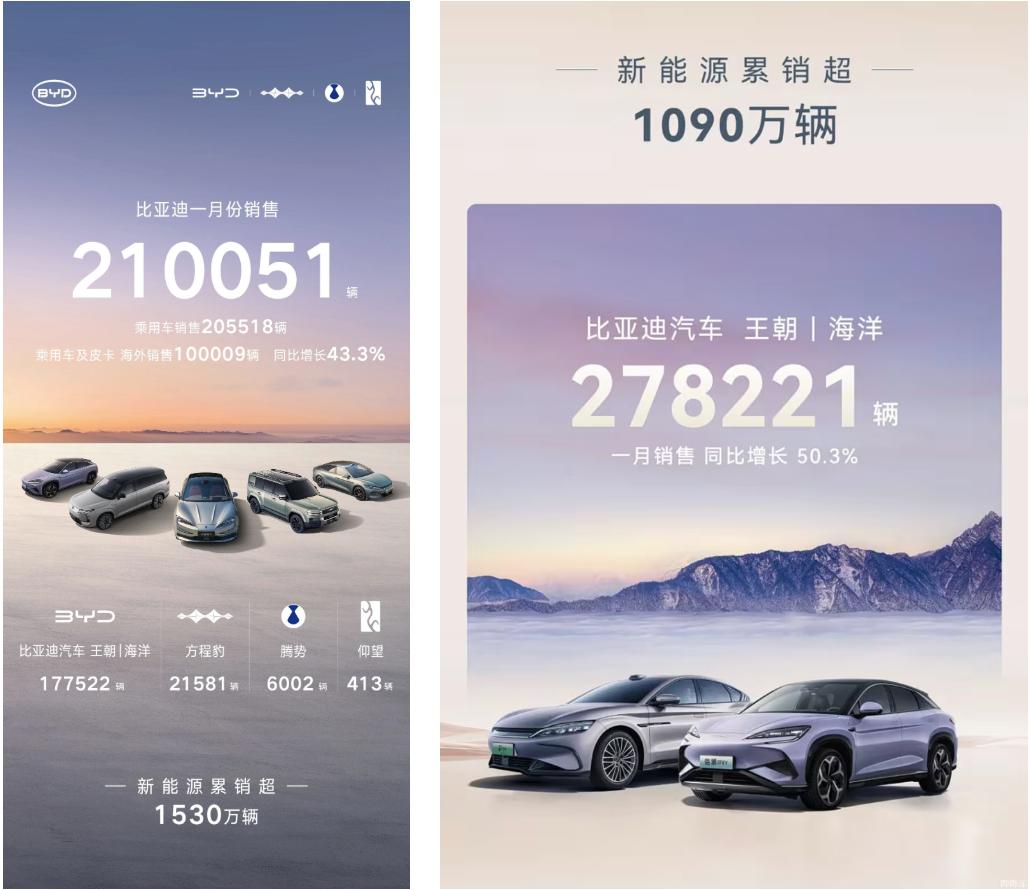
The left figure shows the sales volume in January 2026, and the right figure shows the sales volume in January 2025.
It should be noted that BYD exported more than 100,000 vehicles last month, a year - on - year increase of 51.5%, and the export proportion was almost half of the monthly sales volume. With this increase in exports and decrease in domestic sales, it can be simply calculated that BYD's domestic sales volume decreased by 52% year - on - year in January this year. The increase in export volume is also a good thing for BYD. With limited domestic car - buying demand, it is indeed necessary to upgrade the overseas market to the "second battlefield" as soon as possible.
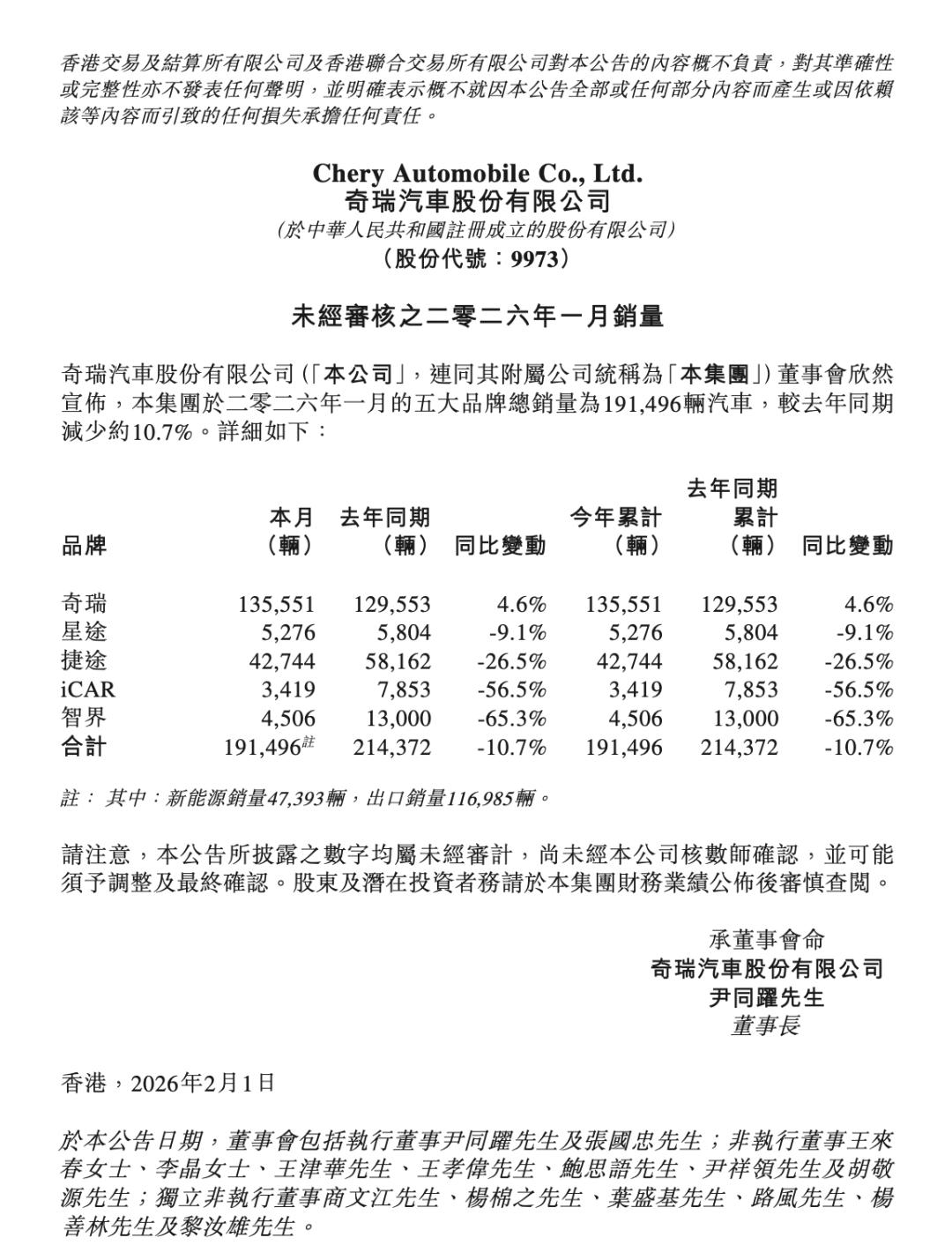
Another automaker that has done an excellent job in going global is Chery Group. Among its monthly sales of 200,000 vehicles, 60% of the models are sold to overseas markets. It is currently the number one among independent brands in terms of export sales volume. Although "export" is indeed an absolute weapon for Chery Group to boost its sales volume, as He Yuhua, the founding partner of Harmony Capital, said: "Chery's main export destinations are Iran, Russia, and emerging countries, and it still needs to further penetrate developed countries such as those in Europe. Moreover, the overseas competition situation is also intensifying."
In addition, the dilemma faced by Chery is different from what was mentioned before. Currently, Chery's new energy vehicle penetration rate is only a little over 20%, far lower than the overall industry penetration rate. The sales volume of Chery's new energy brands, such as Exeed, iCAR, and Jiejie, which were developed with substantial resources, is not optimistic. The sales volume of the latter two in January this year was less than half of that in the same period.
Although Chery can rely on exports and fuel - powered vehicles to maintain its market share in the short term, new energy vehicles are the general trend, and Chery still needs to achieve new energy transformation as soon as possible.
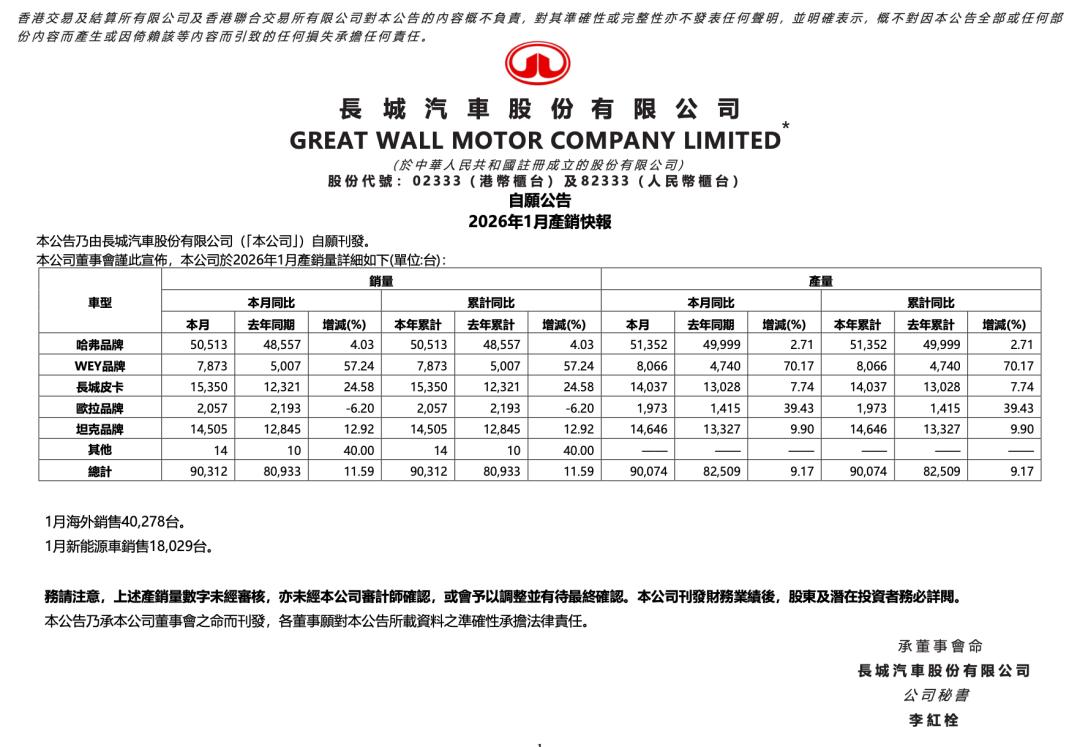
Although the monthly sales volume of Great Wall Motors was only 90,000, it increased by 11.6% compared with the same period last year. Among its five major brands, except for Ora, all had different degrees of growth. Ora happens to be the type of model with a relatively low average unit price and is affected by the decline of policy subsidies. The development bottleneck faced by Great Wall Motors is actually similar to that of Chery. Its new energy vehicle penetration rate in January was also only 20%.
02
After talking about the established automakers, let's take a look at the rising stars.
Hongmeng Smart Mobility ranked first among new - energy vehicle startups with a monthly sales volume of 58,000. Among them, 40,000 were contributed by AITO, whose sales volume increased by 83% year - on - year in January. Jiejie, jointly developed by Hongmeng Smart Mobility and Chery, did not have such good data. Its sales volume was only 4,506 units, a year - on - year plunge of 65.3%, and the situation of other models was also not optimistic. As mentioned in the previous article "The Joys and Sorrows of Hongmeng Smart Mobility after Automakers Handed over Their Souls to Huawei" by the Zhiyi Editorial Department, AITO has developed significantly better than the other four models, which involves reasons such as resource allocation and product definition. According to the official news of Hongmeng Smart Mobility, it plans to launch more than ten new models this year to further enrich its product portfolio and boost the sales volume of non - AITO brands.
The delivery volume of Xiaomi Auto reached 39,000 in January. Although it declined month - on - month, it almost doubled year - on - year. It is worth mentioning that behind this achievement, Xiaomi Auto was in the process of upgrading the SU7, and the YU7 carried the main sales volume. In addition, in January, Xiaomi Auto was still surrounded by negative public opinions such as fire accidents and cooperation with "black fans". To some extent, this also confirms the resilience of Xiaomi Auto's development.
Leapmotor maintained strong growth throughout last year and has achieved consecutive quarterly profits. Against this background, its delivery volume reached 32,000 in January, ranking among the top three new - energy vehicle startups. Although it decreased by 46.9% month - on - month, considering the high - volume sales at the end of last year and the impact of policy subsidies, its development is still strong.
None of the so - called "Wei Xiaoli", often regarded as representatives of new - energy vehicle startups, made it into the top three in terms of sales volume among new - energy vehicle startups. Li Auto, which achieved positive profits in 2023 and 2024 and gained a good reputation, suffered a setback last year and repeatedly stumbled in the pure - electric vehicle segment. After finally launching the Li i6 to redeem itself, it was recently reported to be in a delivery crisis, with production capacity falling short of expectations.
Although Li Auto's sales volume in January was only a few thousand less than that of Leapmotor, it declined both year - on - year and month - on - month. For Li Auto at this stage, the plan to build robots can perhaps be put on hold for now, and the top priority is to increase production capacity and accelerate product iteration and transformation.
Like Li Auto, XPeng Motors also saw a decline both year - on - year and month - on - month.
Looking at NIO, it delivered 27,000 new vehicles in January, a year - on - year surge of 96.1%. However, this data does not necessarily mean that NIO sold very well in January. It is just because its performance in the same period last year was extremely poor.
Overall, in the first month of implementing the new purchase tax policy for new energy vehicles in China, the impact of the decline of policy subsidies on new energy vehicles, especially mass - market and affordable models, was faintly reflected in the Chinese auto market. As the policy continues to be promoted, it may drive the transformation of the Chinese auto industry from focusing on "price" to "quality".
However, it should be emphasized that market fluctuations are normal, and the sales volume in January is only a temporary situation. With the decline of subsidies being a certainty, automakers should quickly find their advantages beyond price and continue to compete with their peers.
This article is from the WeChat official account "Zhiyi", written by the Zhiyi Editorial Department and published by 36Kr with authorization.