Low-altitude economy: Financing skyrocketed by 71% in 2025, and this sector is taking off.
In 2025, the low-altitude economy caught fire.
At the beginning of the year, the "low-altitude economy" was written into the government work report for the first time; at the end of the year, the capital market voted with real money. According to IT Juzi data, there were 255 financing events in China's low-altitude economy track throughout the year, a year-on-year increase of 71%, hitting a record high.
The once science-fiction movie scene of "flying taxis" is accelerating into reality.
Why was it 2025?
The explosion of the low-altitude economy stems from the resonance of three major driving forces.
Policy level: The low-altitude economy has been included in the 14th Five-Year Plan, and the state has clearly designated it as a strategic emerging industry. More importantly, the continuous advancement of airspace management reform - the opening of low-altitude airspace and the simplification of flight approvals have cleared the core obstacles for the large-scale application of drones and eVTOLs (electric vertical take-off and landing aircraft).
Technological level: The iterative upgrading of core technologies such as low-altitude traffic management systems, communication and navigation, and perception and obstacle avoidance has significantly guaranteed the efficiency and safety of low-altitude flights. The maturity of upstream supply chains such as batteries and composite materials has further promoted the formation of a closed-loop in the entire industrial ecosystem.
Market level: The demand in consumer scenarios such as cultural and tourism sightseeing, emergency rescue, and urban delivery has grown rapidly; industrial scenarios such as agricultural and forestry plant protection, power inspection, and surveying and exploration have been deeply penetrated. In remote areas and congested urban roads, low-altitude transportation has demonstrated unique efficiency advantages.
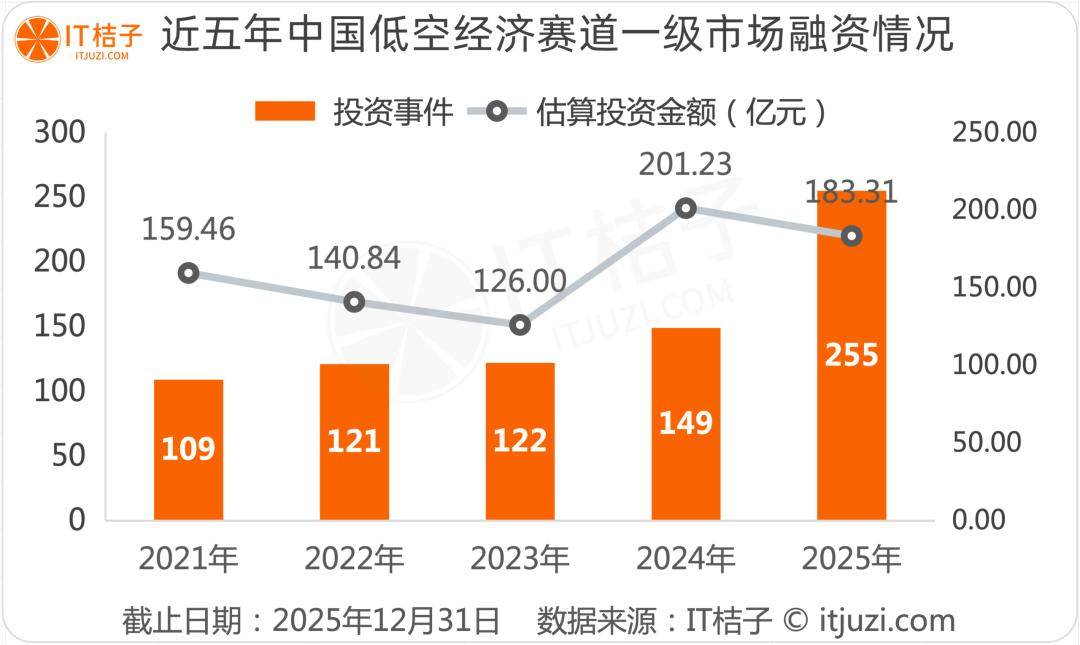
According to IT Juzi data, in the past five years, the financing enthusiasm in the domestic low-altitude economy track has been continuously rising, and it witnessed explosive growth in 2025.
The number of investment events increased from 109 in 2021 to 255 in 2025, showing an overall upward trend. In particular, 2025 was the stage with the most rapid growth. The number of investment events hit a record high, with a year-on-year increase of 71%, indicating a significant increase in the recognition of the track and reaching the peak of capital's attention to the low-altitude economy.
The accelerated growth starting from 2024 - 2025 was mainly because with the implementation of policies, the maturity of technologies, and the verification of scenarios, the primary market reached a stronger consensus on the long-term value of the low-altitude economy. However, although the financing enthusiasm increased significantly in 2025, the estimated investment amount was about 18.331 billion yuan, a year-on-year decrease of 9%. This was mainly because the growth of events was mainly contributed by early-stage investments.
What is the capital investing in?
Different from the "dominance of early-stage investments" in the AI and embodied intelligence industries, the capital logic of the low-altitude economy is more "pragmatic".
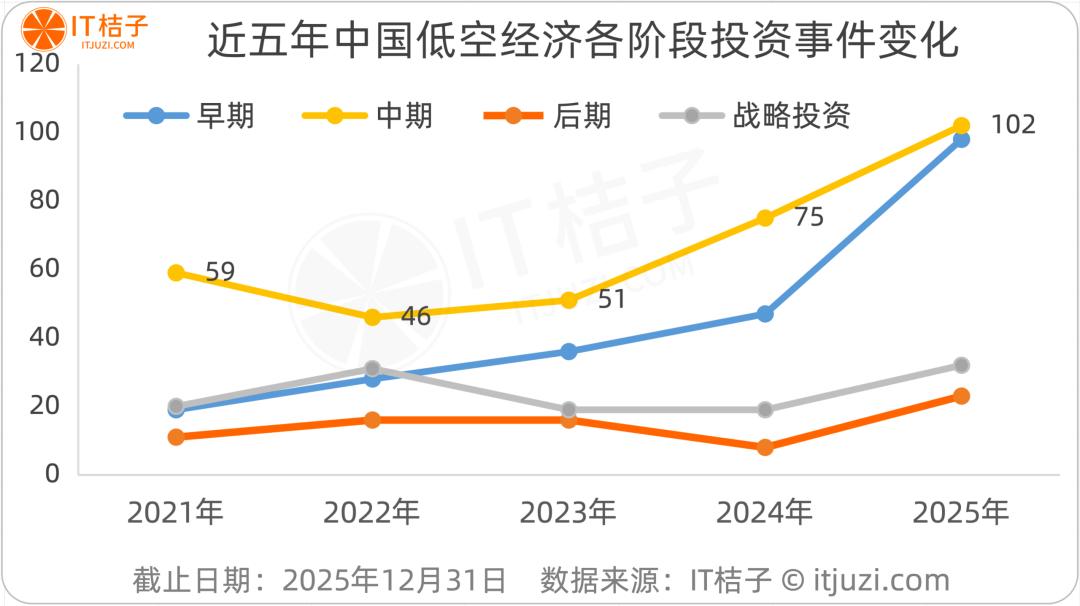
Data shows that mid-term investments (mainly Series A) have always been the mainstream in the low-altitude economy. The reason is that the low-altitude economy involves complex technologies such as aircraft R & D, airspace management, and communication and navigation. Start-up companies need a long time to complete technology verification. Moreover, the safety requirements for manned flights are extremely high, and capital values technology maturity and policy compliance more than just "imagination".
However, in 2025, there was an explosive growth in early-stage investments in the low-altitude economy track, doubling year-on-year to 98. The growth curve was very steep. This was due to the clear implementation of policies, the improvement of the industrial chain ecosystem, and the reduction of the threshold for entrepreneurship caused by technology spillover. The maturity of technologies such as drones and eVTOLs, as well as the improvement of open-source tools and supply chains, allowed start-up companies to build prototypes and verify scenarios more quickly, reducing the start-up costs and risks of early-stage projects.
In addition, late-stage investments (Series C and later) and strategic investments showed a steady growth trend, indicating that some low-altitude economy companies have entered the mature stage and are starting to seek support from industrial capital for large-scale expansion.
Urban competition: Who is leading?
Currently, the urban pattern of China's low-altitude economy has formed a development trend of "leading at the top, competing in echelons, and featuring regional characteristics". Different cities have shown differentiated development paths based on their own industrial foundations, policy advantages, and geographical features.
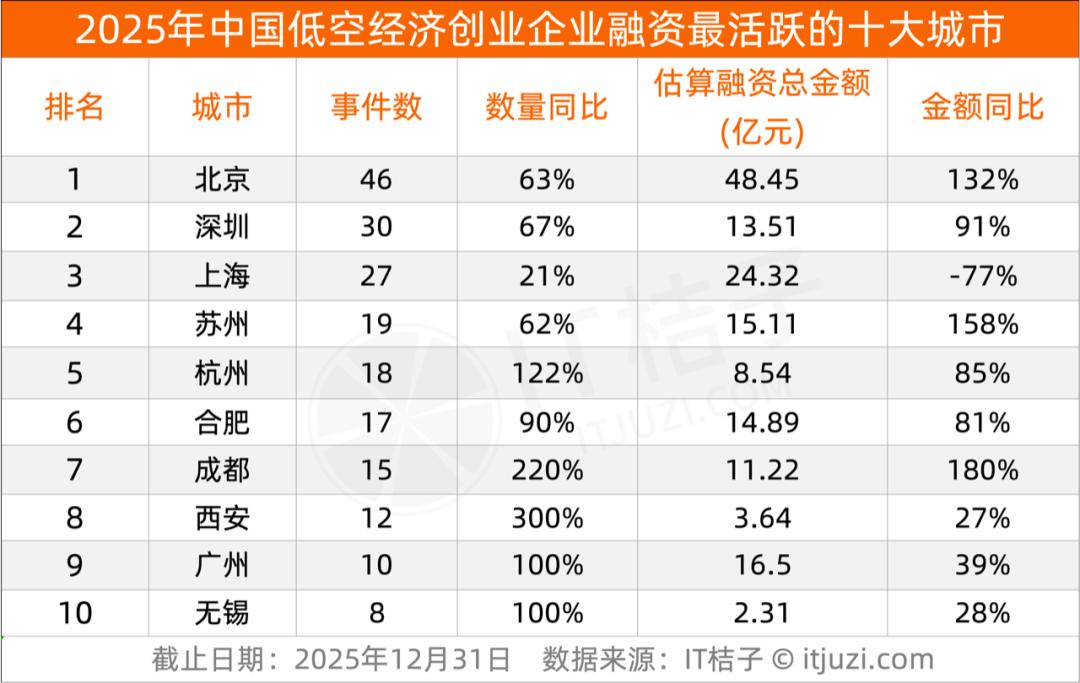
First echelon: Cities with dual cores of policy and industry. They are both pilot areas for policies and core highlands with the most concentrated start-up companies.
Beijing is the core city for policy guidance and technological innovation in the low-altitude economy. In 2025, the number of financing events in Beijing led that of other cities in the country. In particular, the financing amount reached 4.845 billion yuan, an absolute lead. The unicorn enterprise "Weinaxingkong" in low-orbit satellites (core infrastructure for the low-altitude industry) received a large amount of financing, highlighting Beijing's status as the technological base of the national science and innovation center.
As the global birthplace of the drone industry, Shenzhen has leading enterprises such as DJI. Relying on its industrial foundation in electronic information and advanced manufacturing, Shenzhen has formed a complete industrial chain in core links such as aircraft R & D, chips, and navigation.
As a financial and shipping center, Shanghai provides unique advantages for the capital operation and logistics scenario implementation of the low-altitude economy. The representative financing enterprise in Shanghai is the eVTOL unicorn "Volant Aero", which is at the forefront in the fields of electric vertical take-off and landing aircraft R & D, airworthiness certification, and low-altitude traffic operation.
Second echelon: Regionally characteristic cities that have formed unique competitiveness in niche scenarios or industrial chain links.
Relying on the aviation manufacturing foundation in the Chengdu - Chongqing region, Chengdu has advantages in core hardware fields such as drone engines and composite materials. The representative enterprises that received investment in 2025 are "Volantour", a low-altitude travel brand under Geely Holding Group, and "Aoshi Technology", a drone R & D enterprise deeply involved in application scenarios such as mountain emergency rescue and agricultural and forestry plant protection.
Relying on the manufacturing cluster in the Pearl River Delta, Guangzhou has the industrial supporting capacity for core components such as drone flight control systems and motors. It is exploring pilot applications in scenarios such as emergency rescue and urban delivery. The financing enterprise is represented by the low-altitude economy unicorn "XPeng Huitian".
Third echelon: Policy-responsive cities that attract the landing of the industrial chain with local policy support and are in the stage of rapid catching up.
Relying on the capital advantage of government-guided funds, Hefei has introduced low-altitude economy-related enterprises through the "investment + industry" model, focusing on scenarios such as drone manufacturing and low-altitude logistics.
Relying on its aerospace industry foundation, Xi'an has technological advantages in the R & D of military-grade drones and high-end aircraft. It is also actively promoting the application of military - to - civilian technologies in the low-altitude economy.
Relying on the electronic information industry in Optics Valley, Wuhan is promoting the integration of the low-altitude economy and digital technologies. The representative enterprise that received investment in 2025 is "Juxin Microelectronics".
From the ability to implement policies to the integrity of the industrial chain, from the ability to verify scenarios to the reserve of capital and talents, these directly determine the development rhythm of cities, are the core elements to promote technological iteration and industrial upgrading, and are also the core dimensions of urban competition.
This article is from the WeChat public account "IT Juzi". The author is IT Juzi. It is published by 36Kr with authorization.