Slow Companies in a Fast-paced Era: The Arduous Journey of Long-termists
Origin - Why is there a call for "slow companies" in China at this moment?
In the business world, "fast" and "slow" are not simply a binary opposition but two indispensable and complementary aspects of strategic rhythm. "Slow" is the foundation, determining how steadily and how far a company can go; "fast" is the means, determining how quickly and how nimbly a company can run. All outstanding companies are masters of combining "fast" and "slow," dancing to different rhythms in different dimensions.
The concepts of "fast" and "slow" in corporate strategy are not absolute speed concepts but rather priority choices in different dimensions:
It usually refers to the building of long - term core competitiveness, such as technological reserves, brand value, organizational culture, and ecosystem. These require long - term investment and cannot be achieved overnight.
"Fast" usually refers to the agile response in the market, such as product iteration, commercialization, market access, and hot - spot capture. These require agility and efficiency to quickly seize the opportunity.
Outstanding companies are masters of combining "fast" and "slow." They understand this well: use "slow" to build a solid foundation and use "fast" to seize opportunities.
China's economic miracle in the past four decades has written a distinct "fast" in the business field. The efficiency philosophy of "more, faster, better, and more economical," the Internet rule of "only speed can defeat all in martial arts," and the agile tactic of "rapid follow - up and iterative transcendence." This approach based on speed, scale, and model innovation was invincible in the era of catching up and filling market gaps, creating numerous business legends.
However, when the tide of the times has shifted from "availability" to "quality," when the core of competition has moved from "model innovation" to "hard - core innovation," and when the essence of business has changed from "resource - driven" to "value - creation," we suddenly find that the once - successful "fast" approach is hitting the ceiling. Chasing hot - spots leads to homogeneous involution, low - price competition erodes profit foundations, model innovation is easily replicated, and the risk of being "choked" by core technologies hangs like a sword over our heads. We are good at expanding from 1 to 100 but often trapped in original creation from 0 to 1.
Future global competition will be about the depth of R & D, the height of the brand, and the breadth of culture. The building of these capabilities cannot be achieved through "fast." It requires the company to be like a tree, rooting deeply and silently absorbing nutrients to finally thrive and stand firm in the wind and rain. It requires corporate leaders (at the top position) to conduct meticulous and long - term "slow thinking" - a deep - seated thinking that goes beyond quarterly financial reports and focuses on technological trends, market patterns, and user values in the next five, ten, or even more years.
We can see that in the global business landscape, there is a group of "slow companies." They do not chase hot - spots or blindly follow capital. Instead, with almost paranoid patience, they focus on their missions and deeply cultivate their internal strengths. We are also pleased to see that "slow companies" are beginning to emerge in China, including both time - honored traditional enterprises and newly - born emerging species.
Therefore, our exploration of "slow companies" is not a nostalgic act or a devaluation of the value of "fast" but a profound strategic foresight for China's future business. We are trying to find out how to justify the value of "slow" in the era of speed supremacy, how to discover and interpret the corporate samples that win with "slow," and prove that the real "fast" is the persistent pursuit in the right direction.
This article will conduct in - depth analysis of the personal characteristics, team composition, and organizational culture of 5 founders through the samples of slow companies in six global industries and five emerging young slow companies in China. It will decode the organizational characteristics and thinking patterns behind "slow companies" and initiate a dialogue about "fast" and "slow" in combination with the "fast and slow" experiments in talent cultivation being carried out by educational institutions represented by Fuyao University of Science and Technology.
Global Samples and Chinese Practices
Global Samples
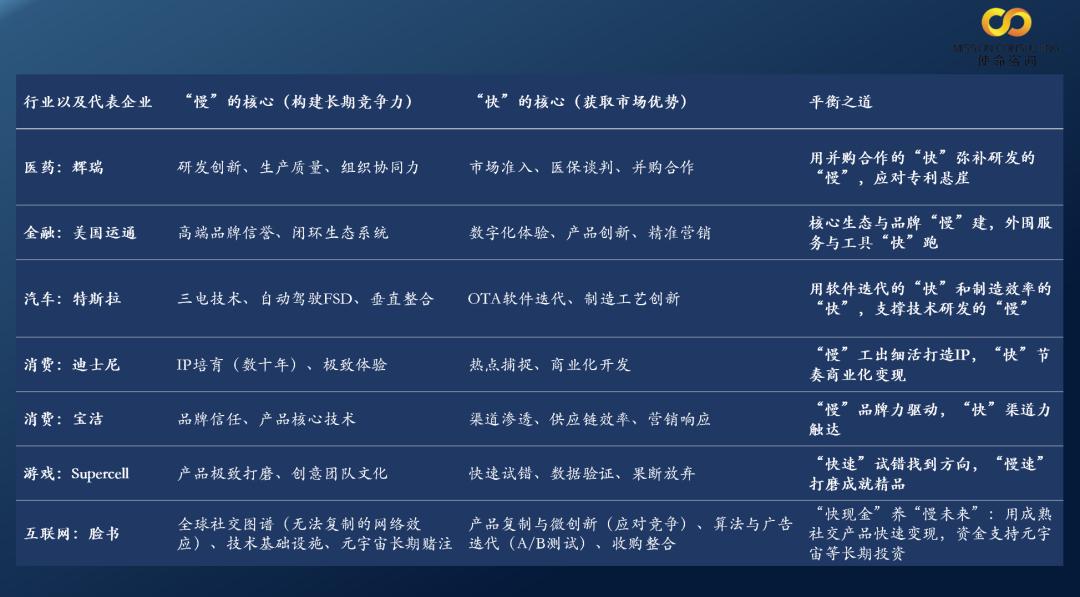
Pharmaceutical Industry: Pfizer - "The Turn of a Giant"
The pharmaceutical industry features "slow R & D and fast commercialization."
1) The "slow" dimension (foundation and bottleneck):
Drug R & D and clinical trials: The R & D cycle of innovative drugs can last 10 - 15 years, cost billions of dollars, and has a very high failure rate.
2) The "fast" dimension (survival and competition):
Market access and medical insurance negotiation: Once a drug is approved, it must enter hospitals and the medical insurance catalog as quickly as possible; otherwise, the sky - high R & D investment cannot be recovered.
Mergers, acquisitions, and cooperation for introduction: To cope with the "patent cliff," pharmaceutical giants have started a "crazy buying" mode, quickly acquiring new products and technologies through large - scale mergers and acquisitions in an attempt to quickly fill the pipeline gaps.
3) The challenges and exploration of balancing "fast" and "slow":
The dilemma of pharmaceutical giants is that their former "slow work" (internal R & D) has not kept up, forcing them to rely on "quick money" (mergers and acquisitions) for emergency relief. However, this brings high - level debts and management integration problems, further squeezing the profit and R & D investment space.
Financial Industry: American Express - "The Agility of the Elite"
American Express has demonstrated a balancing act of "slow brand and fast experience" targeting high - end customer groups in the seemingly traditional financial industry.
1) The "slow" dimension (moat):
Brand value and trust: American Express has spent a century building its high - end, reliable, and prestigious brand image. This brand perception is its deepest moat, enabling it to charge merchants a higher commission than the industry average.
Closed - loop ecosystem: Building a closed - loop network of "issuing - acquiring - clearing" (Closed Loop) is a slow process. It allows American Express to have full - chain data, providing precise services and risk control for core customers. This model is difficult to replicate.
2) The "fast" dimension (evolution and response):
Digitalization and technological empowerment: Facing the challenges from fintech companies, American Express must quickly embrace digitalization, launch mobile payment, optimize the online experience, and use data analysis for precise marketing and risk management.
Product and market innovation: While adhering to the high - end market, it also quickly launches sub - brand products targeting mid - and low - end customers (such as student cards) and specific scenarios to cope with competition and expand market share.
3) The art of balancing fast and slow:
American Express's strategy is "slow at the core and fast at the periphery." It firmly maintains the stability of the "core" of its high - end brand positioning and closed - loop ecosystem without seeking rapid change. However, the service tools, product forms, and technological applications around this core are constantly and rapidly iterated to ensure that the experience of top - level customers never lags behind.
Automobile Industry: Tesla - "The Rhythm of the Disruptor"
Tesla has redefined the rhythm of the automobile industry, and its "fast - slow" logic is completely different from that of traditional automakers.
1) The "slow" dimension (long - term bet):
Three - electric systems and vertical integration: Tesla has made long - term and huge investments in the R & D of battery technology, motors, and electronic controls and has built its own super - factories, conducting in - depth vertical integration in the supply chain. These are all "slow works" with large investments and long cycles.
Autopilot FSD: This is Tesla's biggest "slow bet." With continuous R & D investment for more than a decade and relying on the real - road test data of millions of vehicles for cyclic iteration, it is a marathon - style technological competition.
2) The "fast" dimension (iteration and disruption):
Product iteration and software update: Like a technology company, Tesla quickly pushes new functions, fixes bugs, and even improves performance for vehicles through OTA (Over - the - Air) technology. The hardware iteration speed is also much faster than the "annual model change" cycle of traditional automakers.
Manufacturing innovation and cost control: Tesla continuously and rapidly improves manufacturing processes (such as integrated die - casting) to achieve ultimate cost - reduction and efficiency - improvement and quickly seize market share.
3) The art of balancing:
Tesla's rhythm is to "use the fast software update to make up for the slow hardware innovation and use the fast manufacturing efficiency to support the slow long - term R & D." Its core strategy is to maintain market popularity and cash flow through rapid software iteration and cost reduction to support long - term investments such as autopilot, which are like "poetry and the distant land."
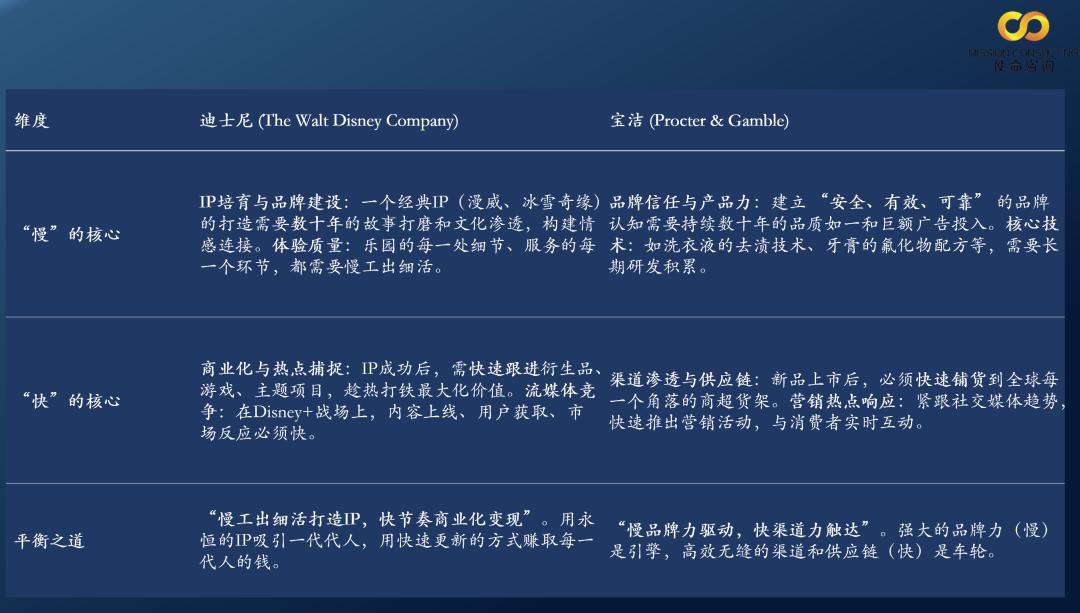
Consumer Industry: Disney & Procter & Gamble - "The Classic Duet"
The consumer industry has a wide scope. Disney and Procter & Gamble represent two different fast - slow rhythms of "emotional consumption" and "functional consumption" respectively.
Game Industry: Supercell - "The Lean Perfectionist"
This Finnish mobile game company, with its "small teams," has created blockbusters such as Clash of Clans. Its fast - slow philosophy is very distinctive.
1) The "slow" dimension (quality and culture):
Extreme product refinement: Supercell believes in "launch only when it's good enough." It can repeatedly adjust or even cancel highly - completed projects for the sake of quality. This extreme pursuit of product experience is an absolute "slow work."
Small - team self - governance culture: Building a creative team culture with a high level of trust and self - governance is not easy. It requires long - term perseverance and patient cultivation, which is an organizational "slow work."
2) The "fast" dimension (trial - and - error and verification):
Fast trial - and - error and iteration: Supercell uses the Minimum Viable Product (MVP) model, quickly creates prototypes, puts them into the market for testing, and quickly iterates or decisively abandons (cancels projects) based on data feedback. The faster the failure, the higher the probability of success.
Data - driven decision - making: Supercell uses real - time data to quickly verify gameplays, payment points, retention rates, etc., and quickly makes decisions on whether to continue or terminate.
3) The art of balancing:
Supercell's rhythm is "fast trial - and - error and slow refinement." It first uses the "fast" way to conduct a large number of trial - and - errors to find potential directions. Once the target is locked, it switches to the "slow" mode and carefully polishes the product like a craftsman, not launching it until it is perfect.
Meta (Facebook) - "The Rhythm of the Social Empire"
1) The "slow" dimension (building the foundation of the empire):
Global social graph and network effect: This is Meta's most core and heaviest "slow asset." The social relationship network connecting billions of people around the world cannot be built overnight. It requires nearly two decades of continuous operation, maintenance, and trust accumulation. This is its deepest moat.
Technological infrastructure: Meta has invested heavily in building global data centers, fiber - optic networks, and other underlying facilities to support the photo and video uploads and real - time interactions of global users at a very low cost and with a huge capacity. This is a long - cycle investment that is capital - and engineering - intensive.
Long - term bet (the metaverse): Mark Zuckerberg renamed the company Meta and promised to invest more than $10 billion annually in the development of VR/AR and metaverse technologies. This is a "slow" strategy that may take 10 years or even longer to see returns, demonstrating a strong long - termism patience (despite facing short - term financial pressure and market doubts).
2) The "fast" dimension (competition and evolution):
Product replication and micro - innovation: Facing competitors (such as Snapchat's Stories and TikTok's short - videos), Meta can quickly respond, launch similar functions (Instagram Stories, Reels), and quickly iterate and optimize them with its huge user base to catch up and overtake.
Algorithm and advertising system iteration: Meta's core advertising push algorithm and commercialization tools are almost undergoing massive A/B testing and rapid iteration every day to maximize the return on investment (ROI) of advertisers and its own revenue.
Acquisition and integration speed: When facing a disruptive threat, Meta will quickly make acquisitions (such as Instagram and WhatsApp) and integrate them into its own ecosystem and commercialization system at an amazing speed.
3) The art of balancing:
Meta's rhythm is to "use the huge profits quickly realized from the existing platforms to support the 'slow' strategic investments for the future." Facebook and Instagram, the two "cash cows," make money efficiently through the rapidly iterated advertising system, providing funds for the long - term losses of Reality Labs (the metaverse department). This is a classic strategic rhythm combination.
Emerging Chinese Samples: The Fast - Slow Balancing Strategies of Unicorns from Trendy Toys, AI to Content Creation
Pop Mart: The Fast - Slow Philosophy of Trendy Toy Culture
As a global trendy culture and entertainment enterprise, Pop Mart's success reflects a unique "fast - slow balance" philosophy. Its founder, Wang Ning, advocates the business concept of "fast decision - making and slow execution," finding a synergistic effect in this seemingly contradictory rhythm.
1) The "slow" dimension: IP cultivation and brand building:
Long - term IP cultivation: Pop Mart spares no effort in cultivating IP value over a period of several years or even longer. Wang Ning emphasizes that the company's goal is not to make LABUBU a short - lived popular symbol but to create an IP with long - term vitality. This concept requires the company to resist the temptation of short - term monetization and focus on the emotional connection and cultural value accumulation of the IP. From MOLLY to SKULLPANDA, each successful IP has gone through a long incubation process, including character setting, story construction, and the formation of user emotional connection.
Exquisite channel experience: Pop Mart operates more than 400 directly - managed stores globally, and each store is carefully selected for its location and designed. Wang Ning proposed the concept of "breathing sense," emphasizing that the stores are not only sales places but also spaces for IP - consumer interaction, providing a temple - like experience.
Building a solid foundation for the supply chain: Through lean production and automation transformation, Pop Mart has increased its production capacity by more than 10 times. Wang Ning believes that "a global enterprise must have global production and manufacturing." This global supply - chain layout not only reduces costs but, more importantly, improves the flexibility to respond to market changes, laying a solid foundation for continuous growth.
2) The "fast" dimension: Market response and commercialization:
Agile market expansion: In the first half of 2025, Pop Mart's performance showed explosive growth, with a revenue of 13.88 billion yuan, a year - on - year increase of 204.4%. Its internationalization process is particularly rapid. This triple - digit growth reflects Pop Mart's ability to quickly seize the global market.
Efficient IP commercialization: Once an IP is verified by the market, Pop Mart can quickly promote the commercialization process. This rapid monetization ability enables the company to quickly convert IP value into commercial results.
Precise limited - edition strategy: Facing scalper speculation and market speculation, Wang Ning firmly adopted a "slow - down" strategy, implementing a series