Shaw Brothers: A Century-Old Hong Kong Brand, Now a Springboard for Chinese Culture to Go Public
Author | Song Wanxin
Editor | Zhang Fan
The Hong Kong entertainment industry is gradually being dominated by the "Li" family.
Recently, Shaw Brothers, a leading film group in Hong Kong, issued an announcement stating that it plans to acquire the core film and television assets of its major shareholder, China Media Capital (CMC).
The core film and television assets mainly refer to the business held by CMC Moon Holdings, which is indirectly controlled by CMC through its wholly - owned subsidiary HoldCo.
CMC Moon almost covers CMC's most core film and television content and channel resources, including top drama production company New Classics Media, film investment and production company Shanghai CMC Pictures, overseas distribution business CMC Pictures, as well as the cinema network operating under the UME brand and CMC Cinemas.
At the close of the second trading day after the announcement, Shaw Brothers' stock price was reported at HK$0.32 per share, a sharp drop of 15.79%.
In terms of asset scale, as of the end of September 2025, the total audited assets of Shaw Brothers were approximately HK$459 million, while the net value of the proposed injected assets was as high as approximately HK$8.558 billion.
On the surface, it seems that Shaw Brothers is "a snake swallowing an elephant" by buying assets, but in essence, CMC has completed its listing through a reverse backdoor listing, and the small and medium - sized shareholders of Shaw Brothers have become the direct payers in this game.
01 Reverse Backdoor Listing
Before the transaction, CMC already held 29.94% of the shares of Shaw Brothers, making it the second - largest shareholder. At that time, Shaw Brothers only focused on the production and a small amount of distribution of Hong Kong films, without any offline cinema layout. Meanwhile, its revenue continued to shrink from 2022 to 2024.
For CMC, the valuation of its film and television assets was previously on the low side, and the financing and expansion of UME Cinemas were also restricted. It lacked a Hong Kong - listed platform for asset securitization.
Through this share - issuance acquisition, CMC's shareholding ratio soared to 59.74%. After achieving absolute control of Shaw Brothers, CMC was able to complete its listing through a reverse backdoor listing.
The reason why CMC did not choose an independent IPO is, on the one hand, that the film and television industry has been under long - term valuation pressure, and investors lack confidence, so it is difficult to achieve the expected valuation through an independent IPO. On the other hand, CMC's business is diversified and scattered, resulting in high costs and long cycles for integration and application.
Through the reverse backdoor listing, CMC not only avoided the cumbersome process of a Hong Kong IPO but also completed the securitization of its film and television assets and found a listing and financing platform for UME Cinemas, solving two major pain points at one go. The essence of the transaction is that CMC has completed efficient integration through "internal transfer", taking into account efficiency, certainty, and long - term value.
However, the 15.8% discount on the rights issue in this transaction has caused a severe shock in the secondary market and is also the core of the controversy in this capital maneuver.
The price of this rights issue is HK$0.32 per share, a discount of 15.8% compared with the closing price before the announcement, far exceeding the average discount rate of 8% - 12% in mergers and acquisitions in the Hong Kong entertainment industry.
More importantly, the issuance scale of 15.93 billion shares accounts for 91.82% of Shaw Brothers' total issued shares after the issuance, directly causing the shareholding ratios of the original small and medium - sized shareholders to be halved collectively, and there are no compensation clauses for small shareholders in the transaction.
In this regard, the market interprets it as CMC's compromise for "quick delivery and absolute control" —
To meet the Hong Kong Stock Exchange's requirement that the public shareholding should not be less than 25%, CMC allocated some shares to related parties such as Alibaba and Tencent, and their combined shareholding reached 34.52%, which not only quickly locked in the controlling stake but also avoided leaving room for price increases in the secondary market.
After the announcement, the secondary market voted with its feet. Shaw Brothers' stock price dropped from HK$0.38 to HK$0.275, and its market value evaporated by more than 30%. The rights and interests of small and medium - sized shareholders shrank significantly.
According to the transaction announcement, CMC plans to integrate the resources of Shaw Brothers, New Classics Media, and UME Cinemas within 12 months after the completion of the transaction to achieve full - link collaboration in "content production, distribution, and offline screening".
However, this plan still faces multiple tests — the cross - regional management of film and television and cinemas tests CMC's integration ability. Although UME Cinemas are located in first - and second - tier cities, there is still a risk that the industry's recovery may fall short of expectations; some small shareholders of Shaw Brothers have launched a joint inquiry, and their rights - protection demands may slow down the transaction delivery process.
For the small and medium - sized shareholders of Shaw Brothers, the short - term shrinkage of their rights and interests is a foregone conclusion. Whether they can recover their capital through long - term valuation repair depends on CMC's integration efficiency and asset realization ability.
For the entire entertainment industry, this transaction may mark that the Hong Kong stock market will become an important platform for the securitization of mainland entertainment assets.
02 The Behind - the - Scenes King of Hong Kong Entertainment
The decline of the Hong Kong entertainment industry is obvious to all.
Since 2018, TVB has been in continuous losses for 7 years. When announcing its full - year financial report for 2024, the company said that it expects to achieve profitability in 2025. Meanwhile, Mango Excellent Media, also from the traditional television industry in the Chinese mainland, has grown to a market value of about HK$50 billion, more than 30 times the market value of TVB's parent company.
As the "Rupert Murdoch" of the Chinese mainland, CMC, headed by Li Ruigang, has made layouts in almost all fields of the media and entertainment industry, including but not limited to film and television, music, and sports. In Hong Kong, CMC also got involved early.
Since 2015, CMC has led the strategic investment in TVB and became its largest shareholder in 2020. It has been re - elected as a director multiple times since 2023 and actually controls TVB's strategic direction.
It can be seen that in the first few years of the investment, Li Ruigang remained inactive towards TVB. It was not until recent years when TVB was on the verge of collapse that a series of adjustments were made. For example, it launched live - streaming e - commerce and co - produced shows such as Sound of Colours: Cantopop Season and Beyond the Dream with mainland platforms like Mango TV and Youku.
Taking Sound of Colours: Cantopop Season as an example, TVB only provided resources such as artists and copyrights, while Hunan Satellite TV was both the investor and the producer. According to a report by Zhengu Research Institute, after the program was broadcast in Hong Kong, all the income belonged to TVB. Zeng Zhiwei, who returned to TVB, said bluntly: "We got a free program."
However, even so, a series of reforms have had little effect on TVB's actual performance turnaround.
In 2022, when this variety show was broadcast and live - streaming e - commerce was launched, although TVB's overall revenue increased by 24%, its losses continued to expand. Compared with the loss of HK$314 million in the previous year, the loss increased by HK$24 million, and the secondary market was also rather cold.
Live - streaming e - commerce significantly boosted the stock price to a four - year high in 2023, but it failed to live up to the hype. That year, TVB's e - commerce business revenue shrank significantly. By 2024, the e - commerce business revenue was only HK$126 million, and it has become the only loss - making business of TVB at present.
After reaching a high of HK$18 in 2023, TVB's stock price has since fallen back to around HK$3.
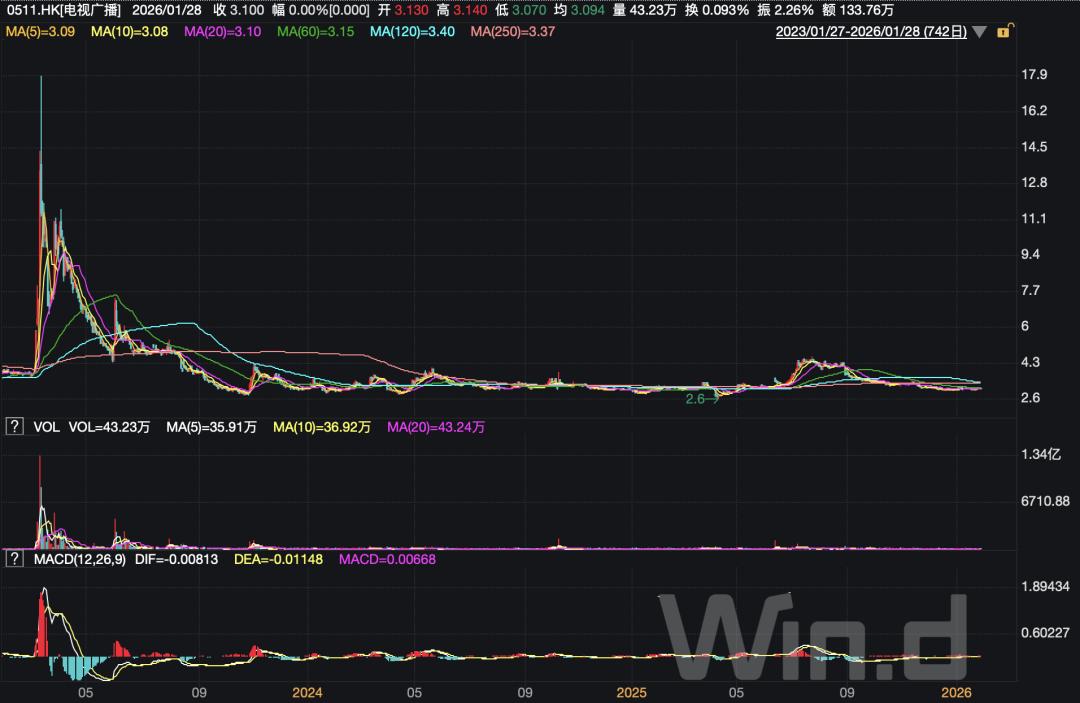
(TVB's stock price in the past three years)
The "shell" Shaw Brothers Film Co., Ltd. that CMC used for the reverse backdoor listing this time, like TVB, is also a "tear of the times" under Run Run Shaw.
"Shaw Brothers' martial - arts films" were the signature of Hong Kong movies from the 1950s to the 1980s. In the 1960s, the martial - arts culture emerged, and Run Run Shaw followed the commercial film - making route, adhering to the principle of "audience first". Based on his insight into the interests of the then urban audience, Shaw Brothers successfully caught the wave of martial - arts film viewing.
In addition, in terms of company management, the American - style studio system introduced by Run Run Shaw also made film production more standardized and industrialized. It was called the "Oriental Hollywood" in the industry, bringing substantial profits to Shaw Brothers.
The Daily Telegraph in the UK reported that at its peak, more than 2 million viewers watched Shaw Brothers' movies every week.
However, it should be noted that this old - established Hong Kong film studio that was active in the last century is actually a different entity from the current "Shaw Brothers" — Shaw Brothers' core content assets were permanently sold to Celestial Pictures in Malaysia in 2000.
After that, Shaw Brothers was left with only an empty brand. The copyrights of about 760 classic movies had nothing to do with Shaw Brothers anymore, and Shaw Brothers officially entered a period of decline. Until 2009, Shaw Brothers completed its privatization and delisted from the stock market.
Then came the appearance of CMC. In 2015, when CMC was actively investing and building its entertainment empire, it took control of a Hong Kong - listed company called Makalot International. Meanwhile, as the largest shareholder of TVB, CMC obtained the brand - use right of Shaw Brothers through the relationship between TVB and Shaw Brothers.
Subsequently, in 2016, CMC renamed Makalot International as "Shaw Brothers", a new "Shaw Brothers" that has nothing to do with the old - established studio in people's perception in essence.
Now, this "Shaw Brothers" shell is once again used by CMC as a listing platform for capitalization operations, with mainland film and television brands and cinema assets injected.
So far, the new "Shaw Brothers" entity integrates the Hong Kong studio brand, the Hong Kong - listed platform, mainland film and television content and cinemas, as well as mainland capital. CMC has clearly become the main testing ground for the integration of the Hong Kong and mainland film and television circles.
However, from the practice in the past few years, against the backdrop of unresolved long - standing problems, after the Hong Kong entertainment industry grafted mainland resources and had a brief revival, it eventually returned to calm.
*Disclaimer:
The content of this article only represents the author's views.
The market is risky, and investment should be cautious. In any case, the information in this article or the opinions expressed do not constitute investment advice to anyone. Before making an investment decision, if necessary, investors must consult professionals and make decisions carefully. We have no intention of providing underwriting services or any services that require specific qualifications or licenses to engage in for the parties involved in the transaction.

Follow us for more information