Which city will become the next major hub for China's chip industry in the next five years?
On January 19, 2026, the National Bureau of Statistics released the full - year economic data for 2025. The annual gross domestic product reached 140.19 trillion yuan, and China's economy grew by 5% year - on - year. Among them, the rapid development of "Artificial Intelligence +" drove the output of products such as memory chips and servers to increase by 22.8% and 12.6% respectively.
On January 20, 2026, Liao Min, the deputy minister of the Ministry of Finance, stated at a press conference held by the State Council Information Office that in 2026, the financial department will continue to implement a more proactive fiscal policy, which can be summarized as "increasing the total amount, optimizing the structure, improving the efficiency, and strengthening the momentum".
China's integrated circuit industry is standing at a crucial historical juncture of leaping from "scale expansion" to "high - quality development". The 15th Five - Year Plan (2026 - 2030) has set the main theme for the industry's development: it is no longer simply about catching up in production capacity, but also about in - depth exploration of the supply chain.
2026 is the first year of the 15th Five - Year Plan. The 15th Five - Year Plan suggestions and special policies released by many regions have clarified the development paths around core areas such as integrated circuits, chips, artificial intelligence, and embodied intelligence, anchoring the direction for the high - quality development of the industry. After comprehensively studying the planning priorities of the integrated circuit industries in Beijing, Shanghai, Guangzhou, as well as central and western regions, Semiconductor Industry Insights found that the regional characteristics of the integrated circuit industry will be obvious in the next five years. This article will look forward to the development prospects of China's integrated circuit industry in the next five years with readers.
01 This is the Best of Times: Seize the Opportunities and Face the Challenges
The "Proposal of the Central Committee of the Communist Party of China for Formulating the 15th Five - Year Plan for National Economic and Social Development" states that one of the main goals of the 15th Five - Year Plan is to significantly improve the level of scientific and technological self - reliance. The "Proposal" points out that it is necessary to strengthen original innovation and tackle key core technologies. Promote decisive breakthroughs in key core technologies in key areas such as integrated circuits, industrial mother machines, high - end instruments, basic software, advanced materials, and biological manufacturing across the entire chain. The "Proposal" also mentions that it is necessary to cultivate and expand emerging industries and future industries, and make forward - looking arrangements for future industries. Quantum technology, biological manufacturing, hydrogen energy and nuclear fusion energy, brain - computer interfaces, embodied intelligence, and sixth - generation mobile communications have become new economic growth points.
During the 15th Five - Year Plan period, innovation will no longer be limited to the "0 to 1" breakthrough in the laboratory, but will emphasize the industrial transformation from "1 to 100" and ecological reconstruction. Under such an overall goal, local regions have introduced 15th Five - Year Plans with different focuses based on their local industrial bases.
From a policy perspective, the integrated circuit industry planning in each region shows the characteristics of co - existence of "differentiated competition" and "local cooperation". Through local - adapted support policies, each province and city is reshaping its local industrial ecosystem.
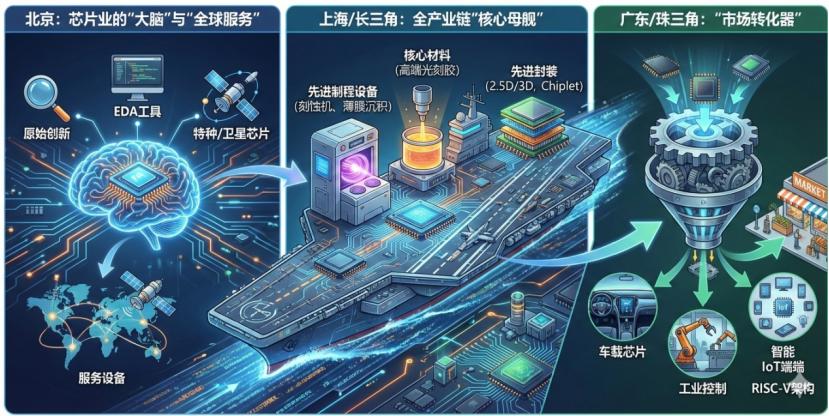
The picture is generated by Gemini.
02 Beijing: Build the Brain of the Integrated Circuit Industry
Beijing has listed "significantly improving the level of scientific and technological self - reliance" as the core goal during the 15th Five - Year Plan period. It will build the Zhongguancun Science Park into a world - leading science and technology park, focusing on the innovation of the underlying architecture of integrated circuits, the research and development of new computing chips, and EDA tools. Haidian District has released a work plan to promote the high - quality development of trade in services, which mentions that Haidian District should create a number of influential service trade brands and industrial clusters. Form influential industrial clusters in key areas such as information technology, artificial intelligence, scientific research and development, and financial services. Promote digital trade to lead development and the digital transformation of trade, and improve the global service capabilities of digital technology enterprises in artificial intelligence, blockchain, integrated circuits, etc. Actively connect with national pilot policies such as the expansion of the opening - up of value - added telecommunications services, promote the implementation of businesses such as Internet Data Centers (IDC) and Internet Service Providers (ISP), and attract innovative entities to settle. Support enterprises to carry out low - orbit satellite export business, cultivate new forms of digital trade, and expand new paths for service exports. Build a coordinated development pattern where the Haidian Cluster of the China (Beijing) Pilot Free Trade Zone and the National Digital Service Export Base of Zhongguancun Software Park cooperate and drive the development of multiple parks.
During the 14th Five - Year Plan period in Beijing Economic - Technological Development Area, the average annual growth rate of the leading industries such as the new - generation information technology in Yizhuang, high - end automobiles and new - energy intelligent vehicles, biotechnology and large - scale health, and robots and intelligent manufacturing was 8%. The number of enterprises above the designated size in future industries accounted for one - quarter of the city, and six industrial clusters with a scale of 100 billion yuan were formed. With only 1.37% of Beijing's land area, it contributed nearly 40% of the industrial added value.
The spill - over effect brought about by the development of Beijing's integrated circuit industry will drive the digital and intelligent transformation of industries in the Beijing - Tianjin - Hebei region, forming a coordinated pattern of "research and development in Beijing, production in Tianjin and Hebei".
03 Shanghai + the Yangtze River Delta: Advance the Whole Industry Chain
Shanghai has listed integrated circuits as one of the three leading industries in its 15th Five - Year Plan suggestions. The goal is to improve the energy level of integrated circuit equipment, manufacturing level, and design ability, and promote the overall breakthrough and development of the whole industry chain; promote full - stack innovation in artificial intelligence, strengthen the coordinated development of high - performance intelligent computing chips, high - quality corpora, and high - efficiency intelligent computing clusters, promote the iterative upgrading of basic large models and the maturation of embodied intelligence technology, deeply implement the "Artificial Intelligence +" initiative, continuously advance the "Molding Shanghai" project, accelerate the application of vertical models and the development of multi - agents, and deepen artificial intelligence governance.
According to the data released by the Shanghai Economic and Information Commission, currently in the integrated circuit industry, Shanghai has established an integrated circuit industry chain system with all links advancing in tandem and supporting each other. A number of leading enterprises in subdivided fields of the industry have been cultivated in chip design, manufacturing, packaging and testing, equipment/materials, EDA/IP, etc., including 35 listed companies on the Science and Technology Innovation Board. Against this background, Shanghai will still be the core city of China's integrated circuit industry in the future. As the center of the Yangtze River Delta region, Shanghai's driving effect on Jiangsu, Zhejiang, and Shanghai areas is already very obvious.
Jiangsu Province stated in its 15th Five - Year Plan that it will take extraordinary measures to promote decisive breakthroughs in key core technologies in key areas such as integrated circuits, industrial mother machines, high - end instruments, advanced materials, basic software, industrial software, and biological manufacturing. Strengthen the strategic, forward - looking, and systematic layout of basic research. Build a laboratory matrix led by the Suzhou Laboratory and the Purple Mountain Laboratory, supported by national key laboratories and provincial laboratories, and effectively operate the provincial laboratory alliance. Promote the construction of the Taihu, Zhongshan, and Yunlonghu Laboratories with greater efforts.
In addition, Jiangsu will deepen the construction of the industrial innovation belt along the Shanghai - Nanjing corridor, support Nanjing in building the Purple Mountain Innovation Belt, and support Suzhou in building the Wusongjiang Science and Technology Innovation Belt. Accelerate the efficient transformation and application of major scientific and technological achievements, and build a high - quality national university regional technology transfer and transformation center.
The "15th Five - Year Plan for New - Type Industrialization in Zhejiang Province (Draft for Comment)" mentions that in the field of chip design and manufacturing, it is necessary to break through low - power chip design and develop high - end general - purpose chips, special - purpose chips, intelligent chips, etc. Develop chips based on the fifth - generation Reduced Instruction Set Computing (RISC) architecture. In the field of wafer manufacturing, accelerate the breakthrough of 3 - 7nm process technology. In the field of key materials, develop compound semiconductor materials, electronic gases, high - purity targets, photoresists, etc. In the field of key equipment, develop ion implanters, photoresist coating and developing equipment, advanced process lithography machines, etching machines, etc. In the field of packaging and testing, accelerate the breakthrough of technologies such as chiplet packaging, three - dimensional heterogeneous integrated packaging, heterogeneous packaging, and pulse sequence testing. In the field of new - generation semiconductors, develop gallium oxide, diamond, silicon carbide, gallium nitride, etc. By 2030, the revenue target of Zhejiang Province's integrated circuit industry will reach 450 billion yuan.
As a province with a scale advantage in the storage and quantum computing industries, from January to November 2025, the added value of industrial enterprises above the designated size in Anhui Province increased by 9.3%, ranking third in the country. The number of science - and - technology - based small and medium - sized enterprises, high - tech enterprises, and specialized and sophisticated "little giants" enterprises ranked fifth, eighth, and seventh in the country respectively; the evaluation of the artificial intelligence industry ranked fifth in the country, the production capacity of dynamic memory chips ranked first in the country, and the production and export volume of automobiles and new - energy vehicles both ranked first in the country.
Hefei has placed great importance on strengthening original innovation and tackling key core technologies in its 15th Five - Year Plan suggestions. It proposes to create a new scientific research paradigm of "organized research + free exploration" and implement major scientific and technological projects. In terms of key area layout, it is clear that it is necessary to accelerate the breakthrough of key core technologies in fields such as quantum technology, integrated circuits, and artificial intelligence; in the frontier fields, strive to produce more landmark original achievements in directions such as brain - computer interfaces, embodied intelligence, and high - level intelligent driving, providing support for the upstream technology research and development of the semiconductor industry.
04 The Pearl River Delta: Encourage Innovation with Real Investment
As the province with the highest GDP in the country, in 2025, Guangdong Province is expected to invest 535 billion yuan in research and development (R&D) across society, with an R&D investment intensity of 3.6%. The "Shenzhen - Hong Kong - Guangzhou" innovation cluster ranked first globally. Eleven enterprises were short - listed in the top 100 global listed humanoid robot companies. The scale of low - altitude flights reached 20.61 million flights. It promoted the technological transformation and digital transformation of 10,000 industrial enterprises. The number of global lighthouse factories increased to 10, and the number of national excellent intelligent factories increased to 22.
In its 15th Five - Year Plan, Guangdong Province clearly proposed to improve the regional innovation system, with the "two corridors" of Guangzhou - Shenzhen - Hong Kong and Guangzhou - Zhuhai - Macao as the main framework, to comprehensively enhance the ability of independent innovation. Strengthen the support of strategic scientific and technological forces and the independent guarantee of scientific and technological basic conditions. Build and make good use of a laboratory system led by the Pengcheng Laboratory and the Guangzhou Laboratory, and supported by national key laboratories and provincial laboratories. Give full play to the role of major carriers such as the Guangming Science City, Songshan Lake Science City, and Nansha Science City. Consolidate and expand the advantages of major scientific and technological infrastructure, high - quality scientific research institutions, high - level research universities, and clusters of leading science and technology enterprises.
Guangzhou has released the "Draft for Comment on Several Policies of Guangzhou for Promoting the High - Quality Development of the Integrated Circuit Industry across the Whole Chain during the 15th Five - Year Plan Period" for public comments. The policy clearly defines two core directions: one is to break through the bottleneck of high - end chip design, accelerate the research and development of design technologies for high - end general - purpose chips such as processors, memory chips, and edge - computing chips. Support the development of special - purpose chips such as RISC - V, automotive - grade, and display driver chips; the other is to increase support for enterprise R&D. For qualified enterprises carrying out tape - outs of chips with independent intellectual property rights at 28nm or below or with significant competitive advantages, subsidies of no more than 50% of the tape - out costs will be provided.
In its 15th Five - Year Plan, Shenzhen has listed integrated circuits, industrial mother machines, high - end instruments, basic software, etc. as key areas in the research and development direction. The goal is to quickly form a number of disruptive and asymmetric technologies with first - mover advantages. At the same time, around the needs of domestic substitution and technological process innovation, promote the application of new technologies and new products in a project - based and list - based manner, and cultivate iconic semiconductor products with international competitiveness.
05 Let the Integrated Circuit Industry in Some Regions "Get Rich First"
Beijing, Shanghai, Guangzhou, Shenzhen, and the Yangtze River Delta region have established a relatively mature development system for the integrated circuit industry. The 15th Five - Year Plans in these regions also have clear characteristics and paths. The concept of "letting some people get rich first" also applies to the integrated circuit industry, which can be seen from the 15th Five - Year Plans for the local integrated circuit industries in Gansu, Sichuan, and other places.
The 15th Five - Year Plan suggestions of Gansu Province focus on the development of the digital economy, proposing to strengthen the national hub node of the integrated computing power network and implement the "Eastern Data, Western Computing" strategy. In the layout of the semiconductor industry, two major measures are clearly defined: one is to promote the agglomeration of the information technology application innovation (ITAI) industry and strengthen the western integrated circuit packaging and testing base; the other is to strengthen the upstream - downstream coordination of computing power, chips, large models, servers, and applications, and build a high - land for the coordinated development of green electricity, green computing, and green industries.
Contributing to the development of the national integrated circuit industry can also start from the "grass - roots" level. The 15th Five - Year Plan of Shaanxi Province states that it will accelerate the construction of a new - type energy system, improve the conversion and utilization system supported by clean and efficient coal - fired power, and promote the increase of the proportion of new - energy supply, local consumption, and external transmission in a coordinated manner. Focus on building a new - type power system, vigorously develop new - type energy storage, accelerate the construction of smart grids and micro - grids, and strengthen the planning and construction of cross - provincial power inter - connection projects such as those between Shaanxi, Gansu, and Qinghai. As energy issues become an important bottleneck restricting the development of data centers, clean energy will also become an important support for the development of integrated circuits.
In the next five years, the characteristics of the integrated circuit industry will become more prominent, and such diversity will support a more stable integrated circuit industry chain. So, which city's semiconductor industry do you think has more potential in the future? Welcome to discuss in the comment section.
This article is from the WeChat official account "Semiconductor Industry Insights" (ID: ICViews), author: Liu Qian. It is published by 36Kr with authorization.