The Great AI Battle Royale in 2026: No Use Cases, No Survival

Stop listening to what AI can change.
It's 2026 now, and a more brutal question is in front of everyone: In which scenarios can your AI survive?
The technology has crossed the singularity, and hot capital money is still surging, but the carnival is ebbing. The catchphrase in the venture capital circle has changed from "How smart is your model" to "How solid is your scenario".
Should it be a "productivity booster" parasitic in the old processes, or should it tear down the old world and create a trillion - level native scenario? Should it embrace the "greenhouse" of chain leaders and big companies, or venture into the "wilderness survival" like in Silicon Valley?
Please listen to the sharing of Xu Yong, the Secretary - General of Zhongguancun Angel Investment Alliance and the Founding Partner of AC Accelerator.
There are three reasons for naming this conference with "scenarios" as the core today:
First, AI technology has passed the stage of "can it be done" and entered the stage of "can it really be implemented to make money". The conditions for the maturity of business scenarios are already in place.
Second, the real needs of ordinary people are never abstract technologies, but problems in specific scenarios.
Third, whether it's capital, industry or policy, the focus of attention is shifting from the technology itself to the value of scenarios.
Based on these changes, at the beginning of 2026, we formed an increasingly clear judgment: Those who master the scenarios will master AI.

In 2025, many scenarios were born in the era of "+AI". AI has been applied in many fields such as industrial manufacturing, financial services, and healthcare, quietly changing the world.
But in 2026, "AI+" is no longer an option but a matter of survival.
The "large models" are accelerating the transformation into "intelligent agents", and "robots" are upgrading to "embodied intelligence". New scenarios such as low - altitude economy, AI for Science, and intelligent manufacturing are expected to achieve in - depth breakthroughs.
Meanwhile, the logic of AI investment is also changing. In the past two years, the focus of capital has been shifting from the background of entrepreneurs and technology demos to whether the scenarios are real, replicable, and can be continuously expanded.
This change was very obvious in the financing market in 2025. Enterprises such as MiniMax, Dark Side of the Moon, and Galaxy Universal obtained large - scale financing by virtue of clear core application scenarios. Tracks such as embodied intelligence, AI chips, and autonomous driving have also become the most concentrated directions for capital.
From a more macro perspective, the factors affecting the development of AI scenarios are becoming more and more diverse: government policies, platform entrances, chain - leading enterprises, base models, AI native companies, ecological systems, and infrastructure such as GPUs and energy are all profoundly affecting how far and how fast AI can go.
In the next 5 to 10 years, which factors can continue to have a profound impact? Whether this answer can be found basically determines whether entrepreneurs and investors can take the lead.
If we look overseas, especially at Silicon Valley, we will find that there are obvious differences in the development paths of AI scenarios between China and the United States, mainly in three aspects: distribution methods, data and compliance boundaries, and industrial structures.
In China, it relies more on chain - leading enterprises, the government, and channels for promotion. Data acquisition is relatively easy, and there are obvious advantages in the combination of AI and hardware, which is more suitable for creating relatively "hard" productivity scenarios.
Silicon Valley, on the other hand, relies on product self - growth and developer ecosystems. It is more restricted by data and compliance. Scenario innovation is mainly software - based, emphasizing measurable ROI, low deployment costs, and strong replicability. Many projects focus on niche fields such as law, healthcare, and finance, and quickly complete business verification through data barriers.
It's hard to simply judge which of the two paths, China's or the United States', is right or wrong, but they may determine the future dominance of AI. This difference also provides a thinking direction for different roles.
For policy - makers, they need to balance the "breadth" and "depth" of AI scenarios: It's not difficult to apply AI to more places, but it's difficult to make it truly useful and effective in specific scenarios.
For large enterprises, should they bet on short - term scenario benefits or lay out long - term technological capabilities? Should they use AI to "patch" old products or use AI to conduct a self - revolution? This is a choice between "+AI" and "AI+".
For entrepreneurs, they need to decide whether to engage in AI native innovation or use AI to improve efficiency. The former requires more patience and resources, while the latter is closer to cash flow.
Investors need to balance investing in consensus or anti - consensus. Many top domestic investors collectively missed out on Cambricon and Moore Threads. In 2025, embodied intelligence and humanoid robots became the categories with the highest financing scale in the AI field by an overwhelming margin - and it was exactly the anti - consensus projects that made investors famous overnight.
An AI investor mentioned a counter - intuitive phenomenon: Sometimes, capital is patient enough, but entrepreneurs may not be willing to invest the same amount of time and perseverance in something that could be very great. This difference in patience also affects the formation of consensus and anti - consensus.
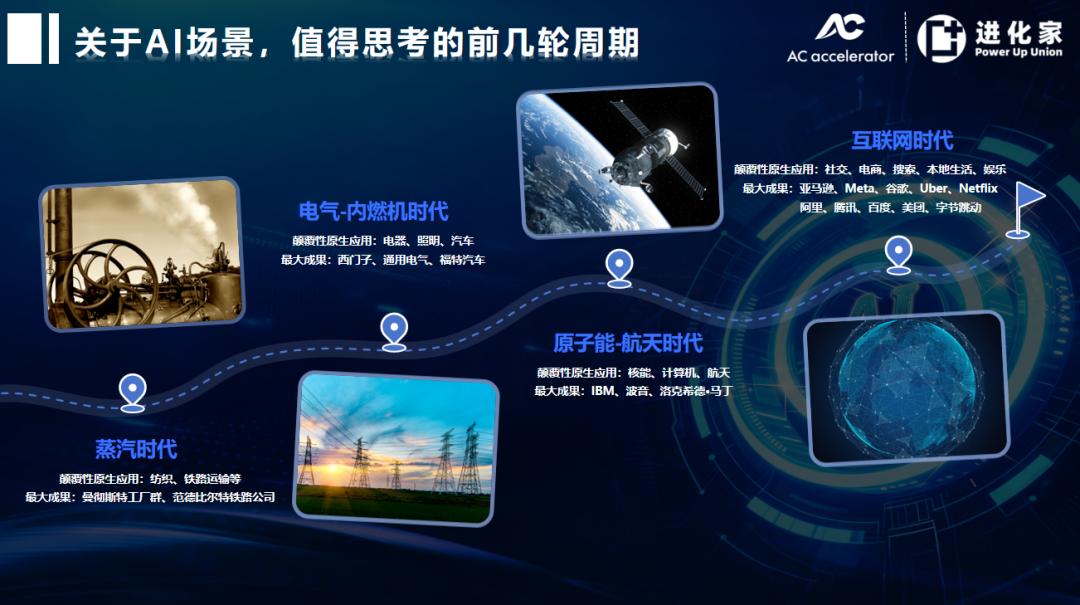
Looking back at the steam age, the electrical age, the atomic age, and the Internet age, each technological revolution will eventually give rise to a brand - new and large - enough core scenario.
The same applies to the AI era: What determines the outcome is not how wide the scenarios are spread, but whether a new and large native scenario can be created.
This scenario must first be new enough. It's hard to create great opportunities by simply "lightly adding AI" to old scenarios. Second, it must be large enough. Even if it stems from AI native innovation, it has the potential to grow into a trillion - level market.
Based on this, we put forward the following initiatives:
Investment institutions should pay more attention to creative projects in new AI scenarios and give real and timely feedback.
Chain - leading enterprises should open up more real application scenarios and share industrial resources and key capabilities.
Startup companies should always focus on a core question - whether the scenario value is truly created.
This article does not constitute any investment advice.
This article is from the WeChat public account "PencilNews" (ID: pencilnews), author: Honest One. It is published by 36Kr with authorization.