Raised $7 billion, with investments from NVIDIA and Volvo, a former Uber tech expert sets sights on autonomous heavy trucks
According to Che Dongxi on January 29th, local time on the evening of the 28th, autonomous vehicle startup Waabi officially announced a $1 billion (approximately 7 billion RMB) financing round and a deep - seated cooperation with Uber.
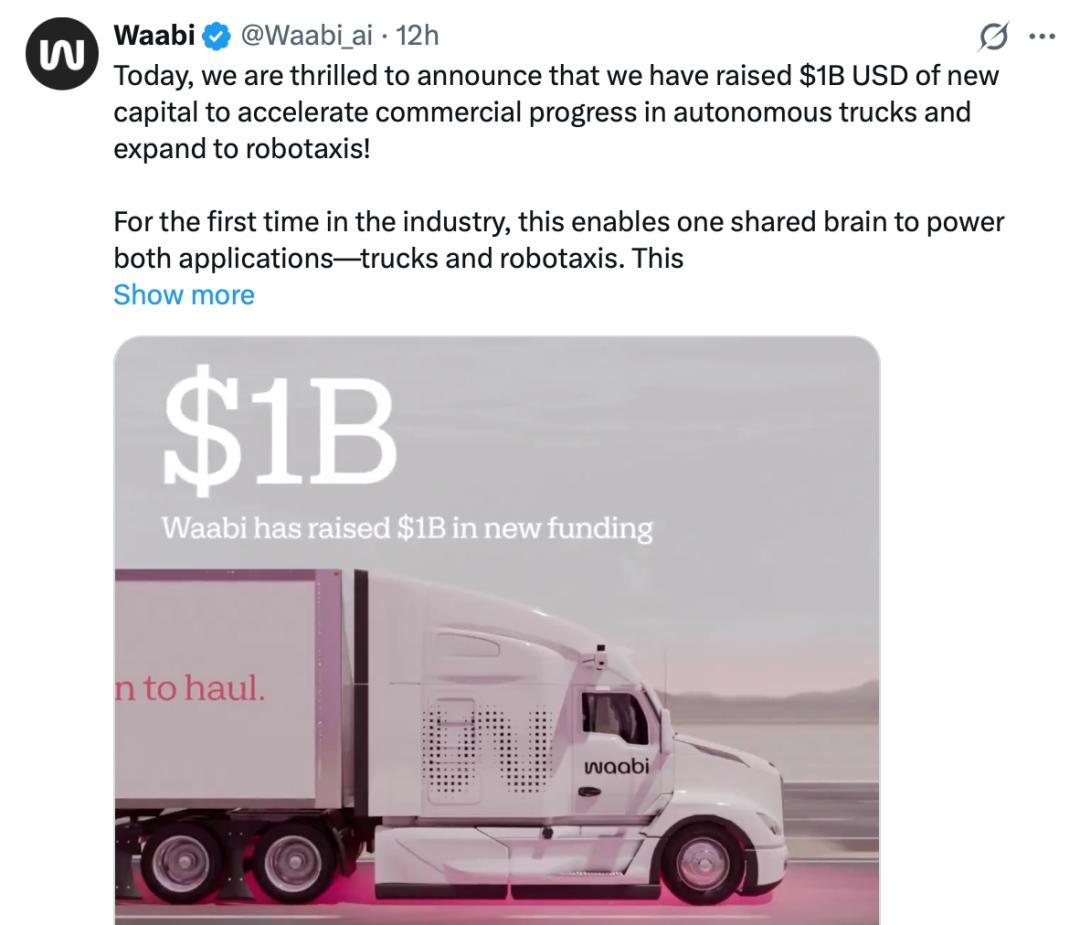
▲Autonomous vehicle startup Waabi officially announces a $1 billion financing round
It is understood that this financing consists of two parts. One is a $750 million (approximately 5.25 billion RMB) Series C financing co - led by Khosla Ventures and G2 Venture Partners, and the other is an additional $250 million (approximately 1.75 billion RMB) investment committed by Uber.
After this financing, Waabi also reached an exclusive agreement with Uber. In the future, RoboTaxis powered by Waabi Driver will be exclusively deployed on the Uber platform, with a target scale of 25,000 vehicles. However, a specific implementation schedule has not been provided yet.
Previously, Waabi had already established a relatively in - depth cooperation with Uber Freight's freight business, conducting autonomous freight tasks on the Dallas - Houston route.
The further expansion of the cooperation between the two parties into the passenger vehicle field can also be regarded as an upgrade of the cooperation.
01.
Business focus on heavy - duty truck freight
Emphasizing Physical AI
At the actual business level, Waabi's current main business area is in Texas. In addition to Dallas, it has also set up logistics centers in Toronto, San Francisco, Phoenix, and Pittsburgh, and is conducting commercialization pilots with human safety drivers in the vehicle.
As of now, Waabi's transportation routes cover the east coast, west coast, central part of the United States, as well as the routes across the central and southern parts of the United States.
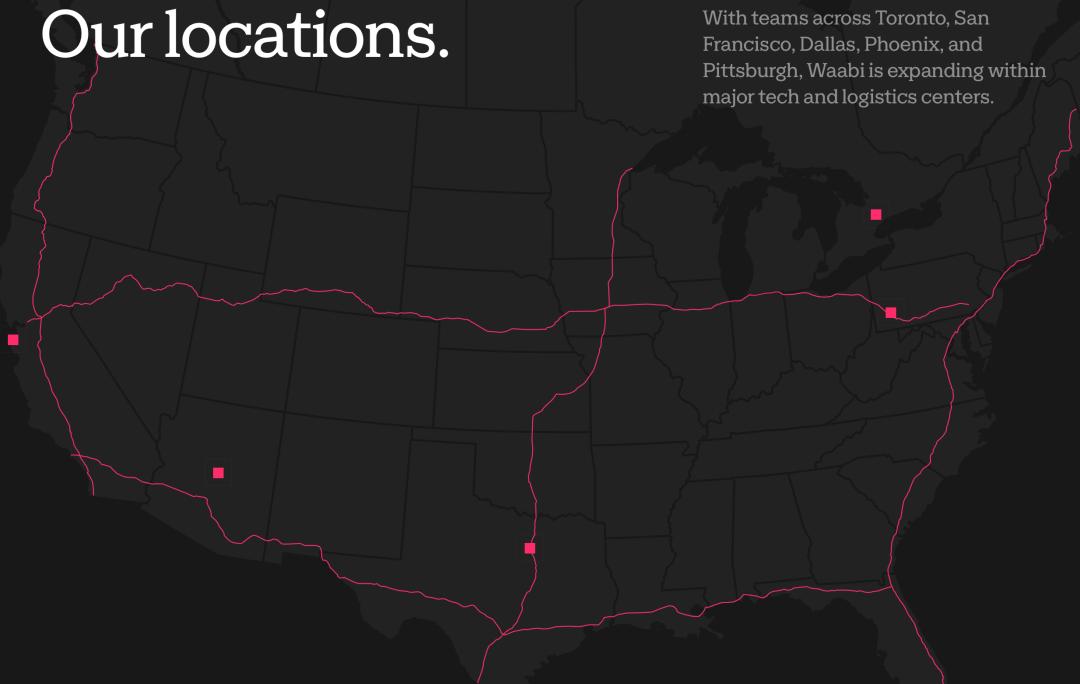
▲Waabi's operation routes
In terms of hardware form, Waabi adheres to the "factory integration" approach and has a deep - seated cooperation with Volvo (Volvo Autonomous Solutions). Through the pre - installation mode, Waabi Driver is integrated into the Volvo VNL Autonomous model.
This approach is not a post - installation modification but allows the sensors, computing platform, and software to be deeply integrated at the factory end to support large - scale deployment without drivers in the future.
It is reported that although Waabi originally planned to launch fully autonomous trucks by the end of last year, the progress has now been postponed to the next few quarters.
From a technical perspective, Waabi's core narrative is "Physical AI".
Waabi believes that autonomous driving should not develop two independent technology stacks for trucks and passenger vehicles but should share a single "brain".
Waabi Driver is this general - purpose autonomous driving system, and its core relies on a high - fidelity neural simulator called "Waabi World".
This system can automatically construct a "digital twin" based on data, conduct real - time sensor simulation, and generate various stress scenarios, allowing the system to learn and correct errors in a simulated environment, thereby significantly reducing the dependence on real - world road test mileage.
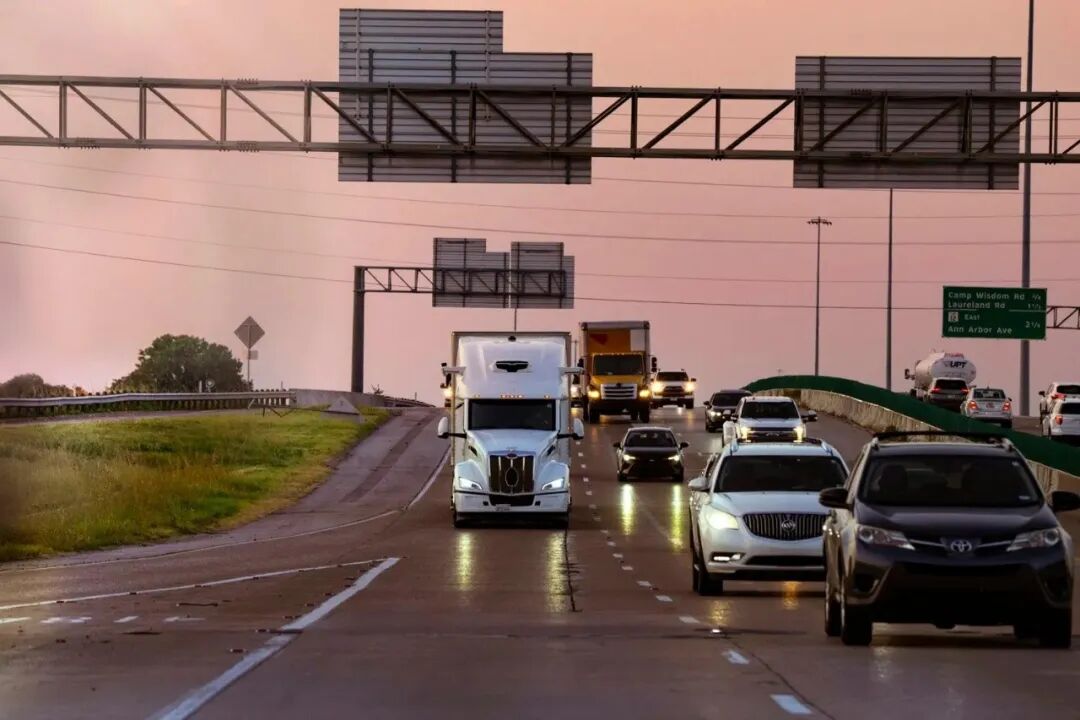
▲Waabi on the road
This differentiated approach of "using one model for different vehicle types" is the key for Waabi to distinguish itself from traditional industry solutions.
The expansion of Waabi's business from heavy - duty truck freight RoboVans to passenger vehicle RoboTaxis may also be a signal that Waabi Driver will be applied across different fields.
02.
Nearly $900 million in financing in five years
NVIDIA, Volvo, and Porsche are all shareholders
Looking back at Waabi's financing history, it can be seen that the matrix of its investors is quite influential.
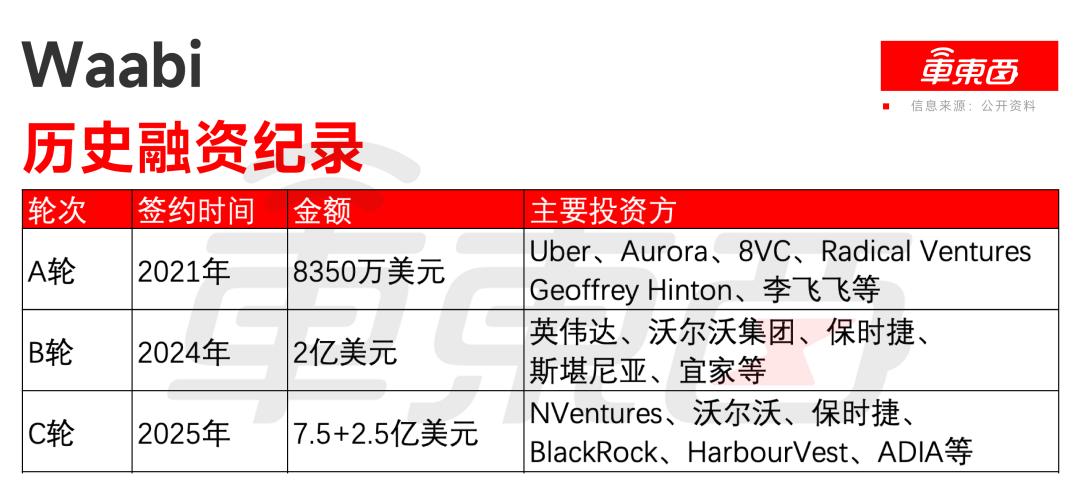
▲Waabi's financing history
During Waabi's $83.5 million (approximately 585 million RMB) Series A financing in 2021, it was led by Khosla Ventures, and the investors included Uber, Aurora, 8VC, Radical Ventures, as well as top scholars in the field of artificial intelligence, Geoffrey Hinton and Fei - Fei Li.
During its $200 million (approximately 1.4 billion RMB) Series B financing in 2024, it attracted strategic partners such as NVIDIA, the Volvo Group, Porsche, Scania, and Ingka Investments.
The list of investors in this $750 million (approximately 5.25 billion RMB) Series C financing has further expanded. In addition to the leading investors, it also includes NVentures (NVIDIA's venture capital department), Volvo, Porsche, funds managed by BlackRock, HarbourVest, and entities related to the Abu Dhabi Investment Authority (ADIA).
In addition, Canadian institutions such as BDC, EDC, and TELUS Global Ventures also participated.
▲Waabi's investors
If the equity financing amount is added to the amount committed by Uber this time, Waabi's cumulative funding has reached approximately $1.284 billion (approximately 8.99 billion RMB).
It is currently unclear what Waabi's valuation has reached. However, according to a report by the Toronto Globe and Mail in December last year, Waabi aims to reach a valuation of $3 billion (approximately 21 billion RMB) after the Series C financing.
03.
A powerful female entrepreneur in the field of autonomous driving
Former Chief Scientist of Uber ATG
Waabi was founded in 2021, and its leader, Raquel Urtasun, is a professor at the University of Toronto and a co - founder of the Vector Institute.
She was the Chief Scientist of Uber's Autonomous Technology Group (ATG). After Uber ATG was sold to Aurora at the end of 2020, Urtasun left and founded Waabi.
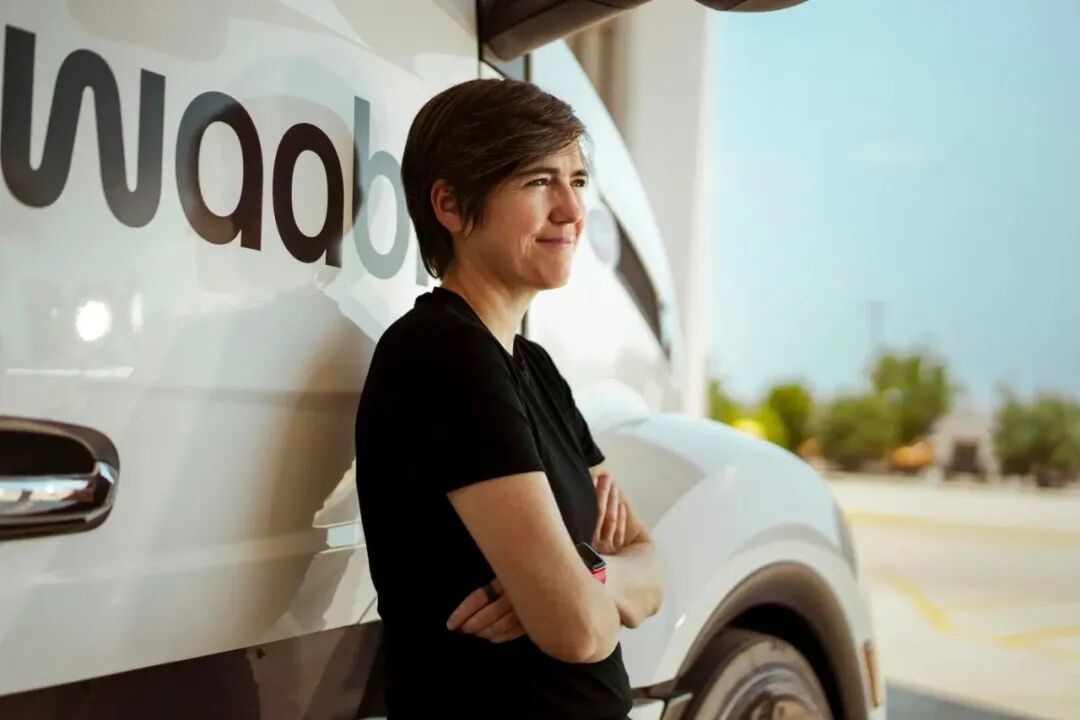
▲Raquel Urtasun, the founder of Waabi
Her combination of "leading academic research + experience in autonomous driving R & D in the industrial sector" makes her often emphasize the "verifiable, explainable, and scalable" technology route and a faster commercialization pace in Waabi's external narrative.
This kind of business model is more practical and more helpful for commercial implementation.
04.
Conclusion: The global financing boom for autonomous heavy - duty trucks continues
Against the backdrop of the resurgence of the global financing enthusiasm for autonomous heavy - duty trucks, Waabi's huge capital injection reflects the capital market's emphasis on the "Physical AI" approach and heavy - duty truck logistics.
The involvement of core players such as NVIDIA and Volvo has accelerated the concentration of industry resources on companies with high - fidelity simulation capabilities and pre - installation mass - production genes.
This round of financing boom is driving the cross - field application of technology. In essence, it is also another round of in - depth game in the market regarding the certainty of the commercialization of unmanned freight.
In the current situation where global capital is focused on autonomous heavy - duty trucks, how to quickly achieve a commercial closed - loop has become the next battlefield.
This article is from the WeChat public account "Che Dongxi". The author is Janson, and the editor is Zhihao. It is published by 36Kr with authorization.