How to distinguish between bubbles and opportunities in the frenzy of AI investment?
Introduction: When generative AI triggers an investment frenzy and technological innovation intertwines with financial bubbles once again, how should we see through the confusion and seize the dividends of the cycle? Recently, the classic "Technological Revolutions and Financial Capital: The Dynamics of Bubbles and Golden Ages" in the field of technology investment has been re - published! As a masterpiece by Carlota Perez, the pioneer of the "techno - economic paradigm" theory, this book is based on five technological revolutions over the past 200 years. It adds new insights into the technology investment cycle in the AI era, cracks the underlying logic of "technological breakthrough - financial frenzy - bubble burst - institutional reconstruction - golden age", and helps us grasp the laws of current technology investment between frenzy and order.
The following is the preface "Between Frenzy and Order: The Ideological Enlightenment of 'Technological Revolutions and Financial Capital'" written by Chen Yongwei, the director of the Research Department of "Comparative", for readers to enjoy.
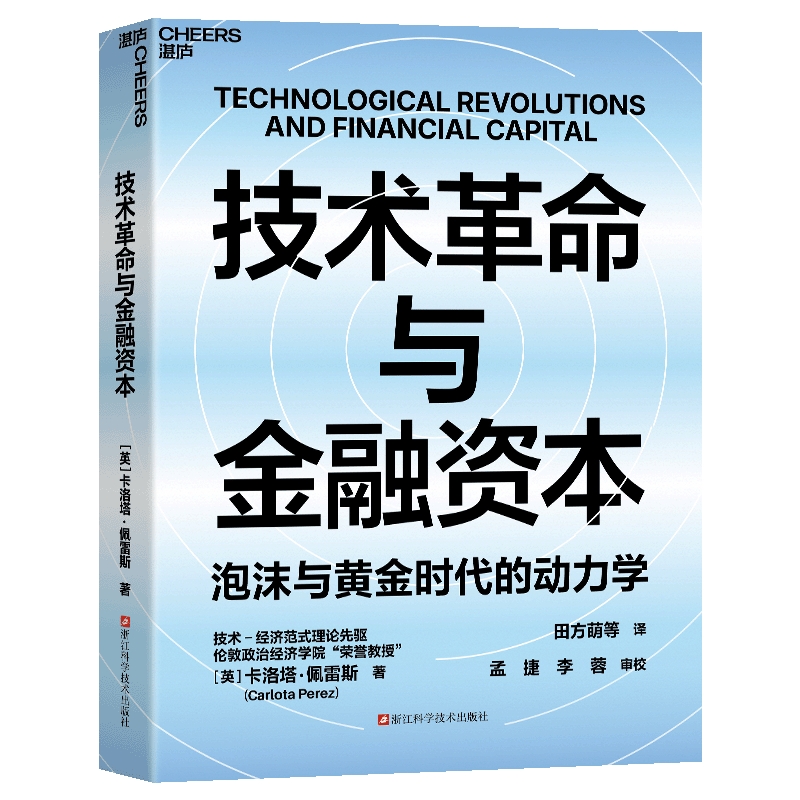
Author: [UK] Carlota Perez
Translators: Tian Fangmeng, etc.
Publisher: Cheerful Culture/Zhejiang Science and Technology Press
Publication Date: December 2025
From Bubble to Order: The Deep - seated Rhythm of Capitalism
Carlota Perez's "Technological Revolutions and Financial Capital" is a classic work that understands the evolutionary laws of capitalism from a long - term perspective. It not only brings new ideas to Schumpeter's tradition of "innovation and cycle" but also reveals the complex relationship of mutual shaping among technology, finance, and institutions from a unique systematic perspective.
Based on more than 200 years of industrial history, Perez depicts the "wave - shaped" structure of capitalist development: from the mechanization revolution in the 18th century, to the steam and railway revolution in the 19th century, then to the steel and electrical revolution, the mass - production revolution, and finally to the contemporary information and communication revolution - each technological revolution is not only the rise of a set of new technologies but also an overall transformation of social organization methods and value systems.
Perez points out that capitalism undergoes a systematic transformation driven by technological revolutions approximately every half - century. This transformation is not a linear rise but unfolds in a cycle of financial prosperity and institutional reconstruction. She divides this cycle into two stages: the installation period and the deployment period. In the installation period, financial capital dominates and promotes the outbreak of new technologies; however, the frenzy of speculation and the lag of institutions inevitably lead to crises and crashes. Subsequently, in the deployment period, social institutions gradually match the new technologies, and productive capital regains the dominant position, and the economy enters a relatively stable and prosperous "golden age".
It is this rhythm of "turbulence - adjustment - prosperity" that constitutes the pulse of the long - term evolution of capitalism. Perez said, "Financial frenzy and production prosperity are not opposite but two beats of capitalism's self - renewal", which is exactly the point.
The Dance of Technology and Finance: The Dual Driving Forces of Capitalism
In Perez's view, the power of capitalism comes from a pair of dynamically symbiotic wheels: technological revolutions and financial capital. The former provides a new growth engine, while the latter provides fuel for it.
Due to its high liquidity and adventurous nature, financial capital is often the first investor in new technologies. It acutely captures future possibilities and allows capital to flow into the innovation field through speculation. It is in this "combination of greed and imagination" that new industries are born and old structures are broken. Perez calls this the "big bang" of capitalism.
However, the short - sightedness and speculation of finance can also turn innovation into a bubble. At the beginning of each technological revolution, there are accompanied by the expansion of inequality, the inflation of assets, and the decline of morality. When the financial system is far from the real economy and indulges in self - circulation, a crash is inevitable.
But the crisis is not the end. The crisis is the restructuring mechanism of capitalism and the pain of the old institutions giving way to the new order. After the crash, the government begins to intervene, and institutions such as laws, education, taxation systems, and regulations gradually adapt to the new technological logic, and society re - establishes coordination. At this time, productive capital takes over the leading power, and the economy enters the stage of "creative construction", and the golden age begins.
This analysis allows people to re - understand the double - edged nature of finance: it is both a catalyst for innovation and a source of crisis. Perez's contribution lies in that she refuses to regard finance as an external disturbance but incorporates it into the internal cycle of capitalism. The interaction between finance and production is not an exception deviating from the norm but an inevitable process of institutional evolution.
The "Techno - economic Paradigm": From Kuhn to Schumpeter
The most original concept in this book is the "techno - economic paradigm". Perez borrows the idea of "scientific paradigm" from Thomas Kuhn and introduces it into economic history to explain the "efficiency common sense" and "organizational rationality" formed by each generation of technological revolutions.
Each technological revolution is not just the renewal of machines but also the replacement of ways of thinking. The era of steam and railways was based on the rationality of "speed and expansion"; the era of mass production was based on the creed of "standardization and economies of scale"; and the core logic of the information age is "networking and flexibility". These "paradigms" not only dominate the management practices of enterprises but also affect the institutional design, consumption culture, and even values of society.
Perez believes that a new technological paradigm can trigger deep - seated social changes not only because it improves productivity but also because it changes "what is regarded as efficient, reasonable, or advanced". When a new efficiency logic is widely accepted among economic entities, the entire society will reshape itself in a new coordinate system.
Therefore, she understands innovation as a process of social absorption - only when technology is absorbed by institutions can it be transformed into economic growth. The success or failure of technological revolutions depends on the "plasticity" of institutions towards them. This insight enables Perez's theory to go beyond the traditional "technological determinism" and enter a more complex and interactive historical perspective.
Bubble, Crisis, and Reconstruction: The Fate of Financial Capital
In Perez's writing, every prosperity of capitalism has its cracks. The financial frenzy in the installation period promotes the outbreak of innovation but also creates social differentiation and institutional vacuums. She points out that from the railway bubble in the 1840s, the Wall Street boom in the 1920s, to the Internet frenzy in the 1990s, bubbles are almost a compulsory course for every new economy.
The structures of these bubbles are surprisingly similar: first, the optimistic belief that "new technologies will change everything"; then, speculation, credit expansion, and asset inflation; finally, a crash and depression. She refuses to simply attribute them to greed or irrationality but regards them as a historical necessity - because the evolution of social institutions always lags behind the diffusion of technologies. When the old institutions cannot restrain the new finance, the crisis becomes a catalyst for institutional renewal.
After the crisis, a new institutional framework will gradually form: bank supervision, tax systems, trade unions and social security systems, public investment policies... These institutions truly release the potential of technologies and form a new "synergistic stage". At this time, financial capital retreats to the background, productive capital regains the lead, and society enters a relatively stable golden age.
This process is the so - called "recoupling": when the technological logic and social institutions are re - aligned, the creative power of capitalism is re - concentrated. In Perez's view, it is precisely because of this cycle of "coupling - decoupling - recoupling" that capitalism can maintain long - term vitality.
Method and Enlightenment: The Systematic Thinking of History
From a methodological perspective, the greatest contribution of "Technological Revolutions and Financial Capital" is to restore the historical dimension of economic thought. Perez refuses to regard the economy as an isolated market but places it back into the interactive network of technology, institutions, and culture. Her analysis spans economics, sociology, and politics, forming a narrative of "systematic evolutionism".
She shows us that economic fluctuations are not accidental events but the repeated occurrence of the misalignment between technology and institutions. Financial bubbles are not market anomalies but a way of systematic learning. The arrival of the golden age is not the result of natural equilibrium but the result of society's active reconstruction of order after the crisis.
Such a historical view has great practical significance. It reminds us that the task of policies is not to eliminate fluctuations but to guide bubbles, utilize crises, and shape opportunities for recoupling. In the face of the waves of artificial intelligence, clean energy, and new infrastructure, this insight still has guiding significance. What the government and society need to do is not to suppress the risks of new technologies but to build institutions that can absorb risks and guide capital to flow into production.
Some Reflections: The Power and Tension of the Theory
As a grand explanatory framework, "Technological Revolutions and Financial Capital" has extraordinary explanatory power but is not without controversy. Although it is a theoretical peak, its "systematic narrative" is also worthy of discussion.
First, it maintains a dangerous balance between laws and contingencies. Perez summarizes technological revolutions into an almost fixed 50 - year cycle, showing the rhythm of history. However, the real world is often more complex: the speed of technological diffusion, the changes in the political environment, and the imbalance of the global system will disrupt the rhythm of the cycle. The fact that the "golden age" of the information revolution has not arrived yet shows that history does not fluctuate mechanically but is full of uncertain deviations.
Second, it seems too mild between functionalism and power politics. Perez emphasizes the logic of institutional "adaptation" but rarely discusses the power conflicts behind this adaptation. Institutional reconstruction is not automatically completed; it often depends on political struggles, social movements, and even wars. The "recoupling" process she depicts seems organically coordinated but actually hides the complexity of power distribution and social contradictions.
Finally, it seems conservative in the face of contemporary digital capitalism. When the platform economy, data monopoly, and algorithmic governance re - blur the boundaries between "finance" and "production", the two forms of capital distinguished by Perez have penetrated each other. The financial logic penetrates into daily production, and algorithmic capital undertakes both speculative and productive functions at the same time. Her historical rhythm of "financial retreat - production dominance" may have been subverted in this era.
However, precisely because of these tensions, her theory is vivid. It is not a closed framework but a way of thinking - a historical system theory that can accommodate deviations and recognize complexity. Perez's value does not lie in providing ultimate answers but in inspiring us to re - question how capitalism self - repairs and self - learns.
Thinking about the Future in the Alternation of Paradigms
"Technological Revolutions and Financial Capital" is not a book about the past but a book about the future. It tells us that the vitality of capitalism does not lie in stability but in cycles; not in eliminating contradictions but in transforming contradictions into the driving force for renewal.
If Schumpeter revealed the logic of "creative destruction", then Perez further revealed the order of "creative reconstruction". She makes us understand that real innovation is not born in the laboratory but in society's absorption of chaos and reconstruction of institutions. In the era of the superposition of artificial intelligence and climate transformation, Perez's thought reminds us that the significance of technological revolutions does not lie in the intelligence of machines but in whether society can find a new institutional container for them. Without this "recoupling", the potential of technology will eventually backfire on itself.
The rhythm of market fluctuations continues. After the bubble, there may be a new golden age. But whether it belongs to the majority will depend on how we understand and control this force. As Perez revealed - the dance of finance and technology cannot stop. The real question is: who is conducting the symphony.
A masterpiece by Carlota Perez, the pioneer of the "techno - economic paradigm" theory
Analysis of the laws of five technological revolutions over 200 years
An investment enlightenment book for the AI era
Help you see the big cycle clearly and stand firm on long - term value